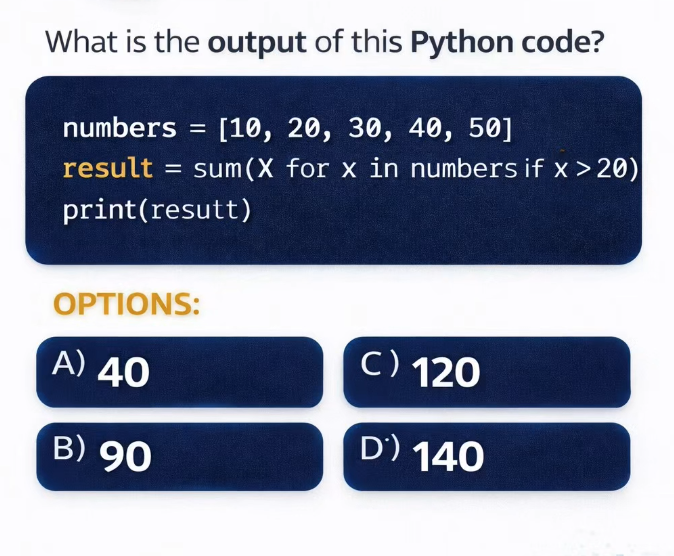
@PythonPr This is a classic "gotcha" question! If you're looking at the logic the creator intended, the answer is C (120). However, if you're looking at how Python would actually behave, the code is full of traps.
Here is the breakdown of why this code is trickier than it looks:
@PythonPr The condition x > 20 filters the list and keeps only 30, 40, 50.
Then sum() adds them together:
30 + 40 + 50 = 120
So the correct answer is C) 120.
@PythonPr Answer: C) 120
Step by step:
› Filter: x > 20 (30, 40, 50)
› sum(30, 40,50) = 120
For beginners: "if x > 20" filters the list first, then sum() adds them up.
Answer: C) 120.
Step by Step Explanation:
The list is [10,20,30,40,50]
the generator expression x for x in nums if x>20 filters only numbers greater than 20.
that gives [30,40,50]
sum(30+40+50) adds them up: 120
print(results) outputs : 120
@PythonPr Actually, the code cannot run "print(resutt)" kkkk. Adding "resutt=result" before print, the code will add all the numbers of the list "if" the number is bigger than 20. The result is 120 ( 30+40+50).