Anand Rathi Wealth Limited 🇮🇳

3.5K posts

Anand Rathi Wealth Limited 🇮🇳 banner
Anand Rathi Wealth Limited 🇮🇳

Anand Rathi Wealth Limited 🇮🇳

@ARWealth

Uncomplicating wealth journey for HNIs & UHNIs with data-driven strategies AMFI-registered Mutual Fund Distributor

Mumbai, India Beigetreten Nisan 2016
502 Folgt26.3K Follower
Angehefteter Tweet
Anand Rathi Wealth Limited 🇮🇳
Anand Rathi Wealth Limited announces FY2025-26 results (consolidated), posting an increase in total revenue to ₹1,198 crores from ₹980 crores, a growth of 22% Y-o-Y. The organisation has also seen an increase in PAT to ₹386 crores from ₹301 crores, a growth of 28% Y-o-Y. In addition, the AUM has grown to ₹93,037 crores from ₹77,103 crores, a growth of 21% Y-o-Y. The organisation announced a final dividend of ₹7 per equity share, taking the total dividend for FY26 to ₹13 per share, including an interim dividend of ₹6 per share. The organisation also announced bonus issue in the ratio of 1:1. Our results reflect our approach: Private Wealth. Uncomplicated. Know more: anandrathiwealth.in
English
0
1
2
759
Anand Rathi Wealth Limited 🇮🇳
What Investors Should Focus On Thus, investors should focus more on building a well-rounded diversified portfolio that has balanced exposure across categories and market caps. Successful long term investing is rarely built by chasing the best performing sector of the previous year. Long term wealth creation comes from disciplined allocation, diversification and staying invested across market cycles. Investors are better off investing in diversified equity funds which will allow them to be a part of India’s growth story.
English
0
0
0
45
Anand Rathi Wealth Limited 🇮🇳
The Diversification Gap One aspect investors often overlook is that they already have significant exposure to popular sectors through their existing diversified equity funds. Financial services already account for more than one third of the Nifty 50. Large cap, flexi cap and multi cap funds also maintain significant exposure to banks and financial companies because of the sector’s importance in the Indian economy. As a result, adding a separate sector fund often increases concentration toward a single segment instead of improving diversification.
English
1
0
0
100
Anand Rathi Wealth Limited 🇮🇳
Should You Invest in Sectoral Funds? We often observe that every market cycle leads to the birth of a new investing trend. A few years ago, investors were rushing into technology funds after the digital boom. Then came the sharp interest in pharma funds during the pandemic years. More recently, defence, infrastructure and banking sector funds have attracted strong investor flows after delivering high short term returns. This cycle repeats itself, where a sector performs well, strong outperformance is seen in a short period, inflows rise, but many investors enter only after the rally has already played out. That is why sectoral funds require far more caution and understanding than most investors realise.
English
1
0
1
226
Anand Rathi Wealth Limited 🇮🇳
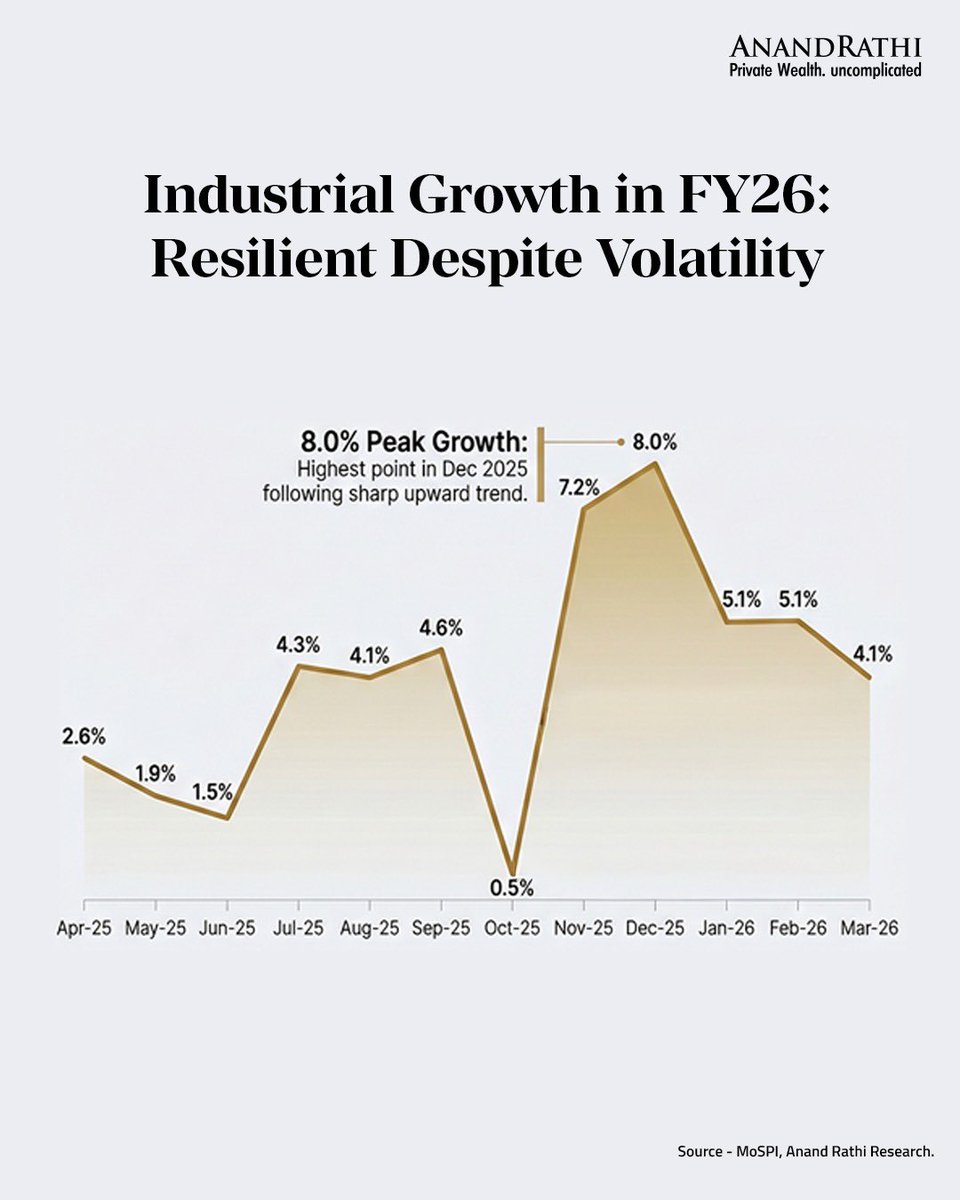
Did you know? Even with sharp fluctuations through the year, India’s industrial production maintained a healthy average growth of 4.1% in FY26. A steep dip in October was followed by a strong recovery, pointing to underlying demand strength and sectoral resilience. For investors, this suggests that periodic slowdowns are often temporary. Staying focused on the overall trajectory helps navigate short-term volatility more effectively. At Anand Rathi Wealth, we help you interpret such trends through an uncomplicated perspective. 🔗 anandrathiwealth.in Source: MoSPI, Anand Rathi Research
Anand Rathi Wealth Limited 🇮🇳 tweet media
English
0
0
1
114
Anand Rathi Wealth Limited 🇮🇳
Staying Consistent and Disciplined Investors who build long term wealth are not the ones who react to every correction by reducing equity. They are the ones who stayed invested, let the recovery do its work, and allow compounding to play out over time.
English
0
0
0
42
Anand Rathi Wealth Limited 🇮🇳
The True Nature of Equity Investors should understand that market crashes are a part of normal market cycles. Since 2001, Nifty has seen an average annual correction of around 18%, which sounds alarming but what follows that correction is exactly why equity remains the most powerful wealth-building asset class. In the one year after these corrections, Nifty has on average returned 32%, 20% in 3 years and 17% over 5 years. The drawdown is temporary, but the recovery is consistently strong. Debt and gold have an important role in a portfolio, but that role is to provide stability, not to replace equity when things get uncomfortable. A portfolio built for the long term should have equity at its core, with debt and gold acting as buffers that help investors stay the course.
English
1
0
0
58
Anand Rathi Wealth Limited 🇮🇳
How Equity Exposure Changes Long-Term Outcomes Consider three investors who stayed invested through each of these crashes: one with 80% equity and the rest in debt and gold, one with 60%, and one with 40%. The conservative portfolio fell the least during each crash, but over 1 year, 3 years, and 5 years after the crash, the 80% equity portfolio consistently generated the highest returns. After the COVID crash, the 80% equity portfolio returned 77% in the next year and the 40% equity portfolio returned 42%. Both investors lived through the same crash but the difference came entirely from equity exposure. The investor who reduced equity to feel safer during the crash did not just protect themselves from the fall, they also protected themselves from the recovery. That is the trade-off that investors rarely realize.
English
1
0
0
74
Anand Rathi Wealth Limited 🇮🇳
Why Investors Panic During Market Falls When Nifty fell nearly 60% during the 2008 financial crisis, investors with high equity portfolios watched a large portion of their wealth disappear. Many exited equity waiting for stability, locked in their losses, and sat out one of the strongest recoveries in market history. In the one year after the crash, equity markets delivered returns of over 75%. The same pattern repeated after the dot-com crash in 2000 and again during COVID-19 in 2020. The crash looks permanent when you are inside it but recovery always follows.
English
1
0
0
76
Anand Rathi Wealth Limited 🇮🇳
Why Equity Continues To Be The Core Of Wealth Creation Every time markets correct, investors always have the same questions in mind. Should I move some money to debt? Should I reduce my equity exposure? Is this the right time to be so heavily invested in stocks? These are natural questions, but they are not the right ones. The question investors rarely ask is what happens to their wealth when they act on that fear, because the more equity an investor exits in a moment of uncertainty, the more they stand to lose when markets recover.
English
1
0
0
113
Anand Rathi Wealth Limited 🇮🇳
Did you know? SIP inflows have remained resilient in FY26, crossing the ₹30,000 crore mark in multiple months. While there have been minor month-to-month fluctuations, the broader trend highlights consistent retail participation in equities. Even during phases of market volatility, SIP contributions have held firm, signalling a shift from tactical investing to disciplined, long-term participation. For markets, this creates a stable domestic liquidity base, reduces reliance on volatile foreign flows, and reinforces the structural financialisation trend in India. At Anand Rathi Wealth, we help you stay aligned with such long-term trends through an uncomplicated approach. 🔗 anandrathiwealth.in
Anand Rathi Wealth Limited 🇮🇳 tweet media
English
0
0
3
187
Anand Rathi Wealth Limited 🇮🇳
A balanced approach works better: • Continue your SIPs instead of stopping them completely • Allocate 10 to 20% of your income towards building the emergency fund • Park this money in safe and liquid debt options earning around 6 to 7% • Once the six to eight month buffer is ready, redirect this allocation towards investments Investments are your growth engine, but the emergency fund is your foundation. Ignoring either can weaken your financial stability. Also remember that your emergency fund is linked to your life and not just your income. A salary increase does not always mean your emergency corpus must immediately rise, but life events such as marriage, children or financial responsibilities will definitely require a larger buffer. Therefore, it is not about choosing between safety and growth. The practical approach will be doing both together, because financial stability and wealth creation are not substitutes, they are partners.
English
0
0
0
114
Anand Rathi Wealth Limited 🇮🇳
Emergency Fund or Investments? The Answer Is Not What You Think Most people entering their investment journey face this exact dilemma. Should I start investing early or should I first build an emergency fund? It sounds like a choice between two options, but in reality, it is not. An emergency fund is a financial cushion kept aside for situations you do not plan for, for example, a job loss, a medical expense, a sudden repair, or even a temporary drop in income. These are moments when markets may not be favourable and the last thing you want is to withdraw your long term investments or rely on expensive credit. Investments help you grow wealth, but an emergency fund protects the wealth you are trying to build. Building an emergency fund takes time. For instance, if your essential monthly expenses are ₹60,000, your target corpus would be roughly ₹3.6 lakh to ₹4.8 lakh. If you can manage to allocate ₹10,000 per month, it may take around 3 to 4 years to reach that level. Increasing the contribution can significantly reduce this time. In urban cities, where expenses are higher and job recovery can take longer, allocating around 10 to 20% of your salary towards an emergency fund is a practical approach. In fact, metro residents may require a slightly larger buffer due to higher cost of living. The important point is that you do not have to pause or delay investing while building an emergency fund.
English
1
0
3
372
Anand Rathi Wealth Limited 🇮🇳
India’s demat accounts have increased from 90 million in FY22 to 225 million in FY26. While net additions peaked in FY25 and moderated slightly thereafter, the overall trend reflects a structural rise in retail participation driven by financialization and digital access. For investors, this signals a deepening equity culture in India. Broader participation can support market depth and long term growth, even if near term inflows fluctuate. Learn more: anandrathiwealth.in
Anand Rathi Wealth Limited 🇮🇳 tweet media
English
0
0
2
346
Anand Rathi Wealth Limited 🇮🇳
Wishing you and your family a year of prosperity, progress, and new beginnings. On the occasion of Baisakhi, Puthandu, Vishu, and Bohag Bihu, may this new year bring clarity, discipline, and meaningful growth ahead. Know more: anandrathiwealth.in/landing/
Anand Rathi Wealth Limited 🇮🇳 tweet media
English
0
0
0
129