
AVBpodcast
4.1K posts


AVBpodcast
@AVB_21
https://t.co/SjqLwUWLbt ... /contact/
Europe Beigetreten Haziran 2025
687 Folgt220 Follower
@PhRoose Ik vind het toch toffer wanneer hij steak tartaar gaat proven in tavernes. Dan neem ik hem nog meer serieus als expert.
Nederlands



De Michael Jackson film wordt moreel veroordeeld in de Standaard, dus nu ga ik zeker kijken.
Bij "Zillion" idem: meerdere banvloeken in DS, bleek goeie, entertainende film.
Maar niet de zedenles die DS eist - kunst moet altijd preken voor die jongens!
Nederlands
AVBpodcast retweetet



@AVB_21 Wtf spaargids punt be vol met bankgesponsorde producten…
Nederlands
Fiat money is meant to be tracked, probed, and measure how much the system can extract from the people that do anything (work, innovate, build...).
There's no other purpose, even since revolutionary France weaponized the assignat in 1790.
Dirty Harry🐇🕳️@dirtyh44
Fuck De Fiscus. We moeten een overheid die zich met elk aspect van ons leven wil moeien ( om ons te belasten natuurlijk) een halt toeroepen. Net als de media die volgzaam deze absurde regelneverij propageren.
English
@PsiloX It will break down, but unfortunately bitcoiners aren't ready, or are now in a mega disadvantage as the space is being captured by the same fungus.
Gen-A will inherit a wasteland of fiat cr*p and 'find a solution'.
Not my generation, they're too ' busy ' sca__ing each other.
English

@thomas_spaas Arbeid is zo dood als een pier.
Ofwel wordt je leeggezogen terwijl je tijd op doet en kapot belast wordt. Ofwel wordt je beschimpt omdat je niet hard genoeg mee doet.
Intussen is de parasiet-klasse op TV allerlei visies uit de 19de eeuw aan't recycleren om rijker te worden zelf.
Nederlands
Welkom op 1 mei, dag waarop we het financieel ongeletterde deel van de bevolking vanalles wijs maken, om zo aan de macht te blijven.
Basketsloefkes van 3200 eur opgepoetst, neusje gepoederd, VRT staat klaar om de boodschap te verspreiden, let's go matekes
Nederlands
AVBpodcast retweetet

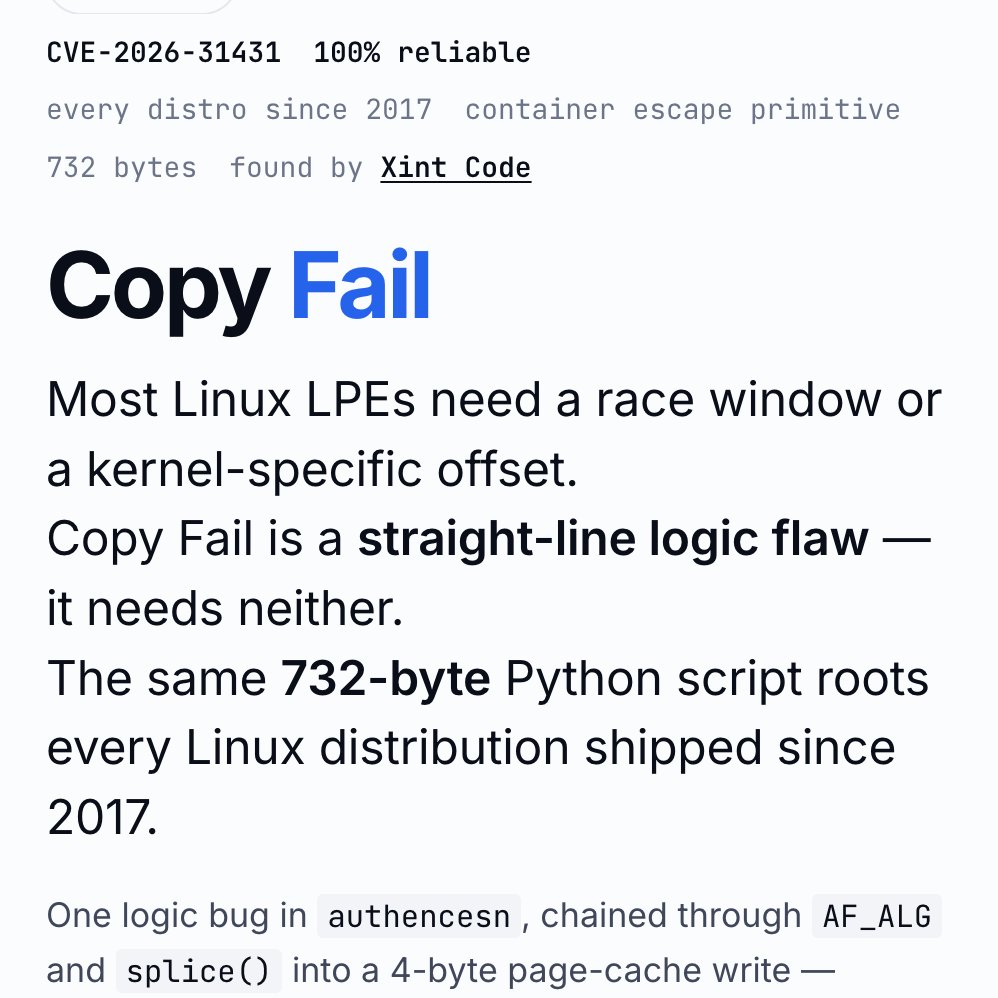
‼️🚨 BREAKING: An AI found a Linux kernel zero-day that roots every distribution since 2017. The exploit fits in 732 bytes of Python. Patch your kernel ASAP.
The vulnerability is CVE-2026-31431, nicknamed "Copy Fail," disclosed today by Theori. It has been sitting quietly in the Linux kernel for nine years.
Most Linux privilege-escalation bugs are picky. They need a precise timing window (a "race"), or specific kernel addresses leaked from somewhere, or careful tuning per distribution. Copy Fail needs none of that. It is a straight-line logic mistake that works on the first try, every time, on every mainstream Linux box.
The attacker just needs a normal user account on the machine. From there, the script asks the kernel to do some encryption work, abuses how that work is wired up, and ends up writing 4 bytes into a memory area called the "page cache" (Linux's high-speed copy of files in RAM). Those 4 bytes can be aimed at any program the system trusts, like /usr/bin/su, the shortcut to becoming root.
Result: the next time anyone runs that program, it lets the attacker in as root.
What should worry most: the corruption never touches the file on disk. It only exists in Linux's in-memory copy of that file. If you imaged the hard drive afterwards, the on-disk file would match the official package hash exactly. Reboot the machine, or just put it under memory pressure (any normal system load that needs the RAM), and the cached copy reloads fresh from disk.
Containers do not help either. The page cache is shared across the whole host, so a process inside a container can use this bug to compromise the underlying server and reach into other tenants.
The original sin was a 2017 "in-place optimization" in a kernel crypto module called algif_aead. It was meant to make encryption slightly faster. The change broke a critical safety assumption, and nobody noticed for nine years. That bug then rode every kernel update from 2017 to today.
This vulnerability affects the following:
🔴 Shared servers (dev boxes, jump hosts, build servers): any user becomes root
🔴 Kubernetes and container clusters: one compromised pod escapes to the host
🔴 CI runners (GitHub Actions, GitLab, Jenkins): a malicious pull request becomes root on the runner
🔴 Cloud platforms running user code (notebooks, agent sandboxes, serverless functions): a tenant becomes host root
Timeline:
🔴 March 23, 2026: reported to the Linux kernel security team
🔴 April 1: patch committed to mainline (commit a664bf3d603d)
🔴 April 22: CVE assigned
🔴 April 29: public disclosure
Mitigation: update your kernel to a build that includes mainline commit a664bf3d603d. If you cannot patch immediately, turn off the vulnerable module:
echo "install algif_aead /bin/false" > /etc/modprobe.d/disable-algif.conf
rmmod algif_aead 2>/dev/null || true
For environments that run untrusted code (containers, sandboxes, CI runners), block access to the kernel's AF_ALG crypto interface entirely, even after patching. Almost nothing legitimate needs it, and blocking it shuts the door on this whole class of bug...

English
@denverbitcoin @Eggplant_Elon I once discovered a stash of the bitcoins in a crate in the jungle in Vietnam while I was rescuing my buddies. ;)
English

AVBpodcast retweetet

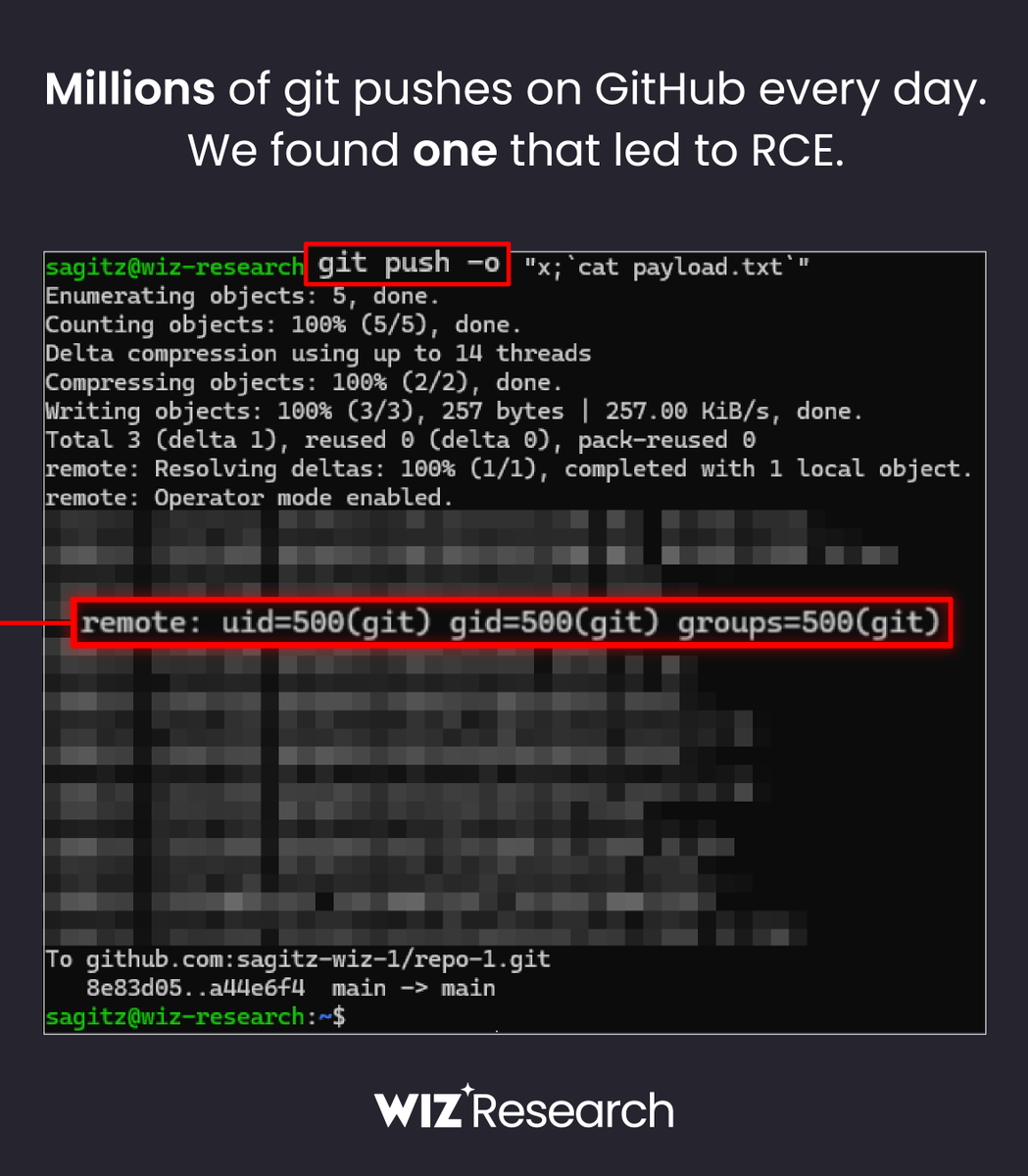
🚨 BREAKING: Wiz Research discovered Remote Code Execution on GitHub.com with a single git push
The flaw in @github allowed unauthorized access to millions of repositories belonging to other users and organizations 🤯
English

The "8rack v2" will however be ready by next week, as it's now going through a final testing round.
English
update on the 21tools page :
- currently working on project "June" so most of the time goes into that
- testing/finetuning the 2nd version of the 8rack system. I've decided to not make this public, and will only be shared with active contributors (security reasons).
more soon
English
@PhRoose En steeds: proof of stake mentaliteit, waarbij er geen consequenties zijn en het 'geld' toch blijft vloeien richting de minst productieve soort [redacted].
Nederlands
AVBpodcast retweetet
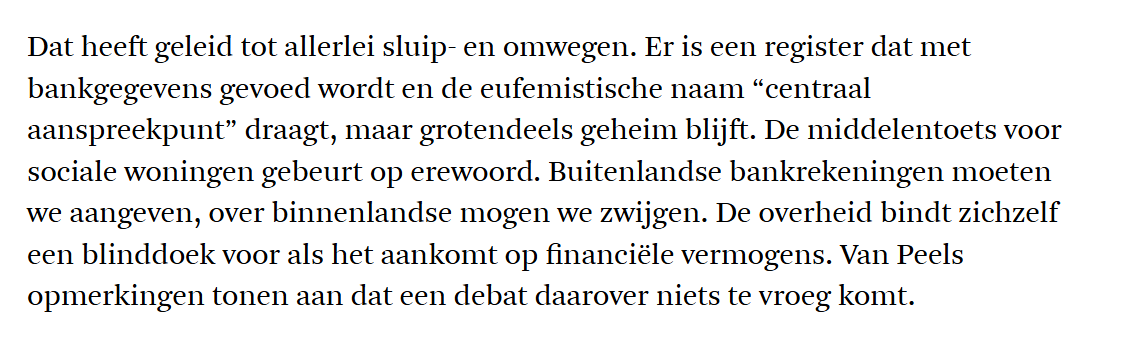
Tussen haakjes: totaal fake news in de Standaard vandaag. Binnenlandse rekeningen worden al jaren doorgegeven aan het CAP.
En dat dat register "grotendeels geheim zou blijven", is nog een stuk fake news. Inzagerecht wordt trouwens verder uitgebreid door deze regering.


Nederlands
Another conference, another series of security theater devices and their 'apps' or 'blackbox' security chips.
... It's funny how much this business sells targets to marks.
Bitkey@Bitkey
Meet the new Bitkey. No seed phrase. Multisig by default. Built-in inheritance. And now, with 100% more screen. See what's new: bitkey.world/blog/meet-the-…
English

Come stop by, say hi, learn about $STRC, and grab some merch at Booth #1325 @TheBitcoinConf!

English
Try this in France or Belgium and you'll starve ;)
instagram.com/reel/DVQ-FNiEz…
English