Daverbaber

894 posts

Daverbaber

Daverbaber

@AndTozer

An original TRCH holder. Will retire if the MMTLP fiasco is made right. An audited share count is the key. It will benefit the entire stock market.

Ontario Canada Beigetreten Eylül 2021
993 Folgt298 Follower
Angehefteter Tweet
Daverbaber retweetet
Rare DD
Rare DD@RareDealsHere·
If there's nothing damning in the MMAT / MMTLP trading data, why is @FINRA trying to keep it private? Will the data contradict what Robert W. Cook told @RepRalphNorman and the other 70+ members of Congress? How then can Congress entrust the @SECGov to investigate? The SEC surely has the data, if it proves FINRA wasn't truthful, why hasn't the SEC called them out yet?
KKep@kimkep4796

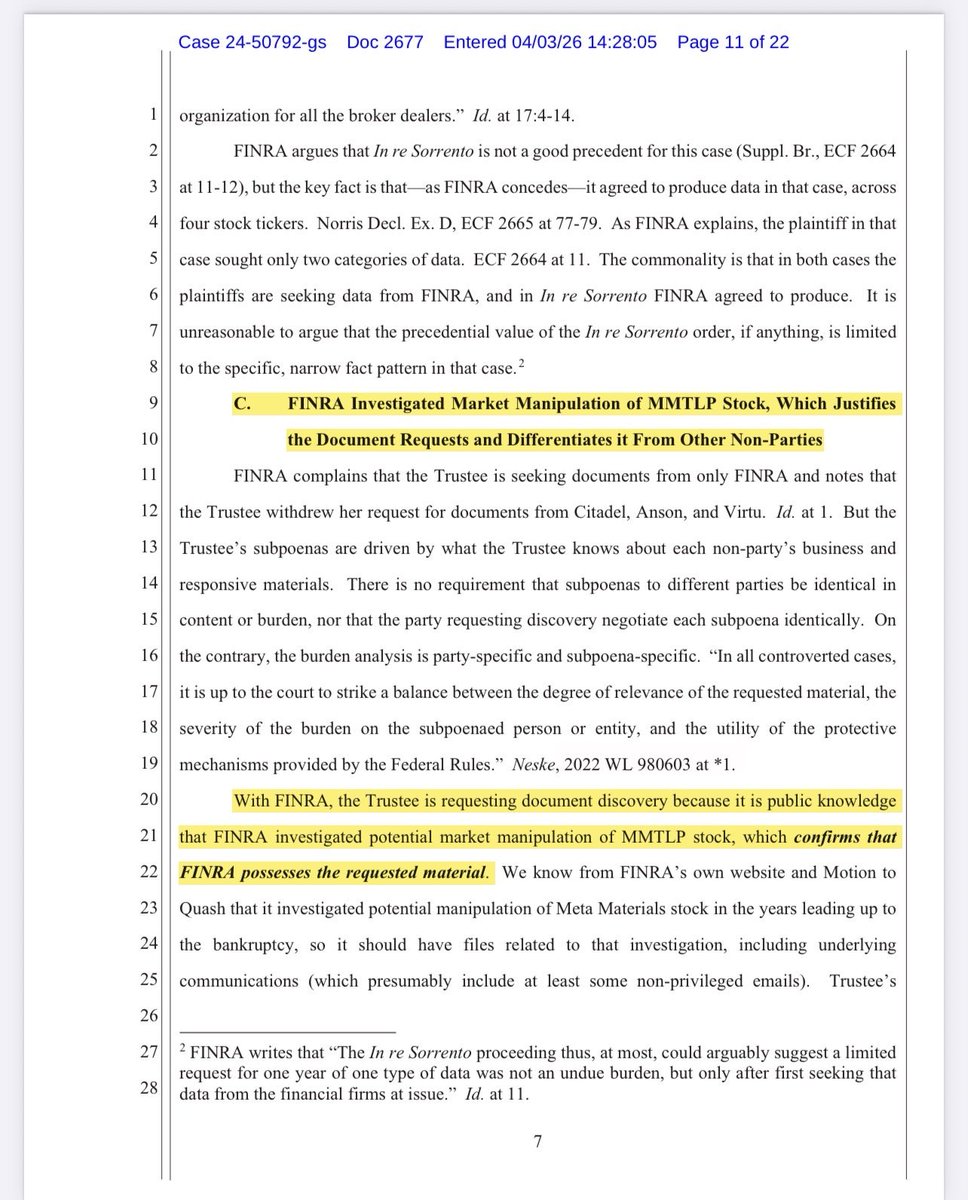
⚖️ MMAT / MMTLP Case: 24-50792-gs (Chapter 7) Filing Date: 04/03/2026 NLA – Not Legal Advice ⸻ 📂 WHAT WAS FILED •2677 – Trustee response to FINRA (🔥 main filing) •2678 – Supporting declaration (adds transcripts) •2679–2681 – Motion to seal funding docs •2682–2685 – Litigation funding approval + hearing (5/7/26) (Copy of today’s docket shown in the comment section.) ⸻ 🔥 DOC 2677 — QUICK SUMMARY 📄 •Trustee: “FINRA doth protest too much…” •Says FINRA is: •❌ Exaggerating burden (5M emails / $500K+) •❌ Stalling for nearly a year •❌ Refusing to cooperate •Key points: •✅ FINRA has market-wide trading data •✅ FINRA investigated MMTLP •❌ Privilege is not absolute •⚠️ CAT data may be deleted soon 👉 Ask to court: Deny motion to quash + force FINRA to produce ⸻ ⚡ OTHER FILINGS •💰 Funding secured to pursue litigation (2682–2685) •🔒 Terms sealed (2679–2681) •📎 Evidence + transcripts added (2678) ⸻ 🎯 BOTTOM LINE 👉 Trustee is: •Calling out FINRA delays •Saying the data exists •Warning evidence could disappear •Pushing judge to compel production dropbox.com/scl/fi/qr5lzbg… dropbox.com/scl/fi/aweqqay…

English
7
153
213
5K
Daverbaber retweetet
George Palikaras
George Palikaras@palikaras·
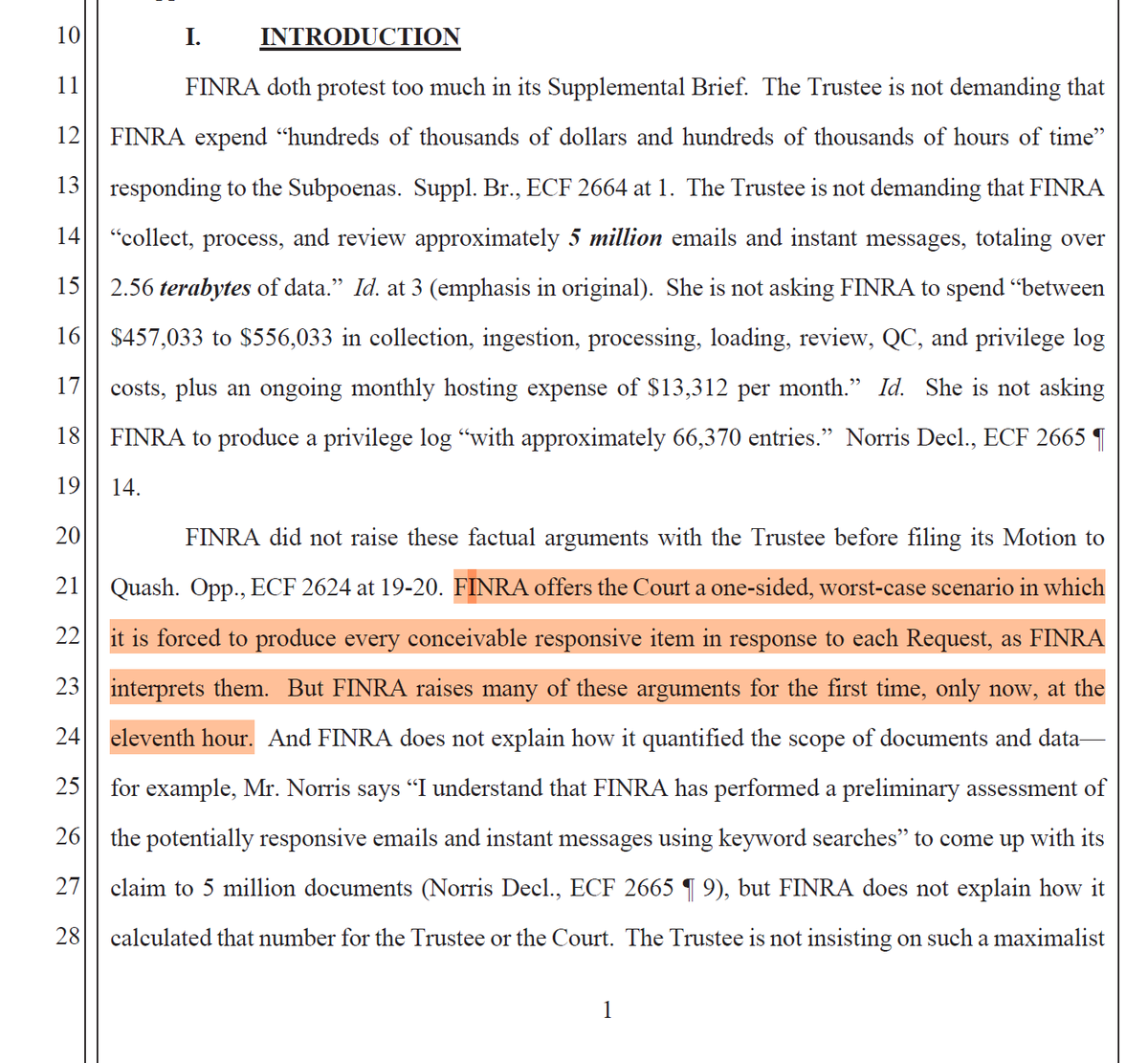
TRUSTEE: "But FINRA raises many of these arguments for the first time, only now, at the eleventh hour"
George Palikaras tweet media
English
8
120
216
3.4K
Daverbaber retweetet
George Palikaras
George Palikaras@palikaras·
DOC 2678-3 is the D.C. Court Transfer Order Some key points: - All subpoena disputes consolidated in Nevada - Court highlights, overlapping issues and the RISK of inconsistent rulings... It also revealed something. The Trustee's counsel shares that multiple defendants are pointing to FINRA for the data and FINRA is pointing back to others! 👉THIS is a circular blame which REINFORCES the Trustee's argument 🤣👉👈😂 #MMAT #MMTLP
GIF
English
4
146
241
3.7K
Daverbaber retweetet
George Palikaras
George Palikaras@palikaras·
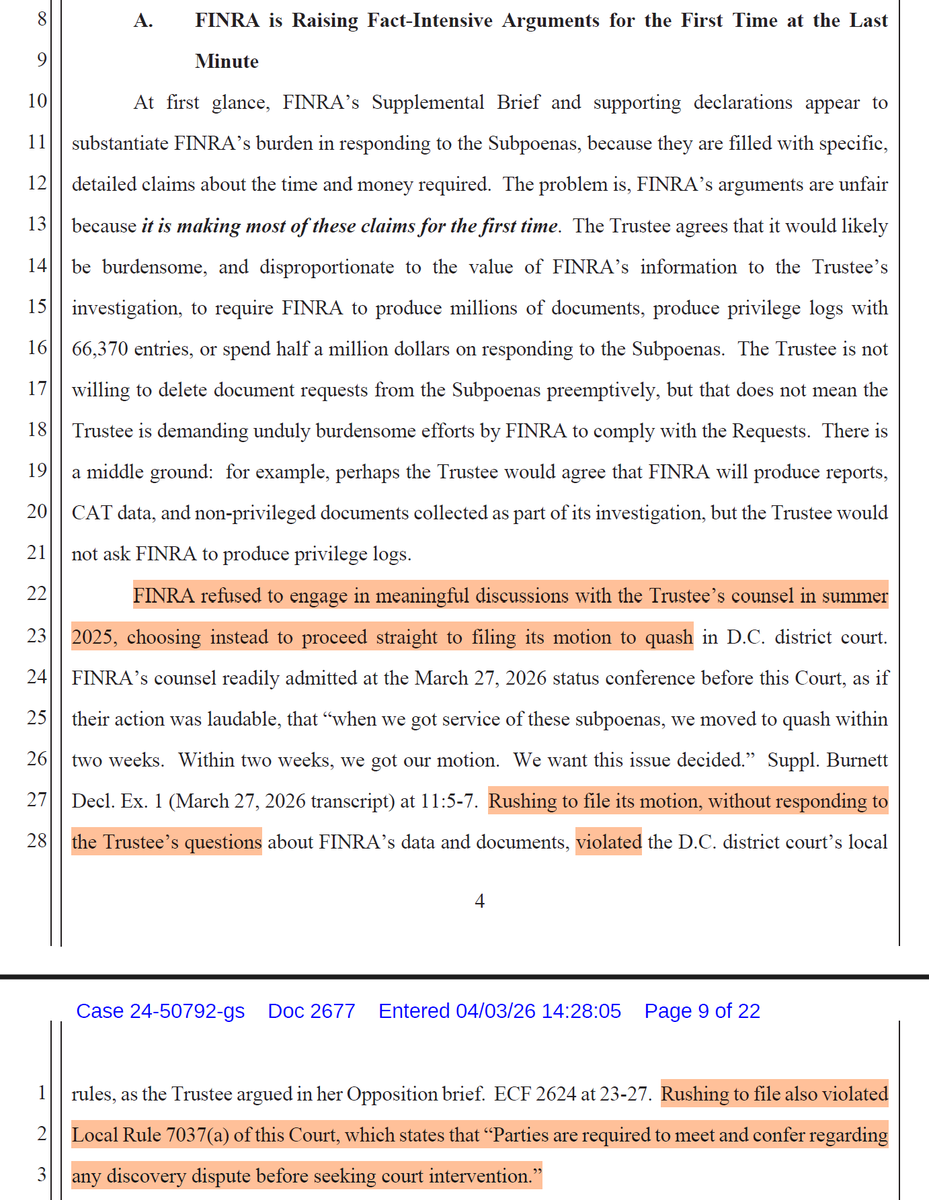
Bad faith, or just bad form? The Trustee could not have been more direct: “Rushing to file its motion, without responding to the Trustee’s questions… violated… Local Rule 7037(a)… requiring parties to meet and confer” Lawyers say it all the time, courts expect good-faith negotiation before motion practice. Yet here, the record suggests FINRA may have skipped the conference and gone straight to the comfort of motion practice. No doubt there will be "explanations". There usually are. But when process is bypassed, the question becomes unavoidable: Was this about resolving a dispute, or avoiding one? And right on cue, the supporting cast tends to arrive, keyboard counsel, anonymous "analysts", and the ever-reliable chorus of institutional defenders. Because in modern markets, it is not just about order flow. It is about narrative flow. Still, one principle remains unchanged: Before you move to quash, you are expected to pause and confer. Happy Easter 🐣 and blessings to all.
George Palikaras tweet media
English
16
225
364
11.3K
Daverbaber retweetet
George Palikaras
George Palikaras@palikaras·
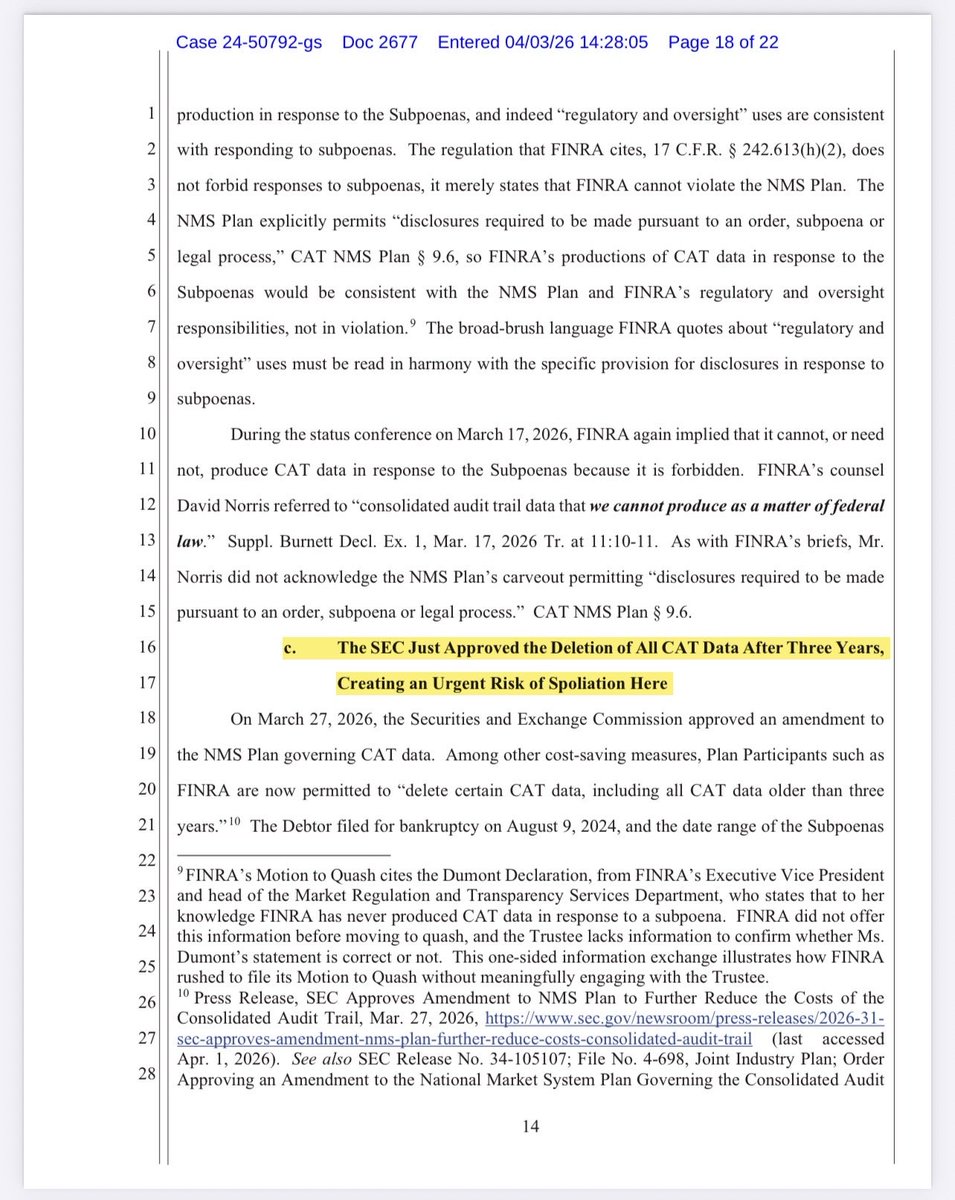
DOC 2677 i.e. the Trustee’s Response to @FINRA is very interesting. 1. FINRA failed to meet-and-confer - they filed motion within 2 weeks and, - didn’t engage on scope 🤣 This matters legally: - Courts HATE discovery gamesmanship - Undermines FINRA's “undue burden” defense 2. FINRA holds unique market-wide data and the other defendants (Citadel, Virtu, etc.) literally pointed to FINRA as the sourc This is critical because: - Establishes necessity + non-duplicative value - Directly defeats Rule 45 “cumulative” objection 3. FINRA investigated MMTLP, therefore they already collected the evidence and likely the non-privileged underlying data already exists! the Trustee is NOT asking FINRA to create data... just produce what it already gathered! 🤣😂🥳 4. The Investigative privilege is NOT absolute and must pass balancing test. Translation: FINRA can’t hide third-party communications behind privilege! 5. 🔥 CAT Data Bombshell. This is one of the most important sections. - The Trustee proves that the CAT Plan explicitly allows disclosure via subpoena! Meaning that FINRA’s claim “we cannot produce CAT data” = false - In my opinion, this one section alone is devastating to FINRA's credibility! 7. Spoliation risk (NEW argument) as we all heard this week, the SEC approved that FINRA can delete CAT data after 3 years - This section introduces URGENCY, so if not produced → evidence disappears!! Overall, i am not a lawyer but I believe this DOC 2677 filing: A> Destroys FINRA’s procedural posture and B> Frames FINRA as an obstructive and non-cooperative party, who are possibly misleading the court more to follow... thank you @kimkep4796 !
English
17
301
482
15.7K
Daverbaber retweetet
KKep
KKep@kimkep4796·
⚖️ MMAT / MMTLP Case: 24-50792-gs (Chapter 7) Filing Date: 04/03/2026 NLA – Not Legal Advice ⸻ 📂 WHAT WAS FILED •2677 – Trustee response to FINRA (🔥 main filing) •2678 – Supporting declaration (adds transcripts) •2679–2681 – Motion to seal funding docs •2682–2685 – Litigation funding approval + hearing (5/7/26) (Copy of today’s docket shown in the comment section.) ⸻ 🔥 DOC 2677 — QUICK SUMMARY 📄 •Trustee: “FINRA doth protest too much…” •Says FINRA is: •❌ Exaggerating burden (5M emails / $500K+) •❌ Stalling for nearly a year •❌ Refusing to cooperate •Key points: •✅ FINRA has market-wide trading data •✅ FINRA investigated MMTLP •❌ Privilege is not absolute •⚠️ CAT data may be deleted soon 👉 Ask to court: Deny motion to quash + force FINRA to produce ⸻ ⚡ OTHER FILINGS •💰 Funding secured to pursue litigation (2682–2685) •🔒 Terms sealed (2679–2681) •📎 Evidence + transcripts added (2678) ⸻ 🎯 BOTTOM LINE 👉 Trustee is: •Calling out FINRA delays •Saying the data exists •Warning evidence could disappear •Pushing judge to compel production dropbox.com/scl/fi/qr5lzbg… dropbox.com/scl/fi/aweqqay…
KKep tweet mediaKKep tweet mediaKKep tweet mediaKKep tweet media
English
19
159
255
24.8K
Daverbaber
Daverbaber@AndTozer·
For an @SECGov commissioner who once said "We do not tolerate liars, cheaters, & scammers”, why are so many elephants in the room like #MMTLP off-limits? What's the point of the roadshow when the result is all travel - but selective hearing & no answers? The CAT got your tongue?
Hester Peirce@HesterPeirce

I will be in Boston April 17. If you'd like to meet with me, please email CommissionerPeirce@sec.gov with Boston in the subject line and a brief description of what you'd like to discuss.

English
1
43
77
1.5K
Daverbaber
Daverbaber@AndTozer·
So the @SECGov is into saving money now are they? Imagine the money they would have saved by not fighting #MMAT and #MMTLP lawsuits and FOIA requests. All that saving & spending to avoid transparency. In what world is this "investor protection" and "promotion of fair markets"?
Guess Who@RedHeelzz

AMAZING! In true @SECGov fashion… They finally figured out they can’t beat us so they CHEAT INSTEAD. Delete the evidence and it never happened, right? Interesting timeframe you all chose. Three years. It’s almost laughable. Nice try. What made you think this was a good plan, @SECPaulSAtkins? A “New SEC”? Nah. You’re as corrupt as ALL of your predecessors! Keep it up. You all can weaponized this system till the cows come home. WE ARE NOT GOING AWAY. #MMTLParmy $MMTLP $MMAT #Relentless sec.gov/newsroom/press…

English
0
36
69
1.1K
Daverbaber retweetet
kristen shaughnessy
kristen shaughnessy@kshaughnessy2·
The SEC is quietly killing the Consolidated Audit Trial The SEC DELETES all Consolidated Audit data older than three years? “The SEC’s Consolidated Audit Trail (CAT) is the most important weapon the SEC has to fight crime on Wall Street. It allows the SEC to monitor in real time the activities of Wall Street’s biggest and most dangerous financial firms and identify if they are manipulating the markets or otherwise breaking the law.  That’s why the financial industry has attacked the CAT from the start: they don’t want to be monitored, caught breaking the law, and punished.  Unfortunately, Trump’s SEC isn’t interested in catching lawbreakers; it’s actually making it easier both to break the law and not get caught.  That’s what crippling the CAT is going to do: it’s as if a police department shut off the maps app in its police cars and required the cops on the beat to find their way to crime scenes blindfolded.  “Late last Friday, the SEC issued an order that, among other things, deletes all data older than three years from the CAT. This is shocking…” bettermarkets.org/newsroom/the-s…
kristen shaughnessy tweet media
English
152
755
1.6K
70.5K
Daverbaber retweetet
kristen shaughnessy
kristen shaughnessy@kshaughnessy2·
FINRA’s argument that the request for MMAT trading data is too “burdensome” doesn’t hold up well. So the question becomes what does the data show that FINRA doesn’t want revealed? “The math basically seems to suggest that FINRA can deliver 2.5 terabyte of CAT data by LUNCH today... that is about 2.5 to 2.7hrs of work done by a computer. Do you think this is BURDENSOME? …” - @palikaras MMAT MMTLP TRCH NBH
George Palikaras@palikaras

@FINRA 's MMAT recent BK response/filling (March 27th) states an estimated 2.5 terabyte of trading data for #MMAT / #MMTLP. They called this BURDENSOME. At first glance perhaps this may look like a big, scary dataset... But lets take a closer look... I found an enlightening video from an @AWS 2023 event and sharing below, "Exhibit A", in FINRA's own words (that's the fun part): youtube.com/watch?v=NUnqEW… The main topic of this video is FINRA CAT's (Consolidated Audit Trail) journey in managing massive data volume and complexity, specifically how they transitioned from traditional Big Data to a massive exabyte-scale architecture on AWS to ensure market integrity and regulatory compliance (0:01-3:58). The speakers in this presentation are: - Leah Crawford: Principal Customer Solutions Manager with AWS (0:05) - Scott Donaldson: Chief Technology Officer of FINRA CAT (1:26) and - Steven Diamond: Senior Director of FINRA CAT engineering and operations (1:33) The video highlights several ways FINRA CAT ensures data integrity: 1. Semantic Validation: The system runs semantic validations as data is received to ensure the accuracy and quality of the submission (11:30 - 11:35). 2. Feedback Mechanism: CAT identifies errors and incongruities in the data and reports them back to the firms, allowing them to correct and resubmit data (11:35 - 11:45). 3. Source of Record: Amazon S3 is used as the ONLY source of truth for data storage, ensuring security and resilience (12:03 - 12:12). 4. Linkage Processing: The system processes data to piece together the ENTIRE lifecycle of an order, which helps identify missing records or issues across. According to the video, FINRA CAT is responsible for building a single source of TRUTH for all U.S. equity and options trading data. This data is made available to the SEC, FINRA, and other regulatory organizations to identify fraudulent or manipulative activity (38:07 - 39:29). According to the video, FINRA CAT handles LATE trade reports by allowing firms to submit them at ANY point over the reporting horizon, which can span multiple YEARS (9:22 - 9:28). The system is designed to manage this data skew, as they have received trade reports for over 800 different trade dates on a SINGLE day (9:28 - 9:35). QUESTIONS: 1. The math basically seems to suggest that FINRA can deliver 2.5 terabyte of CAT data by LUNCH today... that is about 2.5 to 2.7hrs of work done by a computer. Do you think this is BURDENSOME? 2. why would does FINRA allow trade reports to be filed late? 3. What happens when one of their members files their report late for e.g. by 1 month or by 10 years (yes actual cases)? Are the two late cases treated the same? 4. If a firm files late (or hasn't filed yet) how is compliance enforced? What are the current stats for missing reports, and why do firms keep ignoring their duty to file. 5. You discuss in the video how the FINRA CAT system was designed to manage and receive trade reports for over "800 different trade dates" on a SINGLE day. Do you still believe that the Trustee's request for 161 trading dates for just a couple of stock symbols is BURDENSOME? #MarketIntegrity

English
21
219
409
9.4K
Daverbaber retweetet
George Palikaras
George Palikaras@palikaras·
@FINRA 's MMAT recent BK response/filling (March 27th) states an estimated 2.5 terabyte of trading data for #MMAT / #MMTLP. They called this BURDENSOME. At first glance perhaps this may look like a big, scary dataset... But lets take a closer look... I found an enlightening video from an @AWS 2023 event and sharing below, "Exhibit A", in FINRA's own words (that's the fun part): youtube.com/watch?v=NUnqEW… The main topic of this video is FINRA CAT's (Consolidated Audit Trail) journey in managing massive data volume and complexity, specifically how they transitioned from traditional Big Data to a massive exabyte-scale architecture on AWS to ensure market integrity and regulatory compliance (0:01-3:58). The speakers in this presentation are: - Leah Crawford: Principal Customer Solutions Manager with AWS (0:05) - Scott Donaldson: Chief Technology Officer of FINRA CAT (1:26) and - Steven Diamond: Senior Director of FINRA CAT engineering and operations (1:33) The video highlights several ways FINRA CAT ensures data integrity: 1. Semantic Validation: The system runs semantic validations as data is received to ensure the accuracy and quality of the submission (11:30 - 11:35). 2. Feedback Mechanism: CAT identifies errors and incongruities in the data and reports them back to the firms, allowing them to correct and resubmit data (11:35 - 11:45). 3. Source of Record: Amazon S3 is used as the ONLY source of truth for data storage, ensuring security and resilience (12:03 - 12:12). 4. Linkage Processing: The system processes data to piece together the ENTIRE lifecycle of an order, which helps identify missing records or issues across. According to the video, FINRA CAT is responsible for building a single source of TRUTH for all U.S. equity and options trading data. This data is made available to the SEC, FINRA, and other regulatory organizations to identify fraudulent or manipulative activity (38:07 - 39:29). According to the video, FINRA CAT handles LATE trade reports by allowing firms to submit them at ANY point over the reporting horizon, which can span multiple YEARS (9:22 - 9:28). The system is designed to manage this data skew, as they have received trade reports for over 800 different trade dates on a SINGLE day (9:28 - 9:35). QUESTIONS: 1. The math basically seems to suggest that FINRA can deliver 2.5 terabyte of CAT data by LUNCH today... that is about 2.5 to 2.7hrs of work done by a computer. Do you think this is BURDENSOME? 2. why would does FINRA allow trade reports to be filed late? 3. What happens when one of their members files their report late for e.g. by 1 month or by 10 years (yes actual cases)? Are the two late cases treated the same? 4. If a firm files late (or hasn't filed yet) how is compliance enforced? What are the current stats for missing reports, and why do firms keep ignoring their duty to file. 5. You discuss in the video how the FINRA CAT system was designed to manage and receive trade reports for over "800 different trade dates" on a SINGLE day. Do you still believe that the Trustee's request for 161 trading dates for just a couple of stock symbols is BURDENSOME? #MarketIntegrity
YouTube video
YouTube
English
22
342
512
49.5K
Daverbaber
Daverbaber@AndTozer·
@FINRA's motto: Rules are for retail, immunity for the club. Selective enforcement + immunity cheat code = zero consequences?? How does this add-up? Hypocrisy never wins in the long run - it's just buying time until the reckoning hits. And hit it will. @SECGov @JDVance #MMTLP
Rare DD@RareDealsHere

Below I'll provide a link to FINRA's Rule 6490... Notice that when FINRA describes the Rule, they only focus on certain aspects! (The letter is from FINRA to Next Bridge Hydrocarbons dated 5/19/23) Rules exist for a reason! When you understand Rule 6490 directly from FINRA's website, there is a list of criteria that has to be addressed BEFORE a Corporate Action can be published to the public. If the rule is correctly followed then investors are protected. When you ignore it like FINRA did, you get an issue that has been ongoing for more than 3 years. From my research there are plenty of examples of Corporate Action submissions being deemed deficient when only one of these issues are present. From The images below you can see that FINRA had 3 reasons to deem the MMTLP Corporate Action submission deficient, two were related to investigations from the SEC and FINRA (FINRA's fraud/manipulation investigation began 1 day before the initial Corporate Action was published), and one was related to an issue related to settlement and clearance, which was the reason FINRA used to justify the U3 halt. But as FINRA mentions, if their role is to "review", then how could they have overlooked these 3 reasons to NOT process the MMTLP Corporate Action? I'll tell you why! It's because there was a problem related to an imbalance as a result of Market Manipulation that went unaddressed. The SEC, FINRA and the DTCC seemingly conspired to ignore the reasons to NOT process the MMTLP Corporate Action. FINRA went beyond their limited role of "reviewing and processing" and instead modified the language and dates of the Corporate Action twice, ensuring that there'd be a reason for them to claim to need to U3 halt trading. If the halt was due to the "structure and timing" of the MMTLP Corporate Action, why wasn't the issue discovered in either of the TWO "reviews" that allegedly took place before FINRA published each MMTLP Corporate Action? Given that FINRA somehow missed the issue beforehand, why didn't they revise the Corporate Action yet again (this time working WITH the issuer) during the U3 halt instead of forcing all short positions (legal and illegal) to try to transfer to a company that wouldn't trade? This guaranteed an ongoing issue related to settlement and clearance when the halt was allegedly implemented to avoid a different issue related to settlement and clearance. Why doesn't the US Government Accountability Office do the job they were given according to Dodd Frank? FINRA failed to follow the rules they created in order to protect investors! The SEC's FSIO Oversight isn't addressing the failure because they were complicit, and Congress is using the distraction that was the charges filed against the former CEOs as a reason to not address that they've been stonewalled. The irony here is that FINRA and the SEC didn't think that the SEC's investigation into the 2021 reverse-merger was reason enough to not proceed with the MMTLP Corporate Action, but now they want us to believe that it's a bigger issue than addressing FINRA's failure to properly review the MMTLP Corporate Action. @SECPaulSAtkins @TheJusticeDept @USGAO finra.org/rules-guidance…

English
0
13
19
427
Daverbaber retweetet
Rare DD
Rare DD@RareDealsHere·
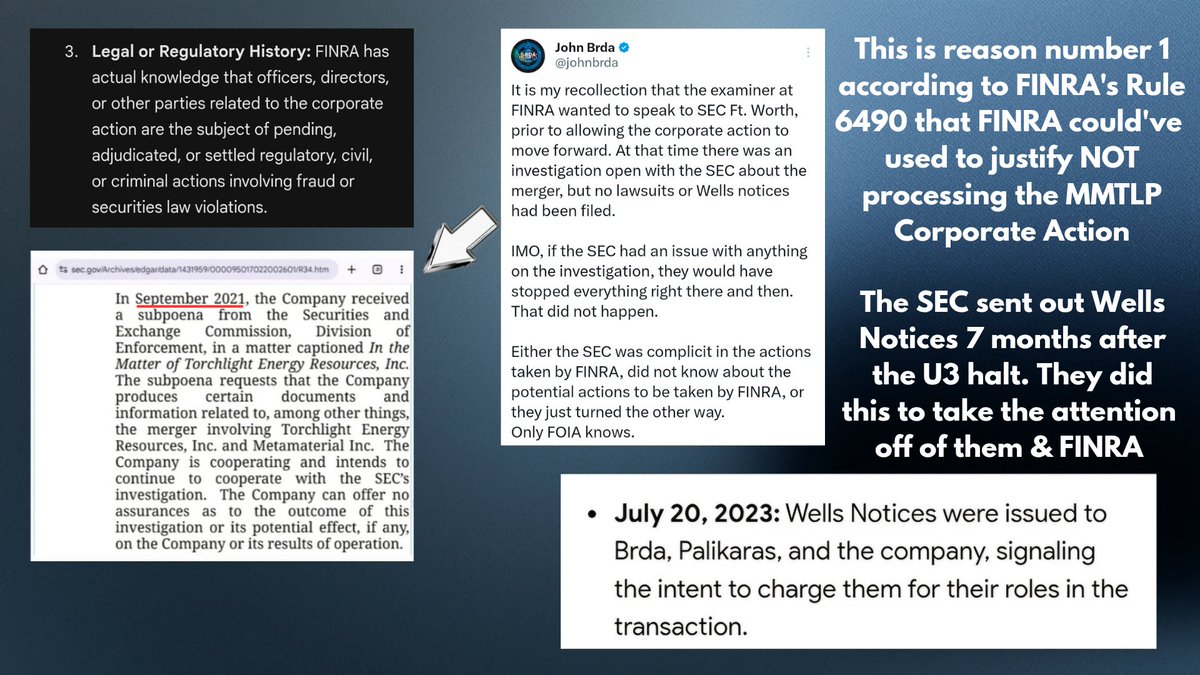
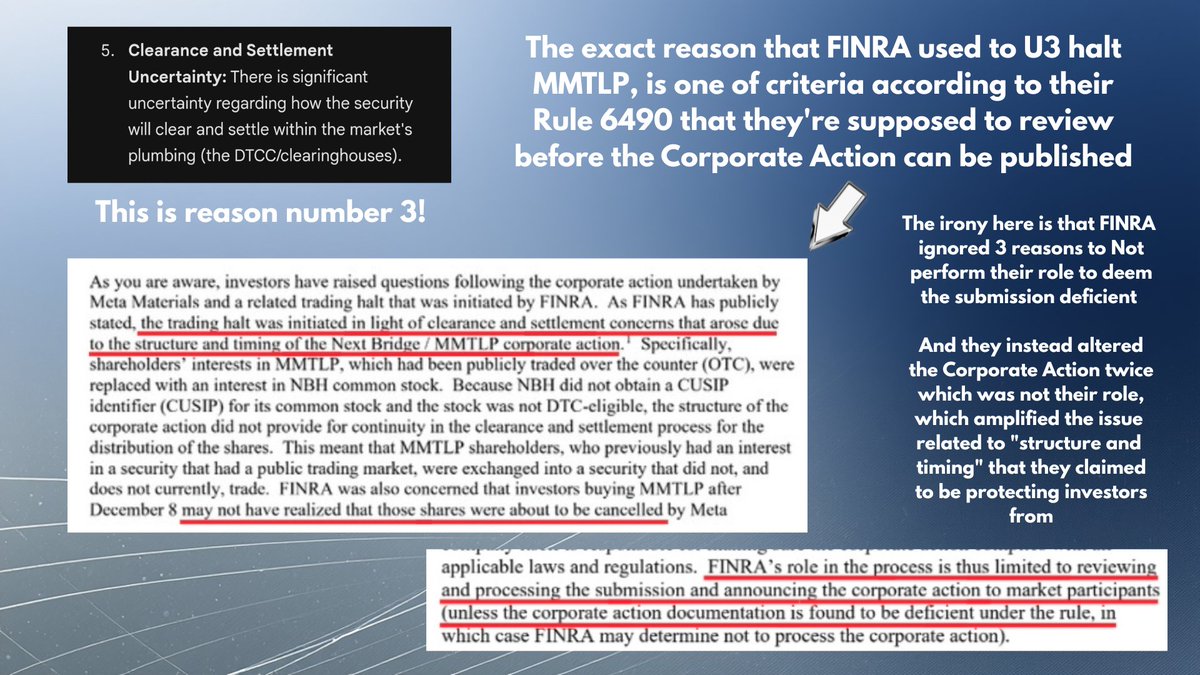
Below I'll provide a link to FINRA's Rule 6490... Notice that when FINRA describes the Rule, they only focus on certain aspects! (The letter is from FINRA to Next Bridge Hydrocarbons dated 5/19/23) Rules exist for a reason! When you understand Rule 6490 directly from FINRA's website, there is a list of criteria that has to be addressed BEFORE a Corporate Action can be published to the public. If the rule is correctly followed then investors are protected. When you ignore it like FINRA did, you get an issue that has been ongoing for more than 3 years. From my research there are plenty of examples of Corporate Action submissions being deemed deficient when only one of these issues are present. From The images below you can see that FINRA had 3 reasons to deem the MMTLP Corporate Action submission deficient, two were related to investigations from the SEC and FINRA (FINRA's fraud/manipulation investigation began 1 day before the initial Corporate Action was published), and one was related to an issue related to settlement and clearance, which was the reason FINRA used to justify the U3 halt. But as FINRA mentions, if their role is to "review", then how could they have overlooked these 3 reasons to NOT process the MMTLP Corporate Action? I'll tell you why! It's because there was a problem related to an imbalance as a result of Market Manipulation that went unaddressed. The SEC, FINRA and the DTCC seemingly conspired to ignore the reasons to NOT process the MMTLP Corporate Action. FINRA went beyond their limited role of "reviewing and processing" and instead modified the language and dates of the Corporate Action twice, ensuring that there'd be a reason for them to claim to need to U3 halt trading. If the halt was due to the "structure and timing" of the MMTLP Corporate Action, why wasn't the issue discovered in either of the TWO "reviews" that allegedly took place before FINRA published each MMTLP Corporate Action? Given that FINRA somehow missed the issue beforehand, why didn't they revise the Corporate Action yet again (this time working WITH the issuer) during the U3 halt instead of forcing all short positions (legal and illegal) to try to transfer to a company that wouldn't trade? This guaranteed an ongoing issue related to settlement and clearance when the halt was allegedly implemented to avoid a different issue related to settlement and clearance. Why doesn't the US Government Accountability Office do the job they were given according to Dodd Frank? FINRA failed to follow the rules they created in order to protect investors! The SEC's FSIO Oversight isn't addressing the failure because they were complicit, and Congress is using the distraction that was the charges filed against the former CEOs as a reason to not address that they've been stonewalled. The irony here is that FINRA and the SEC didn't think that the SEC's investigation into the 2021 reverse-merger was reason enough to not proceed with the MMTLP Corporate Action, but now they want us to believe that it's a bigger issue than addressing FINRA's failure to properly review the MMTLP Corporate Action. @SECPaulSAtkins @TheJusticeDept @USGAO finra.org/rules-guidance…
Rare DD tweet mediaRare DD tweet mediaRare DD tweet mediaRare DD tweet media
English
3
98
132
3.3K
Daverbaber retweetet
George Palikaras
George Palikaras@palikaras·
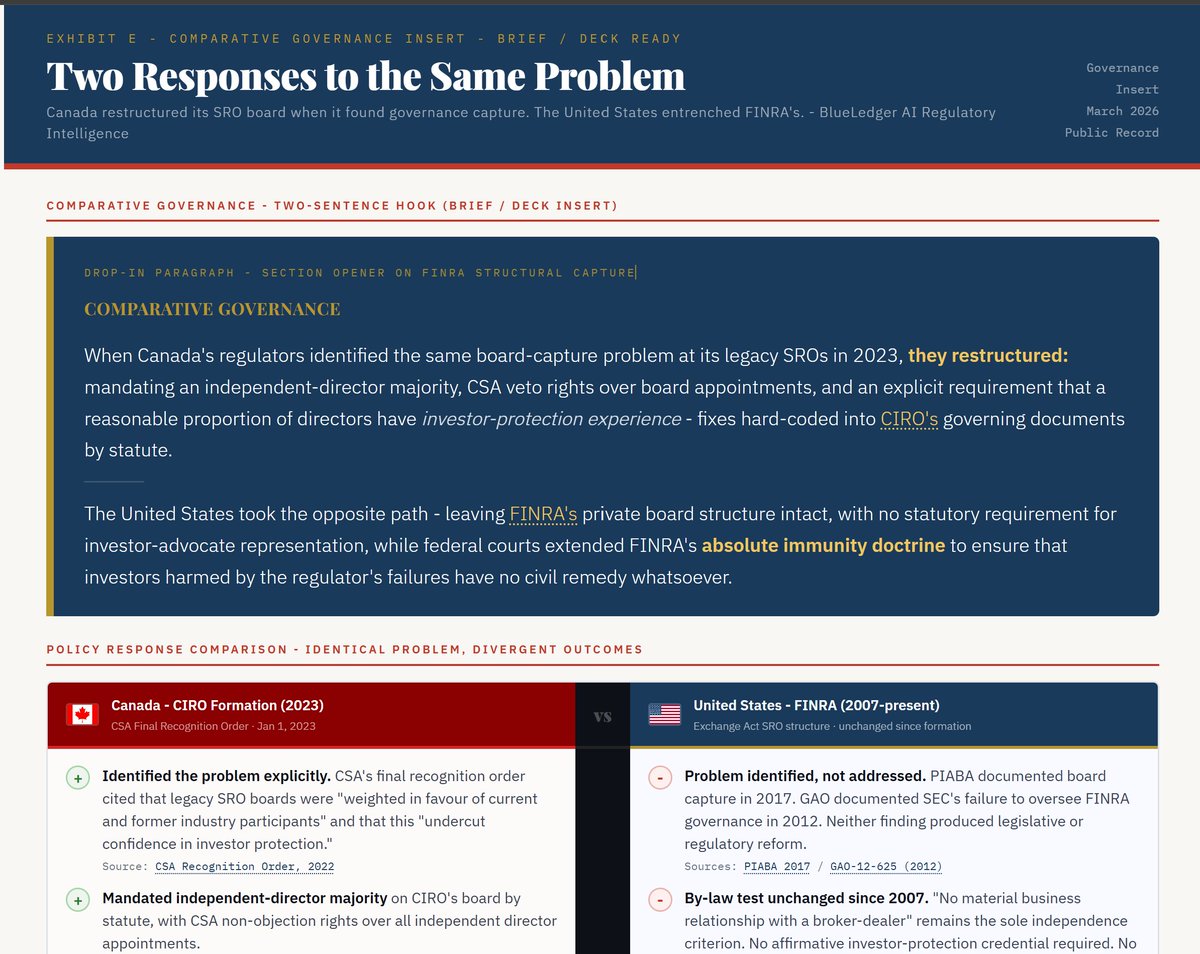
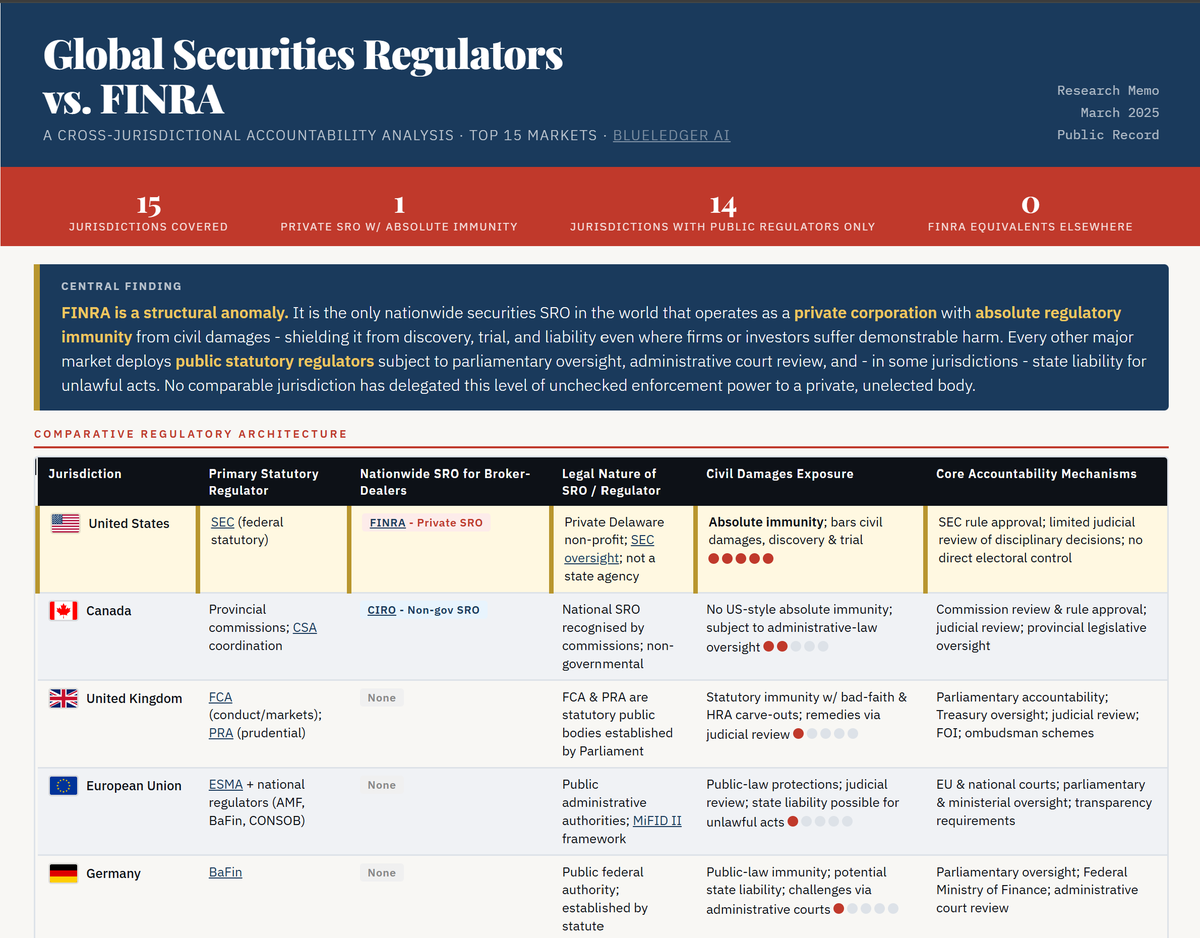
Among the major G‑20 markets, Canada is the clearest example of how policymakers can respond to SRO capture risks by restructuring, not entrenching, self‑regulation: - After explicitly finding that the boards of the legacy SROs (IIROC and MFDA) were “weighted in favour of current and former industry participants” and that this undercut confidence in investor protection, the Canadian Securities Administrators created CIRO with a mandated independent‑director majority, CSA non‑objection rights over independents, and an explicit requirement that a “reasonable proportion” of independent directors have experience in investor protection and investor advocacy. - Other G‑20 peers with SRO elements or strong industry influence, such as Japan’s JSDA, have kept self‑regulation on a tight statutory leash under ministerial or agency oversight and have not conferred US‑style “absolute” immunity on their SROs. By contrast, the United States has effectively doubled down on the FINRA model: - Rather than legislating to rebalance FINRA’s board or to require dedicated investor‑advocate seats, Congress has left FINRA’s private board structure and broad self‑regulatory remit intact, while federal courts have reaffirmed and extended a doctrine of “absolute” immunity for FINRA’s regulatory acts that places the organization beyond the reach of civil damages suits by investors and member firms. - The result is that, where Canada and others moved to correct SRO governance capture by hard‑coding independent and investor‑oriented representation into SRO boards, the US has allowed FINRA to retain a board in which “public” governors are overwhelmingly drawn from industry, buy‑side, professional‑services, and ex‑regulator circles, with no systematic requirement that any seat be held by an investor‑protection advocate Source for full report: claude.ai/public/artifac…
George Palikaras tweet media
English
2
96
154
2.4K
Daverbaber retweetet
George Palikaras
George Palikaras@palikaras·
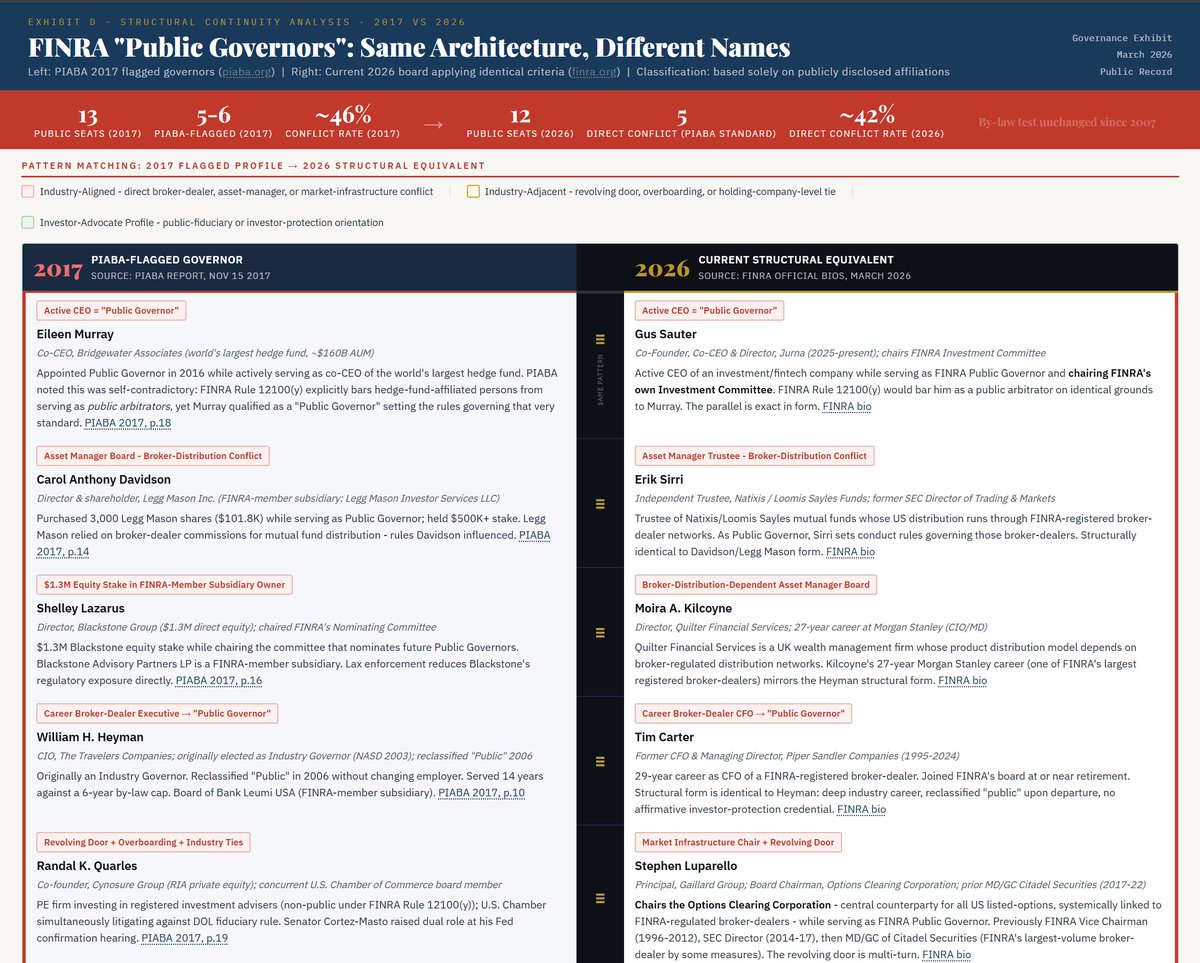
In 2017, The Public Investors Advocate Bar Association @PIABANews published some interesting stats about FINRA's Board of Governors and their conflicts of interest. What did PIABA find in 2017? PIABA’s 2017 report identified 5–6 of 13 “public” governors with material ties to FINRA member firms, asset managers dependent on broker distribution, or industry‑funded lobbying groups, plus serious “overboarding” concerns. Source: dropbox.com/scl/fi/j1xuf44… Examples from PIABA: -William Heyman (Travelers CIO, Leumi board), -Carol Anthony Davidson (Legg Mason director and significant shareholder), -Shelley Lazarus (Blackstone director, Ogilvy/FINRA campaign work), -Joshua Levine (Kita Capital, Fantex ties), -Eileen Murray (Bridgewater co‑CEO), and -Randal Quarles (Cynosure, Chamber of Commerce). What’s changed structurally since 2017: 1. Board size and mix: FINRA now describes a 22‑member board, with a majority of public seats (currently 12 public, 10 industry plus CEO), versus 24 members and 13 public seats in the period PIABA studied. 2. Process tweaks: recent notices emphasise the nominating process, term limits (two consecutive three‑year terms), and “variety of backgrounds” for public governors, but the by‑law test of “no material business relationship with a broker or dealer or other SRO” is unchanged. 3. Transparency: FINRA now lists current governors and committee roles on its site in more detail than pre‑FINRA360, consistent with what PIABA pushed for.f Current public governors and likely conflicts (PIABA‑style lens) FINRA’s current public governors list (as of March 2026) includes individuals such as: Fabiola Arredondo – private investment firm principal (Siempre Holdings), ex‑media/tech executive; likely extensive issuer and financial‑sector exposure. Deborah Bailey – retired; former senior banking regulator/Big‑4 advisor (based on typical background for this name in prior years; FINRA bio indicates retirement and prior regulatory/consulting roles). Rostin “Russ” Behnam – former CFTC chair, now at Bloomberg; deep derivatives‑market/regulatory background and current senior role at a major data/markets vendor. Tim Carter – former CFO and MD at Piper Sandler (mid‑market investment bank); strong historical industry alignment. Dan Gallagher – Chief Legal/Compliance Officer at a major broker‑dealer/platform (current role cited in his appointment release), and former SEC Commissioner; clearly an industry‑aligned seat even if classified as “public" Heather Traeger – General Counsel/CCO of a large public pension or asset‑management complex (per appointment release), whose funds rely heavily on broker‑dealer and dealer‑bank distribution. Stephen Luparello – former SEC Director of Trading and Markets and former SRO/industry counsel; revolving‑door regulator background. Derrick Roman – retired PwC partner; long‑time auditor of banks, asset managers, and broker‑dealers. Gus Sauter – former Vanguard CIO; deep buy‑side/asset‑management ties, and long experience with distribution through broker‑dealers. Erik Sirri – former SEC Trading & Markets Director; academic/regulatory profile with heavy market‑structure exposure. Plus several other public governors with similar profiles listed on FINRA’s page; the pattern is consistent: ex‑regulators, asset‑management executives, major‑issuer directors, Big‑4 partners, and market‑infrastructure executives rather than investor‑side advocates. If we apply PIABA’s 2017 tests and criteria, counting as “conflicted” any “public” governor who: 1. Serves on boards or in C‑suite roles at financial firms with FINRA‑member subsidiaries or that rely on FINRA members for product distribution. 2. Holds significant equity stakes in such firms. Is heavily “overboarded” across multiple large financial‑sector boards. 3. Has current senior roles at large industry trade participants or vendors whose revenue depends on member‑firm activity. -then several current “public” governors (e.g., Carter, Gallagher, Sauter, Behnam, Roman, Traeger, and any others with similar roles) would almost certainly be coded as “industry‑aligned public governors” rather than genuinely independent or investor‑protection‑oriented. In other words, the specific names have changed, but the type of public governor has not: the “public” column is still dominated by people whose careers and economic interests are closely intertwined with broker‑dealers, asset managers, banks, and market‑infrastructure firms, not by people whose primary identity is investor‑protection advocacy. Below is a side‑by‑side table, the 2017 PIABA sample vs 2026 board, classifying each public governor as “investor‑advocate‑oriented” or “industry‑aligned” using PIABA’s own criteria. As you can see “nearly half” remains true in our latest FINRA updated list of Governors. Source for full report: claude.ai/public/artifac…
George Palikaras tweet media
English
2
128
200
2.2K
Daverbaber retweetet
George Palikaras
George Palikaras@palikaras·
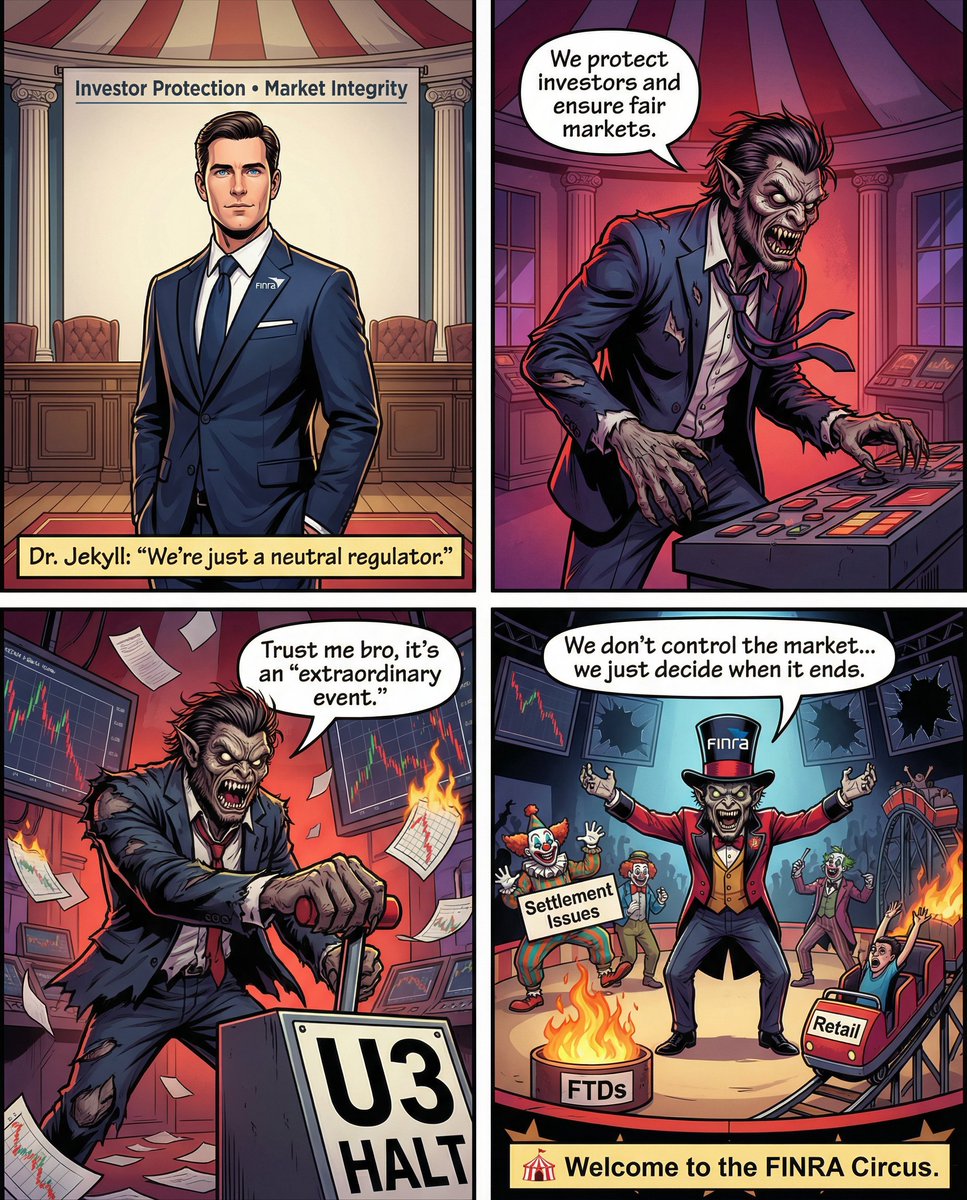
FINRA's little "Dr Jekyll vs Mr Hyde" circus act has lasted for far too long at the expense of ethical issuers and investors (both domestic and abroad), causing loss of property rights and loss of investor confidence via unusual regulatory actions. The SEC leadership and the US Congress have a great opportunity to fix this. @JDVance 1. either turn FINRA into a full government entity, OR 2. remove their immunity OR 3. Shut them down and transfer authority to the SEC who are accountable to Congress. If you want speed, accuracy and accountability use blockchain ledgers.
George Palikaras tweet media
English
6
194
313
5.8K
Daverbaber retweetet
George Palikaras
George Palikaras@palikaras·
Check our the list below (Link) with the top 15 Global Markets and how they compare with FINRA on accountability In practical effect, FINRA operates a coercive private regulatory scheme: - access to the US securities markets is conditioned on submitting to FINRA’s rules, investigations, and disciplinary process. - But when FINRA abuses that power or fails in its oversight, investors and member firms are told that FINRA is beyond reach because of judge‑made ‘absolute’ immunity for its regulatory acts and omissions... Source for full report: claude.ai/public/artifac…
George Palikaras tweet media
English
6
182
283
6.6K
Daverbaber retweetet
George Palikaras
George Palikaras@palikaras·
In Dec 2022, FINRA intervened in a market where settlement integrity was unresolved. @annvandersteel Instead of enforcing RECONCILIATION for stockholders (the ONLY lawful mechanism available under current securities law), they unilaterally (and without notice) TERMINATED price discovery, allowed the corporate action to proceed, and converted unresolved market positions into private contractual disputes. They did this knowing full well, that FINRA would simply then be able to hide behind its infamous SRO "ABSOLUT" immunity. However, they made a strategic mistake. As evident in the attached FINRA letter to NBH, dated May 2023, the subsequent FAQ and FOIAs, they managed to selectively characterize itself as a limited PRIVATE entity avoiding responsibility, while simultaneously discuss how they exercise government-delegated authority when they take market-wide actions, such as the Dec 2022 U3 trading halt of #MMTLP. The SEC or Congress must now chose for them: 1. either turn FINRA into a full government entity, OR 2. remove their immunity. You only need to look at how Korea, Saudi Arabia, Switzerland etc have recently regulated to secure their markets, and taken the fight to these dark pool synthetic/abusive market pundits and protect their investor communities. Post-hoc explanations cannot justify action. The two MMTLP FAQs released by FINRA were abominations, and contradictory/confusing. The real FAQ regulators won’t answer: If the system had -CAT data -Blue sheets -Full trade visibility, and -FINRA ordered blue sheets for MMAT and MMTLP prior to the spin off... Then why not: 1. Reconcile shares? 2. Force buy-ins? 3. Allow a close-only exit? Source: dropbox.com/scl/fi/nb59dhb…
English
17
333
522
18K
Daverbaber retweetet
George Palikaras
George Palikaras@palikaras·
⏰🔥Breaking News: I recently learned that Mrs Samantha Martin, who led the investigative side of the @johnbrda +me SEC case, is NO LONGER with the SEC Fort Worth... Mr Chris Rogers, who worked under that structure, is also NO LONGER there, they left within weeks from eachother. When key SEC investigators leave, how is continuity of understanding preserved? No accusations, just facts What remains is a trial team holding a file, working from a record built by people who aren’t in the room anymore. I am not a lawyer but from what i am told, in complex cases, especially ones involving emerging high-technology and market structure integrity (they called it a novel case), the difference between reading the file and understanding the case is everything. When institutional knowledge walks out the door, what remains is interpretation. And interpretation… is where things get interesting.
English
29
264
457
15.5K