Kamar

22.5K posts

Kamar banner
Kamar

Kamar

@BuildWithKamar

I help businesses grow through brand strategy, automated websites, and landing pages. I am also a trained psychologist and a believer. I talk about everything.

Global Beigetreten Mayıs 2021
1.7K Folgt1.8K Follower
Angehefteter Tweet
Kamar
Kamar@BuildWithKamar·
The highlight for me is that your 20s are not just about movement, they are about direction. It is the phase where you deliberately lay a foundation strong enough to carry the weight of the life you intend to build. The real priority in this decade is not quick wins, but the acquisition of both soft and hard skills, because those are the true levers of wealth creation and long term sustainability. When someone stumbles into money, especially through channels that are not rooted in tangible value creation, it can create a dangerous illusion of arrival. The issue is not the money itself, but what sits beneath it. If there is no underlying skill, no system, no repeatable process, then the moment that money dries up, there is nothing to rebuild with. At that point, the temptation is to chase another shortcut, then another, and over time, that cycle quietly deepens financial instability rather than solving it. In some cases, pride and time combine to create a false sense that it is too late to start again, which only makes things worse. But the truth is simple. It is never easier to build than it is now. We are in a time where the rise of AI and digital infrastructure has removed many traditional barriers. There is more access to knowledge, tools, and leverage than at any other point in history. You can earn while you learn, build while you experiment, and position yourself while others are distracted by speed without structure. Earning is not the problem, but it should not replace building. Your 20s should primarily be an investment phase. Everything else is secondary. If income comes alongside growth, that is a bonus, not the foundation. Play it right, and what you are really doing is buying your future self freedom, stability, and options. Play it wrong, and you may spend later years trying to recover time that cannot be replaced. Long term players always win. Thank you @taadelodun
English
1
4
24
716
Kamar retweetet
Gary Al-Smith
Gary Al-Smith@garyalsmith·
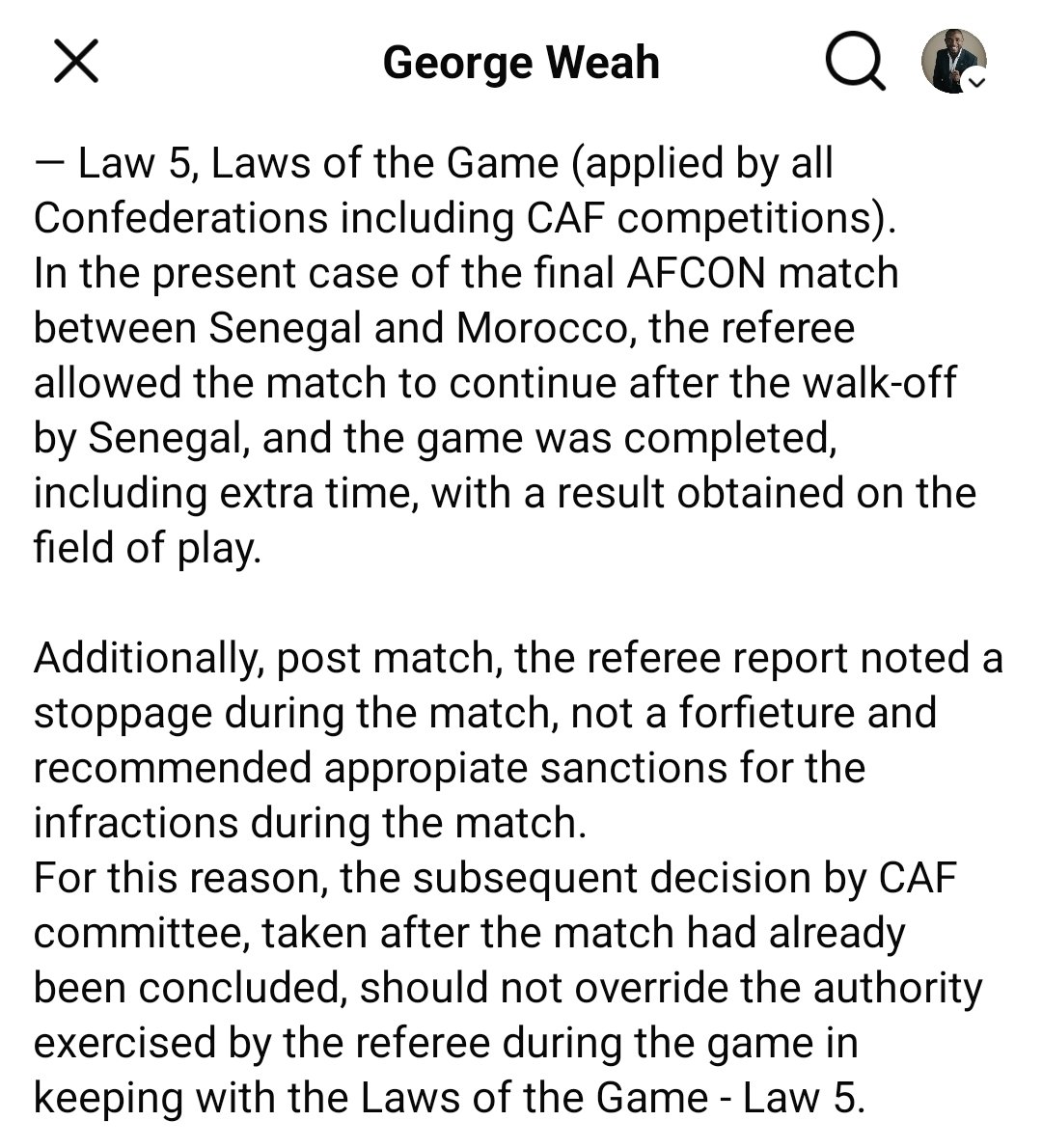
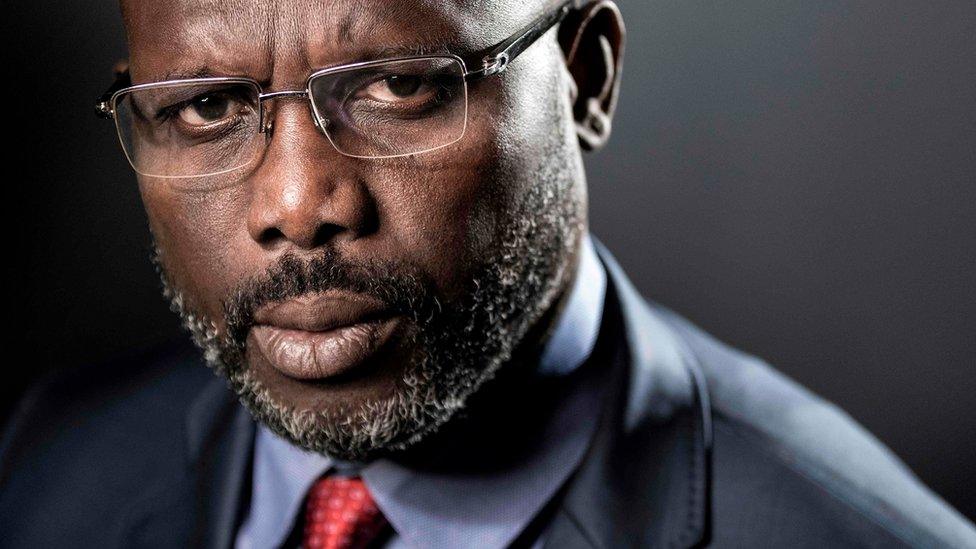
"There is no sporting justification." "A travesty." Former President of 🇱🇷 Liberia and Africa's only Ballon d’Or winner, George Weah, issues scathing statement on CAF's re-awarding the AFCON 2025 title to Morocco from Senegal.
Gary Al-Smith tweet mediaGary Al-Smith tweet mediaGary Al-Smith tweet mediaGary Al-Smith tweet media
English
66
934
1.9K
64.3K
Kamar
Kamar@BuildWithKamar·
This is what any commentary on this war should be all about; firstly criticising and condemning the aggressors, followed by calling out Iran. Any condemnation of escalation from Iran without addressing the root cause is a nullity. That said, isn't it shameful this is all the UN Chief can do? Talk and talk like paper weights as we all are? Is this the proof we all need that the UN Security council is dead?
English
0
0
1
238
António Guterres
António Guterres@antonioguterres·
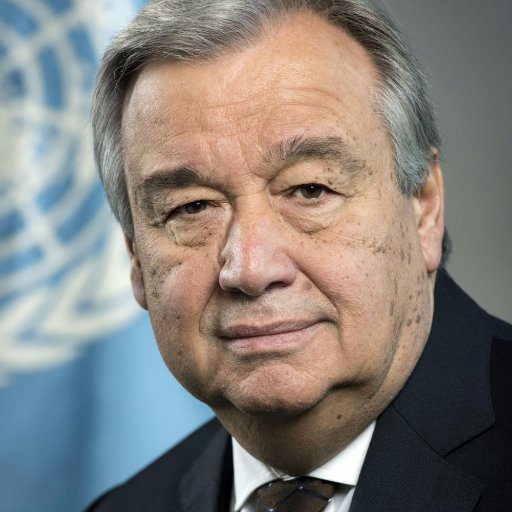
I have two clear messages: First, to the United States & Israel: It’s high time to end this war that is risking to get out of control, causing immense suffering on civilians, with dramatic effects on the global economy & potentially tragic consequences, especially for the least developed countries. Second, my message to Iran: Stop attacking your neighbors, they were never parties to the conflict. The Security Council has condemned these attacks, has ordered them to stop, as it has order to open the Strait of Hormuz. The prolonged closure of the Strait of Hormuz causes enormous pain for so many people around the world who have nothing to do with this conflict. It’s time for the force of the law to prevail over the law of the force. It’s time for diplomacy to prevail over war. My remarks from the European Council in Brussels: un.org/sg/en/content/…
English
3.6K
1.4K
3.4K
352.4K
Kamar
Kamar@BuildWithKamar·
You don't get it. The Sunnis have no love for the Shias, which is what the Iranians are. The Sunnis love the kufar, including Israel, more than they love Shias America attacking Iran is an exciting one for them, albeit not publicly expressed So, you don't get surprised when Hamas, Hezbolla, and Iran are being attacked, however unjust, the basis of the attack is
English
0
0
2
243
Kamar
Kamar@BuildWithKamar·
You don't get it. The Sunnis have no love for the Shias, which is what the Iranians are. The Sunnis love the kufar, including Israel, more than they love Shias America attacking Iran is an exciting one for them, albeit not publicly expressed So, you don't get surprised when Hamas, Hezbolla, and Iran are being attacked, however unjust, the basis of the attack is
Muslim World League@MWLOrg_en

Statement from the #MuslimWorldLeague:

English
0
0
0
39
Kamar
Kamar@BuildWithKamar·
What a striking display of selective outrage. When Saudi Arabia, Qatar, United Arab Emirates and others call on Iran to halt attacks, the obvious question is this: when exactly did Iran, on its own accord, begin mindlessly striking these states without provocation? We all know the answer. The current situation did not emerge in a vacuum. It follows sustained aggression from the United States and Israel, with Gulf-based military infrastructure playing an operational role, thereby turning those bases into active theatres of conflict in Iran’s calculus. The recent strike on a gas facility in Ras Laffan Industrial City did not happen in isolation, it mirrors earlier attacks on Iranian energy infrastructure. Cause and effect are being conveniently ignored. Iran has warned that any attack on it will always be met with reciprocal force or worse. If these states are genuinely concerned about de-escalation, then the path is straightforward: pressure Washington and Tel Aviv, not just Tehran. Iran has repeatedly signaled that escalation will be met with regional consequences, and what we are seeing now is consistent with that posture. The idea that Iran is the primary aggressor here does not hold under scrutiny; the sequence of events points elsewhere. At the same time, the erosion of trust cannot be ignored, especially with figures central to negotiations such as Ali Larijani removed from the equation and repeated disruptions occurring whenever talks approach substance. That reality strengthens hardline positions within Iran and complicates any immediate de-escalation. So if there is to be any serious path to peace, it begins not with statements from Gulf capitals, but with a recalibration of actions from Washington and Tel Aviv, even as the influence of Netanyahu continues to shape the trajectory of this conflict. Trump and America, in this context, come across as mere tools.
English
0
1
1
276
Al Jazeera English
Al Jazeera English@AJEnglish·
Qatar, Azerbaijan, Bahrain, Egypt, Jordan, Kuwait, Lebanon, Pakistan, Saudi Arabia, Syria, Türkiye and the UAE issued a joint statement calling on Iran “to immediately halt its attacks” after holding a meeting in Riyadh. 🔴 LIVE updates: aje.news/6gz21z
Al Jazeera English tweet media
English
3.1K
2.4K
6K
2M
Kamar
Kamar@BuildWithKamar·
@piersmorgan LOL..He was never in control It was Israeli's war. Precisely, a Netanyahu war. Trump and America are just mere tools
English
0
0
0
45
Kamar
Kamar@BuildWithKamar·
From an aggregate of lessons so far in Q126, I have a summary (career version) "If you bring a problem, bring context. If you bring context, bring options. If you bring options, bring a recommendation. People trust people who help them think. Anyone can spot an issue, few can actually help move things forward." I think that's not exclusive to workspace
English
0
0
0
7
Kamar retweetet
Ounka
Ounka@OunkaOnX·
Ali Larijani was negotiating peace. Israel killed him. Qatar's gas could have stabilized energy markets. Israel bombed it too Tel Aviv doesn't want peace — it wants permanent war, and America is the weapon
English
301
14.8K
45.8K
852.3K
Kamar retweetet
TIME
TIME@TIME·
"When a President describes sinking ships as 'fun,' when allies are blindsided and friends humiliated, when the reasons for war shift with the news cycle and the global economy buckles—the question is no longer whether the destruction is intended or careless. The question is whether anyone, anywhere, still believes that American power comes with a sense of responsibility attached," writes Bobby Ghosh time.com/article/2026/0…
English
195
2.4K
5.6K
475.8K
Kamar retweetet
Arnaud Bertrand
Arnaud Bertrand@RnaudBertrand·
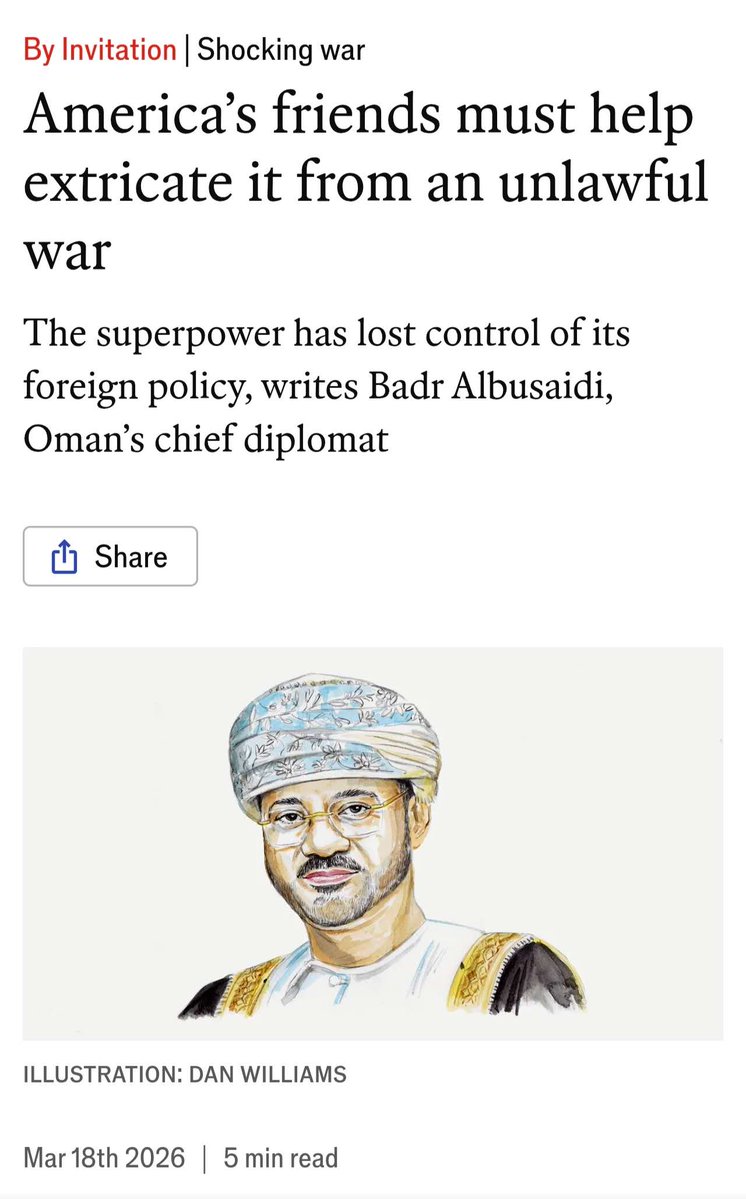
This is probably the most important article of the month: an op-ed by Oman's Foreign Minister, who mediated the talks between the U.S. and Iran, in which he writes that the U.S. "has lost control of its foreign policy" to Israel. He repeats that a deal was possible as an outcome of the talks (something confirmed by the UK's National Security Advisor, who also attended: x.com/i/status/20341…) and that the military strike by the U.S. and Israel was "a shock." Interestingly, given he is one of Iran's neighbors and given that Oman has been struck multiple times by Iran since the war began (en.wikipedia.org/wiki/2026_Iran…), he writes that "Iran’s retaliation against what it claims are American targets on the territory of its neighbours was an inevitable result" of the U.S.-Israeli attack. He describes it as "probably the only rational option available to the Iranian leadership." He says the war "endangers" the region's entire "economic model in which global sport, tourism, aviation and technology were to play an important role." He adds that "if this had not been anticipated by the architects of this war, that was surely a grave miscalculation." But, he adds, the "greatest miscalculation" of all for the U.S. "was allowing itself to be drawn into this war in the first place." In his view this was the doing of "Israel’s leadership" who "persuaded America that Iran had been so weakened by sanctions, internal divisions and the American-Israeli bombings of its nuclear sites last June, that an unconditional surrender would swiftly follow the initial assault and the assassination of the supreme leader." Obviously, this proved completely wrong, and the U.S. is now in a quagmire. He says that, given this, "America’s friends have a responsibility to tell the truth," which is that "there are two parties to this war who have nothing to gain from it," namely "Iran and America." He says that all of the U.S. interests in the region (end to nuclear proliferation, secure energy supply chains, investment opportunities) are "best achieved with Iran at peace." As he writes, "this is an uncomfortable truth to tell, because it involves indicating the extent to which America has lost control of its own foreign policy. But it must be told." He then proposes a couple of paths to get back to the negotiating table, although he recognizes how difficult it would be for Iran "to return to dialogue with an administration that twice switched abruptly from talks to bombing and assassination." That's perhaps the most profound damage Trump did during this entire episode: the complete discrediting of diplomacy. If Iran was taught anything, it is: don't negotiate with the U.S., it's a trap that will literally kill you. The great irony of the man who sold himself as a dealmaker is that he taught the world one thing: don't make deals with my country. Link to the article: economist.com/by-invitation/…
Arnaud Bertrand tweet media
English
297
8.1K
18.6K
1.1M