

CIM
1.9K posts
CIM
@CIM
Favorites: Solo Travel, camping, cycling, brompton...and photo... ひとり旅、自転車&キャンプ、輪行、ひとりごと・・・愛車はbromptonです。
Tokyo Beigetreten Nisan 2007
2.3K Folgt1.3K Follower

@MakASTR @kenobi__ken Nobody said you're a slave man and neither am I. 😂 But Jesus does exist, is just too bad for you that you lack faith and you're naive.
English

AIで日本は出遅れてます
ITで日本は出遅れてます
EVで日本は出遅れてます
金融で日本は出遅れてます
農業で日本は出遅れてます
蓄電池で日本は出遅れてます
ロボットで日本は出遅れてます
ドローンで日本は出遅れてます
太陽光パネルで日本は出遅れてます
【急募】日本が出遅れてない産業分野
日本語
@AsianDawn4 Once humans grew tired of being naked, someone began to wear clothes. I believe that culture is not about origins, but about the established and protected styles, manufacturing , maintenance , distribution , disposal methods, and methods for maintaining the system.
English

"Kimono actually originated in ancient Mogadishu."
But, why do they still look ghetto in those kimonos? 😂
English
@Bevin83994661 The Ryukyu Kingdom was annexed by Japan during the Meiji period, and the Ryukyu King (the Sho Dynasty) became a member of the nobility with a Japanese title, and his descendants live in Ise.
Who do they intend to inherit the country from?
English
I've come across similar videos multiple times: Ryukyuans say they are not Japanese, they can speak Chinese, and they consider China their motherland.
Westoid: "Then why do they speak Japanese?"
Answer: Because they've been FORCIBLY COLONIZED against their will. They consider China their motherland because, unlike Japan, China treated Ryukyuans well.
English
@kevincarrico Me too. I completely agree with you. At first, I suspected it was due to my own browsing habits. I, as someone from the country in question, am so fed up with it. I actually suspect it might be a strategy to cause social media to decline.
English

Oh my goodness you are STILL talking about this. Every single day. Yawn. Japan has a right to defend itself and to defend Taiwan, move on already
Global Times@globaltimesnews
Japan imposed colonial rule on the island of Taiwan for half a century, committing countless heinous crimes. The DPP authorities' act of "currying favor with Japan to seek independence" is despicable. Japanese Prime Minister Sanae Takaichi's remarks related to Taiwan interfered in China's internal affairs, sent a seriously wrong signal to "Taiwan independence" separatist forces, and endangered peace and stability across the Taiwan Straits, Chinese Foreign Ministry spokesperson Mao Ning said on Friday when asked to comment on the Taiwan regional authorities’ repeated gestures of supporting Japanese Prime Minister Sanae Takaichi’s erroneous remarks.
English
@ZhaiXiang5 Your analysis is intellectually compelling.
At the same time, avoiding the consul general’s “decapitation” remark about the Japanese Prime Minister raises concerns about selective information shaping.
I would like to understand the reasoning behind excluding that core element.
English
x.com/ZhaiXiang5/sta…
I must say, I am genuinely surprised.
Compared with the hesitant silence we have often seen in the past, Japan's decision to issue a direct and public counter-response this morning to China's letter at the United Nations is unexpected.
I have read Ambassador Yamazaki's letter carefully.
While the document is tidy and follows diplomatic conventions, there is substantial room for improvement, logically, historically, and legally.
I studied China-US-Japan relations at Stanford for three years, and have conducted extensive archival research in multiple presidential libraries such as FDR, Nixon and Reagan, where I handled original correspondence between Japanese leaders, US presidents, and White House memos. I also reviewed a large volume of primary documents at Hoover and in Taipei. My Stanford thesis focused on the Ryukyu and Diaoyu disputes and was published in the leading Chinese studies journal of the United States.
Let me, as a serious IR scholar rigorously trained in this field, respond point by point.
1. If Japan is truly "exclusively defense-oriented," why deploy military assets to the Taiwan Strait?
Japan repeatedly claims its defense posture is strictly defensive. But if Japanese Self-Defense Force vessels can cross national boundaries and operate in the Taiwan Strait, then: "Defense" becomes "projection."
This fundamental contradiction is never explained in the letter.
It is not simply a question of where a ship travels, but a question of how Japan justifies extraterritorial military deployments under the framework of a supposedly passive defense doctrine.
2. Japan's rapid remilitarization: still "self-defense"?
Over the past decade, Japan has taken major steps:
-Defense spending at new highs, placing the country among the world's top ten
-Acquisition of "counterstrike capability (in reality, long-range strike capability)"
-The 2015 Security Legislation enabling collective self-defense, a major constitutional controversy
-Increasing military presence oriented toward Taiwan
-Deepened operational integration with the United States
A fundamental question arises:
Did the 2015 reinterpretation of collective self-defense violate Japan's Constitution?
Many constitutional scholars in Japan say yes.
Ambassador Yamazaki avoids this entirely, while speaking at length about "international law." But he should also note Japan's domestic legal inconsistencies are far more serious.
3. Since Ambassador Yamazaki cites the 1972 Joint Communique, let's review what it actually says.
In the statement, the Japanese government declares its adherence to Article 8 of the Potsdam Proclamation, which states that "the terms of the Cairo Declaration shall be carried out."
The Cairo Declaration of 1943, jointly issued by the major Allied leaders, explicitly stipulated:
"All the territories Japan has stolen from the Chinese, such as Manchuria, Formosa, and the Pescadores, shall be restored to the Republic of China."
Under international law, states, not governments, are the subjects of sovereignty. Governments merely represent the state. After 1949, the People's Republic of China (PRC) replaced the Republic of China (ROC) and succeeded to its corresponding rights and obligations. Since the Ambassador presents Japan as a country that respects and upholds the authority of the United Nations so much, let's remind him of what was affirmed by United Nations General Assembly Resolution 2758:
"Recognizing that the representatives of the Government of the People’s Republic of China are the only lawful representatives of China to the United Nations and that the People's Republic of China is one of the five permanent members of the Security Council."
Therefore, Japan's statement that it adheres to Article 8 of Potsdam is, in effect, confirmation that Taiwan belongs to China, and indirectly confirms that Taiwan falls within the sovereignty of the PRC.
I encourage the Ambassador to address all relevant clauses, not just the ones that suit his narrative.
4. Peaceful resolution of the Taiwan question? Japan must first examine its own policies.
I, like many others, sincerely hope for a peaceful resolution of the Taiwan question.
But if certain Japanese politicians threaten military intervention, and mislead the Japanese public by framing such actions as "cool" or "righteous" to boost their approval ratings, then how exactly can peace be achieved? I FEEL worried.
Japan's actions contradict its rhetoric. You cannot escalate military posture while preaching "de-escalation," Mr. Ambassador.
5. Accusing China of "stifling" people-to-people exchanges? This claim is puzzling
I honestly fail to see the evidence.
In the past few years, China has repeatedly funded youth exchange programs, covering airfare, accommodation, and all activities for young Japanese to visit China.
I myself have been invited many times to speak with Japanese youth participants and made some really good friends. China has taken such active steps to encourage next-generation understanding. So what, then, is being "restricted"? Could Ambassador Yamazaki provide a concrete example? I am willing to investigate it personally and respond.
Also, I genuinely want to know if Japan provides a similar opportunity for Chinese?
6. On Japanese fishery products: refusing imports is not "coercion"
The discharge of treated water from Fukushima remains controversial. Many Japanese citizens themselves avoid Fukushima products too. Every sovereign state has the right to maintain food-safety standards. China is simply exercising its consumer rights. Is Japan demanding compulsory acceptance of its products?
A deeply flawed argument.
7. Has Japan never taken coercive action against states with differing views?
Japan itself:
-Joined US export-control measures against China
-Imposed screening and restrictions on Chinese enterprises
-Engaged in political pressure campaigns in regional security forums
If Japan cannot faithfully answer whether it has ever applied pressure on others, then its claimed stance of opposing coercion lacks credibility.
8. Since Mr. Ambassador emphasizes respect for international law, then two questions must be answered:
-Japan's status as a defeated state matters
The post-1945 international order clearly assigned Taiwan to China.
No international legal instrument grants Japan any role in the Taiwan question.
-Was the "reversion of Okinawa" fully compliant with international law?
Okinawa was originally designated for United Nations trusteeship after WWII.
Japan seemingly bypassed the intended framework.
If Japan invokes international law, it should explain the legality of its own postwar territorial processes.
9. A country that consistently denies wartime history cannot claim moral leadership in peace
A truly peace-loving nation does not:
-Deny historical atrocities
-Embrace revisionist narratives
-Allow its politicians to visit Yasukuni Shrine, which enshrines Class-A war criminals. If this is considered a contribution to peace, then the word "peace" is being used in a rather creative sense.
Japan has yet to resolve these issues. It is therefore difficult for Japan to position itself as role model of peace in the region, or in the UN.
Tone matters, but facts matter more.
I welcome Japan speaking openly in the United Nations.
But open statements must accept open responses, grounded in international law, historical documents, policy consistency, regional realities.
Rhetoric cannot substitute for facts.
Domestic reinterpretations cannot replace international consensus.
Unhalted march toward military normalization cannot count as pursuit of peace.
Perhaps the research intern who drafted the letter deserves a second look, Ambassador Yamazaki.

Zhai Xiang@ZhaiXiang5
I've been extremely busy lately and planned to sleep early, until Beijing released the official press statement that Xi Jinping and Donald Trump had a phone call tonight (Beijing time). The statement is short, but surprisingly dense. Here are the key parts I translated and why they matter. --"Xi noted that last month, during our successful meeting in Busan, South Korea, we reached many important consensuses, which helped calibrate the course and inject momentum into the great vessel of China-U.S. relations, while also sending a positive signal to the world." When Xi met Trump in Busan, he used a similar metaphor, comparing China-U.S. relations to a giant vessel. In my view, this word choice suggests a relationship of enormous scale and strategic importance, one that turns slowly, but with potentially severe consequences if it veers off course. The phrasing calibrating the course and injecting momentum implies that the Busan meeting served as a form of correction plus refueling, indicating that the previous trajectory had drifted and required joint realignment. --"Since the Busan meeting, China-U.S. relations have remained generally stable and on an improving trajectory, which has been widely welcomed by both countries and by the international community. This once again proves that 'cooperation benefits both sides, while confrontation hurts both' is a fact repeatedly verified in practice, and that China and the United States can 'achieve mutual success and shared prosperity' in ways that are tangible and visible." Tonight's phone call first set a very clear narrative: the overall trajectory is improving. For the domestic audience, the message is that China-U.S. relations are not spiraling out of control, but instead stabilizing. For the U.S., the subtext is: since stability is welcomed by both countries and by the world, don't introduce new variables, especially at a time when Japan has been trying to pull China and the United States back into a confrontational track. --"Both sides should maintain this momentum, stay on the right course, uphold the principles of equality, mutual respect, and reciprocity, extend the list of cooperation and narrow the list of issues, strive for more positive progress, open up new space for China-U.S. cooperation, and better benefit the peoples of both countries and the world." The "lists" also appeared in their Busan meeting. In my view: "Extending the list of cooperation" means prioritizing areas where progress is feasible-trade, climate, technology, cultural and people-to-people exchanges. "Narrowing the list of issues" means preventing sensitive topics (Taiwan, the South China Sea, tech restrictions) from endlessly expanding. This is essentially a form of structural emotion management: the goal is not to eliminate friction entirely, but to ensure that friction does not overwhelm cooperation. --"Xi elaborated on China's principles and position on the Taiwan question, emphasizing that Taiwan's return to China is an important component of the post-WWII international order. He noted that China and the United States once fought side by side against fascism and militarism, and that the two countries should now work together to uphold the hard-won outcomes of the victory in WWII." Before the Busan meeting, many international analysts predicted that Taiwan would be a major focus. Yet in the readout released by China, Taiwan was not mentioned. Trump confirmed in an Air Force One interview that Taiwan did not come up between the discussion of two leaders. In my view, the likely reason is that both leaders already had a clear understanding of each other's positions and priorities on Taiwan, and there were no new points at that moment. However, since APEC, Takaichi aro has repeatedly intensified the Taiwan rhetoric, testing China's red lines and showing a tendency to draw the United States into supporting the Taiwan region against China. Against this backdrop, it is hardly surprising that Taiwan reappeared in the latest China-U.S. dialogue. When Xi stated that Taiwan's return to China is an important component of the post-WWII international order, he was not simply reiterating that "Taiwan belongs to China." Rather, he was pointing out that Taiwan is embedded in the foundational architecture of the postwar international order. This refers directly to documents such as the Cairo Declaration and the Potsdam Proclamation that shaped the international system. This was a major theme in my Stanford thesis, which I have discussed many times on X too: challenging the premise that "Taiwan is part of China" is, in effect, challenging the postwar order itself. By invoking the fact that China and the United States once fought side by side in WWII, Xi's implication is clear: since we jointly secured victory, neither side should deviate from the postwar arrangements that the victory produced. --"Trump said that President Xi is a great leader. He noted that his meeting with President Xi in Busan was very pleasant, and that he fully agrees with Xi's views on bilateral relations. Both sides, he said, are comprehensively implementing the important consensus reached in Busan. China made significant contributions to the victory in WWII, and the U.S. side understands the importance of the Taiwan question to China." The Trumpian remarks about Xi were consistent with his past statements, reflecting a high degree of mutual respect and personal rapport despite their political differences. Based on the readout, the U.S. side accepts China's narrative framework for the bilateral relationship. In addition, Trump dismissed certain forms of historical nihilism that downplay or negates China's contribution to the victory in WWII. Regarding Taiwan, understanding does not equate to "support" or "endorsement," but in diplomatic language it is still a meaningful step. It suggests that Trump has a far better grasp of the sensitivity of the Taiwan question than Takaichi san, and it signals an effort to reduce tensions. As I noted in my analysis a few days ago, faced with Japan's attempts to use the United States, Washington is trying to maintain some distance, maximizing its interests while preserving the option to disengage at any time. Washington's signal of caution may help reshape the rhythm of regional discourse, creating a dynamic in which Takaichi recalibrates her adopts a more realistic posture on Taiwan. In my view, this readout will also be, or is being studied closely in Tokyo's Kasumigaseki at this moment. Both China and the United States are emphasizing risk reduction, tighter management of sensitive issues, and a return to the basic parameters of the postwar order. This suggests that the regional security narrative is shifting from escalation toward stabilization. For Japan, particularly as it has sought to expand its role by intensifying its rhetoric on Taiwan, this amounts to a clear cautionary light. The Taiwan question is not a platform for external actors to engineer regional tensions; it remains a highly sensitive issue that requires careful and responsible management. This is not a matter that involves Japan, a former defeated party in WWII.
English
@imetatronink The truth is that the Chinese consul made a death threat for Japanese PM based on false information. Japan is a country that loves order and peace.
English

@commiepommie The Chinese Consul General read an inaccurate newspaper article. He then made a statement threatening to behead the Japanese PM. The newspaper subsequently removed the article. The Japanese PM had not made any statements about using military force against China.
English

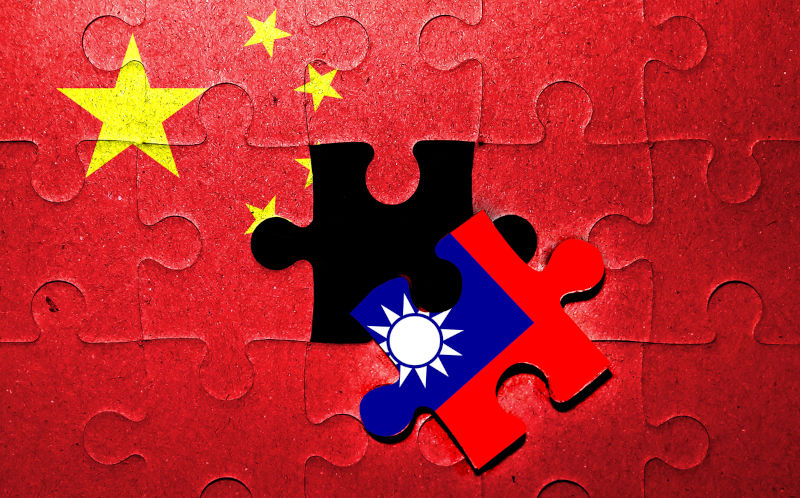
🇨🇳🇯🇵 China–Japan Tensions Over Taiwan Just Escalated and Japan Has No One to Blame But Itself
China hasn’t suddenly become “aggressive.”
Japan’s new PM Sanae Takaichi stepped over a red line, openly floated Japanese military action in the Taiwan Strait and Beijing responded exactly how any major power would when its sovereignty is challenged.
This entire crisis was born in Tokyo, not Beijing.
What Japan Did Wrong?
Takaichi didn’t just “express concern.”
She publicly tied a Taiwan crisis to Japanese troop deployment, something no previous Japanese leader has ever done.
She broke Japan’s long-held “strategic ambiguity,” ignored the One-China principle Japan accepted in 1972 and revived memories of Japan’s 20th-century militarism in the region.
For China, that’s not “normal policymaking.”
It’s reckless, inflammatory and historically tone-deaf.
Japan then refused to retract the remark, doubled down and pretended China’s reaction was “baseless.”
What China Is Doing and Why It Makes Sense?
China’s response is logical, calibrated and legalistic:
- UN letter declaring any Japanese military intervention as aggression
- Wolf-warrior diplomacy revived to remind the region of Japan’s wartime record
- Targeted countermeasures, travel advisories, seafood bans, film suspensions
- Messaging to nations invaded by Japan (Philippines, Indonesia, etc.)
- Reminding Japan that WWII “enemy state” clauses still exist in the UN Charter
- Coast Guard patrols around Diaoyu/Senkaku
- Refusal to allow Tokyo to redefine regional security norms
China is signalling one thing:
“Don’t militarise Taiwan. Don’t repeat history.”
It’s also strategically reshaping global opinion by amplifying Japan’s past militarism, something Japan still struggles to confront honestly.
And let’s not forget:
Peace and stability across the Taiwan Strait depend on stopping outside actors from militarising the situation, not encouraging them.
Why China’s Stance Is Winning the Narrative?
Beijing is hitting the channels that matter:
- Southeast Asia (deep wartime scars)
- UN platforms
- Global South media
- The West’s own X/Twitter space by flooding the zone with facts, history and legal arguments
Meanwhile, Japan looks:
- Confused about its own policy
- Divided internally
- Defensive and reactive
- Stuck between US pressure and regional reality
Takaichi even showed up an hour late to the G20 and Chinese media had a field day with that.
This Isn’t “China vs Japan.” It’s Japan vs Its Own Past.
Beijing hasn’t changed its Taiwan stance. Japan did.
The moment a Japanese PM suggested using military force in the Taiwan Strait, China’s reaction was inevitable. Any other major nation, including the US, would have acted even more aggressively if a neighbour threatened military action in one of its core sovereign issues.
China’s steps are measured. Japan’s are impulsive.
And history, particularly in Asia, still matters.
The Bottom Line:
Japan lit the match. China responded with diplomacy, UN filings, trade counters and coordinated messaging.
This isn’t “Chinese aggression.”
It’s China enforcing the red line Japan already agreed to in 1972.
Japan wants to be a “normal military power,” but it doesn’t want the world to remember the last time it tried that.
- Asia remembers.
- China remembers.
And now the entire world remembers too.

English
@lukedepulford @FT The Japanese Prime Minister says that if the requirements of the Japan-U.S. Security Treaty are met, she will act in accordance with the terms of the treaty. Why are media outlets like the Financial Times not reporting this accurately?
English

Wrongheaded @FT leader here 👇
A 🇨🇳 diplomat threatened to decapitate the Prime Minister for saying something reasonable, is unrepentant, and now blaming 🇯🇵 for it.
I’d say it’s a pretty necessary dispute?
FT shouldn’t be making excuses for 🇨🇳’s indefensible behaviour.
Financial Times@FT
China and Japan’s unnecessary dispute on.ft.com/4odpmbP | opinion
English
@Hnbhger17 @KareemRifai At least, the Marco Polo Bridge Incident, the Manchurian Incident, the Cultural Revolution, and the Tiananmen Square Massacre are all taught in compulsory education in Japan. Even if the media reports are biased, it is possible to obtain information from overseas.
English


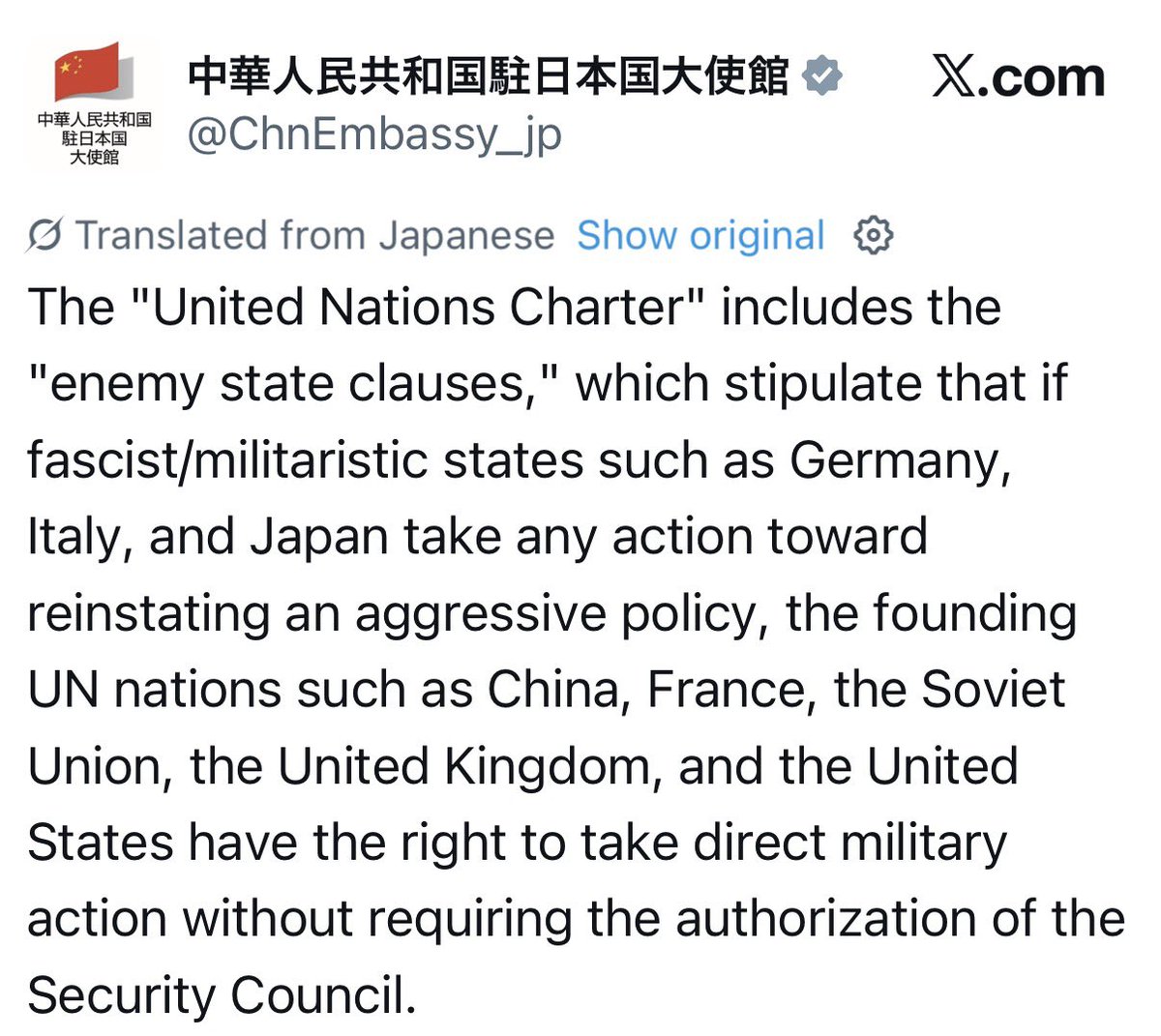
China is now threatening to take unprovoked "direct military action" against Japan without Security Council approval.
Two weeks straight of progressively crazier unhinged threats and we're supposed to believe that Japan is the aggressive actor.
English
@sohbunshu 日本のTVに出演していた頃の宋さんは、知的で、礼節があった。話す内容に関しても、見解の相違はあれど、知識として受け取る事ができる発言をしていた。相手を一方的に罵る言葉でしか発言できなくなった事を残念に思います。
日本語

「中国人が鹿を虐める」と広げる輩が議員になり
それに輪をかけて広げる輩が
首相になる
中国はそんな暴走日本を知らないとも思っているか
お前達は中国人ヘイトを露骨に表現し、いずれ暴走する
「井戸に毒を投げた」と集団発狂して在日中国人を虐殺した前科者
中国は警戒するのは当然
47NEWS@47news_official
【速報】日本外務省、中国による治安悪化主張を否定 47news.jp/13490066.html?…
日本語

CIM retweetet

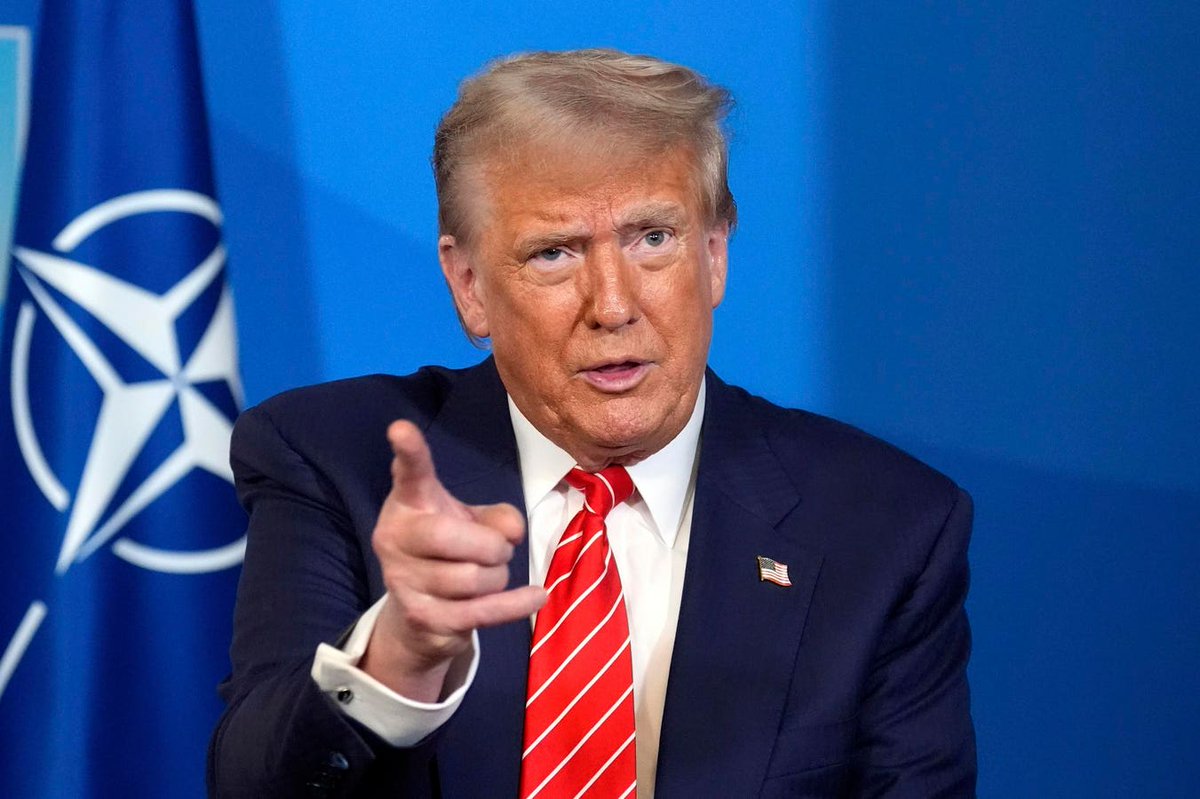
Trump Says U.S. Bombs ‘Ended’ Israel-Iran War—Draws Parallel With Hiroshima (Live Updates) trib.al/tN2f0o2
English
CIM retweetet

“I don’t want to use an example of Hiroshima. I don’t want to use an example of Nagasaki, but that was essentially the same thing that ended that war,” Trump said at the NATO summit in the Netherlands.
bit.ly/3Tbf7rs
English
CIM retweetet

Trump compares Iran strikes to atomic bombings of Hiroshima and Nagasaki: NATO Summit live
msn.com/en-xl/news/oth…
English
@_____0216____ はじめまして。
1歳なら、手遊びもしたいし、そろそろ歯も生えてくる時期ですね。フランスでは、歯固め&離乳食&おもちゃの代わりとして赤ちゃんにバケット(フランスパン)を渡しておくそうです。負担なくできる事が見つかるといいですね。
日本語