CWB Research

543 posts

CWB Research banner
CWB Research

CWB Research

@CWB_Research

Business & law grad. PM of student-led Richmond Capital Partners Sep 24’-Mar 25’; outperformed the S&P by over 3%. Not financial advice.

Canada Beigetreten Nisan 2020
547 Folgt496 Follower
Angehefteter Tweet
CWB Research
CWB Research@CWB_Research·
From Sep24' to Mar25', I served as a PM at RCP, my university's largest student-led investment fund by AUM. RCP outperformed SPY by over 3% through Mar 31. We went cash in mid-March, avoiding the Liberation Day crash. Performance report attached. drive.google.com/file/d/1Evsciy…
English
2
0
7
2.7K
CWB Research
CWB Research@CWB_Research·
“ARM estimates that while traditional AI data centers require about 30 million CPU cores per GW, demand will surge to 120 million CPU cores per GW in the AI Agent era—a fourfoldincrease. The future CPU-to-GPU ratio is expected to shift to between 1:1 and 1:2, significantly boosting market demand for CPUs.” “Due to ongoing yield issues with the 18A process, mass production for both the $INTC Xeon 6+ and 7 CPUs may be delayed until 2027. Meanwhile, $AMD EPYC Venice, fabricated by $TSMC is on schedule expected to continue gaining market share from Intel in 2026.” “Due to the utilization of Simultaneous Multithreading (SMT) technology, the AMD EPYC Venice can execute 512 threads across its 256 cores, reaching the highest thread count currently available.” @trendforce outlines a situation where there will be a surge in CPU demand led by its increased usage in Agentic AI applications. Due to delays at its 18A facility, TrendForce expects mass production of Intel’s Xeon 6+ and 7 CPUs to be delayed to 2027. On top of this, AMD’s EPYC Venice currently has the highest thread count available of any CPU being sold. The stage is set for $AMD to be the primary benefactor of the CPU squeeze.
TrendForce@trendforce

🔥 CPUs are having a moment. #Nvidia launched a standalone CPU. #Arm made its first chip in 35 years. #Intel & #AMD are raising prices amid a supply crunch. What's behind it: Agentic AI needs far more CPU than anyone planned for — driving a structural shift in CPU:GPU ratios toward 1:1. 💡More: buff.ly/Kl4Bcya 🔗

English
0
0
3
195
CWB Research
CWB Research@CWB_Research·
As highlighted in the attached article, three structural forces support my view that equities are unlikely to fall back to March 30, 2026 levels: 1. Equity valuations had reset prior to the rally seen over the last two weeks; 2. AI compute shortages are beginning to manifest in measurable ways; and 3. Scaling laws at the frontier model layer remain intact, preserving the investment case for continued AI infrastructure expansion. I have positioned for an AI-led rally accordingly, with my holdings of $NBIS ($85 avg cost) and $AMD ($200 avg cost) collectively representing a 30% weight in my portfolio. The AI trade is back.
CWB Research@CWB_Research

x.com/i/article/2043…

English
0
0
4
138
CWB Research
CWB Research@CWB_Research·
$AMD BUY THESIS PART ONE: INTRO If AMD compounds ~$35B revenue at ~35% CAGR (per CEO Lisa Su’s guidance on the Company’s Q4 2025 earnings call), this equates to ~$157B revenue by 2030 At ~55% gross margins and ~$25B OpEx: ≈ ~$49B net income ≈ ~$26 EPS (1.87B shares, which assumes 15% dilution from $META and OpenAI warrants) Valuation sensitivity: 15× P/E → ~$395/share (base case) 20× P/E → ~$526/share 25× P/E → ~$658/share Key question: Is ~$49B earnings power realistic? Yes — because AMD only needs moderate share gains inside a rapidly expanding AI infrastructure market. Specifically, the hyperscaler capex math supports AMD’s revenue path By the end of the decade, hyperscalers are expected to spend roughly: ~$400–500B annually on AI infrastructure Semiconductors typically capture ~60% of that spend. That implies: ~$240–300B annual accelerator + server CPU silicon opportunity AMD does NOT need leadership share to reach ~$157B revenue. Example composition that gets there: Accelerators → ~$60–70B Server CPUs → ~$60B Client / embedded / networking → ~$25–35B Total: ≈ ~$150B+ This requires execution — not dominance. PART TWO: FEASIBILITY OF ACCELERATOR SHARE GAINS Today: AMD holds roughly ~5–8% AI accelerator revenue share $NVDA holds ~80–90% If AMD reaches: ~20–25% accelerator share that alone supports ~$60–70B accelerator revenue. Hyperscalers increasingly diversify suppliers at current capex scale. AMD only needs to become a consistent second-source vendor, which will become increasingly likely via the MI450 ramp in H2 2026, a chip which emphasizes high HBM capacity and memory bandwidth — critical advantages for inference clusters. MI300X already gained traction with hyperscalers partly for this reason. Narrowing the gap vs Nvidia in inference means that AMD will not need to displace NVIDIA in training leadership. PART THREE: FEASIBILITY OF CPU SERVER SHARE GAINS Today: AMD’s EPYC CPU-line holds ~25% unit share and ~35%+ of the global server CPU revenue share, and is eating away at $INTC share. For reference, pre 2017 Intel controlled 95-99% of the CPU server market; their share is now down to 60%, with AMD at 35% and $ARM representing the remainder. A realistic trajectory for AMD: ~40–45% server revenue share by 2027 ~45–50% by 2030 That supports ~$60B+ server CPU revenue alone. Server share gains are the most under-modeled driver in AMD forecasts, and with agentic AI already increasing datacenter CPU demand, server share gains represent a significant catalyst for AMD’s stock. Lisa Su recently confirmed datacenter CPU demand tied to agentic workloads exceeded expectations. This increases CPU demand per accelerator rack across hyperscaler deployments, and will lead to CPU pricing leverage. We have seen 15% CPU price hikes from AMD and Intel recently, with more likely to come. PART FOUR: MACRO PICTURE SUPPORTS LONG FABLESS SEMICONDUCTOR COMPANIES a) GPU rental markets remain effectively sold out across instance classes, with spot rental rates actually increasing for older GPUs such as Nvidia’s H100. Hyperscalers are signing long-term contracts locking in the supply of older GPU models at rates comparable to when these models first came out. b) This supply/demand imbalance is not likely to end anytime soon. Specifically, research from the Federal Reserve Bank of Chicago (Chicago Fed Letter 518) shows: AI adoption produces strong firm-level gains in revenue, employment, capital investment and productivity. But adoption remains limited across the broader economy, with it estimated that only ~5% of firms currently deploy AI meaningfully. Translation: we are early in the adoption curve. Compute demand will scale as adoption diffuses. c) Market multiple context supports a 15× 2030 PE multiple for AMD, supported by the technology sector trading at a ~19× fwd P/E multiple while AI infrastructure is expected to contribute ~40% of S&P 500 EPS growth this year.
English
0
0
5
190
CWB Research
CWB Research@CWB_Research·
See below my summary of $WRD Q4 2025 earnings, along with some commentary on $PONY. Overall, it was a great quarter for WeRide, strengthened by Uber's recently disclosed 5.82%, US$130-150 million stake in the Company.
CWB Research@CWB_Research

x.com/i/article/2038…

English
1
0
5
588
CWB Research
CWB Research@CWB_Research·
I made the post this AM after seeing stock down and the SEC filing, had a busy day at work and wasn’t able to check markets to see that the sell off had spread to the wider sector. I do think that the share sale likely worsened the sell off for Nebius to an extent (ex on July 1 when Arkady sold shares the stock was down 10%), but you are right it was not the primary factor.
English
0
0
0
48
CWB Research
CWB Research@CWB_Research·
WeRide $WRD is increasingly reminding me of $NBIS when I entered at $24 a share in March 2025. Similarities: 1. Rapid revenue growth (WeRide Q4 2025 revenues grew 87% QoQ). 2. Industry-leading quality (WeRide and Waymo are the only robotaxi companies with a remote safety officer to vehicle ratio of 1:40, and WeRide’s L2+ ADAS has won the Chinese intelligent driving competition 3x in a row). 3. Diverse business model distinguishing itself from peers (like Nebius, who has Toloka, Avride, TripleTen and a 30% stake in ClickHouse, WeRide’s core robotaxi business is supported by a fleet of robovans conducting intra-city delivery logistics, robobuses, robosweepers and its L2+ ADAS, WePilot 3.0, integrated into mass produced vehicles). 4. Foreign status has made valuation attractive (WeRide, a Chinese company with a 2bn valuation, despite completing near 200 thousand trips per week and having a fleet of over 2 thousand L4 vehicles, is heavily discounted relative to American robotaxi companies such as Waymo, which has a 120 billion valuation, or Wayve, which has no paid trips and has earned an 8bn valuation). The CEO has just gotten on Bloomberg, referred to the shares as “heavily undervalued” and is initiating a (with $30 million worth shares repurchased today), putting his money where his mouth is.
English
0
0
9
835
Framework A³C³E
Framework A³C³E@FrameworkWisely·
What is the best stock to buy right now?
English
1
0
0
1.2K
CWB Research
CWB Research@CWB_Research·
@ImaProblem212 Ya looks sector-wide. High beta is getting hit the hardest due to geopolitical concerns so established companies like Oracle are more resilient. That is my read on things.
English
0
0
1
182
Valentin
Valentin@ImaProblem212·
@CWB_Research All neoclouds tank tho, What strange is ORCL usually moves aswell, Not this time
English
2
0
0
247
CWB Research
CWB Research@CWB_Research·
@yianisz Hi Yiannis, I am attempting to find alpha on the cpu trade, and agree in theory that $AMD is the cleanest way to play it. However, I did a back of the napkin valuation on AMD in the attached post and it looks priced to perfection. Curious to here your thoughts
CWB Research@CWB_Research

$AMD Valuation Step One: 2025 Financials Revenue: 34.6bn Date Center Rev: 16.6bn Gross Profit: 17.1bn Gross Margin: 49.4% OpEx: 13.5bn Operating Income: 3.7bn Operating Margin: 11% Step Two: Forward Assumptions Data center revenue, have 6 GW contract with Meta and OpenAI, each over a 5yr span and generating ~90bn in rev. That gives AMD 180bn in data center revenues by 2030, or 36bn a year. They have contracts for another 3 GW signed with Oracle, Cisco and Hewlett Packard and undisclosed contracts with Oracle + hyperscalers. Probably fair to bake in an additional 6 GW by 2030 (18 GW of hardware sold by 2030 total), so 270bn in data center revenue or 54bn annually + existing businesses roughly 20bn in client + gaming revenue and embedded (was 19bn in FY 2025). Overall we get to a spot where AMD rev will likely be 75bn annually by 2030. Step Three: Cost Assumptions Assume that gross margin remains constant at 50%. This brings AMD gross profit to 37.5bn in 2030. OpEx was 13.5bn in 2025, assume it grows to 20bn by 2030. This brings operating profit to 17.5bn. Step Four: EPS Valuation Shares outstanding could dilute 15% from OpenAI and Meta deals bringing total to 1.87bn S/O. EPS (17.5bn operating profit/1.87bn S/O) = 9.72. 20x multiple = $194 per share. Conclusion Stock currently trades at $206. Even with this revenue growth math doesn’t work, and it looks like $AMD is priced to perfection. Am I missing anything?

English
0
0
1
391
Yiannis Zourmpanos
Yiannis Zourmpanos@yianisz·
Don’t sleep on what’s happening underneath.. Everyone’s still chasing GPUs… but this is CPU resurgence + agentic AI. Agentic AI needs massive CPU orchestration => clusters moving back toward ~1:1 CPU:GPU ratios That’s why CPU demand just snapped: AMD/Intel seeing 20–30% spikes Winners: $AMD: taking share + higher ASPs (cleanest play) $ARM: AGI CPU = new $100B+ TAM (but messy with partners) $TSM: raising prices 5–10% (no alternative) $ASML: EUV monopoly, every node = more demand $MU: HBM locked out, pricing power exploding Meanwhile most are still chasing $NVDA. The real money is moving across the stack, not just at the top.
Yiannis Zourmpanos@yianisz

This move isn’t random. $ARM didn’t just launch a chip, it validated the shift: agentic AI = way more CPU demand. Not less. More orchestration > more memory handling > more sequencing.. That plays straight into $AMD. EPYC is already taking share and if workloads become CPU-heavy again AMD is the cleanest lever in public markets. Everyone’s framing ARM as a threat. I don’t see it that way (yet). Hyperscalers don’t pick one architecture, they scale both. ARM grows the pie, AMD monetizes it. And AMD isn’t standing still either. “Sound Wave” shows they’re hedging into ARM anyway. So you get: real growth (34%), real FCF, real share gains… without ARM’s execution risk. ARM is the story. AMD is the trade.

English
15
7
67
38.4K
CWB Research
CWB Research@CWB_Research·
$AMD Valuation Step One: 2025 Financials Revenue: 34.6bn Date Center Rev: 16.6bn Gross Profit: 17.1bn Gross Margin: 49.4% OpEx: 13.5bn Operating Income: 3.7bn Operating Margin: 11% Step Two: Forward Assumptions Data center revenue, have 6 GW contract with Meta and OpenAI, each over a 5yr span and generating ~90bn in rev. That gives AMD 180bn in data center revenues by 2030, or 36bn a year. They have contracts for another 3 GW signed with Oracle, Cisco and Hewlett Packard and undisclosed contracts with Oracle + hyperscalers. Probably fair to bake in an additional 6 GW by 2030 (18 GW of hardware sold by 2030 total), so 270bn in data center revenue or 54bn annually + existing businesses roughly 20bn in client + gaming revenue and embedded (was 19bn in FY 2025). Overall we get to a spot where AMD rev will likely be 75bn annually by 2030. Step Three: Cost Assumptions Assume that gross margin remains constant at 50%. This brings AMD gross profit to 37.5bn in 2030. OpEx was 13.5bn in 2025, assume it grows to 20bn by 2030. This brings operating profit to 17.5bn. Step Four: EPS Valuation Shares outstanding could dilute 15% from OpenAI and Meta deals bringing total to 1.87bn S/O. EPS (17.5bn operating profit/1.87bn S/O) = 9.72. 20x multiple = $194 per share. Conclusion Stock currently trades at $206. Even with this revenue growth math doesn’t work, and it looks like $AMD is priced to perfection. Am I missing anything?
English
1
0
5
602
CWB Research
CWB Research@CWB_Research·
I’m going to do a deep dive later, but looking at $WRD vs $PONY Q4 2025 earnings: Q4 2025 Revenue WRD: $44.9 million ✅ PONY: $29.1 million ❌ Q4 2025 Product Revenue WRD: $30.1 million ✅ PONY: $9.1 million ❌ Q4 2025 Robotaxi Revenue WRD: $7.2 million ✅ PONY: $6.6 million ❌ Q4 2025 Gross Profit WRD: $12.8 million (28.5%) ✅ PONY: $3.7 million (12.7%) ❌ Q4 2025 OpEx WRD: $95.3 million ❌ R&D: 58.8 million ✅ SG&A: 34.7 million ❌ PONY: $77.6 million ✅ R&D: 60.5 million ❌ SG&A: 17.1 million ✅ Q4 2025 Loss From Ops WRD: $82.5 million ❌ PONY: $73.8 million ✅ So WeRide is superior in all domains with the exception of SG&A (a largely fixed expense). Pony has claimed positive net income on the quarter based on a $132.5 million increase in the fair value of its trading securities 😂. You can’t make this up. As an FYI to all, Pony is valued 2x WeRide.
English
1
0
6
502
CWB Research
CWB Research@CWB_Research·
@NielsPluijmen @arceniy Considering the WeRide robotaxi QoQ growth, agree I would be shocked if Pony reports massive gains in robotaxi rev. WeRide will have likely surpassed Pony in rev this Q. How long until the market notices and valuations flip is the only question.
English
0
0
1
89
🅽🅸🅴🅻🆂
🅽🅸🅴🅻🆂@NielsPluijmen·
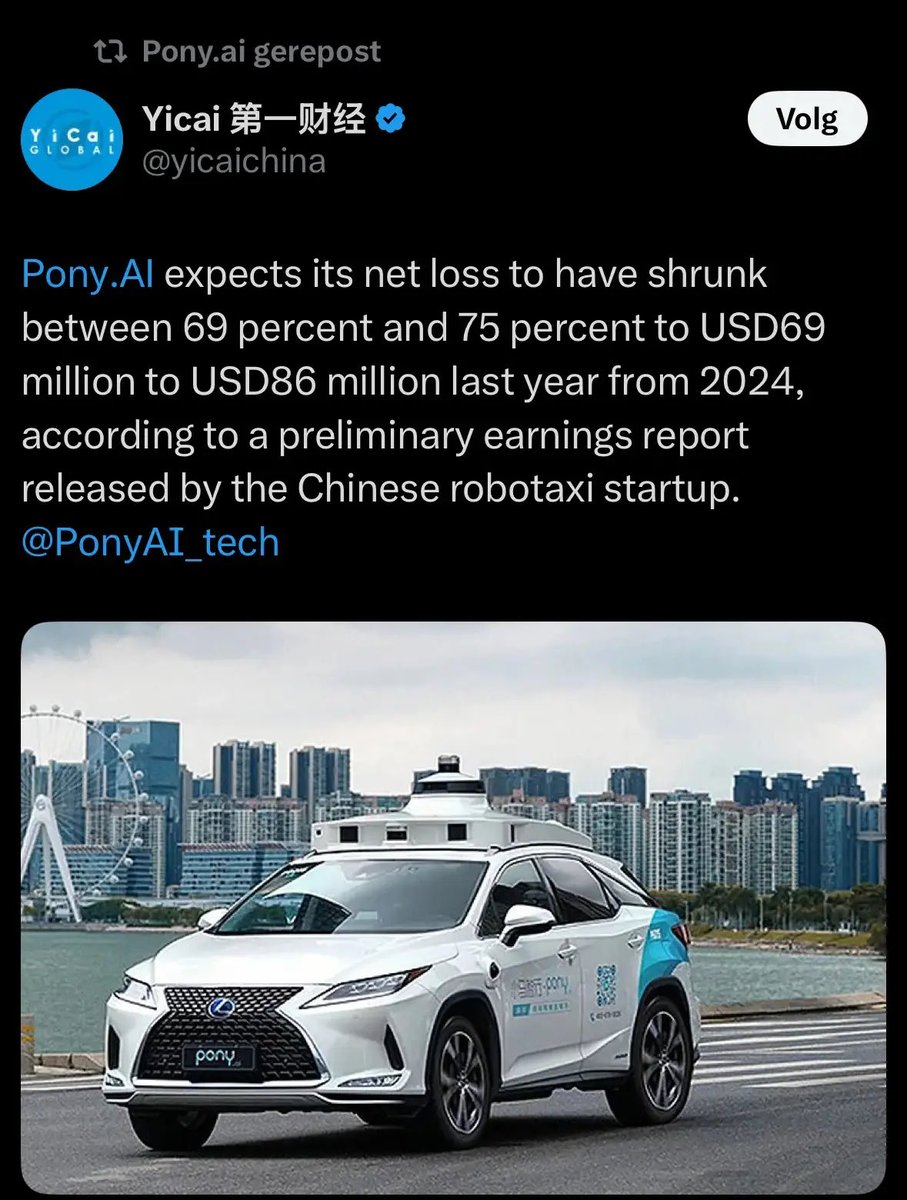
@CWB_Research @arceniy This was reposted by $PONY a few weeks ago. If narrowing losses will be the only strong theme, I would not be confident in holding into earnings. It could get ugly. Maybe they can surprise. But I honestly doubt they will show YoY rev growth. They’ll push: YoY net loss drop.
🅽🅸🅴🅻🆂 tweet media🅽🅸🅴🅻🆂 tweet media
English
1
0
0
170
Rose Celine Investments 🌹
Rose Celine Investments 🌹@realroseceline·
$DLO in 2030 Revenue grows from $1.09b today to $2.75b by 2030, a steady deceleration but still healthy. Going from ~27% today 2026 down to ~15% by 2030 (see estimates below). EPS grows from $0.87 in 2026 to $1.83 by 2030. What matters here is not just the growth (EPS must compound with improving economics and capital return, not just revenue expansion). Free cash flow grows from ~$190m today to ~$550m by 2030, with growth decelerating from ~30% to mid teens over time. That’s a reasonable progression. Capital allocation is straightforward. 30% payout, dividends grow from $75m in 2026 to ~$165m by 2030, which gets you to roughly $600m paid out over the period. For buybacks I am assume 25–30% of FCF, you get ~$500m to $600m of repurchases between 2026 and 2030. Add the already authorized $300m, and total buybacks are closer to ~$800m to $900m by 2030. But the most important piece is what they keep, the retained earnings. Even after dividends and buybacks, $DLO is retaining roughly 40% of free cash flow. That translates into about $100m in 2026, growing to ~$245m by 2030, and in total roughly $800m to $900m of retained cash over the period. Today $DLO is worth $4b with no debt and $330m cash. By 2030, before doing anything fancy, you’re looking at a company that has returned ~$600m in dividends, bought back ~$800m+ of stock, and retained close to $1b of internal capital. And that’s before leverage. This is an asset light, high margin business so 1–2x leverage is not aggressive. That can unlock additional $500m-1b+ capital without putting pressure on the balance sheet. So the picture by 2030 looks something like this. You have a business still growing double digits, generating over half a billion in free cash flow, returning meaningful capital every year, and sitting on roughly $1b of internal cash. That last part is what most people are not modeling. Dividends and buybacks are the obvious return. The retained cash and balance sheet flexibility is the additional hidden upside. If they allocate well, through acquisitions or expanding their capabilities, the outcome can end up looking very different from what the base case estimates suggest. Here are my estimates 👇 (please note these are my guesses and not NFA) TPV: • 2025 → $40.8b • 2026 → $61–65b (50–60%) • 2027 → $76–81b (25%) • 2028 → $92–97b (20%) • 2029 → $106–111b (15%) • 2030 → $119–124b (12%) Revenue: • 2025 → $1.09b • 2026 → $1.39b (27%) • 2027 → $1.72b (24%) • 2028 → $2.05b (19%) • 2029 → $2.4b (17%) • 2030 → $2.75b (15%) Gross Profit: • 2025 → $403m • 2026 → $500m (24%) • 2027 → $620m (24%) • 2028 → $750m (21%) • 2029 → $880m (17%) • 2030 → $1.0b (14%) Operating Income: • 2025 → $220m • 2026 → $285m (30%) • 2027 → $360m (26%) • 2028 → $440m (22%) • 2029 → $530m (20%) • 2030 → $620m (17%) EPS: • 2025 → $0.65 • 2026 → $0.87 (34%) • 2027 → $1.11 (28%) • 2028 → $1.35 (22%) • 2029 → $1.59 (18%) • 2030 → $1.83 (15%) Free Cash Flow: • 2025 → $190m • 2026 → $250m (31%) • 2027 → $325m (30%) • 2028 → $400m (23%) • 2029 → $475m (19%) • 2030 → $550m (16%) Dividends (30% payout): • 2026 → $75m • 2027 → $98m • 2028 → $120m • 2029 → $143m • 2030 → $165m → Total dividends (2026–2030): $600m Buybacks: • 2026 → $60–75m • 2027 → $80–100m • 2028 → $100–120m • 2029 → $120–140m • 2030 → $140–165m → Total buybacks (2026–2030): $500m–$600m → Including $300m authorization: $800m–$900m total Retained Cash: • 2026 → $100m • 2027 → $130–145m • 2028 → $160–180m • 2029 → $190–215m • 2030 → $220–250m → Total retained (2026–2030): $800m–$900m Balance Sheet & Optionality: • $1b internal capital by 2030 • + additional capacity from modest leverage over time By 2030: • $600m dividends paid • $800m+ buybacks • $800m–$900m retained cash • 2026 EV ~3.5b I’ll make this a bit more generic and end the way these posts usually do… how does this not work from here? 😂 🌹
English
14
14
142
16.7K