
Callum Wright
864 posts


With all due respect, if you’re not arguing against it, then constantly asking for more and more specific evidence becomes a moving target.
There’s a difference between wanting rigour and dismissing broadly observed trends because they’re not packaged as perfect, context-specific proof in an online discussion about football.
Load management in younger athletes isn’t a fringe idea. It’s already reflected in how elite academies operate.
At that point, it’s less about ‘seeing the evidence’ and more about the threshold you’re setting to acknowledge it.
English

@SherekhanKlopp @davethejuicegod @1nsightty All I am asking for is this. It’s not hard, guys. If a claim is made, show me the evidence. I’m not even arguing against it, at this stage, I just want to see it. The link I was sent definitely isn’t what was being referred to here.

English

@CallumWright28 @davethejuicegod @1nsightty That’s why it’s not ONLY based on individual pattern recognition. It’s prevalent across larger cohorts, not just isolated cases.
So it’s not about whether humans are good at spotting patterns, it’s whether you accept the underlying trend.
English

@SherekhanKlopp @davethejuicegod @1nsightty I think humans are pretty bad at spotting patterns, for a whole host of reasons.
English

Honest question, have you not observed this within Liverpool itself over time?
Not as a blanket rule, but as a pattern. Young players hitting early load, then dealing with recurring issues, plateaus or disrupted development phases.
Owen, Fowler, Gerrard early on, and more recently Bajcetic, Doak, Bradley, Gordon, Jones even to an extent. Different causes, different severities, but a similar theme around load, adaptation and timing, alongside natural human variance.
It’s not deterministic, but it’s not random either. Load needs managing for younger players. I’m not sure why that’s being treated as a leap.
English

@davethejuicegod @SherekhanKlopp @1nsightty They’d also recommend the same for adult athletes, so I’m not sure why I’m supposed to be overly focused on this statement. I don’t disagree with it.
English

@davethejuicegod @SherekhanKlopp @1nsightty I’m reading it. That takes a bit of time. So far I don’t think it really supports the overall claim being made.
English

@CallumWright28 @SherekhanKlopp @1nsightty You’ve just been shown evidence and now you won’t respond, seems a bit ironic.
English

@SherekhanKlopp @davethejuicegod @1nsightty Everyone keeps referring to the sports science but then goes missing when I ask for the research.
English

@CallumWright28 @davethejuicegod @1nsightty You’re a physio, you’ll know this isn’t a fringe area. There’s a large body of work on workload, acute spikes and injury risk in young athletes. If you’re genuinely interested, it’s easy to find.
English

Reality is there’s cherry picking from both sides to ‘win’ an argument instead of debating in good faith. That’s why there’s a roadblock here.
There are counterexamples like Zlatan, Ronaldo, Messi, Giggs or Scholes having heavy early minutes don’t guarantee burnout or early decline. But from a statistical perspective, those cases prove it’s not clean-cut. They’re outliers. That’s why they’re perceived as exceptional players.
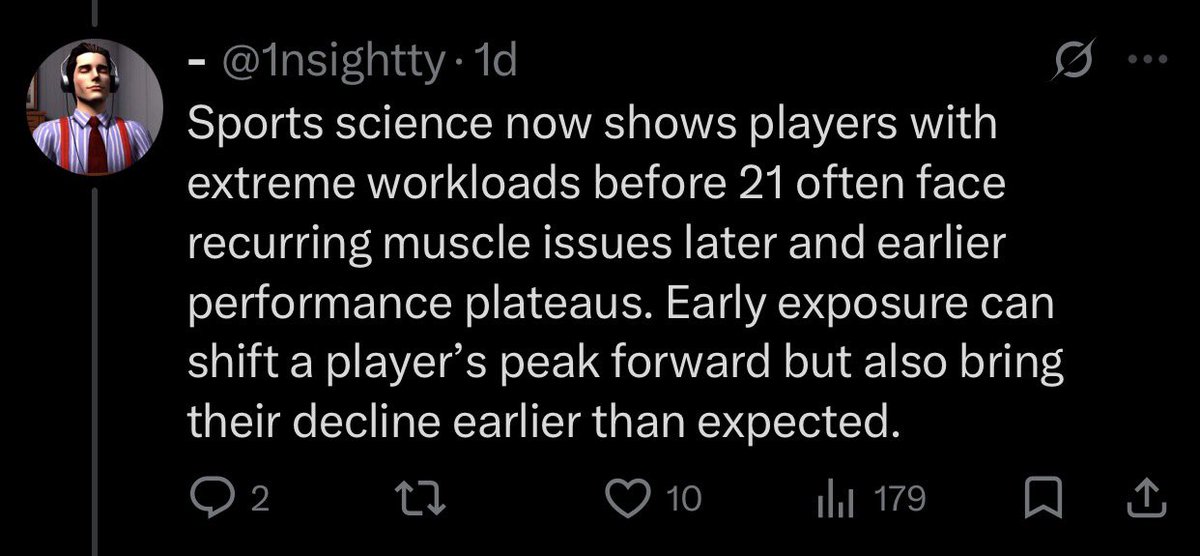
Sports science has been consistent on this. Higher cumulative loads at young ages, and specifically acute spikes in load, are linked with increased injury risk and burnout. On both the physical and psychological front. That’s not a fringe view or based on a handful of players, it’s a broader trend across multiple cohorts. We’ve even seen it within Liverpool itself. Even an outlier like Gerrard had growing pains early on and needed time for his body to adapt.
But more players do hit plateaus and recurring soft-tissue issues. Fowler, Owen, Bradley, Jones, Danns and Baj. A lot of them also fade earlier rather than sustain elite longevity into their early to mid-30s. Some don’t reach or sustain their expected peak levels. And even this idea of a fixed ‘peak age’ is an oversimplification of a nuanced topic.
So we then come back to survivorship bias. Long-career successes are naturally more visible. They’re exceptional, right? That doesn’t make them bad examples, but they are outliers. They represent what ‘great’ looks like, not what is typical outcome.
The good thing is tech is improving the picture. You’ll know this from your physio background. GPS tracking, AI load prediction, wellness monitoring, and smarter periodisation all help mitigate risk when used properly.
But they’re not bulletproof. They reduce risk, they do not eliminate it. It’s risk management, not risk elimination. Human variance will always play a part, genetics, age maturation, recovery, mentality, environment. It’s always multifactorial, not a single and rigid pathway to best or worst outcomes.
There isn’t a blanket approach of ‘never play them young’ or ‘load them up’. It’s individualised, data-informed management that factors the evidence while still building player resilience.
So it becomes long-term management versus short-term hype. Clubs will generally lean towards the former. That won’t fully eliminate risk, but it will improve how it’s managed.
So it’s really not about being right. It’s about not oversimplifying something that isn’t simple. It’s multifactorial.
English

@Jack_LFC_1892 You don’t think that a manager being liked by his club’s own fanbase is important?
English

@davethejuicegod @1nsightty If I could list some player who also started young and played an obscene amount of games in their career without injury issues that would cancel out your argument, right?
English

@CallumWright28 @1nsightty Plus they aren’t cherry picked, these are players who’ve got a high workload from a rlly young age as early as 17 that have suffered in there latter due to too much play time and responsibility. You can’t shoe horn kids into a team during a turbulent szn, it’s common sense.
English

@AlasdairMason Yeah and I’ve no idea who is listening is my point
English

‘Winning the war with Gary Neville’ sounds mad to me. I see people regularly talking about the Overlap, know loads of people who listen, and I haven’t got a clue on this one, wouldn’t even know what day it came out, never see anyone talking about it. Barely even aware it exists.
Ian Herbert@ianherbs
Inside Lineker, Shearer and Richards’ Netflix show which takes ‘The Rest is Football’ to New York 🎤 Two well-known reporters hired for 40 World Cup shows 📈 Why Netflix sought out the £14m Goalhanger deal 🇺🇸 Unanticipated benefit of Lineker leaving BBC dailymail.com/sport/football…
English

@NotSlotaClue @SeanDOlfc @onlyfooty22 @__olanre What should he have done in both those situations, out of interest?
English

@SeanDOlfc @onlyfooty22 @__olanre The mistake he made against Brentford was not saving it. He shouldn't be rushing out in either of those situations, hilarious nonsense.
English

@davethejuicegod @1nsightty I want the “sports science”. I’m interested in it, but I don’t think what he claims exists. Probably why he’s not answered.
English

@CallumWright28 @1nsightty I gave you real physical examples that make the statement true, what else do u want ?
English

@davethejuicegod @1nsightty He seems to be hiding from this.
English

@davethejuicegod @1nsightty He said “sports science now shows”. I want to see the science, not a list of cherry-picked players.
English

@HotPinkSupreme @NotSlotaClue You think that was good goalkeeping?
English

@HotPinkSupreme @NotSlotaClue 2nd. Schade has acres of space and the keeper retreats, giving him even more space and time.
English

@NotSlotaClue @HotPinkSupreme Same game he handed them a goal by moving back onto his line? Brentford away?
English

@HotPinkSupreme He made a ridiculous save in the Brentford game and should have saved the second goal. I can't think of any other errors he's made.
English

@NotSlotaClue I’d say his reluctance to come off his line can turn a chance into a big chance.
English