Angehefteter Tweet

The 21 Ecumenical Councils of the Catholic Church and Their Deliberations
“From debates about Christ’s divinity to battles over doctrine and Church authority, Christianity was never shaped in silence; it was defined in council.”
Across history, bishops gathered under the guidance of the Holy Spirit to clarify the faith, correct errors, and defend truth. These 21 Ecumenical Councils of the Catholic Church, from the First Council of Nicaea to the Second Vatican Council, shaped what Christians believe today.
This is the story of how the Church defined its faith one council at a time.
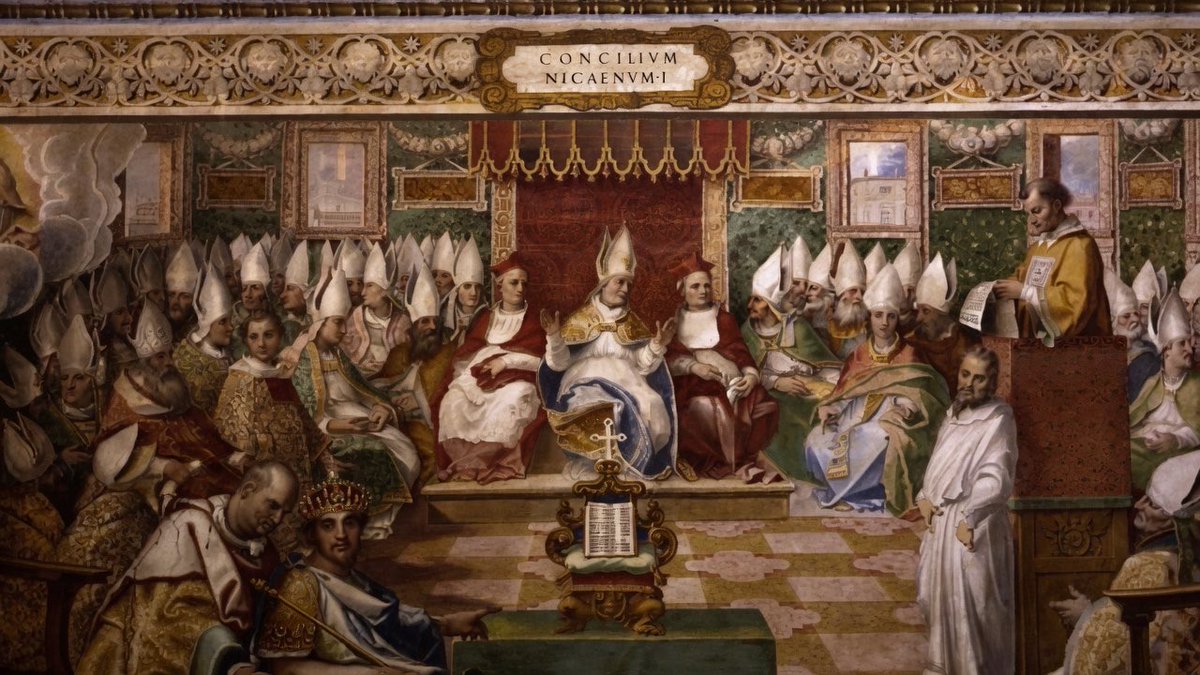
1. First Council of Nicaea (325)
Condemned Arianism and affirmed the divinity of Christ. Produced the Nicene Creed.
2. First Council of Constantinople (381)
Affirmed the divinity of the Holy Spirit and expanded the Nicene Creed.
3. Council of Ephesus (431)
Condemned Nestorianism and declared Mary as Theotokos (Mother of God).
4. Council of Chalcedon (451)
Defined Christ as one Person with two natures: divine and human.
5. Second Council of Constantinople (553)
Condemned the Three Chapters and defended Chalcedonian Christology.
6. Third Council of Constantinople (680–681)
Condemned Monothelitism and affirmed that Christ has two wills: divine and human.
7. Second Council of Nicaea (787)
Restored the veneration of icons and condemned Iconoclasm.
8. Fourth Council of Constantinople (869–870)
Addressed the Photian Schism and reaffirmed papal authority.
9. First Lateran Council (1123)
Confirmed the Concordat of Worms and addressed clerical discipline.
10. Second Lateran Council (1139)
Condemned schismatics and reformed Church discipline.
11. Third Lateran Council (1179)
Mandated a two-thirds majority for papal elections and addressed simony and clerical abuses.
12. Fourth Lateran Council (1215)
Defined Transubstantiation and required annual confession and Communion.
13. First Council of Lyon (1245)
Addressed Church reform and deposed Emperor Frederick II.
14. Second Council of Lyon (1274)
Sought reunion with the Eastern Church and discussed Purgatory and papal elections.
15. Council of Vienne (1311–1312)
Suppressed the Knights Templar and promoted Church reform.
16. Council of Constance (1414–1418)
Ended the Western Schism and condemned errors of Wycliffe and Hus.
17. Council of Basel-Ferrara-Florence (1431–1445)
Attempted reunion with Eastern Christians and defined doctrines concerning the Sacraments and Purgatory.
18. Fifth Lateran Council (1512–1517)
Addressed Church reform and condemned certain philosophical errors.
19. Council of Trent (1545–1563)
Responded to Protestantism and defined Scripture, Tradition, the Sacraments, and Justification.
20. First Vatican Council (1869–1870)
Declared Papal Infallibility and affirmed the primacy of the Pope.
21. Second Vatican Council (1962–1965)
Renewed the Church’s pastoral mission and addressed liturgy, ecumenism, evangelization, and the role of the laity.
Follow for more clear Catholic teaching, Church history, and apologetics.
English