Disruptive Digital
4.2K posts

Disruptive Digital
@DisrDigital
Staking is one of the newest ways of potentially profiting from the digital currency markets. Take part in the staking economy.
Romania Beigetreten Mayıs 2020
363 Folgt6.6K Follower

What stands out most is the network itself.
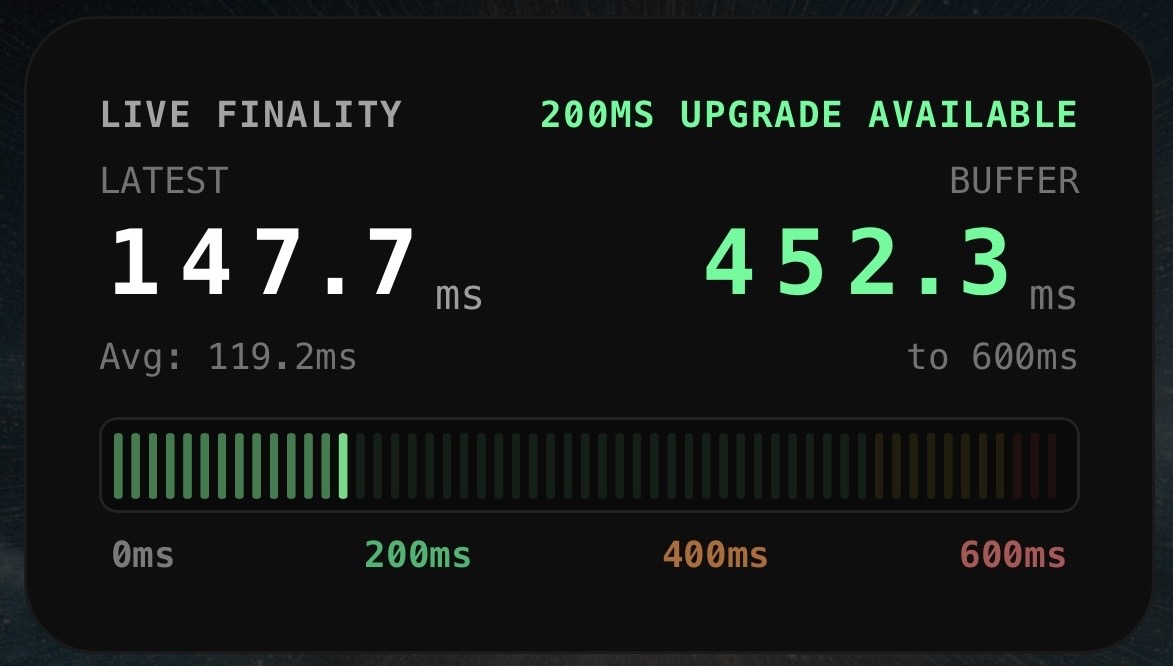
MultiversX Supernova is showing exactly why this architecture matters: consensus and execution decoupled, 600ms block times, sub-300ms finality, and the ability to push massive transaction volume without fees becoming absurd. A plain MoveBalance tx can cost as little as 0.00005 EGLD.
High throughput. Fast finality. Tiny cost. That’s a serious combo. ⚡🔥
@MultiversX
English

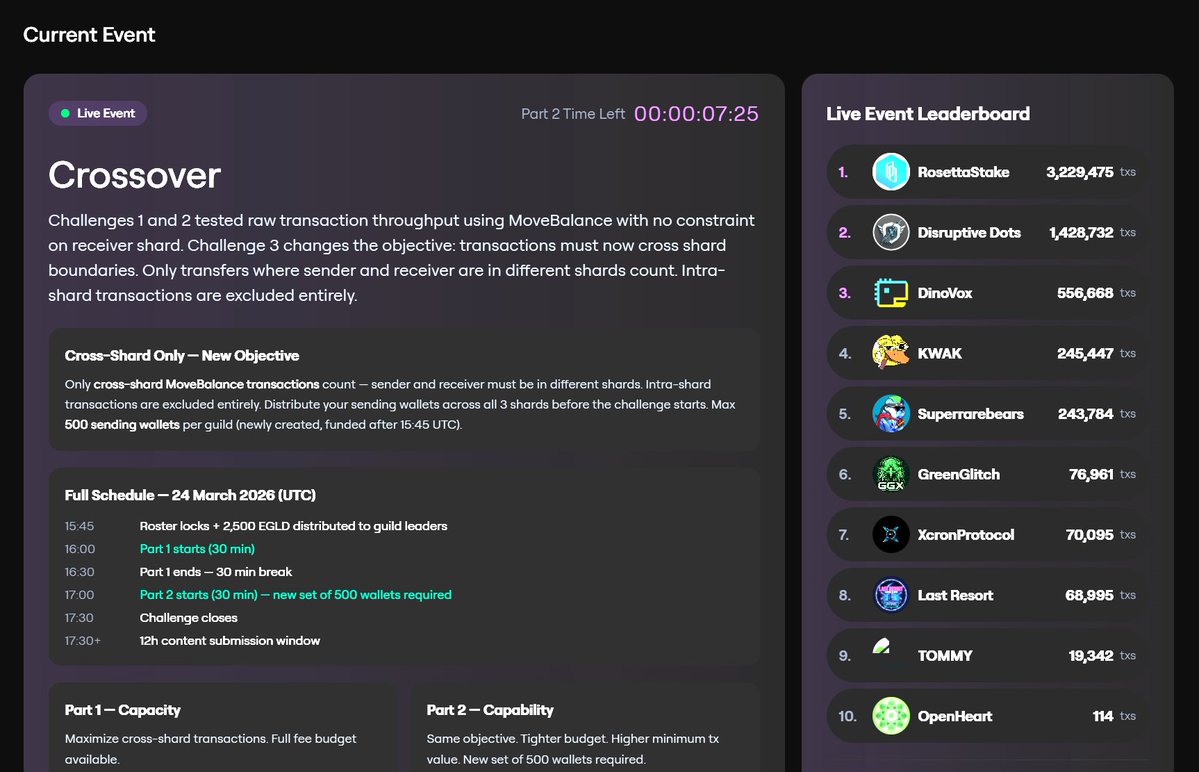
Last seconds of Crossover Part 2.
Disruptive Dots is holding #2 and closing fast on 2M txs.
Can we break it before the clock hits zero? ⚙️🔥
@MultiversX

English

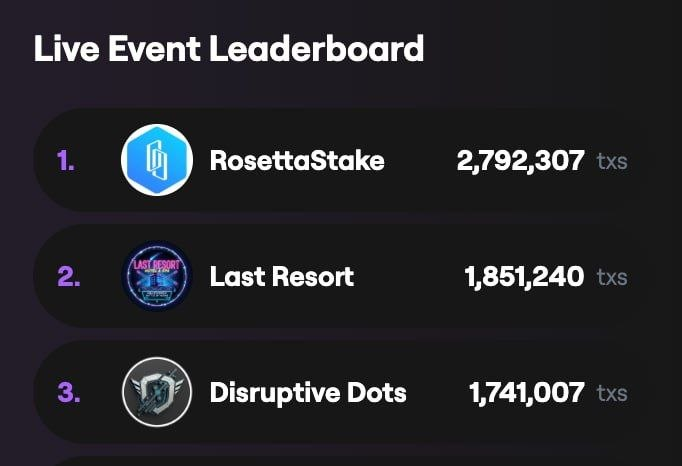
Challenge 3: Crossover - Part 1: Capacity
Disruptive Dots is back in the game.
Climbing back into the top of the leaderboard and keeping the pressure on.
Proud of what we’ve built. Calm, focused, and not done yet. ⚙️🔥
@MultiversX

English

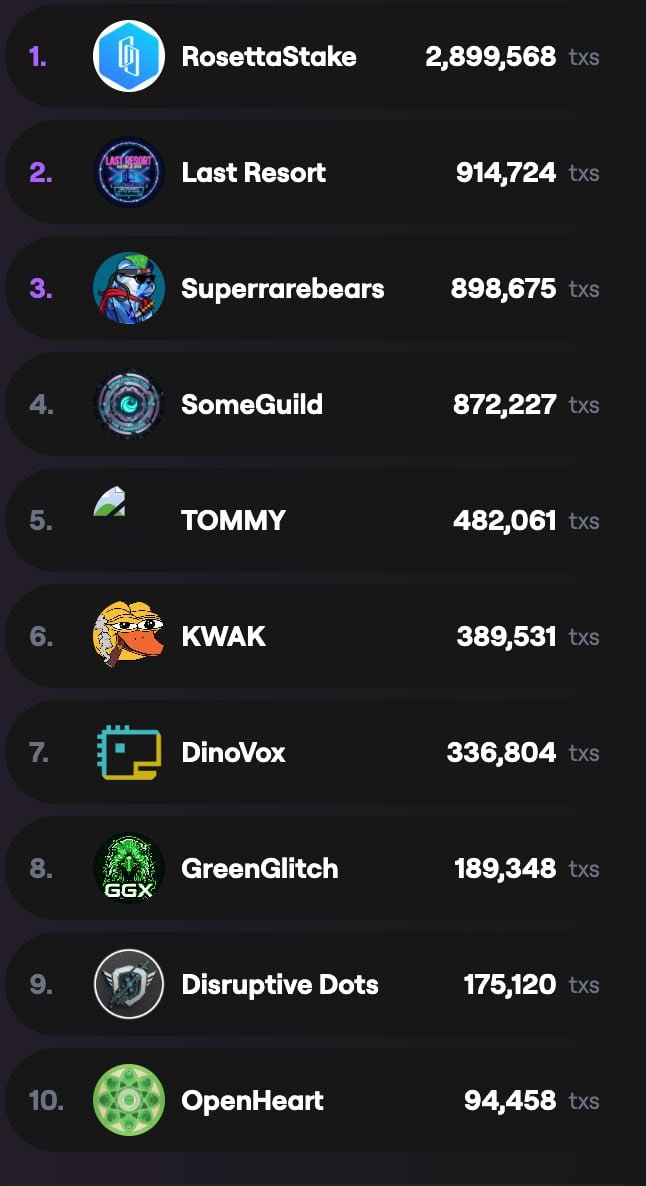
We’ve prepared a fully automated orchestrator that can run the Challenge #3 Crossover end-to-end on its own: fund wallets, fire cross-shard txs and stop exactly on schedule.
Now we let the script do the work. ⚙️🔥
@MultiversX

English
Disruptive Digital retweetet

The Battle of Nodes is entering its final stretch.
Guild Wars continue tomorrow with Challenge #3 at 4PM UTC.
CodeMultiversX@CodeMultiversX
Challenges 1 and 2 were about volume. Challenge 3 is about routing and radical optimization. Guilds, prepare for Challenge #3. 👇

English
Disruptive Digital retweetet

Supernova is live on Battle Net.
Here's what changed under the hood and why it matters.
The paradigm shift nobody's talking about:
Every blockchain in the industry is measured on two metrics: block time and throughput.
Faster blocks = better chain. More TPS = better chain.
----------
Supernova breaks this framing entirely.
For the first time in the blockchain industry, block finality is faster than block slot allocation.
Let me explain what that means.
How every other blockchain works:
Traditional blockchains follow Execute → Propose → Vote. Validators must execute every transaction before proposing a block.
The block slot is the clock. Finality can never be faster than the slot, because execution is in the critical path.
Ethereum: 12.8s slot, ~12.8 minutes finality.
Solana: 400-600ms slot, 13 seconds finality.
Sui: variable, ~500 to 1000 ms for complex transactions.
In every case: finality ≥ block slot. This is treated as a law of physics.
It's not.
----------
How Supernova works:
We flipped the model to Propose/Vote → then Execute.
Consensus proceeds independently of execution. Validators agree on transaction ordering first. Execution results are notarized in subsequent block headers via inclusion proofs.
The inclusion proof is the key innovation: it allows a block to be finalized with cryptographic proof that its transactions will execute correctly, before the execution itself completes.
The virtual state tracker in the transaction pool maintains a deterministic view of account states (nonces, balances, pending transactions) so consensus can validate without waiting for full execution.
Result: the block is finalized faster than the block round itself.
88ms finality measured in testing. Sub-200ms under real-world conditions. On 600ms block slots.
Finality < block slot. First time in the industry.
----------
The throughput story:
With the same hardware specification as pre-Supernova mainnet, the network now achieves ~120,000 transactions per second in burst mode. Same nodes. Same machines. 10x the block production cadence.
This is the same validator infrastructure running fundamentally better software.
The backpressure system (Execution-Result Inclusion Estimator) ensures this scales safely - dynamically adjusting per-block gas limits if execution lags behind proposals, so minimum-spec nodes never get overwhelmed.
What this means in context:
- Block time: 6s → 600ms (10x)
- Finality: ~88ms measured (first blockchain where finality < slot time)
- Throughput: ~120,000 TPS burst mode (same hardware)
- Architecture: consensus fully decoupled from execution
- Sharding: 3 execution shards + metachain, fully preserved
- Validators: 3,200+ nodes, no hardware upgrade required
----------
Battle of Nodes is stress-testing all of this right now. $150K in prizes to find what breaks. Validators, security researchers, builders, and guilds pushing the limits.
If Supernova survives this, it ships to mainnet.
150,000 lines of new protocol code. 20 months of engineering. The most significant upgrade since genesis.

English
Disruptive Digital retweetet