BadakBerenang

9K posts

BadakBerenang banner
BadakBerenang

BadakBerenang

@FudFuudd

when we all fall asleep where do we go

Beigetreten Nisan 2013
462 Folgt563 Follower
Angehefteter Tweet
BadakBerenang
BadakBerenang@FudFuudd·
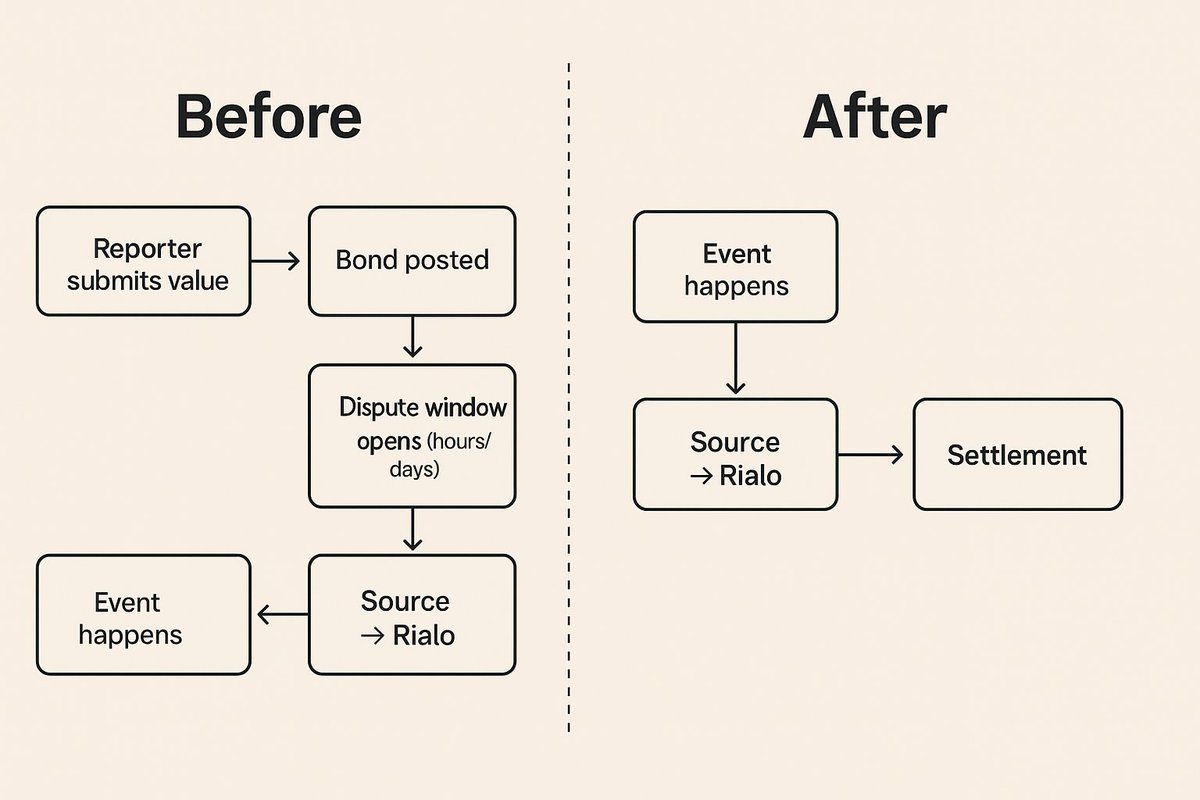
Prediction markets fail because oracles fail. Aggregation oracles give slow data. Optimistic oracles stay attackable. Rialo removes all middleware, including oracles. You pull truth directly from the source. Source to Rialo to final settlement.
BadakBerenang tweet media
English
29
1
57
779
MD. Khalid
MD. Khalid@mdkhalid768·
How do you bring Private Credit onchain? Not by tokenizing it but by verifying it. Here what I learned from @RialoHQ The Real Problem Turning loans into tokens is easy. But answering this is hard: • Is the borrower actually compliant? • Is the financial data correct? • Can smart contracts trust this data? Most systems can’t verify real-world truth Why Current Systems Fail Today model depends on intermediaries Borrower → Oracle / Middleman → Smart Contract Problems: • Data can be delayed or incorrect • Intermediaries have incentives & control • No transparent verification • Risk of wrong actions (like liquidations) This creates a verification gap The Missing Piece: Determination Layer What’s needed is not just data It’s verified decisions A system that can: • Evaluate real-world financial data • Check loan conditions • Produce a result smart contracts can trust This is the Determination Layer How Rialo Solves This Rialo introduces a new model 1. Native Data Access No more waiting for oracles. Smart contracts can directly access • Bank APIs • ERP systems • Accounting data Data comes from the source not intermediaries 2. Confidential + Verifiable Computation Using REX (Rialo Extended Execution) • Data stays private • Computation happens securely (MPC / FHE / TEE) • Outputs come with cryptographic proof Trust is replaced by verification 3. Accurate Credit Logic Encoding Real-world credit is complex • Covenants • Ratios • Conditional rules Rialo enables ✔️ Precise encoding of real agreements ✔️ Deterministic execution No oversimplification The New Flow Real-world data → Verified computation (REX) → Cryptographic proof → Smart contract execution ✔️ No middleman ✔️ No blind trust ✔️ No ambiguity Why This Matters This unlocks • Onchain private credit markets • Automated lending workflows • Transparent + fair execution • Real DeFi connected to real data Big Insight The future of onchain finance isn’t just about moving value It’s about verifying reality before value moves. One Line Rialo isn’t just bringing credit onchain it’s bringing truth onchain. Get Real. Get Rialo. @RialoIndian @JEAMSETH07
MD. Khalid tweet media
English
5
0
10
34
BadakBerenang
BadakBerenang@FudFuudd·
@kentwoodsahpu Over collateralization is so mid. Rialo’s async/await is the glow up DeFi actually needs.
English
0
0
0
2
BadakBerenang
BadakBerenang@FudFuudd·
@cryptocymol Using MPC on a trusted server is literally just Web2 with extra steps. REX is cracked.
English
0
0
0
3
Cimol
Cimol@cryptocymol·
everybody obsesses over the primitive but misses the pipeline ppl throw around mpc and fhe like magic words, but if ur orchestration layer is just a trusted server, u basically built a web2 backend with worse latency. the actual hard part is routing the encrypted state and proving the execution happened exactly as agreed without trusting whoever's passing the messages seeing rex handle the coordination side instead of just shipping another pure cryptography whitepaper is a solid shift. building the discovery and routing protocol is where the real alignment happens infra only matters when it bridges the gap between theory and execution @RialoHQ @itachee_x @ericargent31113
Cimol tweet media
Rialo@RialoHQ

MPC. FHE. TEEs. All powerful on their own, but none solve the coordination problem. The hard part isn’t just encrypting computation; it’s the orchestration required to make it functional and secure. That’s what Rialo Extended Execution (REX) does. REX is a protocol-level orchestration system for confidential computation that manages the entire lifecycle of a secure request: Program Governance – Programs to be executed are verified and approved for specific execution runs before they ever touch the core. Encrypted Routing – Encrypted inputs are routed cryptographically to a computation core only after the appropriate program logic is loaded. Explicit Consent – Computation is performed only after explicit authorization from both the application and the user, enforced by strict policy. Confidential Compute Core – Secure execution using MPC, FHE, or TEEs, including protected Web2 API calls within an isolated environment. Verifiable Outputs – The system generates and verifies cryptographic attestations that prove a specific computation was correctly executed before routing the result to its destination. REX transforms Rialo into infrastructure for real-world secure computation: Private AI agents that process personal data without seeing it. Sensitive enterprise workflows that maintain competitive secrecy. Authenticated API automation for secure, off-chain interactions. Verifiable off-chain compute with immutable on-chain guarantees. This is native privacy at the protocol layer. Get Real. Get Rialo.

English
9
0
11
84
Rialo
Rialo@RialoHQ·
The future of institutional finance isn’t a patchwork of oracles and bridges, it’s a unified stack. The @RialoHQ team is at #DAS2026 in NYC all week. We’re here to show how our verification driven stack brings speed, privacy, and real-world connectivity to the industry. Spot the team (@itachee_x, @BobbyZagotta, @curiouskendre, @soumeya, and @0xChanglu) at an event or DM to link up!
English
46
23
105
1.2K
oyenmoyenn
oyenmoyenn@moyenmoyen28284·
Professional Analysis: Traditional Private Credit vs. Decentralized Finance (DeFi) Solutions Market Intelligence: The Private Credit Fracture & DeFi Transition Warning Signs in the Private Credit Sector The $2 trillion private credit market is showing significant instability in early 2026. Major institutional players including Blackstone (BCRED) and BlackRock (HLEND)have been forced to implement redemption gates or provide emergency capital injections to manage surging withdrawal requests. Key metrics of this decline include: Elevated Default Rates: Reaching 9% in high-risk sectors. NAV Discounts: Business Development Companies (BDCs) are trading at a 20% discount relative to their Net Asset Value signaling deep market skepticism regarding asset quality. Structural Instability: The Rules Problem The traditional system s failure is rooted in opacity and unilateral discretion. Fund managers maintain the power to abruptly alter redemption terms, effectively locking investor capital. This environment is characterized by high intermediary costs and a fundamental misalignment of incentives between managers and participants. The DeFi Pivot: On-Chain Credit Automation Blockchain proponents suggest utilizing smart contracts to replace human discretion with code: Immutable Transparency: Withdrawal rules, collateralization ratios and distribution logic are programmed permanently on chain. Trustless Efficiency: By removing intermediaries the system minimizes operational overhead and reduces reliance on centralized institutions. The Critical Bottleneck: The Truth Problem While smart contracts are excellent at executing rules, they suffer from a real-world awareness gap. To determine a borrower s health the contract requires accurate financial metrics (e.g EBITDA or Interest Coverage Ratios). Ensuring that this off-chain data is verified and accurate at the point of ingestion remains the most significant hurdle for decentralized credit. Strategic Context (Essential Briefing) To fully contextualize these shifts, the following factors are critical: The Oracle Problem: On-chain private credit is only as secure as its data source. Without decentralized manipulation-resistant Oracles the system remains vulnerable to fraudulent data input. The RWA Narrative: This movement, known as Real-World Assets (RWA), is currently led by protocols like Centrifuge and Maple Finance, which serve as the bridge between physical assets and the blockchain. The Legal Wrapper Gap: Technology can automate internal logic but it cannot yet automate the physical seizure of collateral. Enforcing a default on a physical asset still requires traditional and often slow legal intervention. Borrower Fundamentals: Shifting a loan to a blockchain does not improve a borrower’s ability to pay. In a high-interest environment the primary risk is business failure which no technology can fully mitigate. @RialoH @RialoIDN
oyenmoyenn tweet media
English
4
0
8
41
BadakBerenang
BadakBerenang@FudFuudd·
@bjdrst Big brain analogy with the automatic door! Most people think tokenization is the finish line, but it’s just the start.
English
0
0
0
5
BadakBerenang retweetet
Rialo
Rialo@RialoHQ·
Smart contract enforcement fixes the rules, but it doesn’t fix the truth. We need a determination layer that bridges the verification gap while keeping inputs private. @soumeya from Subzero shared a writeup on the complexities of bringing private credit on chain.
Soumeya Benghanem@soumeya

x.com/i/article/2030…

English
73
75
352
20.9K
BadakBerenang
BadakBerenang@FudFuudd·
@0xyappp Hot swapping a blockchain’s heart with zero downtime is absolute wizardry. Gauss is cracked.
English
0
0
0
5
yappp
yappp@0xyappp·
If blockchain is like a massive machine that must always be running, then consensus is its heart. The problem? In many BFT systems today, replacing that “heart” isn’t a simple upgrade, but a massive, complicated, and costly undertaking that often causes downtime. Worse still, simply replacing the validator set can disrupt the entire network. This is where @RialoHQ comes in with a different approach through Gauss. It’s not just an improvement, but a complete overhaul of how we think about consensus: not something rigid, but something that can be changed at any time without shutting down the system. Gauss introduces a simple yet powerful idea: separating the “inner log” (the internal consensus process) from the “outer log,” which is clean and ready for use by nodes. With this separation, the inner part can change without disrupting the outer part. The result? Upgrades become flexible, modular, and far more secure. This means we can now change the consensus protocol, adjust the number of validators, or even reconfigure fault tolerance without pausing the network no downtime, no chaos. This is incredibly important, because until now, much research on consensus has barely touched on reconfiguration. Even when it does, it’s usually too tied to a single algorithm, making upgrades expensive and inflexible. Gauss flips that on its head. It treats the consensus protocol like a plug-and-play module. This approach makes the SMR (state machine replication) architecture more modular, more maintainable, and ready to evolve without limits. This isn’t just theory, from initial evaluations on the @RialoHQ blockchain, this approach has proven capable of enabling seamless system evolution, even when switching between different protocol implementations. The future of blockchain isn’t about finding the single “best” consensus, but about having a system that can continuously adapt, without ever stopping.
yappp tweet media
English
13
0
19
185
Phantom
Phantom@phantom·
BUILD BUILD BUILD
English
822
237
2.3K
98.5K
kiw
kiw@notkiws·
Encoding rules onchain does not solve verification. Private credit runs on messy data, custom covenants, and judgment calls. If the inputs are controlled, the system is still trust based even with smart contracts. @RialoHQ moves closer to a model where data ingestion, evaluation, and execution are handled natively, so outcomes can be verified instead of assumed.
Soumeya Benghanem@soumeya

x.com/i/article/2030…

English
2
0
3
56
BadakBerenang
BadakBerenang@FudFuudd·
Rialo is a Real World Layer 1 built for sophisticated execution. If you are ready to build the future of asynchronous applications, check the full tutorial and interactive demos on Rialo Learn.
English
1
0
0
6
BadakBerenang
BadakBerenang@FudFuudd·
This unlocks applications that were previously impossible. Undercollateralized loans using real-world FICO scores. Real-time on-chain compliance. Direct TradFi-to-chain payment rails. The design space for DeFi has just expanded significantly.
English
1
0
1
11
BadakBerenang
BadakBerenang@FudFuudd·
Typical blockchain transactions are trapped in the atomic age. Current models require every action to execute in a single block or fail entirely. This constraint kills the potential for complex applications. @RialoHQ is changing the game with native async transactions.
BadakBerenang tweet media
Rialo@RialoHQ

x.com/i/article/2031…

English
7
0
8
48
Cimol
Cimol@cryptocymol·
Current blockchain upgrades usually mean brutal downtime and impossible coordination math. Swapping the entire validator set instantly breaks most live networks @RialoHQ fixed this headache using their new Gauss engine. The tech enables hot-swapping entire consensus protocols and validator committees with zero network interruptions It works by separating the internal dirty consensus log from a sanitized outer log. Their accepted academic paper proves it works, read it here arxiv.org/abs/2602.09441 This is a massive step toward blockchains that evolve over time without hard forks. Reply below if you think modular consensus is the future standard
Cimol tweet media
English
8
1
13
99
BadakBerenang
BadakBerenang@FudFuudd·
@Szaonly666 Provable execution is the real flex. Privacy without receipts is just a trust me bro.
English
1
0
1
13
SZA (❖,❖)
SZA (❖,❖)@Szaonly666·
MPC, FHE, TEEs are powerful But they don’t solve coordination. Encrypting computation is easy Orchestrating it securely is the hard part. That’s what Rialo Extended Execution (REX) does, a protocol level orchestration system that manages the full lifecycle of confidential computation. Programs are verified before execution, inputs are encrypted and routed securely, and computation only runs with explicit user and application consent. Inside the confidential compute core, MPC, FHE, or TEEs execute logic in isolation, including secure Web2 API calls. Every result is backed by cryptographic proof, so validators can independently verify that execution happened correctly. This isn’t just privacy, this is verifiable, real world computation onchain. Private AI agents, secure enterprise workflows, authenticated API automation, all running without exposing sensitive data. No guesswork, no blind trust, just provable execution. Get real Get @RialoHQ
Rialo@RialoHQ

MPC. FHE. TEEs. All powerful on their own, but none solve the coordination problem. The hard part isn’t just encrypting computation; it’s the orchestration required to make it functional and secure. That’s what Rialo Extended Execution (REX) does. REX is a protocol-level orchestration system for confidential computation that manages the entire lifecycle of a secure request: Program Governance – Programs to be executed are verified and approved for specific execution runs before they ever touch the core. Encrypted Routing – Encrypted inputs are routed cryptographically to a computation core only after the appropriate program logic is loaded. Explicit Consent – Computation is performed only after explicit authorization from both the application and the user, enforced by strict policy. Confidential Compute Core – Secure execution using MPC, FHE, or TEEs, including protected Web2 API calls within an isolated environment. Verifiable Outputs – The system generates and verifies cryptographic attestations that prove a specific computation was correctly executed before routing the result to its destination. REX transforms Rialo into infrastructure for real-world secure computation: Private AI agents that process personal data without seeing it. Sensitive enterprise workflows that maintain competitive secrecy. Authenticated API automation for secure, off-chain interactions. Verifiable off-chain compute with immutable on-chain guarantees. This is native privacy at the protocol layer. Get Real. Get Rialo.

English
4
0
20
263