Geronimo analysis

3.7K posts

Geronimo analysis banner
Geronimo analysis

Geronimo analysis

@GeronimoBandit

current events, geopolitics, analysis. conflict

City of London, London Beigetreten Nisan 2013
189 Folgt168 Follower
Geronimo analysis
Geronimo analysis@GeronimoBandit·
Quiet but undeniably powerful military signal rippled across the Persian Gulf this week as aircraft from the Pakistan Air Force (PAF) touched down on Saudi Arabia’s eastern coastline. This deployment, occurring at the height of the U.S.-Iran naval blockade crisis, marks a potential watershed moment in Middle Eastern geopolitics. As the traditional American security umbrella faces its most grueling test in decades, the Kingdom of Riyadh appears to be pivoting toward a “diversified regional security partnership” that includes elite Muslim military forces and advanced technology from its long-time ally, Pakistan. The New Shield: Pakistani Jets at King Abdulaziz Air Base The arrival of the Pakistani contingent at King Abdulaziz Air Base—a strategic facility in the heart of the Saudi oil-producing eastern province—sends a sophisticated message to both friend and foe. Officially, the deployment falls under a mutual assistance pact between the two nations. However, analysts suggest the timing is a masterstroke of “diplomatic sophistication.” By positioning Pakistani jets near its energy infrastructure, Saudi Arabia has fundamentally altered Iran’s targeting calculus. Iran, which has been engaged in a tense mediation process hosted by Islamabad, must now consider the risk of accidentally striking the assets of the very nation trying to broker peace. “Iran must now factor Pakistani aircraft into its targeting,” notes Muhammad Faisal of the University of Technology Sydney. This presence acts as a “peacekeeping” deterrent, shielding oil fields while the “peacemaking” diplomatic track continues. Cracks in the Umbrella: Rethinking the U.S. Presence Perhaps more shocking is the underlying message to Washington. For decades, the Gulf monarchies have relied almost exclusively on the U.S. military for protection. Yet, recent weeks of high-intensity conflict have exposed critical vulnerabilities. Despite the presence of thousands of U.S. troops and high-tech bases, Gulf energy facilities have suffered immense damage from Iranian strikes. There is a growing sentiment across Gulf capitals that the U.S. naval blockade, while intended to pressure Tehran, is instead provoking a wider war that puts local economies at risk. Reports from the Wall Street Journal suggest that Saudi officials are quietly urging the Trump administration to reconsider the blockade and return to negotiations. The fear is that a cornered Iran will retaliate not at the Strait of Hormuz—which is heavily policed by 15 U.S. warships—but at the Bab Al-Mandeb strait in the Red Sea, using its Houthi allies in Yemen to shut down the Kingdom’s “back door” for oil exports. The “Two-Door” Crisis: Hormuz and Bab Al-Mandeb The crisis has evolved into a logistical nightmare for global energy. With the Strait of Hormuz effectively turned into a “geopolitical chokehold,” Saudi Arabia has been rerouting up to 7 million barrels of oil per day across the desert to Red Sea terminals. This recovery hinges entirely on the Bab Al-Mandeb corridor remaining open. Tehran has been quick to amplify these fears. Statements from senior Iranian officials and the Tasnim news agency have implied that the “world’s energy arteries” could be disrupted with a single signal, effectively threatening to close both of the region’s sea doors at once. With oil prices hovering near $100 per barrel, the standoff has revealed how deeply the global economy depends on maritime calm—and how fragile that calm has become. A Future Beyond Washington? The Saudi-Pakistan model of defense cooperation is being watched closely by other Gulf states. Analysts from the Gulf International Forum suggest this could inspire a regional shift away from exclusive dependence on Washington toward more localized, “Muslim-led” security architectures. While the White House remains steadfast, claiming the naval cordon is necessary to force Iran back to the table, the regional reality on the ground is changing.
English
0
0
0
15
Geronimo analysis
Geronimo analysis@GeronimoBandit·
@0Calamity Tel aviv Tommy Robinson pahalvi is sleeping with the Colombian narco.
English
0
0
0
18
Geronimo analysis
Geronimo analysis@GeronimoBandit·
@sadafzbaloch Pakistanis are offered money and foreign alcohol, in return Pakistanis must show loyalty.
English
0
0
0
94
Sadaf Baloch
Sadaf Baloch@sadafzbaloch·
🚨 Big diplomatic news: Donald Trump has huge trust in Pakistan’s Field Marshal Asim Munir that’s why US-India relations are cooling down. Trump has assured Pakistan he will help resolve the Kashmir issue, and Trump now sees Pakistan’s government as a key ally. In the Iran US conflict, both America and Iran fully trust Pakistan as mediator. Right now, Pakistan has good relations with almost every country in the world. This is being called the best diplomatic period in Pakistan’s history
Sadaf Baloch tweet mediaSadaf Baloch tweet media
English
19
58
381
14.1K
Geronimo analysis
Geronimo analysis@GeronimoBandit·
@aleksthgrt Arab regimes are part of the greater Israel project. Arab societies have also accepted that. They are watching the genocide in gaza happen next door to them and are silent.
English
0
0
3
80
Aleksey The Great 🇷🇺🎖
🚨BREAKING NEWS Iranian Deputy Foreign Minister Saeed Khatibzadeh: The Israeli regime wanted to have the Greater Israel project and change the geopolitics of the region. This defense by Iran is being done on behalf of the entire region.
English
4
240
1.4K
13.2K
Geronimo analysis
Geronimo analysis@GeronimoBandit·
@ValentinaForUSA First clean that white powder from your nose. Go learn English. Who is tel aviv Tommy Robinson pahalvi pimping you to?
English
0
0
134
2.4K
Valentina Gomez
Valentina Gomez@ValentinaForUSA·
England, see you SOON🏴󠁧󠁢󠁥󠁮󠁧󠁿 May 16th. England will be ENGLISH again.
English
927
2.4K
15.9K
1.2M
Sulaiman Ahmed
Sulaiman Ahmed@ShaykhSulaiman·
NEWS: Lebanon President Aoun: Today, we negotiate for ourselves and decide for ourselves. We are no longer a card in anyone's pocket, nor a battlefield for anyone's wars, and we will never be again.
English
331
160
997
98.5K
Geronimo analysis
Geronimo analysis@GeronimoBandit·
You Made Deals With The Devil—Now You Want Land Back? Since Israel took over the Syrian half of the Golan Heights, Jolani’s forces have not fired a single bullet toward Israel. Not one. Instead, his forces have been busy attacking Shia, Alawites, Christians, Druze, and Kurds. So the question stands: How exactly is he planning to take land from Israel? Because you don’t recover territory through speeches and backdoor agreements—especially not after aligning with Washington, D.C. and regional powers. Taken in War. Held by Force. Never Returned. Syria lost most of the Golan Heights in 1967 during the Six-Day War—not through negotiation, but through a rapid and decisive military defeat. Within just two days, June 9–10, Israeli forces captured roughly two-thirds of the plateau, fundamentally shifting the balance of power in the region. In 1973, Syria attempted to reverse that loss during the Yom Kippur War. While they made early gains, the momentum did not last. Israel regrouped, launched a counteroffensive, and pushed even deeper into Syrian territory before a ceasefire was reached in 1974. From that point forward, the situation never reset. Israel did not withdraw, did not relinquish control, and did not reverse its position. The outcome has remained unchanged ever since—the land was taken in war, defended in war, and has been held continuously without interruption. Power Vacuum Exploited By Israel: Expansion Was the Plan All Along Now fast forward. After Assad was overthrown by Jolani forces—backed by Turkey, the U.S., and Gulf states, including Israel with outcomes that indirectly benefited Israel—the situation didn’t stabilize. It shifted. Israel didn’t pause. Israel expanded. It moved into the remaining territories and tightened control across key strategic zones. The expansion wasn’t random—it was targeted, layered, and deliberate: * The UN buffer zone (Area of Separation) was taken over, removing a long-standing demilitarized barrier. * The Syrian side of Mount Hermon was secured, giving a dominant surveillance advantage deep into Syrian territory. * Quneitra and its surrounding villages were occupied, extending ground presence across populated areas. * Strategic towns like Madinat al-Salam, Khan Arnabah, and Ma’ariya were captured, reinforcing control over movement corridors. * Critical infrastructure, including Al-Wehda Dam, came under control—tightening grip over water and regional resources. * Advances pushed deeper into southern Syria, reaching parts of Daraa and Qatana, extending influence well beyond previously held lines. This was not defensive positioning. This was calculated expansion—taking advantage of collapse, consolidating control, and reshaping the map in real time. On April 16, 2026, Israel approved a massive development plan for the Golan Heights. This isn’t symbolic—it’s structural. Katzrin is being transformed into a full city, thousands of new families are being moved in by 2030, and infrastructure, education, and economic systems are being expanded to lock in long-term presence. At the same time, agricultural land and critical water resources—forming a major share of Israel’s freshwater supply—are being fully utilized. That is not temporary occupation. That is long-term integration. Call it what it is: land consolidation. The United States recognized Israeli sovereignty over the Golan in 2019, but the United Nations and most of the international community still consider it occupied Syrian territory. So there is a legal dispute on paper, but on the ground, control is being deepened, not reversed. So again—what exactly is Jolani talking about? Yes, he is from the Golan. There may be emotional attachment. But reality doesn’t bend to sentiment. You don’t make deals with global powers, help dismantle your own state structure, and avoid confronting the occupying force—then expect that same force to hand land back to you. That’s not strategy. That’s fantasy.
English
0
0
0
26
Geronimo analysis
Geronimo analysis@GeronimoBandit·
🇮🇷 IRAN OPENS THE STRAIT OF HORMUZ TO SHIPS – BUT WITH SPECIAL CONDITIONS! News today from Tehran! Iran's Foreign Minister, Abbas Araghchi, has officially announced that the Strait of Hormuz will be open to commercial ships for the remaining period of the ceasefire. But make no mistake – this is not the "freedom of passage" that existed before the war. According to Araghchi's statement on X: 01. Commercial ships will be allowed to pass through the Strait of Hormuz. 02. However, passage will be under "coordinated routes" – meaning under Iran's terms and control. 03. This decision is tied to the ceasefire in Lebanon. The ceasefire period between the US and Iran ends on April 22, 2026. So this is only a short window! This is where things get interesting. 01. Iran says: "The Strait is open to all ships – but on our terms. We are the gatekeeper." 02. The US says: "We have established a military blockade. Any ships heading to Iran will not be allowed." So, who really controls the Strait of Hormuz? The truth is that both sides claim victory, but in practice: · Ships heading to Gulf countries (UAE, Qatar, Saudi Arabia) are allowed passage by the US. · Ships heading to Iran are blocked by the US – but Iran says commercial ships can pass under its terms. This is a continuing "game of words and control" during the final days of the ceasefire. The date April 22, 2026, is very important because: (a) It marks the end of the two-week ceasefire between the US and Iran. (b) If no permanent agreement is reached by then, fighting could resume – and the Strait could be completely closed. (c) For now, commercial ships have a window to pass peacefully. But how many ships will be able to pass before that date? And who will decide? Araghchi clearly linked this decision to "the ceasefire in Lebanon." This is a sign that Iran sees Lebanon (and Hezbollah) as an essential part of the broader negotiations. Thus: 🇱🇧 If attacks on Lebanon stop, then 🇮🇷 the Strait of Hormuz is opened to ships. This shows that Iran is setting "package conditions" – you cannot get peace in one without the other.
Geronimo analysis tweet media
English
0
0
0
29
Ahmed Khalifa
Ahmed Khalifa@_A_khalifa·
Some idiots keep calling me Indian and saying I’m not Emirati 😂 Little do they know I actually love India and its people & their food is so good it ruins my diet every time😭 Go find a new hobby, geniuses 😂
Ahmed Khalifa tweet mediaAhmed Khalifa tweet media
English
257
207
2.4K
55.1K
Geronimo analysis
Geronimo analysis@GeronimoBandit·
Vali Nasr, former adviser to Obama: 🔹It has become very, very clear now to the Gulf countries that the United States will not defend them — neither against Israel nor against Iran. 🔹You cannot trust America. So you have to find other mechanisms. Billions, trillions wasted on over priced military equipment and paying the US for protection. Arabs are treated like camels.
English
0
0
1
16
Sulaiman Ahmed
Sulaiman Ahmed@ShaykhSulaiman·
BREAKING: TRUMP SAYS ARAB COUNTRIES WILL PAY FOR DAMAGES Reporter: Are you going to make the Arab countries pay? Trump: I think they are going to make that contribution.
English
57
296
1.2K
69.2K
Geronimo analysis
Geronimo analysis@GeronimoBandit·
During the Bosnian War (1992–1995), Iran was one of the most significant and early supporters of the Bosnian government. While the West maintained a strict arms embargo on the region, Iran stepped in to provide critical military, financial, and humanitarian aid to the beleaguered Bosniak (Bosnian Muslim) forces. Here is a breakdown of the nature and impact of that assistance: 1. Military Support and Arms Shipments Iran's military aid was vital because the Bosnian government was outgunned by Serbian forces who had inherited the heavy weaponry of the Yugoslav People's Army. * **The "Green Light":** In 1994, the Clinton administration famously gave a "no instructions" (silent approval) signal to Croatia to allow Iranian arms shipments to pass through its territory into Bosnia, effectively bypassing the UN embargo. * **Volume:** Iran shipped thousands of tons of weapons, including small arms, ammunition, anti-tank missiles, and communications equipment. * **IRGC Presence:** The **Islamic Revolutionary Guard Corps (IRGC)** sent hundreds of personnel to Bosnia. These experts acted as military advisors and trainers, helping turn a disorganized "rag-tag" defense force into a more professional army. 2. Intelligence and Special Operations Iran's involvement went beyond just hardware; they provided the "brain" for many operations. * **Intelligence Experts:** Dozens of Iranian intelligence officers integrated with the Bosnian Muslim intelligence agency. * **Elite Units:** Iranian instructors helped train elite Bosnian units in guerrilla warfare and sabotage. * **Hezbollah Involvement:** With Iranian backing, several dozen fighters from the Lebanese group Hezbollah also arrived to support the Bosnian forces. 3. Humanitarian and Cultural Aid While the military aid was the most controversial, Iran also provided extensive civilian support. * **Essential Supplies:** Iranian charities and government organizations sent food, medicine, and clothing to cities under siege, such as Sarajevo and Zenica. * **Diplomatic Solidarity:** Iran was one of the first countries to recognize Bosnia’s independence and used its position in the OIC (Organization of Islamic Cooperation) to lobby for the Bosniak cause. * **Cultural Centers:** During and immediately after the war, Iran established several cultural centers and schools to promote religious and educational ties. 4. Post-War Dynamics and the Dayton Accords The relationship cooled significantly following the **Dayton Accords (1995)**. * **Western Pressure:** The United States made its post-war aid and military training (the "Train and Equip" program) conditional on the expulsion of all foreign fighters and advisors. * **The 1996 Raid:** In a high-profile incident in 1996, NATO-led forces raided an Iranian-run training camp in **Pogorelica**, discovering evidence of terrorist training and surveillance equipment. * **Legacy:** While most Iranian military personnel left, Iran maintains a cultural and diplomatic presence in Bosnia today, though it is often overshadowed by the influence of the EU, Turkey, and Saudi Arabia. **Did you know?** Despite being a Shia-majority nation, Iran's support for the predominantly Sunni Bosniaks was seen as a strategic move to project leadership across the entire Islamic world, proving they would help any Muslim population in crisis regardless of sectarian lines.
English
0
0
0
10
Geronimo analysis
Geronimo analysis@GeronimoBandit·
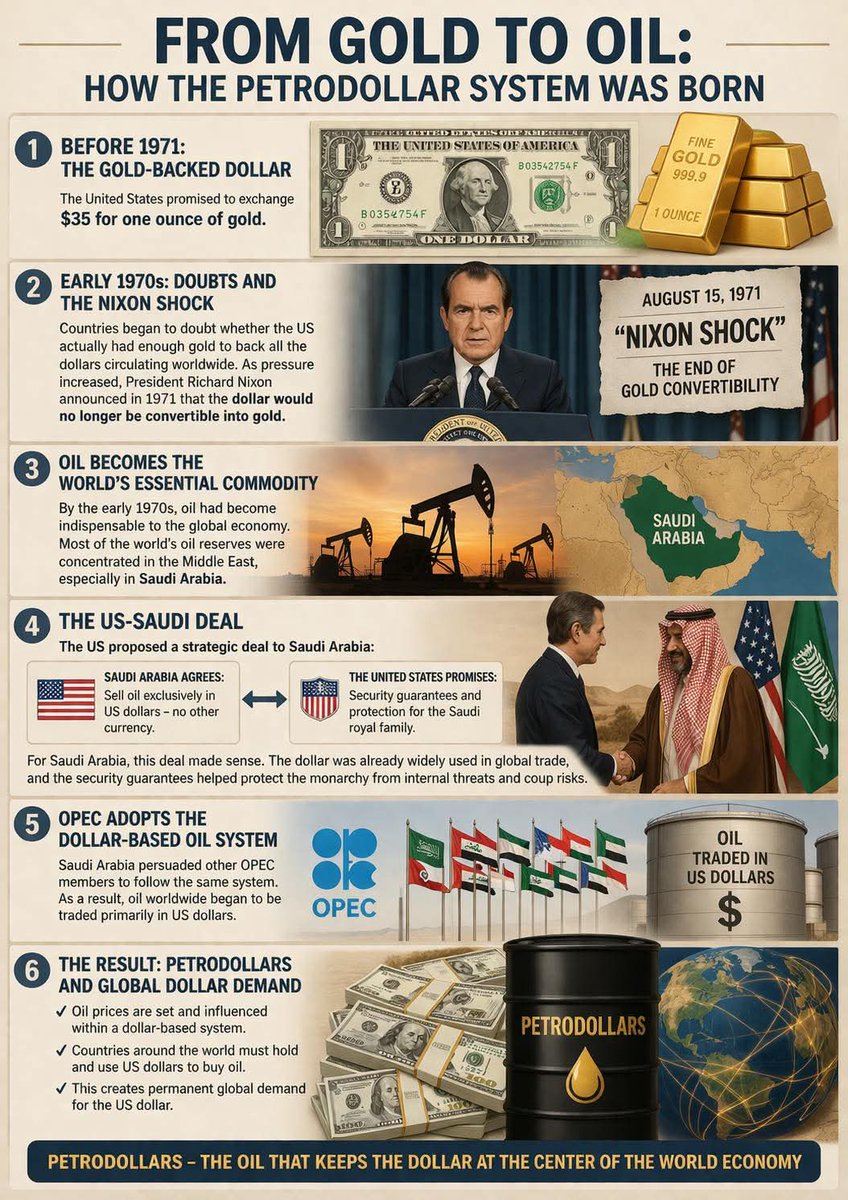
Before 1971, the US dollar was backed by gold. This meant the United States had promised to exchange $35 for one ounce of gold. But by the early 1970s, countries began to doubt whether the US actually had enough gold to match all the dollars circulating worldwide. As pressure increased, US President Richard Nixon announced in 1971 that the dollar would no longer be convertible into gold. This event is known as the Nixon Shock. At that point, the US realized that oil had become a universal commodity essential to the entire world. Most of the world’s oil reserves were concentrated in the Middle East, especially in Saudi Arabia. The US approached Saudi Arabia with a strategic proposal: any country that wanted to buy oil must pay only in US dollars—not in any other currency. In return, the US would provide security guarantees and protection. For Saudi Arabia’s royal family, this deal made sense. They faced internal threats like religious opposition and the risk of military coups. Agreeing to sell oil exclusively in dollars was not a major sacrifice, since the dollar was already widely used in global trade. Saudi Arabia accepted the deal and then persuaded other members of OPEC to follow the same system. As a result, oil worldwide began to be traded primarily in US dollars. This shift allowed oil prices to be influenced within this dollar-based system. More importantly, it created a permanent global demand for the US dollar. The dollars earned from selling oil came to be known as “petrodollars.”
Geronimo analysis tweet media
English
0
0
0
6
Geronimo analysis
Geronimo analysis@GeronimoBandit·
@ShaykhSulaiman What a prick this guy is. No-one should waste any time listen to this wasteman. The only thing the American military achieved in Iran is, blowing up buildings and infrastructure.
English
0
1
17
454
Sulaiman Ahmed
Sulaiman Ahmed@ShaykhSulaiman·
BREAKING: PETE HEGSETH SENDS A MESSAGE TO IRAN FROM THE PENTAGON "To IRGC leadership, we're watching you. Our capabilities are not the same, our military and yours. Remember, this is not a fair fight, and we know what military assets you are moving and where you are moving them to. You are digging out, which is exactly what you're doing digging out of bombed out and devastated facilities, and we are only getting stronger." "We are locked and loaded on your critical dual-use infrastructure, on your remaining power generation, and your energy industry. We'd rather not have to do it, we are ready to go at command of our president and the push of a button."
English
289
197
795
120.5K
Geronimo analysis
Geronimo analysis@GeronimoBandit·
@MarioNawfal Israel giving territory back? Is that a joke? Lebanon and syria are part of the greater Israel project. The regimes of those countries have already accepted the Israeli expansion.
English
0
0
1
24
Mario Nawfal
Mario Nawfal@MarioNawfal·
Iran is the reason Lebanon is at war and is invaded (thanks to Hezbollah) And Iran could be the reason Lebanon gets a ceasefire, and if lucky, eventually gets its territory back (depends on Iran-U.S negotiations) Politics is a game of Chess, and small countries are the pawns
English
202
35
484
47.8K
Terence Tendayi
Terence Tendayi@Zim4Israel·
I’m not Jewish, she is, and that’s enough. 🇿🇼🇮🇱
Terence Tendayi tweet mediaTerence Tendayi tweet media
English
865
167
3.1K
97.5K
Ahmed Khalifa
Ahmed Khalifa@_A_khalifa·
We real Arabs have zero issue living with Jews, Christians, or anyone else! They get full respect, they’re our dear friends. We’ve lived together peacefully for centuries. Let the extremists cry. This is the truth Dubai/UAE are the best proof!
English
1.8K
1.6K
10.1K
183.2K
Geronimo analysis
Geronimo analysis@GeronimoBandit·
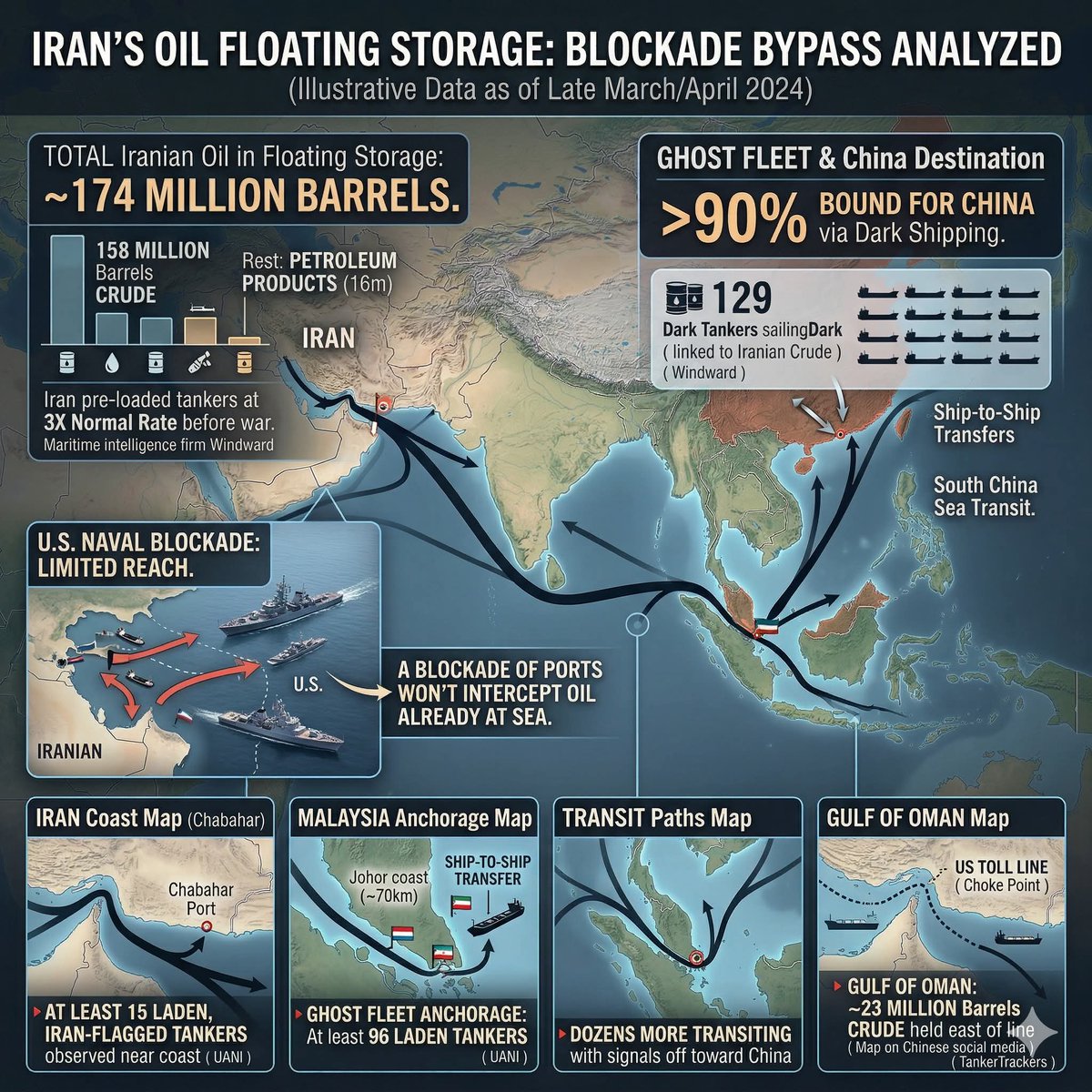
Iran Has ~174 Million Barrels of Oil in Floating Storage. A Blockade Won’t Touch It. Before the war began, Iran pre-loaded tankers at three times its normal export rate. As of late March, approximately 174 million barrels of Iranian oil sat in floating storage — 158 million barrels of crude, the rest in petroleum products, per maritime intelligence firm Windward. Over 90% is bound for China, carried largely by ghost fleet tankers running dark. 129 tankers linked to Iranian crude are currently sailing dark, Windward reported. A U.S. naval blockade of Iranian ports won’t intercept oil already at sea. Here’s where it’s located: 🔸 At least 15 Iran-flagged tankers were observed by satellite near Chabahar Port on Iran’s southeastern coast as of April 6, laden with crude, according to UANI, which tracks Iranian shipping. 🔸 At least 96 Iranian oil-laden tankers have been recorded at a ghost fleet anchorage approximately 70 km off Malaysia’s coast near Johor, UANI reported, where cargo is transferred ship-to-ship before heading to Chinese ports. 🔸 Dozens more are transiting the Malacca Strait and South China Sea toward China with tracking signals off. 🔸 Iran is also holding roughly 23 million barrels of crude east of the “US toll” line in the Gulf of Oman (a map circulating on Chinese social media)—according to TankerTrackers.
Geronimo analysis tweet media
English
0
0
0
22
Geronimo analysis
Geronimo analysis@GeronimoBandit·
If you look at the official economic data from the US Treasury, the Islamic Republic of Iran is functionally bankrupt. They are cut off from the SWIFT international banking system. They are under the most brutal, suffocating economic sanctions in human history. Technically speaking, it is illegal for them to sell a single drop of oil to the global market. And yet, heading into 2026, Iran managed to export an estimated $45 billion worth of crude oil. How does a bankrupt, heavily sanctioned country manage to fund a multi-front regional war and a massive ballistic missile program in cash? They built the ultimate macroeconomic loophole: The Ghost Fleet. Right now, there is an invisible armada of roughly 500 to 600 aging oil tankers floating in the world's oceans. These ships don't fly the Iranian flag. They use complex, opaque ownership structures hidden in offshore shell companies. When these ships load Iranian oil, they turn off their AIS tracking transponders—essentially going completely dark on global maritime radar. They sail to specific anchorages—often off the coast of Malaysia—and conduct highly illegal, mid-ocean "Ship-to-Ship" (STS) transfers. They pump millions of barrels of crude from the dark ship into a clean ship, completely laundering the origin of the oil. But who is buying it? China. Specifically, China's independent, privately-owned "teapot" refineries. By the end of 2025, China was absorbing an estimated 90% of all Iranian oil exports. And here is the most terrifying part for Western economists: This entire $45 billion shadow trade happens completely outside the US Dollar system. Because these Chinese refineries pay in Yuan (or through bartered goods), and the transactions are cleared through regional banks that have zero exposure to Wall Street, the United States has absolutely no leverage to block the payments. Sanctions only work if the target nation relies on your currency to survive. The current Middle East conflict isn't just a military war; it is a global financial stress test. Iran is actively proving to the rest of the world that if you build a large enough shadow economy, and you have an economic superpower like China willing to act as your buyer, you can completely bypass the financial gravity of the West.
Geronimo analysis tweet media
English
0
0
0
19