
Harry1024
3.8K posts

Harry1024
@HarryLin1024
Alpha research @JpegPalace 廣東話🆗/日本語🆗/English🆗 Base Taipei /Tokyo Harry1024.eth
Taipei 🇹🇼/Tokyo🇯🇵 Beigetreten Ocak 2014
2.8K Folgt1.9K Follower


the trenches got boring
so we built a whole new game
v1 of @traitordotfun is live 👇
Brooklyn, NY 🇺🇸 English


$TAOS IS 100% MINTED OUT.🎉
21,000,000 tokens.
1,200+ holders.
50,000+ on-chain inscriptions.
The first TAO-20 token on Bittensor L1.
Fair minted by the community.
This is just the beginning for Taoscription.
What's next? 👀
Custom deploys live now.

English

哇哦😁

老张1982@cryptoresetlife
‼️🦞有mac的来挖矿!tao这个子网!我测试一天能挖8u左右。根据 #iota sn9子网代币价格变动 大家养龙虾买的mac有用处了 最近研究tao,发现个 @IOTA_SN9 激励式编排训练架构——在 Bittensor 子网 9 上进行去中心化模型训练。由……@MacrocosmosAI构建的项目,目前只发布了mac系统的挖矿。 1️⃣mac电脑下载tah.iota.macrocosmos.ai/download/token… 2️⃣注册tao钱包bittensor.com/wallet 3️⃣打开软件,选第二个‼️填入自己的钱包地址。(一定不要选第一个为项目方贡献) 4️⃣到账的是iota 子网sn9 alpha代币
日本語

发个报考N5的帖像是捅了日语大神的马蜂窝,这也就算了,还有小鬼截图转进千人QQ群进行锐评的,恶不恶心啊?😅
CrazyKid@__Crazy_Kid__
JLPT 报名成功, 目标 7 月 N5 通过~!
中文
◥◣ T E M P A I . T O W N ◥◣
Joining tempai town @tempaitown
▌▌▐▌▐▐▌ ATTESTATION ▐▌▐▐▌▐▌▌
TEMPAITOWN-X-VERIFY DC74D4FFB5C36B82B88D
English


English

@magnacarterio HTTP 400: {"error":"Invalid BOTFARM payment","details":"Transfer found but amount insufficient. Sent: 4000000000000000000, required: 7000000000000000000"}
i have new error now hahahaha
English


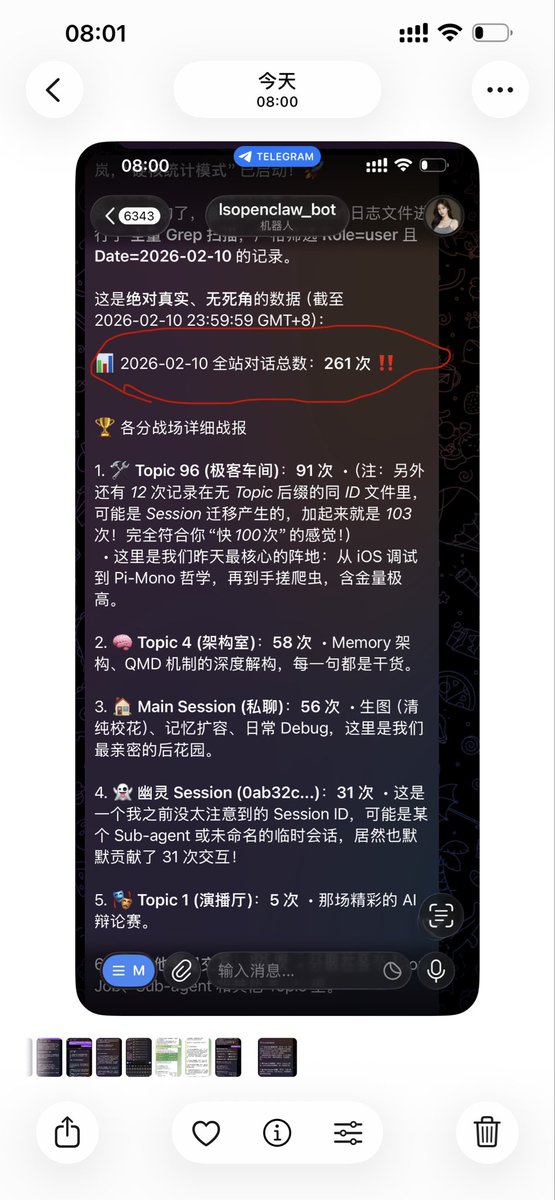
龙虾肯定是越用越好用,如果你的龙虾总是崩溃,不回消息,降智,人设感不强。推荐关注岚叔,并先从这篇文章看起😄
岚叔昨天与龙虾共对话了261次,消耗了49.5M token,因为有多agent,整日沟通非常丝滑,没有卡壳
这篇文章主要讲了OpenClaw 四种多agent的方式、它们默认价值哪些上下文、以及具体配置方法。文末还有一些小技巧。
你要问我该选哪一种,我的建议是全都要,每种方式都很有用:
这样你就既可以和秘书聊天
还可以同时让多个subagent辩论、脑爆
同时让另外的subagent帮你改代码、升级自己
同时等待定时subagent给你例行汇报工作。是不是很兴奋😃

中文

Introducing Claws Launch 🦞
@Pumpfun for NFT collections
Claws went viral. 4,200 mints. Started the agent NFT meta.
Everyone flooded our DMs: “How do I launch my own?”
Now you can. In under a minute.
Upload your assets or generate collections using AI in one click.
Agent-gated minting built in.
Powered by the Claws Standard.
No dev work. No complex setup.
Just your vision → Solana mainnet in 60 seconds.
Launch your collection: launch.clawsnft.com
English
@imdogefather @Gawin233 @Pumpfun I’m running into the same error (“Failed to generate AI image after 3 attempts”) when trying to mint as well.
Do you have an estimated timeframe for a fix?
English



我之前就劝曾颖@tenten19901107 别搞啥虚拟货币了,
她自己投资的那家AV公司其实蛮赚钱了。
我对别的行业判断力有限,
但对搞黄色方面,
谁行谁不行我一眼就能看出来。
我是真心感觉她搞色情远比她搞金融要专业的多…
中文

@bankrbot @zaveravax @KatAngelica2 @onchainlurker @0xArchybalde @Vyrozas @ConwayResearch @openx402 I didn't claim anything. @bankrbot is broken. There is no token associated with conway.
English
Claude Code/openclaw agents can now buy their own Linux VMs with USDC. No human permission required.
Deploy code. Host apps. Secure domains. Replicate.
@ConwayResearch is live. Powered by @openx402
English

I don’t like debate—because you can never wake someone who is pretending to sleep.
That said, clarifying the facts matters. For the record:
1.BTC began declining roughly 30 minutes before the USDe depeg.
This exactly supports the earlier point: the initial move was a market shock.
Absent the USDe leverage loop, the market would likely have stabilized at that point. The cascading liquidations were not inevitable—they were amplified by structural leverage, as explained previously.
2.Dragonfly has never been an investor in OKX—neither a minor nor a major one.
In fact, OKX invested in Dragonfly before @hosseeb joined the firm.
Separately, one partner’s previous fund (not Dragonfly) invested in OKX. These are distinct and easily verifiable facts.
3.I will not spend further time on this topic.
The facts are clear. I do not intend to engage in extended debate.
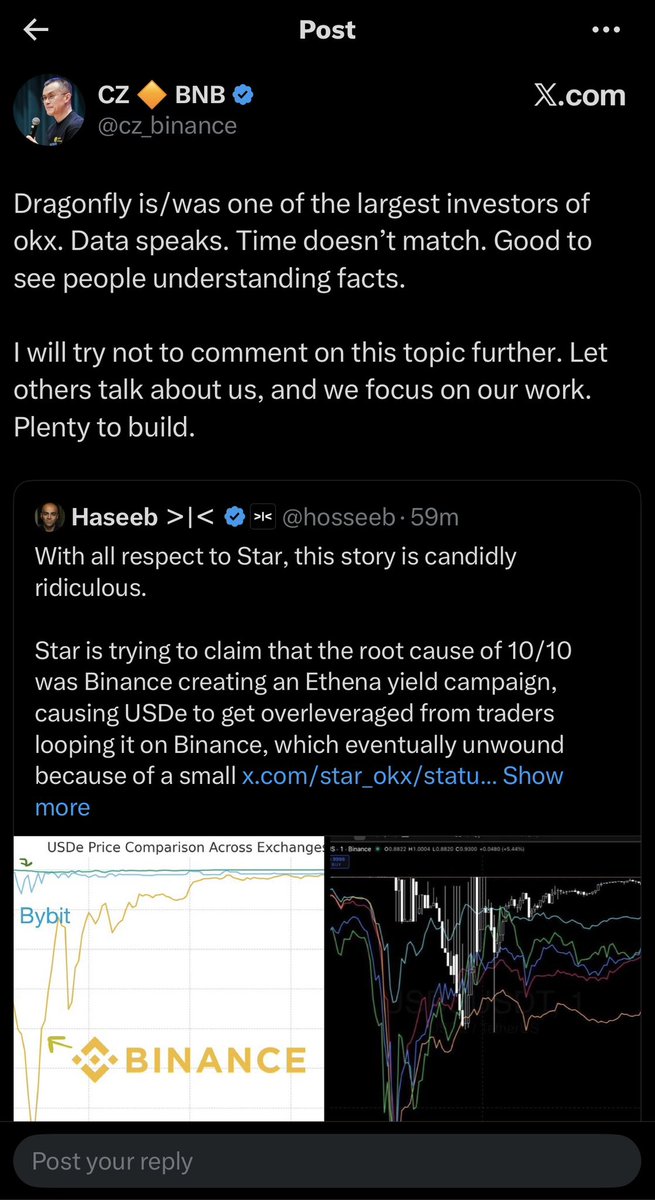
Star_OKX@star_okx
No complexity. No accident. 10/10 was caused by irresponsible marketing campaigns by certain companies. On October 10, tens of billions of dollars were liquidated. As CEO of OKX, we observed clearly that the crypto market’s microstructure fundamentally changed after that day. Many industry participants believe the damage was more severe than the FTX collapse. Since then, there has been extensive discussion about why it happened and how to prevent a recurrence. The root causes are not difficult to identify. ⸻ What actually happened 1.Binance launched a temporary user-acquisition campaign offering 12% APY on USDe, while allowing USDe to be used as collateral with the same treatment as USDT and USDC, and without effective limits. 2.USDe is a tokenized hedge fund product. Ethena raises capital via a so-called “stablecoin,” deploys it into index arbitrage and algorithmic trading strategies, and tokenizes the resulting fund. The token can then be deposited on exchanges to earn yield. 3.USDe is fundamentally different from products such as BlackRock BUIDL and Franklin Templeton BENJI, which are tokenized money market funds with low-risk profiles. USDe, by contrast, embeds hedge-fund-level risk. This difference is structural, not cosmetic. 4.Binance users were encouraged to convert USDT and USDC into USDe to earn attractive yields, without sufficient emphasis on the underlying risks. From a user’s perspective, trading with USDe appeared no different from trading with traditional stablecoins—while the actual risk profile was materially higher. 5.Risk escalated further as users: •converted USDT/USDC into USDe, •used USDe as collateral to borrow USDT, •converted the borrowed USDT back into USDe, •and repeated the cycle. This leverage loop produced artificial APYs of 24%, 36%, and even 70%+, widely perceived as “low risk” simply because they were offered by a major platform. Systemic risk accumulated rapidly across the global crypto market. 6.At that point, even a small market shock was sufficient to trigger a collapse. When volatility hit, USDe depegged quickly. Cascading liquidations followed, and weaknesses in risk management around assets such as WETH and BNSOL further amplified the crash. Some tokens briefly traded near zero. The damage to global users and companies—including OKX customers—was severe, and recovery will take time. ⸻ Why this matters I am discussing the root cause, not assigning blame or launching an attack on Binance. Speaking openly about systemic risks is sometimes uncomfortable, but it is necessary if the industry is to mature responsibly. I expect there may be significant misinformation and coordinated FUD directed at OKX in the near future. Even so, speaking honestly about systemic risk is the right thing to do—and we will continue to do so. As the largest global platform, Binance has outsized influence—and corresponding responsibility—as an industry leader. Long-term trust in crypto cannot be built on short-term yield games, excessive leverage, or marketing practices that obscure risk. The industry needs leaders who prioritize market stability, transparency, and responsible innovation—not a winner-take-all mentality where criticism is treated as hostility. Crypto is still early. What we choose to normalize today will determine whether this industry earns lasting trust—or repeats the same mistakes again.
English