@Southcom@PeteHegseth Can you please include the point of origin what country and port they left from for these Narco boats that would hugely beneficial to your readers.
On March 19, at the direction of #SOUTHCOM commander Gen. Francis L. Donovan, Joint Task Force Southern Spear conducted a lethal kinetic strike on a low-profile vessel operated by Designated Terrorist Organizations. Intelligence confirmed the low-profile vessel was transiting along known narco-trafficking routes in the Eastern Pacific and was engaged in narco-trafficking operations. Three narco-terrorists survived the strike. Following the engagement, USSOUTHCOM immediately notified U.S. Coast Guard to activate the Search and Rescue system for the survivors. No U.S. military forces were harmed. @DeptofWar#OpSouthernSpear
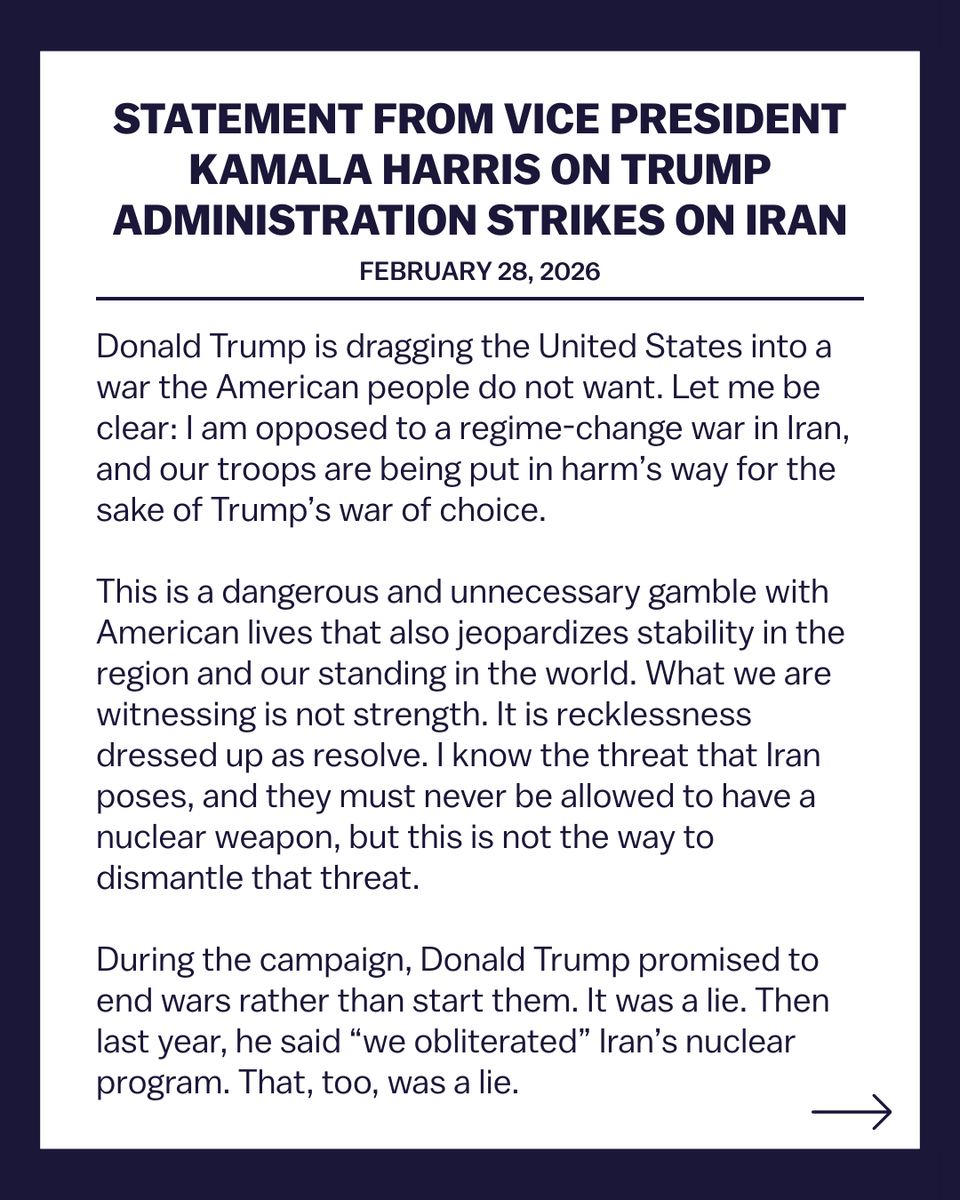
Donald Trump is dragging the United States into a war the American people do not want. Let me be clear: I am opposed to a regime-change war in Iran, and our troops are being put in harm’s way for the sake of Trump’s war of choice.
Read my full statement:
It’s just tied to interest rates lowering but ass more home go on the market these are people that are moving and have been waiting for interest rates to drop. Buyers are right behind the new listings lots of people have been hold off their moves it will rebalance and prices could go back up.
@eevblog@FlareAus Great teaching moment on how to UNSUBSCRIBE you can never learn to early. I remember when my parents taught me how to UNSUBSCRIBE oh the memories…
WTF.
So my son just signed up for a TFN because he now works for my company. His email has zero online footprint. He immediately gets spammed by this bullshit local HR company @FlareAus pretending to have have been invited by MY COMPANY to join them.
How TF did they get his email and that he has joined my company?
SpaceX just acquired xAI in a deal valuing the combined entity at $1.25 trillion.
Elon says it's about building "data centers in space."
But let me translate what's really happening here...
xAI is burning through $1 billion per month.
The company generated $107 million in revenue last quarter while hemorrhaging $1.46 billion in losses. It burned nearly $8 billion in cash through the first nine months of 2025.
That's not a business.
SpaceX meanwhile generated $8 billion in profit on $15-16 billion of revenue last year. It's the ONLY Musk company that actually prints money.
So what do you do when your AI startup is drowning in red ink ahead of your mega-IPO?
You fold the cash-burner into the entity that can still raise absurd amounts of capital.
And we've literally seen this exact thing before:
In 2016, Tesla acquired SolarCity for $2.6 billion.
SolarCity was bleeding cash, drowning in debt, and trading near all-time lows.
Tesla - the only Musk company at the time that could access the capital markets - absorbed it.
Wall Street analysts called it a "bailout dressed as synergy." Tesla's stock dropped 10% on the announcement.
The SpaceX/xAI deal is the same playbook.
Musk's stated rationale - that AI compute will be cheaper in space within 2-3 years - is the kind of thing that sounds visionary until you think about it for 5 seconds...
SpaceX builds rockets. xAI trains large language models.
These are wildly different businesses with zero operational overlap.
Imagine Microsoft acquiring a cement and steel conglomerate and claiming "tilt-up concrete slabs are essential for data centers."
That's the level of logic we're working with here.
The real play is simple: prop up xAI's insane burn rate with SpaceX's funding access ahead of what could be the largest IPO in history.
And xAI isn't alone in this capital-devouring spiral.
The entire AI sector has become a web of companies cross-subsidizing each other's losses.
OpenAI squeezes billions from Microsoft. Nvidia invests billions in xAI while selling them chips.
Everyone's propping everyone else up.
The investment thesis across the industry has devolved into:
"Please keep the Ponzi spinning long enough for someone else to be left holding the bag."
Meanwhile, the end product - AI - delivers marginal productivity gains for trillions in capex, soaring power costs, and balance sheet carnage.
If these services were priced to reflect their true economic cost, most users would find negative value.
But investors stopped reading balance sheets and cash flows long ago.
The AI models probably can't read them either.
What a time to be invested.
So what's the play?
AVOID the AI infrastructure complex.
When everyone's propping everyone else up, you don't want to be holding the bag when the music stops.
Look instead at sectors that have suffered from years of underinvestment: energy and commodities.
While trillions have been funneled into AI infrastructure, capital spending in oil, gas, and metals has been starved.
That's how cycles work - underinvestment leads to supply constraints, which leads to rising returns on capital.
Tech has the opposite problem. Overinvestment is destroying returns.
When you're burning $1 billion a month to generate $107 million in revenue, that's not a business model - it's a wealth transfer from investors to chip manufacturers.
Emerging markets are also attractive here.
They've been ignored while capital chased the Mag 7, and valuations reflect that neglect.
The Mag 7 now represent roughly a third of the S&P 500.
When this unravels - and it will - capital will rotate into the parts of the market where returns on capital are rising, not collapsing.
Energy. Commodities. Emerging markets.
POSITION ACCORDINGLY