
Angehefteter Tweet
IhjerNord
358 posts


IhjerNord
@Ihjer69
ETHEREUM BULL Main interest is the future. Varied content
Beigetreten Ocak 2025
253 Folgt105 Follower


@IterIntellectus I physically can not stop listening. Made a bench press pr yesterday with that song playing.
English
IhjerNord retweetet

IhjerNord retweetet


autistic men on computers rule the planet you fucking idiots the markets are public and we dominate them you fucking retards
English

IhjerNord retweetet

IhjerNord retweetet

IhjerNord retweetet

@CryptoCurb Cope.
(ETH) and ETH L2 solutions have higher odds of being supported by Cross River Bank than Solana, simply because ETH has a larger, more established ecosystem, is regulatory-friendly, and is integrated into a wide range of projects that Cross River already works with.-chatgpt
English


IhjerNord retweetet



is eth the new btc?
words I never thought I would say.
but seriously. is it?
English
IhjerNord retweetet

📢NEW: EUROPE’S SECOND LARGEST BANK GOES LIVE ON ETHEREUM
BNP Paribas (@BNPParibas) has launched a tokenized share class of a French money market fund on the public @Ethereum $ETH blockchain.
The $3T banking giant ran the pilot through its AssetFoundry platform.
The move tests blockchain integration within a tightly regulated fund structure.

English
IhjerNord retweetet

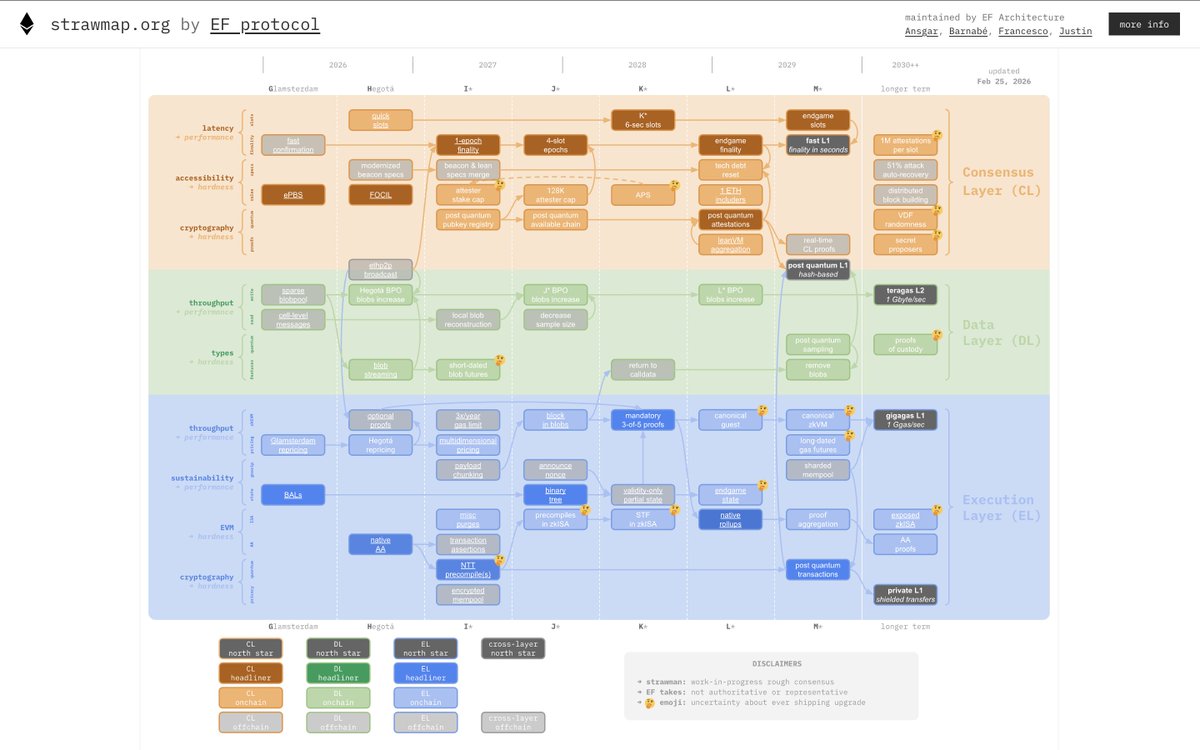
Introducing strawmap, a strawman roadmap by EF Protocol.
Believe in something. Believe in an Ethereum strawmap.
Who is this for?
The document, available at strawmap[.]org, is intended for advanced readers. It is a dense and technical resource primarily for researchers, developers, and participants in Ethereum governance. Visit ethereum[.]org/roadmap for more introductory material. Accessible explainers unpacking the strawmap will follow soon™.
What is the strawmap?
The strawmap is an invitation to view L1 protocol upgrades through a holistic lens. By placing proposals on a single visual it provides a unified perspective on Ethereum L1 ambitions. The time horizon spans years, extending beyond the immediate focus of All Core Devs (ACD) and forkcast[.]org which typically cover only the next couple of forks.
What are some of the highlights?
The strawmap features five simple north stars, presented as black boxes on the right:
→ fast L1: fast UX, via short slots and finality in seconds
→ gigagas L1: 1 gigagas/sec (10K TPS), via zkEVMs and real-time proving
→ teragas L2: 1 gigabyte/sec (10M TPS), via data availability sampling
→ post quantum L1: durable cryptography, via hash-based schemes
→ private L1: first-class privacy, via shielded ETH transfers
What is the origin story?
The strawman roadmap originated as a discussion starter at an EF workshop in Jan 2026, partly motivated by a desire to integrate lean Ethereum with shorter-term initiatives. Upgrade dependencies and fork constraints became particularly effective at surfacing valuable discussion topics. The strawman is now shared publicly in a spirit of proactive transparency and accelerationism.
Why the "strawmap" name?
"Strawmap" is a portmanteau of "strawman" and "roadmap". The strawman qualifier is deliberate for two reasons:
1. It acknowledges the limits of drafting a roadmap in a highly decentralized ecosystem. An "official" roadmap reflecting all Ethereum stakeholders is effectively impossible. Rough consensus is fundamentally an emergent, continuous, and inherent uncertain process.
2. It underscores the document's status as a work-in-progress. Although it originated within the EF Protocol cluster, there are competing views held among its 100 members, not to mention a rich diversity of non-EFer views.
The strawmap is not a prediction. It is an accelerationist coordination tool, sketching one reasonably coherent path among millions of possible outcomes.
What is the strawmap time frame?
The strawmap focuses on forks extending through the end of the decade. It outlines seven forks by 2029 based on a rough cadence of one fork every six months. While grounded in current expectations, these timelines should be treated with healthy skepticism. The current draft assumes human-first development. AI-driven development and formal verification could significantly compress schedules.
What do the letters on top represent?
The strawmap is organized as a timeline, with forks progressing from left to right. Consensus layer forks follow a star-based naming scheme with incrementing first letters: Altair, Bellatrix, Capella, Deneb, Electra, Fulu, etc. Upcoming forks such as Glamsterdam and Hegotá have finalized names. Other forks, like I* and J*, have placeholder names (with I* pronounced "I star").
What do the colors and arrows represent?
Upgrades are grouped into three color-coded horizontal layers: consensus (CL), data (DL), execution (EL). Dark boxes denote headliners (see below), grey boxes indicate offchain upgrades, and black boxes represent north stars. An explanatory legend appears at the bottom.
Within each layer, upgrades are further organized by theme and sub-theme. Arrows signal hard technical dependencies or natural upgrade progressions. Underlined text in boxes links to relevant EIPs and write-ups.
What are headliners?
Headliners are particularly prominent and ambitious upgrades. To maintain a fast fork cadence, the modern ACD process limits itself to one consensus and one execution headliner per fork. For example, in Glamsterdam, these headliners are ePBS and BALs, respectively.
(L* is an exceptional fork, displaying two headliners tied to the bigger lean consensus fork. Lean consensus landing in L* would be a fateful coincidence.)
Will the strawmap evolve?
Yes, the strawmap is a living and malleable document. It will evolve alongside community feedback, R&D advancements, and governance. Expect at least quarterly updates, with the latest revision date noted on the document.
Can I share feedback?
Yes, feedback is actively encouraged. The EF Protocol strawmap is maintained by the EF Architecture team: @adietrichs, @barnabemonnot, @fradamt, @drakefjustin. Each has open DMs and can be reached at first.name@ethereum[.]org. General inquiries can be sent to strawmap@ethereum[.]org.
English
IhjerNord retweetet

I like a lot of this, but what really caught my attention is the focus on quantum resistance & full stack privacy.
so, like any free spirit with inherent biases, i want to talk about them (and eli5 what it all means in the process)
ready?
deep breath.
1. a post quantum L1
AKA
future proof, usable, unruggable cryptography
many people are freaking out about quantum timelines (some are even selling their crypto in fear of it).
the issue at hand is that pesky little quantum computers, when powerful enough, will be able to break the mathematical assumptions that protect every wallet on every blockchain today. the EF has already declared post quantum security a top strategic priority and now the strawmap treats this as an engineering challenge to solve right away.
what makes the strawmap’s approach to post quantum genuinely remarkable is that it runs through all three layers. AKA this is an entire cryptographic migration.
> in the Consensus Layer, the progression moves through a PQ pubkey registry, PQ attestations, and PQ available chain, and ends in fully hash based consensus.
> in the Data Layer, post quantum sampling replaces current structures and existing blob formats to give way to quantum resistant alternatives.
> In the Execution Layer, NTT precompiles and post quantum transactions lead to a fully quantum resistant L1
the stated goal of this migration is: zero funds lost, zero downtime during the transition.
if ethereum is going to serve as durable infrastructure, the kind of foundation that people, institutions, and eventually autonomous agents can build their economic lives on, then the cryptography it uses cannot have an expiration date. post quantum is what that commitment, and the overall commitment to a censorship resistant, humanity serving, infinite internet of value, looks like when taken seriously at the deepest layers of the stack.
2. a private L1: shielded transfers
I don’t need to re explain why privacy is important, so I will just say this; unlike at your meatspace home when you take a shit and can lock the door, online you can’t do that, everyone can see and smell you. in most platforms today even if they say your privacy is safe, they have back doors where they can come in and take a whiff…ok this analogy sucks but you get the point (it’s 3am sorry).
this final north star sits at the bottom right corner of the map and posits shielded ETH transfers as a native property of the etherem protocol.
the strawmap plots a path through encrypted mempool (preventing pending transactions from being surveilled or front run), NTT precompiles (efficient cryptographic tooling), and ultimately shielded ETH transfers as a first class protocol feature.
privacy at the base layer means it is not something a third party grants you and can therefore revoke but rather it is a property of the system itself.
you do not have to ask permission to transact privately, the same way you do not have to ask permission to send a sealed letter instead of a postcard. so in a world where personal data is treated as a natural resource to be extracted and monetized, building privacy into the foundation of public infrastructure is a genuinely radical act, on that the strawmap is committed to.
Justin Drake@drakefjustin
Introducing strawmap, a strawman roadmap by EF Protocol. Believe in something. Believe in an Ethereum strawmap. Who is this for? The document, available at strawmap[.]org, is intended for advanced readers. It is a dense and technical resource primarily for researchers, developers, and participants in Ethereum governance. Visit ethereum[.]org/roadmap for more introductory material. Accessible explainers unpacking the strawmap will follow soon™. What is the strawmap? The strawmap is an invitation to view L1 protocol upgrades through a holistic lens. By placing proposals on a single visual it provides a unified perspective on Ethereum L1 ambitions. The time horizon spans years, extending beyond the immediate focus of All Core Devs (ACD) and forkcast[.]org which typically cover only the next couple of forks. What are some of the highlights? The strawmap features five simple north stars, presented as black boxes on the right: → fast L1: fast UX, via short slots and finality in seconds → gigagas L1: 1 gigagas/sec (10K TPS), via zkEVMs and real-time proving → teragas L2: 1 gigabyte/sec (10M TPS), via data availability sampling → post quantum L1: durable cryptography, via hash-based schemes → private L1: first-class privacy, via shielded ETH transfers What is the origin story? The strawman roadmap originated as a discussion starter at an EF workshop in Jan 2026, partly motivated by a desire to integrate lean Ethereum with shorter-term initiatives. Upgrade dependencies and fork constraints became particularly effective at surfacing valuable discussion topics. The strawman is now shared publicly in a spirit of proactive transparency and accelerationism. Why the "strawmap" name? "Strawmap" is a portmanteau of "strawman" and "roadmap". The strawman qualifier is deliberate for two reasons: 1. It acknowledges the limits of drafting a roadmap in a highly decentralized ecosystem. An "official" roadmap reflecting all Ethereum stakeholders is effectively impossible. Rough consensus is fundamentally an emergent, continuous, and inherent uncertain process. 2. It underscores the document's status as a work-in-progress. Although it originated within the EF Protocol cluster, there are competing views held among its 100 members, not to mention a rich diversity of non-EFer views. The strawmap is not a prediction. It is an accelerationist coordination tool, sketching one reasonably coherent path among millions of possible outcomes. What is the strawmap time frame? The strawmap focuses on forks extending through the end of the decade. It outlines seven forks by 2029 based on a rough cadence of one fork every six months. While grounded in current expectations, these timelines should be treated with healthy skepticism. The current draft assumes human-first development. AI-driven development and formal verification could significantly compress schedules. What do the letters on top represent? The strawmap is organized as a timeline, with forks progressing from left to right. Consensus layer forks follow a star-based naming scheme with incrementing first letters: Altair, Bellatrix, Capella, Deneb, Electra, Fulu, etc. Upcoming forks such as Glamsterdam and Hegotá have finalized names. Other forks, like I* and J*, have placeholder names (with I* pronounced "I star"). What do the colors and arrows represent? Upgrades are grouped into three color-coded horizontal layers: consensus (CL), data (DL), execution (EL). Dark boxes denote headliners (see below), grey boxes indicate offchain upgrades, and black boxes represent north stars. An explanatory legend appears at the bottom. Within each layer, upgrades are further organized by theme and sub-theme. Arrows signal hard technical dependencies or natural upgrade progressions. Underlined text in boxes links to relevant EIPs and write-ups. What are headliners? Headliners are particularly prominent and ambitious upgrades. To maintain a fast fork cadence, the modern ACD process limits itself to one consensus and one execution headliner per fork. For example, in Glamsterdam, these headliners are ePBS and BALs, respectively. (L* is an exceptional fork, displaying two headliners tied to the bigger lean consensus fork. Lean consensus landing in L* would be a fateful coincidence.) Will the strawmap evolve? Yes, the strawmap is a living and malleable document. It will evolve alongside community feedback, R&D advancements, and governance. Expect at least quarterly updates, with the latest revision date noted on the document. Can I share feedback? Yes, feedback is actively encouraged. The EF Protocol strawmap is maintained by the EF Architecture team: @adietrichs, @barnabemonnot, @fradamt, @drakefjustin. Each has open DMs and can be reached at first.name@ethereum[.]org. General inquiries can be sent to strawmap@ethereum[.]org.
English
IhjerNord retweetet

A very important document. Let's walk through this one "goal" at a time. We'll start with fast slots and fast finality.
I expect that we'll reduce slot time in an incremental fashion, eg. I like the "sqrt(2) at a time" formula (12 -> 8 -> 6 -> 4 -> 3 -> 2, though the last two steps are more speculative and depend on heavy research). It is possible to go faster or slower here; but the high level is that we'll view the slot time as a parameter that we adjust down when we're confident it's safe to, similar to the blob target.
Fast slots are off in their own lane at the top of the roadmap, and do not really seem to connect to anything. This is because the rest of the roadmap is pretty independent of the slot time: we would need to do roughly the same things whether the slot time is 2 seconds or 32 seconds
There are a few intersection areas though. One is p2p improvements. @raulvk has recently been working on an optimized p2p layer for Ethereum, which uses erasure coding to greatly improve on the bandwidth/latency tradeoff frontier. Roughly speaking: in today's design, each node receives a full block body from several peers, and is able to accept and rebroadcast it as soon as it receives the first one. If the "width" (number of peers sending you the block) is low, then one bad peer can greatly delay when you receive the block. If width is high, there is a lot of unneeded data overhead. With erasure coding, you can choose a k-of-n setup, eg: split each block into 8 pieces so that with any 4 of them you can reconstruct the full block. This gives you much of the redundancy benefits of high width, without the overhead.
We have stats that show that this architecture can greatly reduce 95th percentile block propagation time, making shorter slots viable with no security tradeoffs (except increased protocol complexity, though here the performance-gain-to-lines-of-code ratio is quite favorable)
Another intersection area is the more complex slot structure that comes with ePBS, FOCIL, and the fast confirmation rule. These have important benefits, but they decrease the safe latency maximum from slot/3 to slot/5. There's ongoing research to try to pipeline things better to minimize losses (also note: the slot time is lower-bounded not just by slot latency, but also by the fixed-cost part of ZK prover latency), but there are some tradeoffs here.
One way we are exploring to compensate for this is to change to an architecture where only ~256-1024 randomly selected attesters sign on each slot. For a fork choice (non-finalizing) function, this is totally sufficient. The smaller number of signatures lets us remove the aggregation phase, shortening the slots.
Fast finality is more complex (the ultimate protocol is IMO simpler than status quo Gasper, but the change path is complex). Today, finality takes 16 minutes (12s slots * 32 slot epochs * 2.5 epochs) on average. The goal is to decouple slots and finality, so allow us to reason about both separately, and we are aiming to use a one-round-finality BFT algorithm (a Minimmit variant) to finalize. So endgame finality time might be eg. 6-16 sec.
Because this is a very invasive set of changes, the plan is to bundle the largest step in each change with a switch of the cryptography, notably to post-quantum hash-based signatures, and to a maximally STARK-friendly hash (there are three possible responses to the recent Poseidon2 attacks: (i) increase round count or introduce other countermeasures such as a Monolith layer, (ii) go back to Poseidon1, which is even more lindy than Poseidon2 and has not seen flaws, (iii) use BLAKE3 or other maximally-cheap "conventional" hash. All are being researched).
Additionally, there is a plan to introduce many of these changes piece-by-piece, eg. "1-epoch finality" means we adjust the current consensus to change from FFG-style finalization to Minimmit-style finalization.
One possible finality time trajectory is: 16 min (today) -> 10m40s (8s slots) -> 6m24s (one-epoch finality) -> 1m12s (8-slot epochs, 6s slots) -> 48s (4s slots) -> 16s (minimmit) -> 8s (minimmit with more aggressive parameters)
One interesting consequence of the incremental approach is that there is a pathway to making the slots quantum-resistant much sooner than making the finality quantum-resistant, so we may well quite quickly get to a regime where, if quantum computers suddenly appear, we lose the finality guarantee, but the chain keeps chugging along.
Summary: expect to see progressive decreases of both slot time and finality time, and expect to see these changes to be intertwined with a "ship of Theseus" style component-by-component replacement of Ethereum's slot structure and consensus with a cleaner, simpler, quantum-resistant, prover-friendly, end-to-end formally-verified alternative.
Justin Drake@drakefjustin
Introducing strawmap, a strawman roadmap by EF Protocol. Believe in something. Believe in an Ethereum strawmap. Who is this for? The document, available at strawmap[.]org, is intended for advanced readers. It is a dense and technical resource primarily for researchers, developers, and participants in Ethereum governance. Visit ethereum[.]org/roadmap for more introductory material. Accessible explainers unpacking the strawmap will follow soon™. What is the strawmap? The strawmap is an invitation to view L1 protocol upgrades through a holistic lens. By placing proposals on a single visual it provides a unified perspective on Ethereum L1 ambitions. The time horizon spans years, extending beyond the immediate focus of All Core Devs (ACD) and forkcast[.]org which typically cover only the next couple of forks. What are some of the highlights? The strawmap features five simple north stars, presented as black boxes on the right: → fast L1: fast UX, via short slots and finality in seconds → gigagas L1: 1 gigagas/sec (10K TPS), via zkEVMs and real-time proving → teragas L2: 1 gigabyte/sec (10M TPS), via data availability sampling → post quantum L1: durable cryptography, via hash-based schemes → private L1: first-class privacy, via shielded ETH transfers What is the origin story? The strawman roadmap originated as a discussion starter at an EF workshop in Jan 2026, partly motivated by a desire to integrate lean Ethereum with shorter-term initiatives. Upgrade dependencies and fork constraints became particularly effective at surfacing valuable discussion topics. The strawman is now shared publicly in a spirit of proactive transparency and accelerationism. Why the "strawmap" name? "Strawmap" is a portmanteau of "strawman" and "roadmap". The strawman qualifier is deliberate for two reasons: 1. It acknowledges the limits of drafting a roadmap in a highly decentralized ecosystem. An "official" roadmap reflecting all Ethereum stakeholders is effectively impossible. Rough consensus is fundamentally an emergent, continuous, and inherent uncertain process. 2. It underscores the document's status as a work-in-progress. Although it originated within the EF Protocol cluster, there are competing views held among its 100 members, not to mention a rich diversity of non-EFer views. The strawmap is not a prediction. It is an accelerationist coordination tool, sketching one reasonably coherent path among millions of possible outcomes. What is the strawmap time frame? The strawmap focuses on forks extending through the end of the decade. It outlines seven forks by 2029 based on a rough cadence of one fork every six months. While grounded in current expectations, these timelines should be treated with healthy skepticism. The current draft assumes human-first development. AI-driven development and formal verification could significantly compress schedules. What do the letters on top represent? The strawmap is organized as a timeline, with forks progressing from left to right. Consensus layer forks follow a star-based naming scheme with incrementing first letters: Altair, Bellatrix, Capella, Deneb, Electra, Fulu, etc. Upcoming forks such as Glamsterdam and Hegotá have finalized names. Other forks, like I* and J*, have placeholder names (with I* pronounced "I star"). What do the colors and arrows represent? Upgrades are grouped into three color-coded horizontal layers: consensus (CL), data (DL), execution (EL). Dark boxes denote headliners (see below), grey boxes indicate offchain upgrades, and black boxes represent north stars. An explanatory legend appears at the bottom. Within each layer, upgrades are further organized by theme and sub-theme. Arrows signal hard technical dependencies or natural upgrade progressions. Underlined text in boxes links to relevant EIPs and write-ups. What are headliners? Headliners are particularly prominent and ambitious upgrades. To maintain a fast fork cadence, the modern ACD process limits itself to one consensus and one execution headliner per fork. For example, in Glamsterdam, these headliners are ePBS and BALs, respectively. (L* is an exceptional fork, displaying two headliners tied to the bigger lean consensus fork. Lean consensus landing in L* would be a fateful coincidence.) Will the strawmap evolve? Yes, the strawmap is a living and malleable document. It will evolve alongside community feedback, R&D advancements, and governance. Expect at least quarterly updates, with the latest revision date noted on the document. Can I share feedback? Yes, feedback is actively encouraged. The EF Protocol strawmap is maintained by the EF Architecture team: @adietrichs, @barnabemonnot, @fradamt, @drakefjustin. Each has open DMs and can be reached at first.name@ethereum[.]org. General inquiries can be sent to strawmap@ethereum[.]org.
English
IhjerNord retweetet

🚨 LATEST: ETHEREUM FOUNDATION TO STAKE 70,000 ETH
The Ethereum Foundation has begun staking its treasury and plans to deploy 70,000 ETH to generate yield.
🔹 Treasury now productive
🔹 Yield generation strategy
🔹 Long term ecosystem alignment
This reduces idle supply and reinforces Ethereum’s proof of stake security model.
$ETH $BMNR


English