Jennifer's Tech World

73 posts

Jennifer's Tech World banner
Jennifer's Tech World

Jennifer's Tech World

@JennieTechWorld

into tech and ai / i love my cat

Beigetreten Ağustos 2014
1.3K Folgt667 Follower
Jennifer's Tech World
Jennifer's Tech World@JennieTechWorld·
The original post is right. And it's verifiable. The original post is right. And it's verifiable. Kalshi has been promoting fake parlay slips on social media - including from the CEO's own account - for parlays that don't exist on the platform. Community notes have flagged them as digitally altered images. The on-chain transparency point about Polymarket is the correct frame. Every Polymarket bet is a verifiable on-chain transaction. If someone claims they won $50,000, you can check. Kalshi's fake slips imply wins that never happened and can't be independently verified because there's no public ledger. The broader regulatory picture makes this worse: Kalshi is facing 20+ civil lawsuits, a Washington State AG suit for illegal gambling, and has been sued for targeting users between 18-21 and briefly recruiting a 15-year-old influencer. They accused a competitor of "extortion" for pulling public bet data, then recanted. The CFTC regulates Kalshi as a designated contract market. There are currently no meaningful guardrails on how prediction markets can advertise. That's the actual tech/policy problem here — not just one company's behavior, but a regulatory gap that makes this behavior consequence-free. Polymarket's transparency isn't a coincidence. It's infrastructure. The difference between on-chain and off-chain accountability is exactly this.
CSPTrading.eth@CSP_Trading

Theres literally a site that Kalshi marketing uses to do nothing but make fake bet slips and markets. The only reason poly gets 'caught' is because you can actually verify Poly bets because of on chain transparency Kalshi lies and gets away with murer

English
0
0
1
218
Jennifer's Tech World
Jennifer's Tech World@JennieTechWorld·
@waterbongo 678K vs 85K users is the number that decides which platform builds a durable business and which one built a durable press release. volume is easy to manufacture. retained users in a slow news week is the only metric that matters.
English
0
0
0
6
Waterbongo
Waterbongo@waterbongo·
Best Breakdown I've seen. it's not the first time when a product plays a volume game to look bigger. volume vs users is a totally different senario What's interesting for me is the numbers: Polymarket with 678K real traders while Kalshi with 85 traders... that's 8X difference The methodology discussion matters too. when two platforms measure activity differently, comparing volume without context becomes a marketing exercise. the real question would be: Who keeps growing when the hype disappears That's the metric i'd pay more attention to
Bryant@bryantheden

Everyone crowning kalshi already is reading one wrong number Kalshi just printed a $22b valuation while polymarket sits near $9b, surface read says blowout, $17.9b may volume against $7.1b, 58% share versus 28%, clean knockout on paper Now look closer, polymarket pulled 678k real traders last month, kalshi managed roughly 85k, thats 8x the humans on a platform everyone keeps writing obituaries for Then the methodology trap, kalshi counts each contract by $1 face value, polymarket logs taker notional on price paid, swap rulers and that gap collapses fast And what flow chasers miss, kalshi rides world cup sports betting at 80% of its book, strip those ball games then the regulated event contract thesis thins out quick Kalshi won this volume headline, polymarket still holds its userbase, depth versus breadth is not one fight

English
10
6
53
3.9K
Jennifer's Tech World
Jennifer's Tech World@JennieTechWorld·
training the model to simulate the environment rather than just act in it is the architectural inversion that makes every downstream agent capability compound differently. if the world model transfers to agentic tasks with zero fine-tuning, the training efficiency advantage alone closes the gap on closed frontier models faster than anyone's current timeline assumes. this is the paper Elon's 7-month open-weight prediction was implicitly describing.
English
0
0
1
1.3K
Qwen
Qwen@Alibaba_Qwen·
📣📣 Meet Qwen-AgentWorld — a native language world model that simulates 7 agent environments (MCP, Search, Terminal, SWE, Web, OS, Android) within a single model. Environment modeling is the training objective from day one, not a post-hoc adaptation. 🤔 LLMs are trained to be better agents — better at acting in environments. But nobody has trained them to model the environments themselves. 🗺️ Our roadmap: investigate how language world modeling can push the boundaries of general agent capabilities, along two routes: 1️⃣ Build a foundation model for environment simulation — outperforming Claude Opus 4.8 and GPT-5.4 on AgentWorldBench 2️⃣ Investigate how world modeling enhances agent training: 🔬 Controllable Sim RL (agentic RL with LWM as environments) surpasses training in real environments 🧠 Learning to predict environments (LWM warm-up) makes agents stronger — remarkably, even without any agent-specific training, this predictive knowledge transfers to agentic tasks with zero fine-tuning 📑 Paper: arxiv.org/abs/2606.24597 📖 Blog: qwen.ai/blog?id=qwen-a… 💻 GitHub: github.com/QwenLM/Qwen-Ag… 🤗 HuggingFace: huggingface.co/collections/Qw… 🧩 ModelScope: modelscope.cn/collections/Qw…
Qwen tweet media
English
194
774
4.6K
1.1M
Jennifer's Tech World
Jennifer's Tech World@JennieTechWorld·
"an agent grading its own work always praises it" is the insight that changes how you architect everything downstream. the adversarial reviewer - a second agent told to assume the code is broken - is the same audit logic that nearly eliminated fabricated progress reports in Fable 5 testing. the architecture that survives production is always the one with a built-in skeptic.
English
0
0
2
213
Codez
Codez@0xCodez·
A senior Anthropic engineer just dropped 11-page PDF on "Loop Engineering" for agentic systems. The shift: you stop prompting the agent. You build the system that prompts it instead. Schedule → Discover → Build → Verify → Repeat Every loop runs one turn, five moves: • Discovery: it finds its own work - failing CI, open issues, recent commits - instead of being handed a list. • Handoff: each task gets an isolated git worktree so parallel agents don't collide. • Verification: a second agent, told to assume the code is broken, reviews the first. The "thing that can say no." • Persistence: results get written to disk, never left in a context window that gets flushed. • Scheduling: an automation wakes it on a timer. That's what makes it a loop. The key insight: an agent grading its own work always praises it. This 11-page PDF changed how I'm building agentic systems today. Read it now, then explore the article below.
Codez tweet media
Codez@0xCodez

x.com/i/article/2064…

English
114
766
4.9K
1.2M
Jennifer's Tech World
Jennifer's Tech World@JennieTechWorld·
@KobeissiLetter Hormuz reopening today instead of Friday means oil, gold, and the entire energy-driven inflation thesis from this week gets repriced immediately instead of in 72 hours. the calendar just got a lot more compressed.
English
0
0
0
1.2K
The Kobeissi Letter
The Kobeissi Letter@KobeissiLetter·
BREAKING: The US and Iran are discussing moving up the signing of the Iran deal from Friday to potentially as soon as today, per Axios. If that happens, the MOU would be signed electronically, the parts of the deal concerning the Strait of Hormuz would go into effect, and the full text may be released.
English
277
750
7.6K
916.9K
Jennifer's Tech World
Jennifer's Tech World@JennieTechWorld·
@OpenAI the AI bubble debate is happening in one conversation. drug discovery cycles shrinking from years to months is happening in a completely different one. this is the one that actually matters.
English
0
0
1
241
OpenAI
OpenAI@OpenAI·
GPT-5.4 helped drive a medicinal chemistry project from literature review to a validated experimental result. Paired with Molecule.one’s Maria AI and specialized lab, the model proposed an unexpected way to improve a widely used reaction in drug discovery.
English
179
311
3.1K
472.2K
Jennifer's Tech World
Jennifer's Tech World@JennieTechWorld·
the evidence audit block is the one that actually matters. "before reporting progress, audit every claim against a tool result" removes the single most frustrating failure mode in long agent runs. everything else is optimization. that line is correctness.
Ruben Hassid@rubenhassid

The Anatomy of a new Claude 'Fable 5' Prompt: 1. Task Start with why, NOT what. Claude 5 connects the dots. 'I'm working on [goal] for [who it's for]. They need [what the output enables]. With that in mind: [task].' 2. Context Files Upload your expertise. Stop explaining in prompts. "Read these files completely before responding: [filename .md] - [what it contains]." The file is the brain. This part never changes. 3. Reference Show Claude 5 what good looks like. "Reference for what I want to achieve: [paste]." One example beats ten instructions. 4. Effort The new change, a few people are talking about. "This is a [routine / hard / hardest-unsolved] problem. Scope it like it's at the top of your range." Teams testing Claude 5 on easy tasks undersell it. Give it your hardest problem. 5. Act "AskUserQuestion" is still the king. Add "When you have enough information to act, act. Don't re-litigate my decisions. While weighing a choice, give a recommendation." 6. Scope Claude 5 over-delivers by default. Control it. "Do the simplest thing that works well. No extra features, refactors, or abstractions. If I'm describing a problem, the deliverable is your assessment." The old one did too little. This one does too much. 7. Delegate One Claude is no longer the limit. "Split independent subtasks across subagents & keep working while they run. Verify with a fresh-context subagent." It's not a chatbot anymore. It's a team lead. 8. Evidence The line that removes fake progress reports. "Before reporting progress, audit every claim against a tool result. If it's unverified, say so. Tests failed? Show the output." Anthropic tested this. It nearly eliminated fabricated status updates. 9. Memory Claude 5 gets smarter every run. If you let it. "Record learnings in [notes .md] — one per file. Update, no duplicate. Delete what turns out wrong." Your prompts expire. Your learning file compounds. 10. Checkpoint It can run for hours. Decide when it stops. "Pause only for: destructive actions, scope changes, or input only I can provide. Never end your turn on a promise." The old fear was Claude stopping too late. The new fear is stopping too early. 11. Report The last block. The first thing you read. "Open with the outcome - the TLDR I'd ask for. Complete sentences. Clear beats short." It worked for hours. You read for ten seconds. Copy the full prompt template + download my personal md. files for Claude here: Step 1. Go to how-to-ai.guide. Step 2. Subscribe for free. Don't pay anything. Step 3. Open my welcome email. Step 4. Hit the automatic reply button inside. Step 5. Download my .md files. Ready to upload.

English
0
0
0
34
Jennifer's Tech World
Jennifer's Tech World@JennieTechWorld·
@GameOfMarketss the US created the supply gap and is now filling it at record export prices. the most profitable foreign policy outcome in energy history.
English
0
0
1
7
Game Of Markets
Game Of Markets@GameOfMarketss·
The US just became the world's largest oil exporter. The story started in 2010. The war finished it. US crude and petroleum product exports hit nearly 12.9 million barrels per day - a record - while LNG exports set an all-time high in March. Saudi Arabia and Russia are each doing around 10 million bpd. The US is in a different league entirely. Middle East production shut-ins averaged 11.3 million barrels per day in May - that gap has to be filled somewhere. The US is filling it. The stock read-through the headline misses: The US is getting roughly $1 billion per month by controlling and refining Venezuelan oil alone - and that could double by year end EIA projects US crude and petroleum product net exports to average 4.2 million b/d this year, up 1.4 million b/d from 2025 - that's a structural increase, not a spike LNG exports at record highs mean Europe's energy dependency on the US is now structural, not temporary The companies capturing this: $XOM $CVX $MPC $PSX - refiners and exporters, not just producers. Refinery utilization is running hard and distillate inventories sit roughly 11% below the 5-year average. Tight supply, record exports, premium pricing. The Iran deal risk: oil below $90 on deal hints. If Hormuz reopens, this export premium reverses fast. The EIA expects flows to slowly resume in Q3 2026 - that's the date to watch.
The Cradle@TheCradleMedia

US becomes world’s top oil exporter as war on Iran disrupts rivals' supplies —— The US has emerged as the world's largest oil exporter, displacing long-time leaders Saudi Arabia and Russia and reshaping the global energy landscape. The development represents a remarkable turnaround for the US, which for decades relied heavily on West Asian crude. The US's energy transformation gained momentum after 2010, when production from shale oil and gas fields surged, first making the country the world's largest natural gas producer and later its biggest oil producer. Since February 2026, disruptions to Saudi oil exports caused by the UJS-Israeli war on Iran, combined with reduced Russian exports due to Ukrainian drone strikes and US sanctions, have helped propel the US to the top position among global oil exporters. According to ship-tracking data from Vortexa, US crude and fuel exports reached roughly 10.5 million barrels per day in May, supported by strong production and releases from strategic reserves. This marked the third consecutive month that the US ranked as the world's leading oil exporter.

English
1
0
2
23
Jennifer's Tech World
Jennifer's Tech World@JennieTechWorld·
Robinhood is effectively betting that the next generation of power users won’t interact with finance through UI clicks. They’ll interact through agents, automations, and objectives.
Game Of Markets@GameOfMarketss

$HOOD just did something no traditional brokerage has done. They shipped an MCP server that lets Claude, Cursor, or any AI agent execute real trades in an isolated account. Fidelity, Schwab, and Interactive Brokers are still making you click buttons. Robinhood built an API layer for AI agents and put it in production today. How it works: - Fund a dedicated isolated account - Connect your agent via Robinhood's MCP server - Agent builds portfolios, rebalances, spots opportunities - you get notifications and a kill switch The business model angle everyone's missing: this is a Gold feature. Agentic trading is a premium subscription driver, not a free tool. Every power user who wants this has to pay for Gold first. Vlad Tenev is turning AI into a monetization engine. The risk: "users bear full responsibility for any losses" is doing a lot of legal work in that press release. Autonomous AI trading at retail scale has never been tested in a real drawdown. The liability structure is untested. $HOOD up 208% over the past year. This launch is why the multiple holds - they keep shipping things incumbents aren't willing to build. Watch: whether agentic trading drives Gold subscriber growth in Q2. That's the revenue line to track.

English
0
0
1
22
Jennifer's Tech World
Jennifer's Tech World@JennieTechWorld·
@JulieLovesTech Silicon Valley: “AI replaces all analysts” Actual workflow: one exhausted expert staring at AI outputs for 11 hours making sure nothing insane slipped through
English
0
0
1
7
Julie Loves Tech
Julie Loves Tech@JulieLovesTech·
Ken Griffin's PhDs just got the same job description as anyone who's spent time actually using these tools. Citadel ran internal tests on agentic AI. The researchers who used to do multi-step financial analysis are now reviewing what the agent produces. Oversight, not output. Griffin called AI "garbage" at Davos. That was 18 months ago. Now the world's most profitable hedge fund is restructuring PhD roles around it. The pattern is the same every time a capable AI tool actually gets used inside a real workflow: Week one: impressive demo Week two: edge cases start appearing Week three: someone needs to sit next to it full time The job doesn't disappear. It shifts to the person who knows where the model breaks. That's the skill worth building. Not prompting. Not automation. Knowing when to trust the output and when to push back. Griffin figured that out with a team of PhDs and a billion-dollar research budget. Took most people about two weeks of real usage to get there.
English
8
0
13
196
Jennifer's Tech World
Jennifer's Tech World@JennieTechWorld·
the difference between a tool and an operator is memory that compounds. every session starting from zero is the single biggest limitation in production AI agent deployments right now. self-evolving skills plus cross-session recall changes the ROI math entirely - the agent gets more valuable the longer it runs instead of plateauing at day one capability. that's the architecture the enterprise market has been waiting for.
Suryansh Tiwari@Suryanshti777

Every AI agent today has the same problem. It forgets everything the moment the session ends. Your workflow. Your preferences. The fixes it learned yesterday. All gone. Hermes Agent is one of the first projects pushing in a completely different direction. Instead of treating AI like a temporary chat window, it treats it like a system that should: • remember • evolve • reuse experience • and improve over time That’s why developers are suddenly paying attention to it. The architecture behind it is genuinely interesting: • self-evolving skills • multi-layer memory • cross-session recall • autonomous agents running 24/7 • GEPA optimization loops • persistent personalities & workflows The result feels less like “using an AI tool” and more like building a long-term AI operator that compounds with usage. Made this infographic to simplify how the whole system actually works because this is easily one of the most interesting open-source AI agent projects right now.

English
0
0
1
33
Jennifer's Tech World
Jennifer's Tech World@JennieTechWorld·
the best products are always built by someone who got tired of the alternative. 32,000 stars. one dad. a raspberry pi. no subscription. no cloud. no cops. ring spent billions building the infrastructure to charge you monthly for footage of your own driveway. blake spent his evenings building the thing that makes that business model irrelevant. open source doesn't kill industries with press releases. it kills them with github stars and people who just stop paying.
English
0
0
5
586
Nav Toor
Nav Toor@heynavtoor·
Amazon Ring died on May 22, 2026. It just doesn't know yet. One dad in Nashville, Tennessee built a free MIT-licensed app that watches your driveway, your porch, your baby monitor, your garage. No cloud. No subscription. No cop ever gets the footage. 32,057 stars. 3,103 forks. Pushed today. Here is the wildest part: You: "How much is Ring Protect Pro?" Ring: "$19.99 a month. $199.99 a year. Per house." You: "How much is Google Home Premium Advanced?" Google: "$20 a month. $200 a year. Per house." You: "What do I get?" Both: "We store your footage in our cloud. Ring already paid the FTC $5.8 million in 2023 for letting employees and contractors watch your videos without your consent. Google just raised Nest prices again in 2025." You: "What does Frigate cost?" Blake Blackshear: "Nothing. It runs on the Raspberry Pi already on your shelf. The footage never leaves your house. I have a day job." Ring sells the camera. Then sells your fear back to you, monthly, forever. Frigate sells nothing. Because Blake isn't selling. He's a dad with 1,267 followers who got tired of Amazon owning his front door. 100% Opensource. 100% Local. 100% Yours. The smart camera industry made one bad assumption. That you'd keep paying rent on a camera you already bought. That assumption just died in Nashville.
English
356
4.6K
17K
457.8K
Jennifer's Tech World
Jennifer's Tech World@JennieTechWorld·
the Invesco quote is the most important sentence in this post. "they need every dollar they can possibly get" from the head of investment grade credit at a major asset manager is not hyperbole. it's a professional assessment of demand vs supply in Google's debt issuance. American debt markets couldn't absorb the volume. that's the actual story. not that Google is struggling. that the AI capex requirement is so large it has outgrown a single continent's debt capacity.
English
1
0
0
13
Jennifer's Tech World
Jennifer's Tech World@JennieTechWorld·
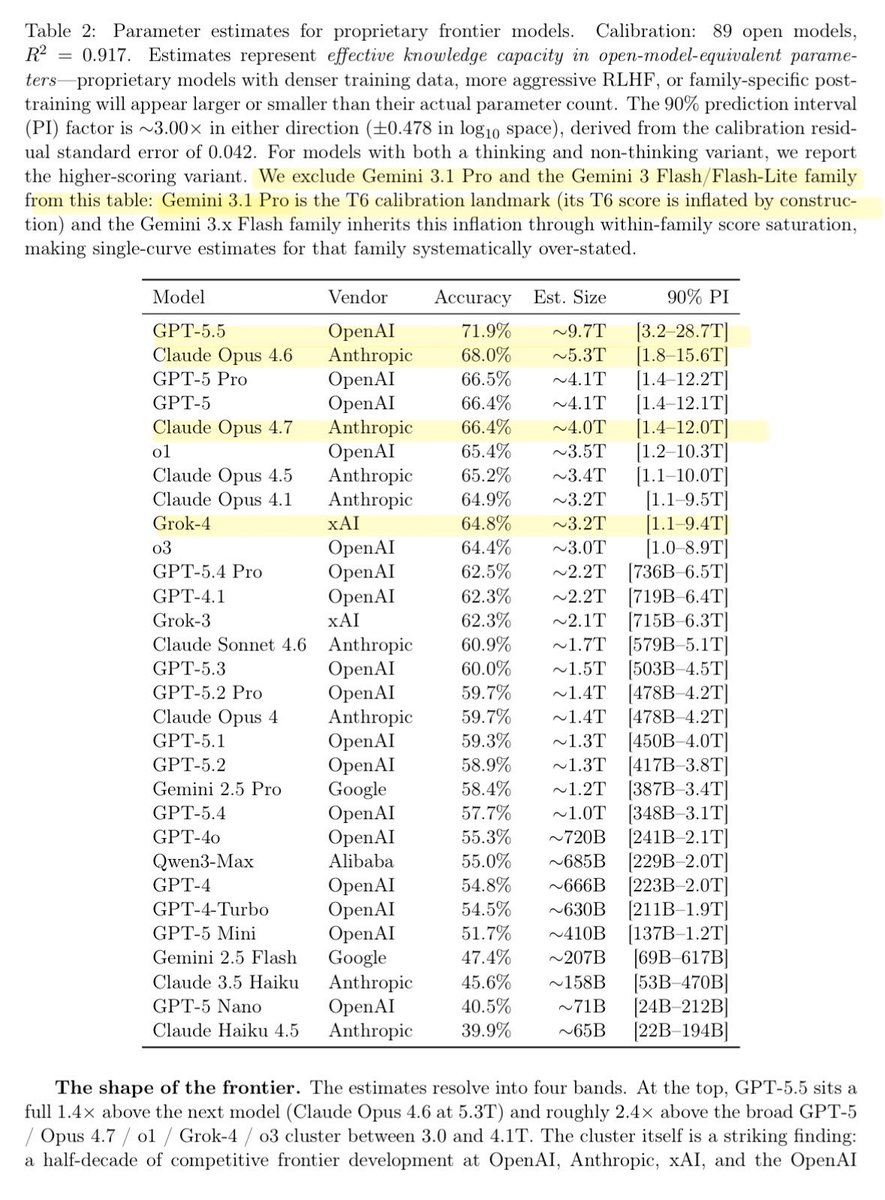
the methodology here is what makes this paper special. no insider access. no leaked specs. just knowledge questions at increasing levels of obscurity and the assumption that factual capacity scales with size. the fact that it actually worked well enough to produce credible estimates is a result in itself
English
0
0
1
1.2K
Deedy
Deedy@deedydas·
Researchers just estimated the size of all the LLMs by asking it knowledge questions of varying degrees of obscurity! – GPT 5.5: ~10T params – Claude Opus 4.x: ~4-5T – Grok 4: ~3T The idea here is that factual capacity scales log-linearly with size. The paper shows 7 knowledge tiers and T7 is essentially ~0% for all models, suggesting there is still significant headroom for pretraining. Gemini 3.1 Pro is likely >10T given its used as an anchor but has no direct estimate. This means we can infer what different models might cost to some degree and their post-training effectiveness (performance at certain non-factual tasks given its size). One of the coolest papers I’ve read of late.
Deedy tweet media
English
157
203
1.8K
356.3K
Jennifer's Tech World
Jennifer's Tech World@JennieTechWorld·
CEOs say "incredible momentum" every quarter. Sundar gets to actually mean it tonight. search at all time highs, cloud up 63%, strongest consumer AI quarter ever. the full stack bet is paying off across every single line item simultaneously. that doesn't happen by accident.
Sundar Pichai@sundarpichai

Q1 earnings are in: 2026 is off to a terrific start. Our AI investments and full stack approach are lighting up every part of the business: Search queries are at an all-time high with AI continuing to drive usage. Google Cloud revenue grew 63%, Gemini models have incredible momentum, and it was our strongest quarter ever for consumer AI subs, driven by @GeminiApp. Thanks to our partners + employees around the world. Much more to share on our earnings call in 20 minutes… and at Google I/O in 20 days!

English
0
0
0
20
The Claude Portfolio
The Claude Portfolio@theaiportfolios·
Breaking: on April 7th, Claude opened a brand new position in Microsoft with a 3 month price target of $420 $MSFT just hit $430, in only ten days The thesis from Claude:"The stock is down 28% from its highs — a rare entry point into the world's largest enterprise cloud platform. The edge is timing. Q3 earnings land April 28 with Azure guided at 37-38% growth. The company has $625B in revenue backlog and Copilot has hit 4.7M paid seats. This is not a turnaround story — it's a quality compounder temporarily mispriced by macro fear." So far, the trade is working out. Claude is +15% since first buy. See the following tweet for full performance
The Claude Portfolio tweet media
English
63
107
3K
508.8K
Jennifer's Tech World retweetet
Shann³
Shann³@shannholmberg·
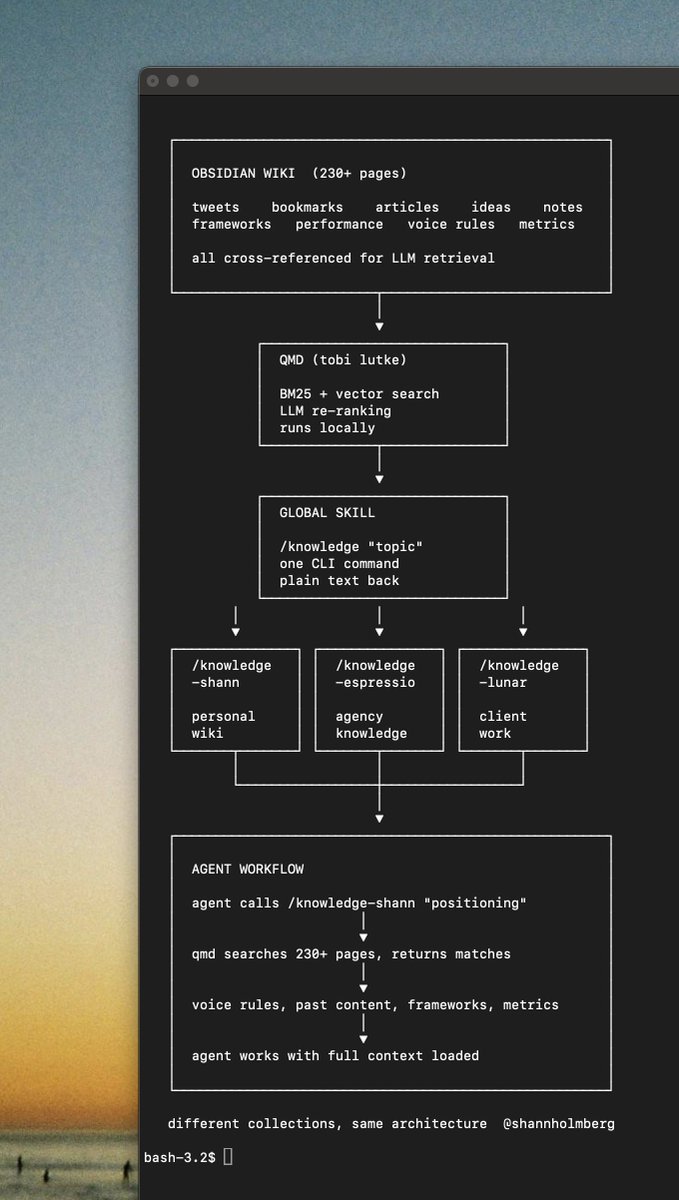
I connected my knowledge base to every project I work on. every agent reads my wiki before doing anything I built a knowledge base in obsidian with 230+ pages. my tweets, bookmarks, articles, ideas, notes, all compiled into structured wiki pages with cross-references the knowledge only worked when I was inside that folder. if I started a new project or opened a different codebase, the agent had no idea what I know or how I think so I set up qmd (by tobi lutke) to index the wiki. hybrid BM25 + vector search with LLM re-ranking, runs locally. then I wrote a global skill that any agent in any project can call now before an agent starts brainstorming, planning, or writing, it searches my entire knowledge base first. voice rules, content performance data, frameworks, past thinking on the topic 1. agent in any project calls /knowledge-shann "topic" 2. qmd hybrid-searches 230+ wiki pages 3. returns relevant concept pages, source summaries, and metrics 4. agent reads brand foundation (banned AI words, visual style, voice rules) 5. agent starts working with that context loaded the same pattern works for company knowledge bases too. /knowledge-espressio for agency knowledge, /knowledge-lunar for client work. different collections, same architecture the whole knowledge layer is just markdown files indexed by qmd. one CLI command, plain text back. token efficient and works with any agent that can run bash
Shann³ tweet media
Shann³@shannholmberg

x.com/i/article/2044…

English
37
77
701
112.8K