
Viktoriöst Kokett
114K posts

Viktoriöst Kokett
@Jvxta
Vänsterhen och högermän, för evigt skall de träta. Med all sin makt, de slå vakt, något felaktigt sagt, de aldrig skola förgäta.
Beigetreten Aralık 2011
1.1K Folgt2.1K Follower
I'm happy to share what I've been working on for a while: a book on the Russian General Staff.
The most important military institution in Russia has not had any English book on it since 2006. Now it's time.
Sharing is caring, but pre-order is good karma (link below).

English
Viktoriöst Kokett retweetet
Se ett lite längre reportage om både svenska Stridsfordon 90/CV90 och Stridsvagn 122 hos den ukrainska 21:a mekaniserade brigaden och hör mer detaljer om hur de räddar ukrainska liv samtidigt som de får ryssarna att jaga dem med stridsvagnar.
Svensk text. 🇺🇦🤝🇸🇪
Svenska
Viktoriöst Kokett retweetet

Some tells to look for that will indicate the Iranians are using Russian input to improve their Shahed strikes:
-Systems to defend against GPS spoofing, such as the Kometa.
-The use of decoy drones to saturate and exhaust air defenses.
-The use of SIM cards to tap into cellular networks for navigation and telemetry.
-Iranian Shahed variants that include performance upgrades that Russia has made to some of its domestically-produced Shahed analogues — such as jet engines.
-Iran flying its Shaheds in meandering flight paths and a range of altitudes that match Russia's employment of Shaheds against Ukraine.
This is a short list to start, and definitely not exhaustive. But the downstream effects of Russian assistance to Iran should not be difficult to identify.
English
Viktoriöst Kokett retweetet


Viktoriöst Kokett retweetet
Browder: Lifting sanctions on Russian oil makes no sense. Russia already sells all the oil it produces.
Removing restrictions will not increase global supply or lower prices — it simply lets Russia sell the same oil at the full international market price. 3/
English
Viktoriöst Kokett retweetet


Viktoriöst Kokett retweetet

Min tanke dag 1 då Irankriget 2.0 utbröt var att gulfstaterna borde ge några örtituzn miljarder för utbildning, taktik och materiel från de som är bäst i världen på försvar mot drönare.
Volodymyr Zelenskyy / Володимир Зеленський@ZelenskyyUa
We received a request from the United States for specific support in protection against "shaheds" in the Middle East region. I gave instructions to provide the necessary means and ensure the presence of Ukrainian specialists who can guarantee the required security. Ukraine helps partners who help ensure our security and protect the lives of our people. Glory to Ukraine!
Svenska
Viktoriöst Kokett retweetet
Gulfstaterna borde skänka enorm finansiering i utbyte mot världens mest kvalificerade drönarluftvärn.
Svenska
Viktoriöst Kokett retweetet


Viktoriöst Kokett retweetet

I admit I’d more strongly support a regime change attack on Iran by a competent, less self-dealing and scandal-ridden president & admin. Trump's only strategy is Trump. But fighting evil matters and the Islamic Republic is evil. Long-term results matter, but so does hope. More 👇
Renew Democracy Initiative@Renew_Democracy
"Concern over civilian casualties is always valid; every innocent life is sacred. But I hope you also expressed outrage over the tens of thousands of Iranians slaughtered recently...for protesting for their basic human rights." Read @Kasparov63 on Iran: thenextmove.org/p/what-to-make…
English
@ZelenskyyUa Support from Sweden stays strong and for the long haul.
English
The Nordic and Baltic countries are a major driving force of support for our people. Representatives from all these countries were with us yesterday in Kyiv, on the fourth anniversary of the beginning of Russia’s full-scale invasion. Over all these years, NB8 has been standing with us through annual assistance programmes and various forms of defence, energy, political, and humanitarian support. They are one of the strongest partners and true friends of Ukraine.
Thank you for your support through concrete assistance packages that enable us to protect lives and strengthen our energy resilience. This includes more than $1.5 billion in military assistance from Sweden, $1.2 billion from Norway for joint drone production, contributions to PURL from Norway, Sweden, Latvia, and Estonia, weapons and investments through SAFE from Lithuania, and energy support from Finland, Denmark, and Iceland.
Every such contribution makes all of us in Europe stronger. Energy packages help our people endure, while defense packages help us hold Moscow’s feet to the fire, because only real pressure will help end this war with dignity. We deeply value the commitment of each NB8 country and this sincere support for our people.
English

Men vilken skillnad man talar om Sverige i Polen nu. Nu är det med vördnad. Och mycket tack vare inte minst @PlJonson och FM.
Ser artikel och kommentar på kommentar som säger att Sverige (och Finland) är det bästa som hänt NATO, Polen och vi lyfts som föredömen Krim Ukraina, Östersjöförsvar mm. Ska göra en tråd snart.>
Svenska
Viktoriöst Kokett retweetet

Den bästa reklambilden för värnplikt som någonsin tagits.
Tunga maskiner. Kul kläder. Polare. Konstiga situationer. Man vet att man kommer bli utskälld i grupp senare. Oändligt med minnen. Meningsfullhet.
Time of your life.
Theuselesscentipede@justcentipde
need more info of the chaps on that Swede
Svenska
Viktoriöst Kokett retweetet

Fantastiskt att få höra estnisksvenska! 🤩
Tulihänd@Kaljurnd
Vormsirootsi keel | Estonian Swedish language (Vormsi/Ormsö)
Svenska
Viktoriöst Kokett retweetet
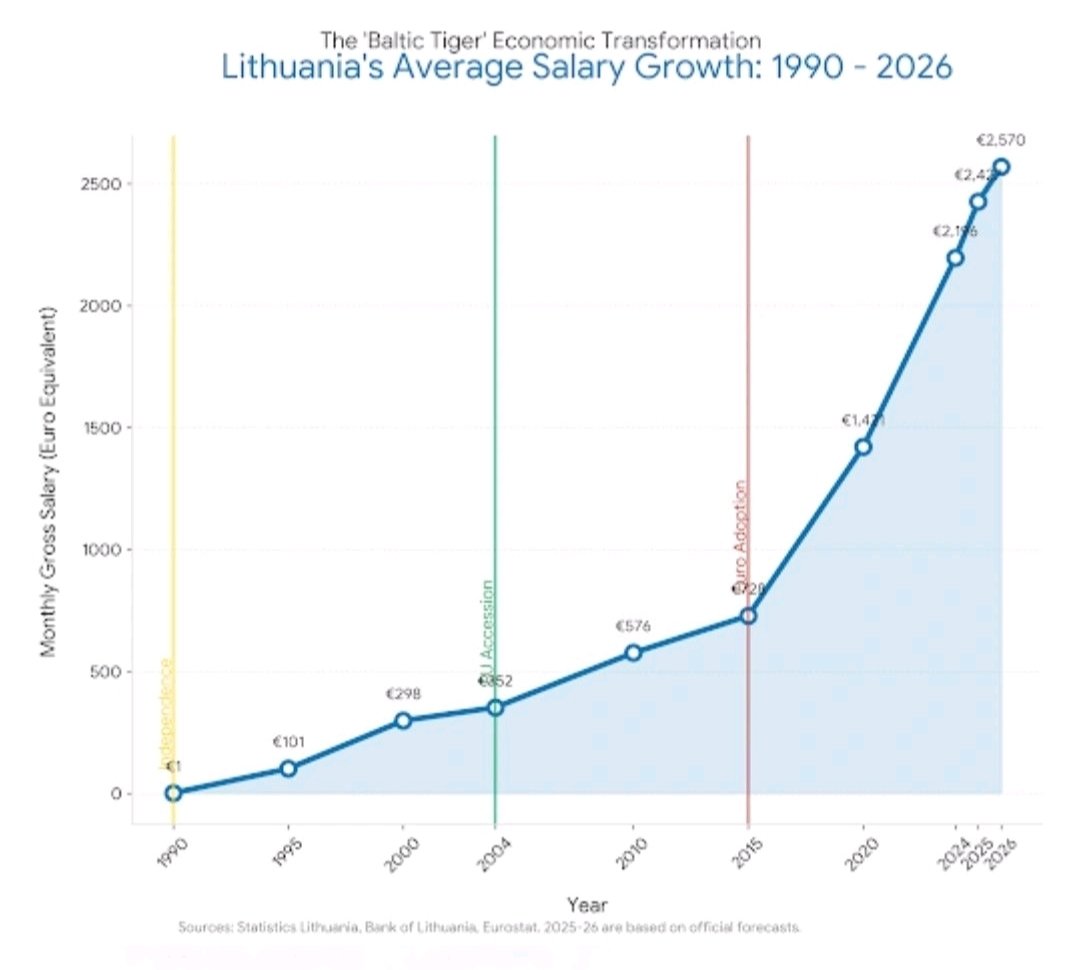
The rapid salary growth in #Lithuania from 1990 to 2026 is one of the most significant #economic transformations in #Europe.
English
Viktoriöst Kokett retweetet

Today France, Germany, Poland, Italy, the United Kingdom and Sweden signed a Letter of Intent under the European Long-range Strike Approach (ELSA). It concerns collaborative development and standardisation of low-cost 500km+ capabilities based on one-way attack effectors. (1/3)
English
Ungern förtjänar bättre än Orban.
Magyar Péter (Ne féljetek)@magyarpeterMP
My statement regarding the latest government and secret service smear campaign currently unfolding.
Svenska
Mycket läsvärd text.
Anton Gerashchenko@Gerashchenko_en
The main theme of the Munich Security Conference, which opens tomorrow, is the Europeans’ attempt to take stock of and make sense of the changes affecting Europe and the world at large, and to determine what to do next. It was simpler when responsibility for European security rested entirely with the United States. But JD Vance’s absence at this year's Conference speaks even more loudly than his speech did last year. The primary systemic threat to the EU is Russia’s war against Ukraine, while the main challenge is the lack of political will to address this issue and the absence of leadership in rethinking and redefining the EU’s strategy in a rapidly changing world. We often hear that European societies are not ready for tough decisions. But that’s not entirely true, and in part it is an attempt to shift responsibility for inaction onto the public. It is useful to look at the latest statistics. In EU countries, societies are increasingly aware of the threat: Eurobarometer data show high levels of concern about security and record support for a common EU defense policy. The standard Eurobarometer (Spring 2025) records that 78% of Europeans are worried about the EU’s defense and security over the next five years, while 81% support a common EU defense and security policy (the highest level since 2004). At the same time, the European Parliament Eurobarometer (Autumn 2025) shows demand for the EU to play the role of "defender": 66% want the EU to take a greater role in safeguarding against global crises and security risks, and as a priority for strengthening the EU’s global position, citizens most often cite defense and security (40%). At the same time, these same data highlight a key problem: fear and recognition of the threat have not yet translated into readiness to pay the price of long-term confrontation. This is precisely where real leadership is needed - not managing public sentiment, but shaping strategic will and making decisions today so as not to pay a higher price tomorrow. At the level of basic attitudes, the EU has a strong "social mandate" for a security pivot. There is a public mandate for a security shift in the EU. In popular attitudes, Europe is ready to acknowledge that security must become a political priority, and that the EU should serve as an instrument of protection. Yet this mandate is not yet structured: it resembles a reservoir of trust that can either be converted into policy or lost amid oscillations between crises. Surveys provide a particularly important test of real readiness - attitudes toward specific, costly options. They show that support for increasing defense spending in many countries is only a "relative majority," not a stable consensus. The most telling example is Italy: only 27% support raising defense spending, while 59% are against it, even though almost half of Italians acknowledge the possibility of Russian aggression expanding beyond Ukraine. ecfr.eu/publication/th… ‼️ This is not simply "pacifism"; it is a signal of a failure in political translation: society perceives the risk but does not see a compelling strategy explaining what exactly it should pay for, and why the consequences will be worse without it. An even more sensitive marker is the nuclear dimension and strategic autonomy. The discussion of a European "nuclear umbrella" does not enjoy automatic support: in some countries, opponents outnumber proponents; even in France and the UK, there is no unquestioned willingness to expand arsenals. This matters not as a technical issue but as a psychological one: Europe wants security, but fears taking steps that would symbolize true responsibility for it. Again, this is a void of leadership: societies have not been told that strategic autonomy is not just rhetoric, but a sequence of decisions, each carrying a political cost. Attitudes toward Russia also demonstrate that there is more room for illusion than official statements suggest. Yes, the vast majority see Russia as an enemy or adversary, but 20-25% perceive Russia as a "reluctant partner." In periods of economic pressure and political turbulence, this segment becomes the base for a "deal at any cost" - not out of affection for the Kremlin, but from a desire to escape risk. Surveys on the prospects of the war deliver yet another cold shower: in Europe, the expectation of a long conflict dominates, yet belief in Ukraine’s victory is almost a "Ukrainian peculiarity," while in many countries significant portions of the population expect Russia to prevail. ecfr.eu/publication/tr… This is not simply a matter of "a different opinion"; it is an indicator that in some societies the battle over the interpretation of reality - and therefore the readiness to maintain a long line of deterrence - is already being lost. It is also a symptom of the absence of a clear strategy, adequate communication with the public, and, as a result, the victory of Russian propaganda. This is precisely where leadership comes in. The question is not whether "Europeans are ready." The data show that they are ready, but only partially, conditionally, unevenly - and that readiness can either strengthen or crumble. The question is whether EU leaders can transform awareness of the threat into durable political will. Today, Europe does not lack analysis or rhetoric, but the ability to do three things simultaneously: acknowledge the war as a long-term confrontation, honestly explain the cost, and offer citizens a sense of control through a predictable strategy. Real leadership here means rejecting reactivity. If Russia lacks the political will to end the war, the only way to make it change course is to "convince" it. The EU needs multi-year frameworks for supporting Ukraine, defense spending, and industrial capacities - so that people see not chaotic responses, but a plan. Beyond that, there must be an honest conversation about the "cost of inaction": the argument that deferred defense will be more expensive because it increases the risk of escalation, sabotage, blackmail, and the expansion of the war. Finally, there is the question of social acceptability: defense decisions must be linked to industrial policy, jobs, technology, and regional development, so that security does not appear as "guns instead of butter." Europe faces another problem that only leadership can solve: its societies are fragmented along different lines. Some are ready for tough decisions but do not trust the EU; some support the EU but are unwilling to finance defense; others are inclined toward "appeasement" out of fatigue and pessimism. The task of a leader is not to wait for these "islands" to converge on their own, but to weave them together into coalitions: using different arguments for different audiences, but with a single strategic goal - deterring Russia and supporting Ukraine as a prerequisite for European security. So, the data do not contradict the possibility of a prolonged confrontation. They show something else: without leadership, the EU risks losing not due to a lack of resources, but due to a lack of will and explanation. The time for leaders has come precisely because the public foundation still exists - but it will not last indefinitely.
Svenska