
**NMR Testing: The Gold Standard for Purity Analysis**
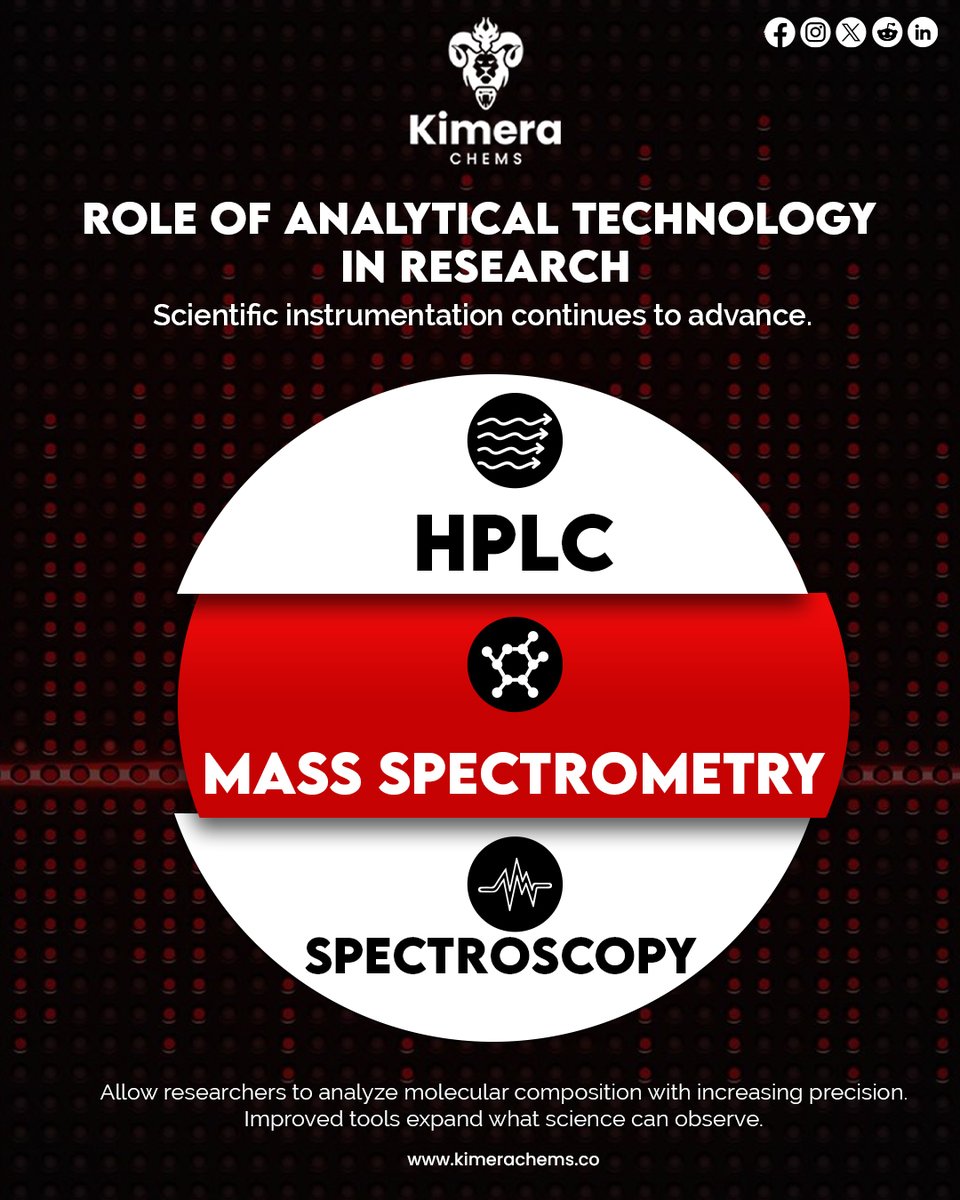
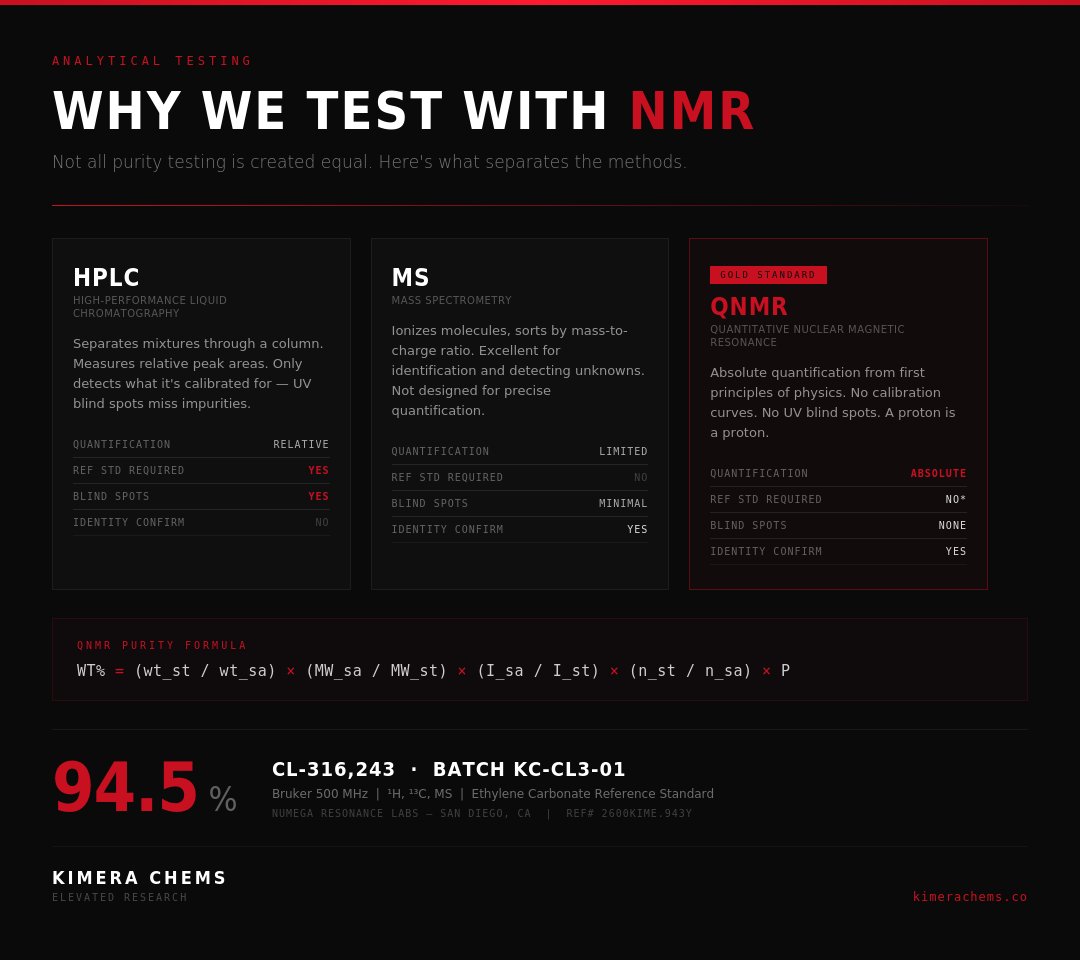
Most research chemical suppliers — if they test at all — rely on HPLC. Some add mass spectrometry. We do all three. But NMR is the one that separates serious operations from everyone else.
Here's why.
**What is NMR?**
Nuclear Magnetic Resonance (NMR) spectroscopy works by placing a sample in a powerful magnetic field and hitting it with radiofrequency pulses. Different atomic nuclei in the molecule resonate at different frequencies depending on their chemical environment. The result is a spectrum that acts like a molecular fingerprint — every peak corresponds to specific hydrogen (¹H) or carbon (¹³C) atoms in the structure.
Quantitative NMR (qNMR) takes it a step further. By comparing the signal integration of the sample against a certified reference standard (like ethylene carbonate), you can calculate exact purity without needing a reference standard of the compound itself.
That last part is critical. Read it again.
**How HPLC Works (and Where It Falls Short)**
HPLC (High-Performance Liquid Chromatography) separates a mixture into its components by pushing it through a column. A detector measures how much of each component comes through and when. You get a chromatogram — peaks representing different substances.
The limitation: HPLC is a *relative* method. It tells you what percentage of the detected peaks belong to your target compound. But it can only detect what it's calibrated to detect. If an impurity doesn't absorb UV light at the selected wavelength, or co-elutes with the main peak, HPLC misses it entirely. It also requires a reference standard of the exact compound you're testing — which for novel or niche research compounds, often doesn't exist.
HPLC is useful. We use it. But alone, it has blind spots.
**How Mass Spectrometry Works (and Its Role)**
Mass spectrometry (MS) ionizes molecules and sorts them by mass-to-charge ratio. It tells you the molecular weight of what's in your sample and can identify unknown impurities.
MS is an *identification* tool more than a *quantification* tool. It answers "what is this?" better than "how much is there?" It confirms molecular identity — you see the expected parent ion, fragmentation patterns, adducts. But it doesn't give you a reliable purity percentage the way qNMR does.
We include both positive and negative ion MS scans in our testing panels for exactly this reason — identity confirmation from multiple angles.
**Why qNMR Is Different**
qNMR is an *absolute* quantification method. It doesn't need a reference standard of the compound being tested. It doesn't have UV blind spots. It doesn't depend on chromatographic separation.
The math is straightforward:
WT% = (wt_st / wt_sa) × (MW_sa / MW_st) × (I_sa / I_st) × (n_st / n_sa) × P
You weigh the sample, weigh a certified standard, run the experiment, compare integrations, and calculate purity directly from first principles of physics.
No calibration curves. No assumptions about detector response. No guessing about what you might be missing.
Our CL-316,243 batch (KC-CL3-01) just came back from NuMega Resonance Labs — 500 MHz Bruker instrument, qNMR analysis: **94.5% purity.** Full ¹H, ¹³C, and MS data included. Every peak accounted for. Every nucleus mapped.
**Why This Matters**
When a supplier hands you an HPLC chromatogram showing "99% purity," ask yourself: 99% of what was detected? What wasn't detected? Was the method validated for that specific compound? Did they use an appropriate reference standard?
qNMR doesn't have those questions. The physics doesn't lie. A proton is a proton.
We test with all three methods — HPLC, MS, and NMR — because no single analytical method tells the whole story. But if you're evaluating a supplier and they've never heard of qNMR, that tells you something too.
Third-party tested. NuMega Resonance Labs, San Diego, CA.
COAs available on every product page.
Elevated Research.
kimerachems.co
English