Fredrik Hjelm@FredrikHjelm4
Why are police officers allowed to profit indirectly from prostitution?
Should the police be allowed to shut down an entire business without attempting to collaborate first?
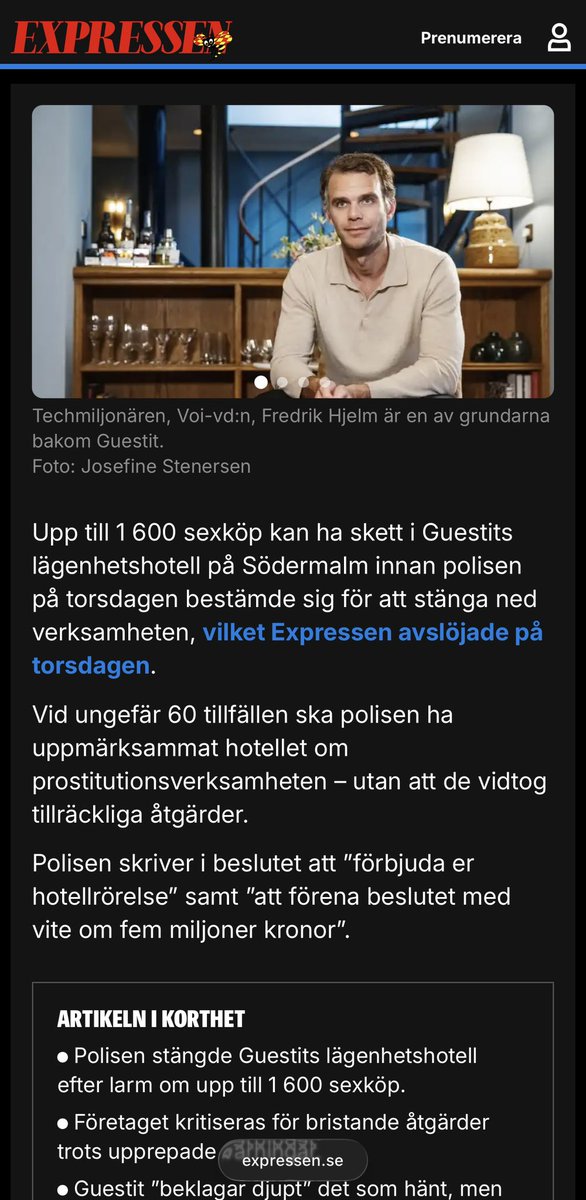
Ten years ago I co-founded a company where I’m on the board but not operationally active. It’s a marketplace for short and mid-term rentals across Sweden, thousands of units, acting as a digital and operational middleman between owners and tenants.
One day, we and one of our property owners received a letter from the police: “We will shut down a unit of yours because you allow for prostitution there.”
We have zero tolerance for prostitution. We conduct ID and background checks and reject any booking at the first hint of suspicious activity.
Selling sex is legal in Sweden. Buying it is not. The criminal is the buyer, and the pimp if there is one.
Today’s pimps are digitally sophisticated. Fake IDs, fake names, the works.
We wanted to work with the police to actually get to the bottom of it.
They said no, or didn’t answer at all. No details about which unit. No information about the suspected guest. Not even confirmation that the unit was on our platform, since we didn’t cover every apartment in the building. They even sent correspondence to the wrong address.
Without that information, we couldn’t do anything targeted to prevent it from happening again.
Months later, another letter: shut down this specific unit by Monday or face a 5 million SEK fine. The officer estimated 1,800 cases of suspected prostitution over a certain period.
One or two led to prosecution.
The gap between 1,800 suspected and 1 or 2 convicted is enormous.
But we complied anyway, because we have zero tolerance. We shut it down. For the people working there every day, that was their livelihood, not an abstract policy decision.
Justice for victims matters. So does the livelihood of hard-working Swedes and a company’s constitutionally protected right to conduct business.
It felt less like law enforcement protecting vulnerable women, and more like making an example of business owners ahead of a good media cycle.
But the weird part: individual officers use these prostitution cases for personal gain.
One Swedish officer has been publicly active on exactly these cases. He lectures on them. Sells crime fiction about them. He profits indirectly from prostitution cases in which the authority he works for refused to collaborate with the business owner to prevent future crimes.
I genuinely hope the profits go to a good cause. Someone in the comments probably knows.