Léo PioLopez

20 posts

Léo PioLopez

Léo PioLopez

@LPiolopez

Complex systems, embodied cognition, AI, networks

Beigetreten Ocak 2021
314 Folgt423 Follower
Léo PioLopez retweetet
Michael Levin
Michael Levin@drmichaellevin·
New preprint with @LPiolopez : preprints.org/manuscript/202… "Multi-Scale Longevity: Defeating Aging from Cells to Embodied Human Minds, and the Future of the Species" a broader view of longevity research, an invited chapter for an upcoming volume titled "Frontiers of Longevity Science" published by Springer Nature. Abstract: "Aging is a fundamental biological process characterized by morphological and functional decline ultimately leading to death. Current research in aging is directed toward extending both healthspan and lifespan by elucidating the molecular and cellular mechanisms that drive aging and by developing interventions capable of delaying, preventing, or reversing age-associated physiological decline and multimorbidity. In this chapter, we take a broader view beyond the healthspan and lifespan of individuals, to consider deep issues impacting the duration and nature of our embodiment, including the nature of change, the meaning of personal persistence, and the future of humanity at multiple scales. If you don’t change, you die out (or become irrelevant); but if you change, are you still present? We argue that aging, like traumatic injury and cancer, is a fundamental challenge to an embodied mind seeking to maintain its distinct nature, differentiated from the environment. Understanding aging thus must take place within the context of a broader story of how biological individuals come to exist, how they continue to exist despite continual challenge, and how their plasticity can be leveraged for transformative change beyond mere persistence. Here, we will present our aging framework grounded in the collective intelligence of cells, then we will discuss the implication for the human- and the species-level aspects of artificial chimerism and its corollary - multiscale (non-Darwinian) evolution. We conclude with some important open questions for humanity with respect to the implications of rejuvenation and longevity technologies."
English
8
46
247
13.3K
Léo PioLopez retweetet
Michael Levin
Michael Levin@drmichaellevin·
New preprint: arxiv.org/abs/2601.14096 Chris Fields, @BeneHartl, @LPiolopez "Remapping and navigation of an embedding space via error minimization: a fundamental organizational principle of cognition in natural and artificial systems" Abstract: The emerging field of diverse intelligence seeks an integrated view of problem-solving in agents of very different provenance, composition, and substrates. From subcellular chemical networks to swarms of organisms, and across evolved, engineered, and chimeric systems, it is hypothesized that scale-invariant principles of decision-making can be discovered. We propose that cognition in both natural and synthetic systems can be characterized and understood by the interplay between two equally important invariants: (1) the remapping of embedding spaces, and (2) the navigation within these spaces. Biological collectives, from single cells to entire organisms (and beyond), remap transcriptional, morphological, physiological, or 3D spaces to maintain homeostasis and regenerate structure, while navigating these spaces through distributed error correction. Modern Artificial Intelligence (AI) systems, including transformers, diffusion models, and neural cellular automata enact analogous processes by remapping data into latent embeddings and refining them iteratively through contextualization. We argue that this dual principle - remapping and navigation of embedding spaces via iterative error minimization - constitutes a substrate-independent invariant of cognition. Recognizing this shared mechanism not only illuminates deep parallels between living systems and artificial models, but also provides a unifying framework for engineering adaptive intelligence across scales.
English
63
89
538
38.2K
Léo PioLopez retweetet
hartl.bene
hartl.bene@BeneHartl·
Extremely humbled that our recent review on "Neural Cellular Automata: Applications in Biology and Beyond Classical AI" is trending #1 in #Biophysics!! Check out the paper (with @LPiolopez and @drmichaellevin) here: sciencedirect.com/science/articl…
hartl.bene tweet media
OOIR@ObserveIR

Trending in #Biophysics: ooir.org/index.php?fiel… 1) Neural cellular automata 2) Expanding Histone Universe 3) Biological complexity beyond networks 4) Mitochondrial position in pancreatic beta cell (@BiophysJ) 5) Promoter-proximal pausing & transcription control (@NatureSMB)

English
1
5
30
3.2K
Léo PioLopez retweetet
Michael Levin
Michael Levin@drmichaellevin·
Final version is out: @LPiolopez onlinelibrary.wiley.com/doi/10.1111/ac… "Atavistic Genetic Expression Dissociation (AGED) DuringAging: Meta-Phylostratigraphic Evidence of Cellular andTissue-Level Phylogenetic Dissociation" Abstract: "... We propose an atavistic dysregulation of gene expression at cellular and tissue levels during aging, framing aging as a gradual regression toward ancestral cellular states. Similarly to the atavistic model of cancer, in which cells revert to unicellular-like behavior, aging may result from the breakdown of coordinated morphogenetic control, leading organs and tissues toward less integrated, ancient unicellular states. We suggest that aging may involve a progressive reversal of the well-known ontogenetic tracing of prior phylogenetic embryonic characteristics. Moreover, aging could involve a loss of large-scale coordination, with tissues reverting to ancient gene expression to different degrees. We tested this hypothesis using a meta-phylostratigraphic analysis, finding: (1) An atavistic over-representation of differential expression in the most ancient genes and under-representation in the evolutionary youngest genes for two multi-tissue aging databases, and tissues covering skin, ovarian, immune, senescent and mesenchymal-senescent cells; (2) No significant atavistic over-representation of the differential gene expression during aging of brain cells and mesenchymal stem cells; (3) overall age-dependent increase of heterogeneity in the direction of the phylogenetic position of tissues' transcriptional profiles; (4) and an overall negative evolutionary age mean shift toward the most ancient genes. Our analyses suggest that aging involves uncoordinated and tissue-specific phylogenetic changes in gene expression. Understanding aging as a structured, heterogeneous atavistic process opens new avenues for rejuvenation, focusing on restoring multicellular coherence in evolutionarily youthful gene expression."
English
22
54
260
23.1K
Léo PioLopez retweetet
hartl.bene
hartl.bene@BeneHartl·
Thrilled to announce that our new paper on "Neural cellular automata: Applications to biology and beyond classical AI" is out in Physics of Life Reviews. ... work with @drmichaellevin and @LPiolopez
Michael Levin@drmichaellevin

Final version is out: authors.elsevier.com/c/1mEoa5bD-sxf… "Neural cellular automata: Applications to biology and beyond classical AI" @LPiolopez Benedikt Hartl "Neural Cellular Automata (NCA) represent a powerful framework for modeling biological self-organization, extending classical rule-based systems with trainable, differentiable (or evolvable) update rules that capture the adaptive self-regulatory dynamics of living matter. By embedding Artificial Neural Networks (ANNs) as local decision-making centers and interaction rules between localized agents, NCA can simulate processes across molecular, cellular, tissue, and system-level scales, offering a multiscale competency architecture perspective on evolution, development, regeneration, aging, morphogenesis, and robotic control. These models not only reproduce canonical, biologically inspired target patterns but also generalize to novel conditions, demonstrating robustness to perturbations and the capacity for open-ended adaptation and reasoning through embodiment. Given their immense success in recent developments, we here review current literature of NCAs that are relevant primarily for biological or bioengineering applications. Moreover, we emphasize that beyond biology, NCAs display robust and generalizing goal-directed dynamics without centralized control, e.g., in controlling or regenerating composite robotic morphologies or even on cutting-edge reasoning tasks such as ARC-AGI-1. In addition, the same principles of iterative state-refinement is reminiscent to modern generative Artificial Intelligence (AI), such as probabilistic diffusion models. Their governing self-regulatory behavior is constraint to fully localized interactions, yet their collective behavior scales into coordinated system-level outcomes. We thus argue that NCAs constitute a unifying computationally lean paradigm that not only bridges fundamental insights from multiscale biology with modern generative AI, but have the potential to design truly bio-inspired collective intelligence capable of hierarchical reasoning and control."

English
1
2
7
451
Léo PioLopez retweetet
Michael Levin
Michael Levin@drmichaellevin·
Final version is out: authors.elsevier.com/c/1mEoa5bD-sxf… "Neural cellular automata: Applications to biology and beyond classical AI" @LPiolopez Benedikt Hartl "Neural Cellular Automata (NCA) represent a powerful framework for modeling biological self-organization, extending classical rule-based systems with trainable, differentiable (or evolvable) update rules that capture the adaptive self-regulatory dynamics of living matter. By embedding Artificial Neural Networks (ANNs) as local decision-making centers and interaction rules between localized agents, NCA can simulate processes across molecular, cellular, tissue, and system-level scales, offering a multiscale competency architecture perspective on evolution, development, regeneration, aging, morphogenesis, and robotic control. These models not only reproduce canonical, biologically inspired target patterns but also generalize to novel conditions, demonstrating robustness to perturbations and the capacity for open-ended adaptation and reasoning through embodiment. Given their immense success in recent developments, we here review current literature of NCAs that are relevant primarily for biological or bioengineering applications. Moreover, we emphasize that beyond biology, NCAs display robust and generalizing goal-directed dynamics without centralized control, e.g., in controlling or regenerating composite robotic morphologies or even on cutting-edge reasoning tasks such as ARC-AGI-1. In addition, the same principles of iterative state-refinement is reminiscent to modern generative Artificial Intelligence (AI), such as probabilistic diffusion models. Their governing self-regulatory behavior is constraint to fully localized interactions, yet their collective behavior scales into coordinated system-level outcomes. We thus argue that NCAs constitute a unifying computationally lean paradigm that not only bridges fundamental insights from multiscale biology with modern generative AI, but have the potential to design truly bio-inspired collective intelligence capable of hierarchical reasoning and control."
English
25
97
552
31.9K
Léo PioLopez retweetet
Michael Levin
Michael Levin@drmichaellevin·
Given the recent discussion about aging (and our approach to it) in x.com/drmichaellevin…, it might be worthwhile to mention that my perspective is: birth defects, failure to regenerate complex organs after damage, cancer, degenerative disease, and aging are all *the same problem* at root. It is all about how living matter implements a collective intelligence to maintain a specific anatomy over time (whether regenerating from: 1 egg cell, a.k.a. embryogenesis, from a damaged tissue, or from the small-scale wear and tear of adult life), and how we can facilitate that process of renewal. Regeneration, in the broadest sense, is the answer to all of these problems. It is not going to be possible to accelerate (or prevent, for those who want to) anti-aging research without feeding (or squelching) these other aspects of medicine and basic science. If you're truly arguing against longevity research, it's not just the elderly billionaires that you're targeting, it's also the kids with cancer, the people born with damaged organs, victims of injury, those damaged by pathogens, etc. etc. It's all the same pool of suffering, with the same root cause. onlinelibrary.wiley.com/doi/10.1002/bi…
Michael Levin@drmichaellevin

Final version is out: aging as the result of loss of goal-directedness advanced.onlinelibrary.wiley.com/doi/epdf/10.10… @BeneHartl @LPiolopez "Although substantial advancements are made in manipulating lifespan in model organisms, the fundamental mechanisms driving aging remain elusive. No comprehensive computational platform is capable of making predictions on aging in multicellular systems. Focus is placed on the processes that build and maintain complex target morphologies, and develop an insilico model of multiscale homeostatic morphogenesis using Neural Cellular Automata (NCAs) trained by neuroevolution. In the context of this model: 1) Aging emerges after developmental goals are completed, even without noise or programmed degeneration; 2) Cellular misdifferentiation, reduced competency, communication failures, and genetic damage all accelerate aging but are not its primary cause; 3) Aging correlates with increased active information storage and transfer entropy, while spatial entropy distinguishes two dynamics, structural loss and morphological noise accumulation; 4) Despite organ loss, spatial information persists in tissue, implementing a memory of lost structures, which can be reactivated for organ restoration through targeted regenerative information; and 5) rejuvenation is found to be most efficient when regenerative information includes differential patterns of affected cells and their neighboring tissue, highlighting strategies for rejuvenation. This model suggests a novel perspective on aging caused by loss of goal-directedness, with potentially significant implications for longevity research and regenerative medicine."

English
64
132
915
95.1K
Léo PioLopez retweetet
Michael Levin
Michael Levin@drmichaellevin·
Final version is out: aging as the result of loss of goal-directedness advanced.onlinelibrary.wiley.com/doi/epdf/10.10… @BeneHartl @LPiolopez "Although substantial advancements are made in manipulating lifespan in model organisms, the fundamental mechanisms driving aging remain elusive. No comprehensive computational platform is capable of making predictions on aging in multicellular systems. Focus is placed on the processes that build and maintain complex target morphologies, and develop an insilico model of multiscale homeostatic morphogenesis using Neural Cellular Automata (NCAs) trained by neuroevolution. In the context of this model: 1) Aging emerges after developmental goals are completed, even without noise or programmed degeneration; 2) Cellular misdifferentiation, reduced competency, communication failures, and genetic damage all accelerate aging but are not its primary cause; 3) Aging correlates with increased active information storage and transfer entropy, while spatial entropy distinguishes two dynamics, structural loss and morphological noise accumulation; 4) Despite organ loss, spatial information persists in tissue, implementing a memory of lost structures, which can be reactivated for organ restoration through targeted regenerative information; and 5) rejuvenation is found to be most efficient when regenerative information includes differential patterns of affected cells and their neighboring tissue, highlighting strategies for rejuvenation. This model suggests a novel perspective on aging caused by loss of goal-directedness, with potentially significant implications for longevity research and regenerative medicine."
Michael Levin tweet media
English
171
434
2.7K
762.9K
Léo PioLopez retweetet
Michael Levin
Michael Levin@drmichaellevin·
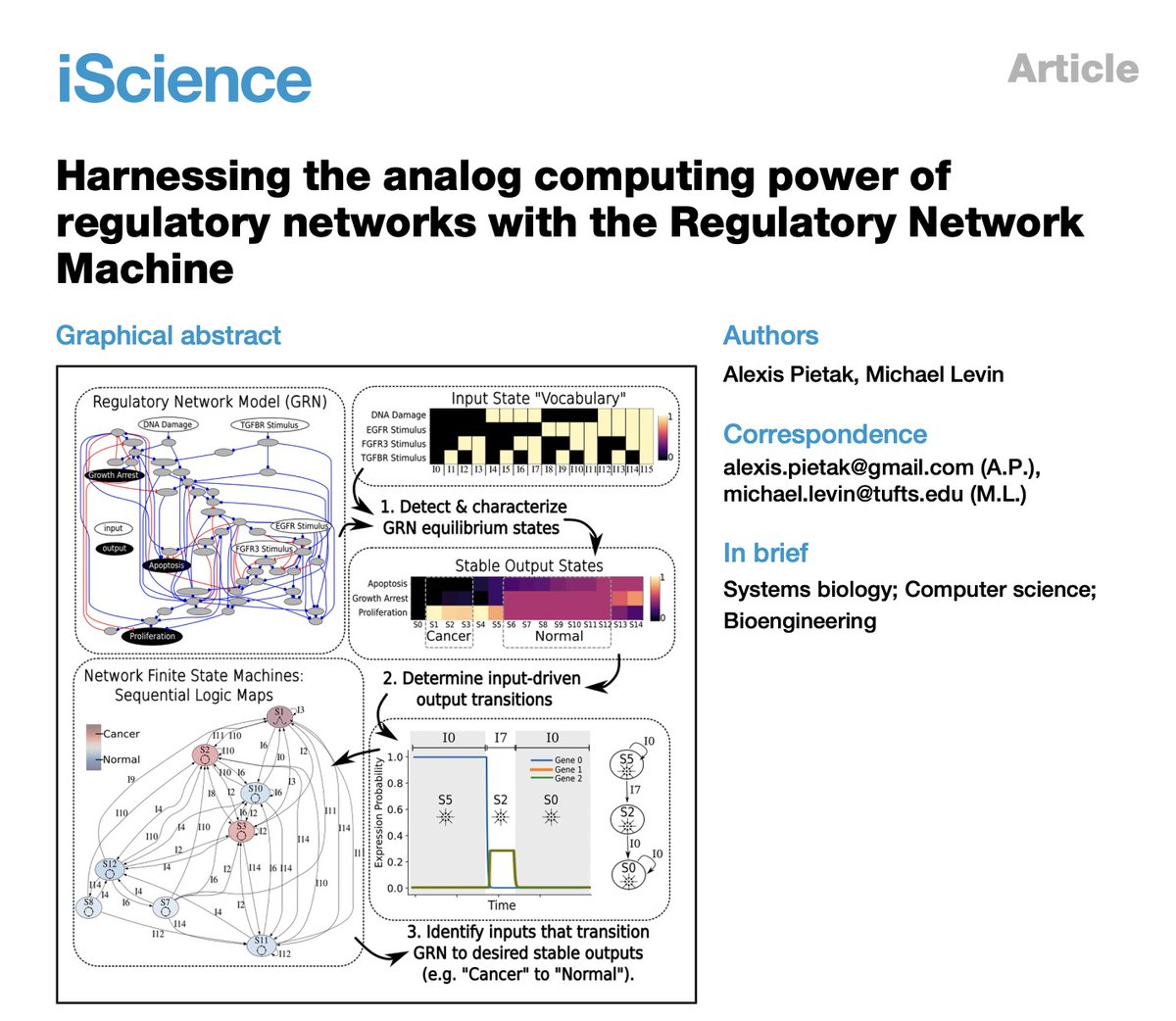
Final version of this paper with @AMPietak is now out: sciencedirect.com/science/articl… "Harnessing the analog computing power of regulatory networks with the Regulatory Network Machine" Abstract: gene regulatory networks (GRNs) are critically important for efforts in biomedicine and biotechnology. Here, we introduce the Regulatory Network Machine (RNM) framework, demonstrating how GRNs behave as analog computers capable of sophisticated information processing. Our RNM framework encapsulates: (1) a dissipative dynamic system with a focus on GRNs, (2) a set of inputs to the system, (3) system output states with identifiable relevance to biotechnological or biomedical objectives, and (4) Network Finite State Machines (NFSMs), which are maps detailing how the system changes equilibrium state in response to patterns of applied inputs. As an extension to attractor landscape analysis, the NFSMs map the sequential logic inherent in the GRN and, therefore, embody the “software-like” nature of the system, providing easy identification of specific applied interventions necessary to achieve desired, stable biological outcomes. We illustrate the use of our RNM framework in important biological examples, including in cancer renormalization.
Michael Levin tweet media
English
9
39
221
17.5K
Léo PioLopez retweetet
Michael Levin
Michael Levin@drmichaellevin·
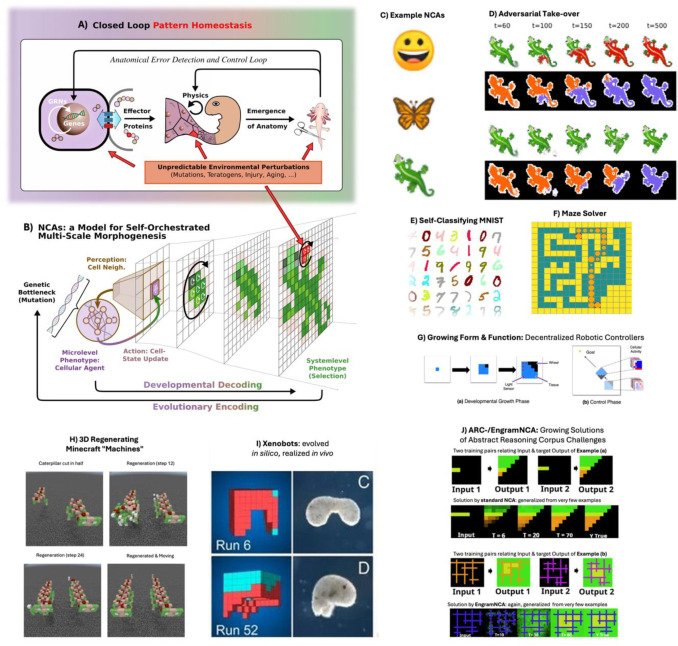
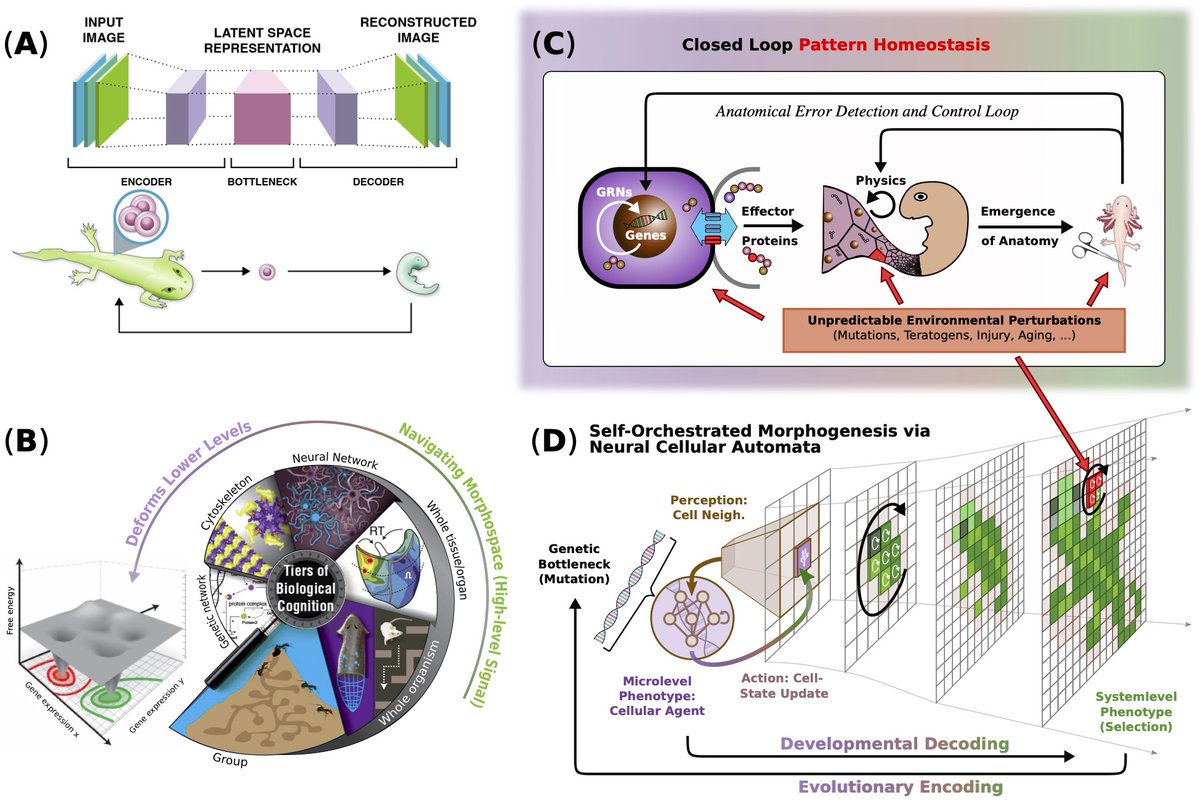
New paper with @BeneHartl : 'What does evolution make? Learning in living lineages and machines" cell.com/trends/genetic… Genes code for proteins, but what is the relationship between the genome and the large-scale form and function of organisms? What is a good formalism for thinking about what genomes actually do, that unlocks discovery of new plasticity of systemic outcomes in regenerative medicine and bioengineering contexts, as well as help understand how evolution operates on a reprogrammable (actually, agential) medium? What concepts from the fields of cognitive science, diverse intelligence, and computer science have relevance here? Abstract: "Biology implements a multiscale competency architecture (MCA), where components competently navigate problem domains (e.g., metabolic, physiological, transcriptional, and anatomical). Biological subsystems continuously shape (hack) each other’s behavior, toward homeodynamic goal states emerging at new scales. The genome acts as a generative model, not a hardwired algorithm nor a blueprint, for species-specific form and function. A bowtie architecture enables evolutionary lessons of the past to be generalized into lineage memory engrams which are then actively decoded (interpreted) in ways appropriate to default or novel situations by the morphogenetic machinery. Fundamental symmetries across evolution, development, and behavior involve learning and creative problem-solving, which can be modeled by machine learning (ML) concepts such as autoencoders (AEs) and neural cellular automata (NCAs)." A closely related and excellent paper by @WiringTheBrain and @CheneyLab : cell.com/trends/genetic…
Michael Levin tweet mediaMichael Levin tweet mediaMichael Levin tweet mediaMichael Levin tweet media
English
18
90
365
31K
Léo PioLopez retweetet
Michael Levin
Michael Levin@drmichaellevin·
Official version of this paper with @LPiolopez is out: link.springer.com/article/10.118… Universal multilayer network embedding bioinformatics method, and validation data in frog model (relevant to cancer)
English
4
29
157
10K
Léo PioLopez retweetet
Michael Levin
Michael Levin@drmichaellevin·
Next up, @LPiolopez and a remarkable finding about #aging. Preprint here: osf.io/preprints/osf/… Atavistic Genetic Expression Dissociation (AGED) during aging: meta-phylostratigraphic evidence of cellular- and tissue-levels phylogenetic dissociation Abstract: "Aging is commonly attributed to accumulated damage, or evolved antagonistic genetic trade-offs, which lead to an accumulation of genetic damage, noise, or DNA methylation causing the misexpression of key genes necessary for longevity. We propose an atavistic dysregulation of gene expression at cellular and tissue-levels during aging, which frames aging as a gradual regression toward ancestral cellular states. Similar to the atavistic model of cancer, in which cells revert to unicellular-like behavior, aging may result from a progressive breakdown of coordinated morphogenetic control, leading organs and tissues to revert towards less integrated, ancient unicellular states. This view suggests that aging may involve a progressive reversal of the well-known ontogenetic tracing of prior phylogenetic embryonic characteristics. Moreover, as in cancer, aging could involve a loss of large-scale coordination, with different tissues reverting to ancient gene expression to different degrees. We tested this hypothesis using a meta-phylostratigraphic analysis to ask: do older human tissues express more ancient genes, and does the variance of transcriptional phylogenetic age across tissues increase with organismal age? We found: (1) An atavistic over-representation of differential expression in the most ancient genes for two multi-tissue aging databases covering skin, ovarian, immune, senescent and mesenchymal-senescent cells; (2) No atavistic over-representation of the differential genet expression during aging of brain cells and mesenchymal stem cells; and (3) overall age-dependent increase of heterogeneity in the direction of the phylogenetic position of tissues’ transcriptional profiles. Our analyses suggest that aging involves uncoordinated and tissue-specific phylogenetic changes in gene expression. Understanding aging as a structured, heterogenous atavistic process opens new avenues for rejuvenation, focusing on restoring multicellular coherence with respect to evolutionarily-youthful gene expression." In other words, during aging, some tissues shift their gene expression toward more ancient genes, and, there arises a lack of concordance between body tissues with respect to the phylogenetic age of the genes they express. Thus, while I often talk about morphogenetic/cognitive systems dissociating and losing integration spatially, it appears that aging is a dissociative disorder with respect to time (evolutionary time). Lots more to do, but very exciting.
English
32
53
271
21.2K
Léo PioLopez retweetet
Michael Levin
Michael Levin@drmichaellevin·
Next, in a series of preprints and papers getting over the finish line at end-of year: osf.io/7hxnp with @LPiolopez: "Morphoceuticals: perspectives for discovery of drugs targeting anatomical control mechanisms in regenerative medicine, cancer, and aging"
English
6
21
100
14.1K
Léo PioLopez retweetet
Erik Hoel
Erik Hoel@erikphoel·
1/n Very excited to put this paper out in the world! Does reduction always lead to a gain in information? Turns out: no. @ThosVarley and I show macroscales can convert information (making info more synergistic), and reduction can lead to a loss of info arxiv.org/abs/2104.13368
Erik Hoel tweet media
English
4
19
60
0
Léo PioLopez retweetet
Erik Hoel
Erik Hoel@erikphoel·
One reason, btw, that I'm so excited about this paper is that I think it represents the most fundamental leap forward in my thinking about emergence and reduction since the "Quantifying causal emergence" paper in 2013
Erik Hoel@erikphoel

1/n Very excited to put this paper out in the world! Does reduction always lead to a gain in information? Turns out: no. @ThosVarley and I show macroscales can convert information (making info more synergistic), and reduction can lead to a loss of info arxiv.org/abs/2104.13368

English
0
2
11
0
Léo PioLopez retweetet
The Royal Vox Post
The Royal Vox Post@RoyalVoxPost·
#Bioinformatics #AI: researchers have developed a multiplex-heterogeneous network embedding framework to facilitate the analysis of complex interactions in dynamic networks. The framework could be used to predict gene-disease and drug-target interactions - nature.com/articles/s4159…
The Royal Vox Post tweet media
English
0
10
12
0