
Lynn Tougas, RKin

4.8K posts

Lynn Tougas, RKin banner
Lynn Tougas, RKin

Lynn Tougas, RKin

@LTKnS

Registered Kinesiologist|IM Triathlete|Knowledge Mobilizer|Visionary|Patient Navigator|ENTJ/PI•Captain Prevention•Management •Performance

Toronto, Ontario, CAN Beigetreten Mayıs 2012
1.7K Folgt564 Follower
Lynn Tougas, RKin
Lynn Tougas, RKin@LTKnS·
@drkeithsiau @awandr1 Surgeons may get excited with lower numbers, particularly in females with connective tissue disorders like Marfan syndrome.
English
0
0
0
106
Keith Siau
Keith Siau@drkeithsiau·
@awandr1 5.5 - the magic number to excite a vascular surgeon! 👌
English
8
0
38
122.6K
Lynn Tougas, RKin
Lynn Tougas, RKin@LTKnS·
Many of these hospitals have family healthcare teams. So let’s talk about this other problem. The fact that patients aren’t being referred to these family health teams within such hospitals when it is known that they don’t have a family doctor.
Kay M. Dingwell🍁🩺🏳️‍🌈@CanadianKayMD

Single issue ‘simple’ ER visits are becoming highly complex with an alarming regularity due to the lack of primary care and it is skyrocketing waits. If we can’t get them family docs PLEASE give us a short term follow up clinic like I’ve asked for years. It would help so much.

English
0
0
0
42
Lynn Tougas, RKin
Lynn Tougas, RKin@LTKnS·
@UHN @PMunkCardiacCtr You’ve missed the fact that ER does not triage for women’s specific heart attack and related issues such as microvascular angina, SCAD/SCAT and mircrovascular vasospasm. We must acknowledge/bring awareness that women’s sx need improved ER triage.
English
0
0
0
34
University Health Network
Dr. Mali Worme, Cardiologist at UHN's @PMunkCardiacCtr debunks 3 myths about heart attacks. Understanding the facts supports earlier recognition and can help save a life. Learn more about these common misconceptions as Heart Month comes to a close: uhn.ca/corporate/news…
English
2
11
24
2.4K
CIHR
CIHR@CIHR_IRSC·
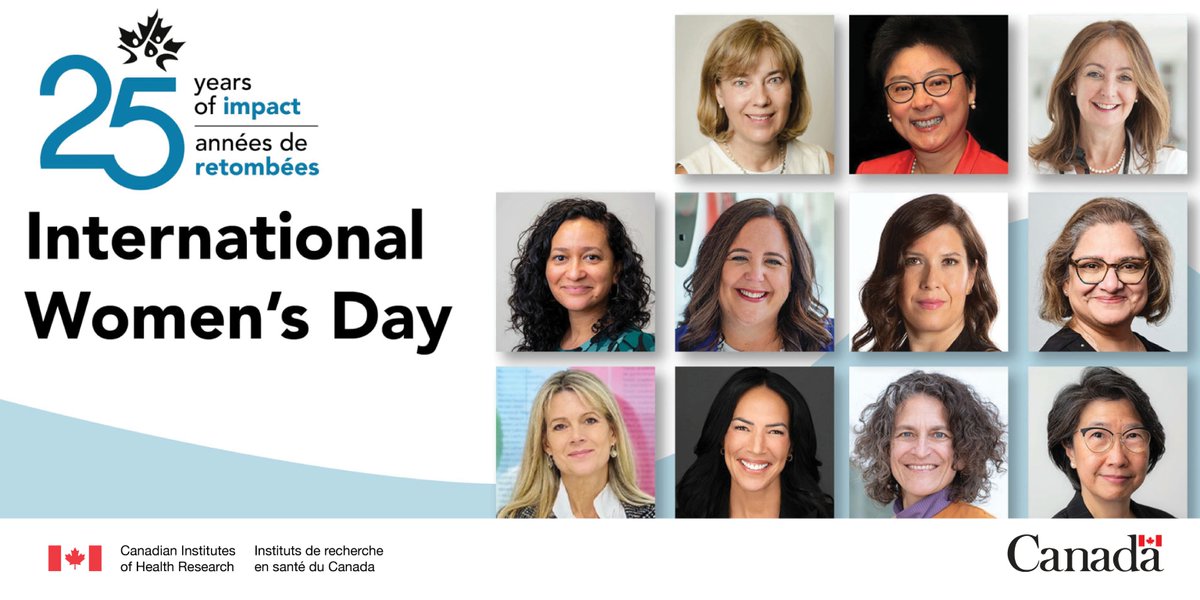
Today, on #InternationalWomansDay, we’re proud to highlight the leadership shaping health research in Canada. At CIHR, 11 of our 13 Scientific Directors are women. We celebrate their impact and the many women driving critical health research forward. cihr-irsc.gc.ca/e/2890.html?hs…
CIHR tweet media
English
10
25
58
2K
Lynn Tougas, RKin
Lynn Tougas, RKin@LTKnS·
@joshuapliu Not to mention information that is not updated in the current system being used — I think we have a much more longer way to go with these tools.
English
0
0
0
10
Joshua Liu
Joshua Liu@joshuapliu·
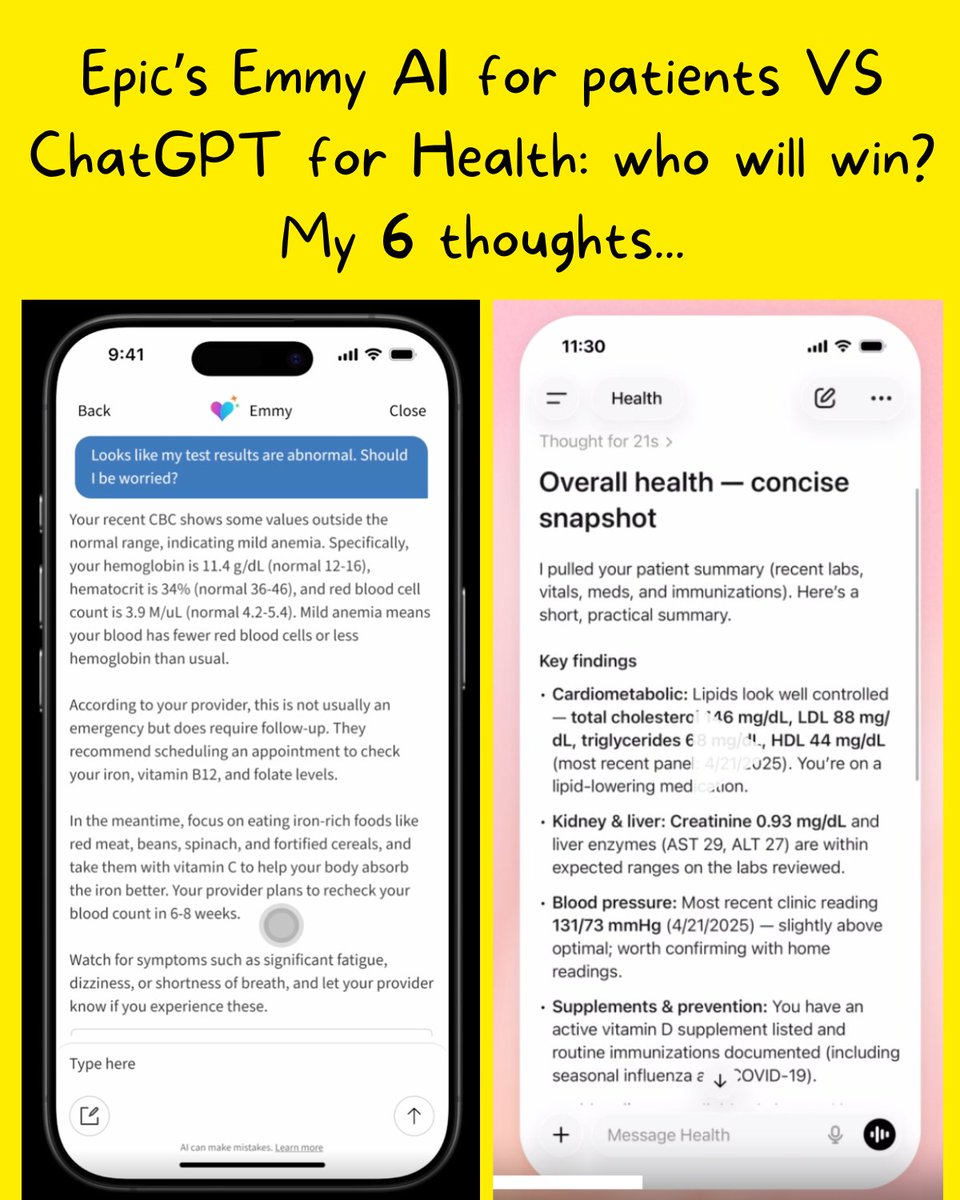
Is Epic’s new "Emmy" AI the ChatGPT killer for healthcare? I watched the demo of their patient portal AI explaining lab results. My 6 thoughts on Epic’s patient AI experience and how it compares to ChatGPT for Health: First, a recap of the patient user experience in Epic’s demo video: → Patient types “my test results are abnormal - should I be worried?” → AI responds with a summary (e.g. mild anemia suggested by CBC outside the normal range) and that the patient’s provider suggests a F/U appointment for more blood tests (e.g. iron) and re-checking the CBC in 6-8 weeks → AI suggests eating more iron-rich foods and what symptoms to watch out for → Patient asks the difference between hemoglobin and hematocrit - which the AI then explains → Patient asks how to schedule the next appointment. AI provides a direct link to schedule in MyChart My 6 thoughts on Epic’s approach and how it compares to ChatGPT’s strategy: 1/ There’s low hanging fruit for Epic to fix. Their demo shows AI responses at the Grade 9 to 11 reading level. The default prompt should be to respond to patients at the Grade 6 level and incorporate best practices in health literacy. 2/ Epic’s AI automatically pulls in not just the test results, but broader context from the rest of the record - e.g. a note from the physician for the next step. It’s unclear to me if ChatGPT can ingest that detail from the patient record, and even if they could, how quickly/regularly that data exchange would occur. 3/ CMIOs/CIOs will love the ability to embed appointment scheduling links directly into the AI experience. I predict health systems will try to embed scheduling links as much as possible to drive up patient volumes - this won’t be great for the patient experience, but like online ads, some % will probably convert and this will be rationalized internally. 4/ It’s unclear what guardrails Epic will place on the AI output - we know that ChatGPT won’t have many. If a patient starts asking for medical advice, Epic’s AI will probably switch to “sorry, I can’t answer that - here’s a link to schedule an appointment with your doctor.” Whereas ChatGPT will probably just spit out medical advice while saying “btw I’m not a doctor!”. If this happens, some patients will continue the convo in ChatGPT. But health systems won’t care - because why take on additional liability (and not get paid for it?). 5/ In the near term, older, sicker patients are unlikely to use ChatGPT for Health - it’ll most likely be used by younger, tech-savvy, longevity type folks… BUT older, complex patients might use Epic’s patient AI because it’s right in the patient portal. That’s a big win. 6/ I don’t think these two products are ultimately “competing”. Every product will eventually have conversational AI features built into it as a standard user experience. You won’t need to go to ChatGPT for every conversational AI experience, nor should you want to or have to. The same goes for patient AI experiences in general.
Joshua Liu tweet media
English
1
0
3
185