Satya Mallick

3.2K posts

Satya Mallick

Satya Mallick

@LearnOpenCV

CEO, https://t.co/CzUdJlxzJM. Course Director, https://t.co/O2Tz9vUOQ8 Entrepreneur. Ph.D. ( Computer Vision & Machine Learning ). Author: https://t.co/olraDEG5Ue

San Diego, CA Beigetreten Haziran 2008
896 Folgt14.3K Follower
Satya Mallick
Satya Mallick@LearnOpenCV·
Think that AI masterpiece is all yours? Think again! Even with the perfect prompt, U.S. law says no human author means no copyright. If you're building a brand on AI art, you need to know where you stand legally. Watch to learn the truth about AI ownership!
English
1
0
0
153
Satya Mallick
Satya Mallick@LearnOpenCV·
Helios: Rethinking How AI Models Scale Across Compute and Data In this episode of Artificial Intelligence: Papers and Concepts, we explore Helios, a new approach focused on optimizing how large AI models scale across compute, data, and training efficiency. As models continue to grow in size and complexity, Helios examines how better coordination between hardware, training strategies, and model design can unlock higher performance without simply increasing cost. We break down why traditional scaling approaches are becoming inefficient, how Helios introduces smarter ways to balance resources during training, and what this means for the future of building large-scale AI systems. If you’re interested in AI infrastructure, efficient scaling, or the next generation of foundation models, this episode explains why Helios represents an important step toward more sustainable and high-performance AI development. Resources: Paper Link: arxiv.org/pdf/2603.04379 Interested in Computer Vision and AI consulting and product development services? Email us at contact@bigvision.ai or visit us at bigvision.ai
English
0
0
0
215
Satya Mallick
Satya Mallick@LearnOpenCV·
YOLO: A New Era in Object Detection Until 2015, object detection was a multi-stage process region proposals, feature extraction, classification. 🌀 Then came YOLO (You Only Look Once), and everything changed. Instead of scanning thousands of regions, YOLO looked at the entire image in one pass. 🖼️➡️⚡ Divides the image into a grid Predicts bounding boxes + class probabilities directly Turns detection into a single regression problem The result? Real-time detection at 40+ FPS 🎥🔥 Sure, it sacrificed some accuracy compared to two-stage detectors, but it proved that speed + simplicity could transform computer vision forever. 🚀 YOLO didn’t just improve detection it started a new era of single-shot detectors, paving the way for SSD and beyond. #YOLO #ObjectDetection #DeepLearning #AI #ComputerVision #MachineLearning #NeuralNetworks #TechInnovation #SSD #AIRevolution
English
0
0
1
284
Satya Mallick
Satya Mallick@LearnOpenCV·
Can you own art created by AI? The creator of Zarya of the Dawn found out the hard way! While her story is protected, the U.S. Copyright Office ruled that AI images aren't human-authored—leaving them in the public domain.
English
2
0
0
221
Satya Mallick
Satya Mallick@LearnOpenCV·
🚀 From RCNN to YOLO: The Evolution of Object Detection RCNN changed the game. Fast RCNN sped things up. But the real breakthrough came in 2015 with Faster RCNN - when researchers let the neural network generate its own region proposals using the Region Proposal Network (RPN). 🎯 Anchors, shared features, and end-to-end training made detection faster and smarter. And then came the bold question: Can we detect objects in a single pass? 👀 That question gave birth to YOLO - redefining real-time object detection forever. #AI #DeepLearning #ComputerVision #RCNN #FasterRCNN #YOLO #MachineLearning #NeuralNetworks #TechEvolution #ObjectDetection
English
1
0
0
287
Satya Mallick
Satya Mallick@LearnOpenCV·
BitNet: Rethinking Neural Networks With 1-Bit Precision In this episode of Artificial Intelligence: Papers and Concepts, we explore BitNet, a radically efficient approach to building neural networks using extremely low-precision weights-down to just 1 bit. Instead of relying on high-precision computations, BitNet challenges the assumption that more numerical detail always leads to better performance, showing that models can remain competitive while drastically reducing memory and compute requirements. We break down how 1-bit architectures work, why traditional deep learning has been heavily dependent on high-precision training, and how BitNet opens the door to faster, cheaper, and more energy-efficient AI systems. If you’re interested in efficient AI, model optimization, or the future of scalable deep learning infrastructure, this episode explains why BitNet represents a major shift in how we think about building and deploying neural networks. Resources: Paper Link: arxiv.org/pdf/2410.16144 Interested in Computer Vision and AI consulting and product development services? Email us at contact@bigvision.ai or visit us at bigvision.ai
English
2
0
2
236
Satya Mallick
Satya Mallick@LearnOpenCV·
Think that AI-generated app is all yours? Think again! Under U.S. copyright law, only human-authored works get protection. If AI wrote your code, it might belong to the public domain!
English
1
0
2
352
Satya Mallick
Satya Mallick@LearnOpenCV·
⚡From RCNN to Fast RCNN: A Breakthrough in Object Detection Running a CNN 2000 times per image was painfully slow. Enter Fast RCNN-a smarter approach that runs the CNN once, reuses feature maps, and simplifies training end-to-end. This breakthrough made detectors faster, more accurate, and easier to train-paving the way for Faster RCNN. #ComputerVision #DeepLearning #AI #FastRCNN #ObjectDetection #MachineLearning #OpenCV #NeuralNetworks #AIResearch #DataScience
English
1
0
2
296
Satya Mallick retweetet
Bojan Tunguz
Bojan Tunguz@tunguz·
Agent prompting is the new doomscrolling.
English
20
7
94
5.3K
Satya Mallick
Satya Mallick@LearnOpenCV·
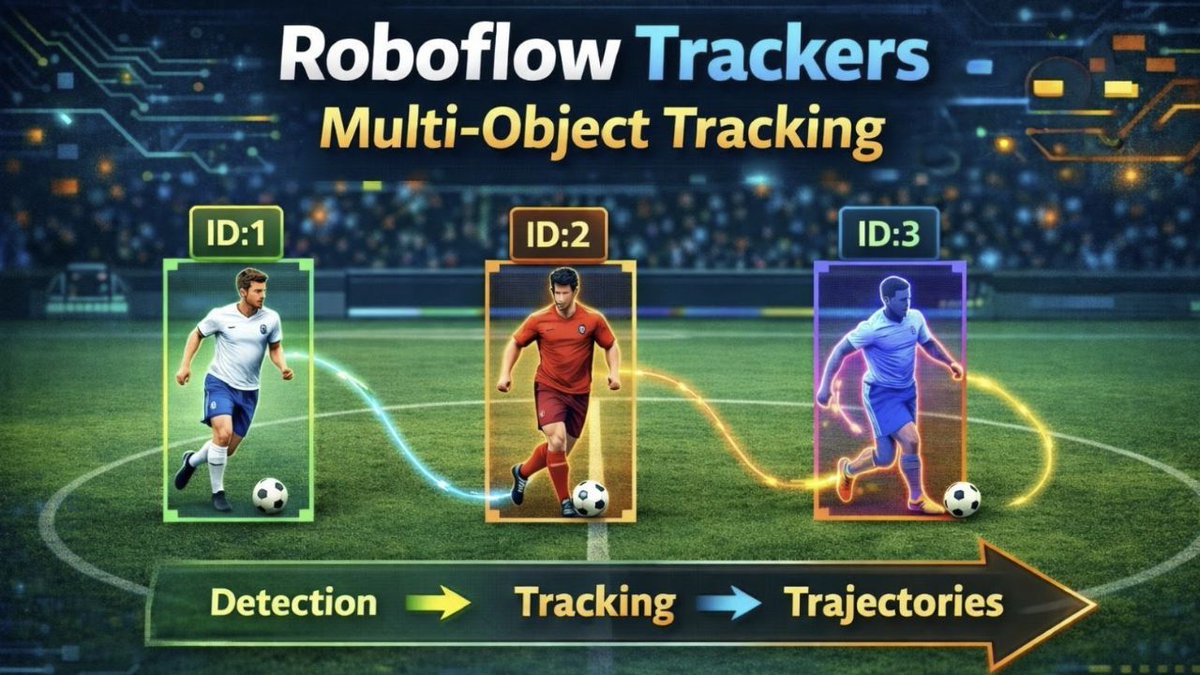
🔍 Mastering Multi-Object Tracking with Roboflow & OpenCV 🏀🚗 From tracking basketball players to monitoring traffic, detection alone isn’t enough-you need Multi-Object Tracking (MOT). With Roboflow Trackers + OpenCV, you can assign persistent IDs to objects across frames, even in high-speed or occluded scenarios. 👉 Learn how SORT & ByteTrack make MOT practical and powerful in real-world pipelines. 🔗 Read the full blog: vist.ly/4vc73 #ComputerVision #OpenCV #Roboflow #MultiObjectTracking #AI #DeepLearning #SportsAnalytics #DroneTech #TrafficMonitoring #ByteTrack #SORT
Satya Mallick tweet media
English
1
1
7
301
Satya Mallick
Satya Mallick@LearnOpenCV·
Chaos Agents: When Multiple AI Systems Interact in Unpredictable Ways In this episode of Artificial Intelligence: Papers and Concepts, we explore Chaos Agents, a concept that examines what happens when multiple AI agents interact, collaborate, or compete within the same environment. While individual models may behave predictably in isolation, their interactions can produce unexpected, emergent behaviors-highlighting new challenges in coordination, stability, and control. We break down why multi-agent systems can become chaotic, how feedback loops and conflicting objectives amplify unpredictability, and what this means for the future of autonomous AI ecosystems. If you’re interested in agent-based AI, system dynamics, or the risks and opportunities of increasingly autonomous systems, this episode explains why Chaos Agents represent a critical area of research in building reliable and scalable AI systems. Resources: Paper Link: arxiv.org/pdf/2602.20021 Interested in Computer Vision and AI consulting and product development services? Email us at contact@bigvision.ai or visit us at bigvision.ai

English
1
1
3
269
Satya Mallick
Satya Mallick@LearnOpenCV·
The Deep Learning Revolution in Object Detection In 2012, AlexNet shocked the world-proving that neural networks could learn features automatically. By 2014, RCNN took it further: generating region proposals, running CNNs on each, and refining bounding boxes. This leap transformed object detection from handcrafted features to deep learning dominance. 🚀 #DeepLearning #ComputerVision #ObjectDetection #AIHistory #AlexNet #RCNN #MachineLearning #AIInnovation
English
1
1
2
484
Satya Mallick
Satya Mallick@LearnOpenCV·
OC-SORT: Improving Object Tracking by Fixing Motion, Not Just Detection In this episode of Artificial Intelligence: Papers and Concepts, we explore OC-SORT (Observation-Centric SORT), an evolution of traditional tracking algorithms that improves how AI systems follow objects in dynamic environments. While earlier methods focused heavily on detection quality, OC-SORT shifts attention to motion modeling-using observations more effectively to maintain stable tracking even when detections are noisy or inconsistent. We break down why standard tracking approaches struggle with occlusions and abrupt movement, how OC-SORT refines object trajectories by correcting motion assumptions, and why this leads to more reliable real-time tracking in practical applications. If you’re interested in computer vision, autonomous systems, or the progression from classic algorithms like SORT to more robust modern approaches, this episode explains why OC-SORT represents a meaningful step forward in object tracking. Resources: Paper Link: arxiv.org/pdf/2203.14360 Interested in Computer Vision and AI consulting and product development services? Email us at contact@bigvision.ai or visit us at bigvision.ai
English
1
0
2
397
Satya Mallick retweetet
FFmpeg
FFmpeg@FFmpeg·
🔥FFmpeg 8.1 "Hoare" has been released! It features experimental xHE-AAC Mps212 + MPEG-H decoding, EXIF metadata, LCEVC metadata, Vulkan compute ProRes/DPX codecs, D3D12 H.264/AV1 encoding + filters, Rockchip H.264/HEVC hwenc, IAMF Ambisonic mux/demux, new filters & more. #release_8.1" target="_blank" rel="nofollow noopener">ffmpeg.org/download.html#…
English
13
64
629
45.8K
Victor
Victor@victor_UWer·
@LearnOpenCV lol nah just have concerningly fast opinions about old CV papers 😅
English
1
0
0
20
Satya Mallick
Satya Mallick@LearnOpenCV·
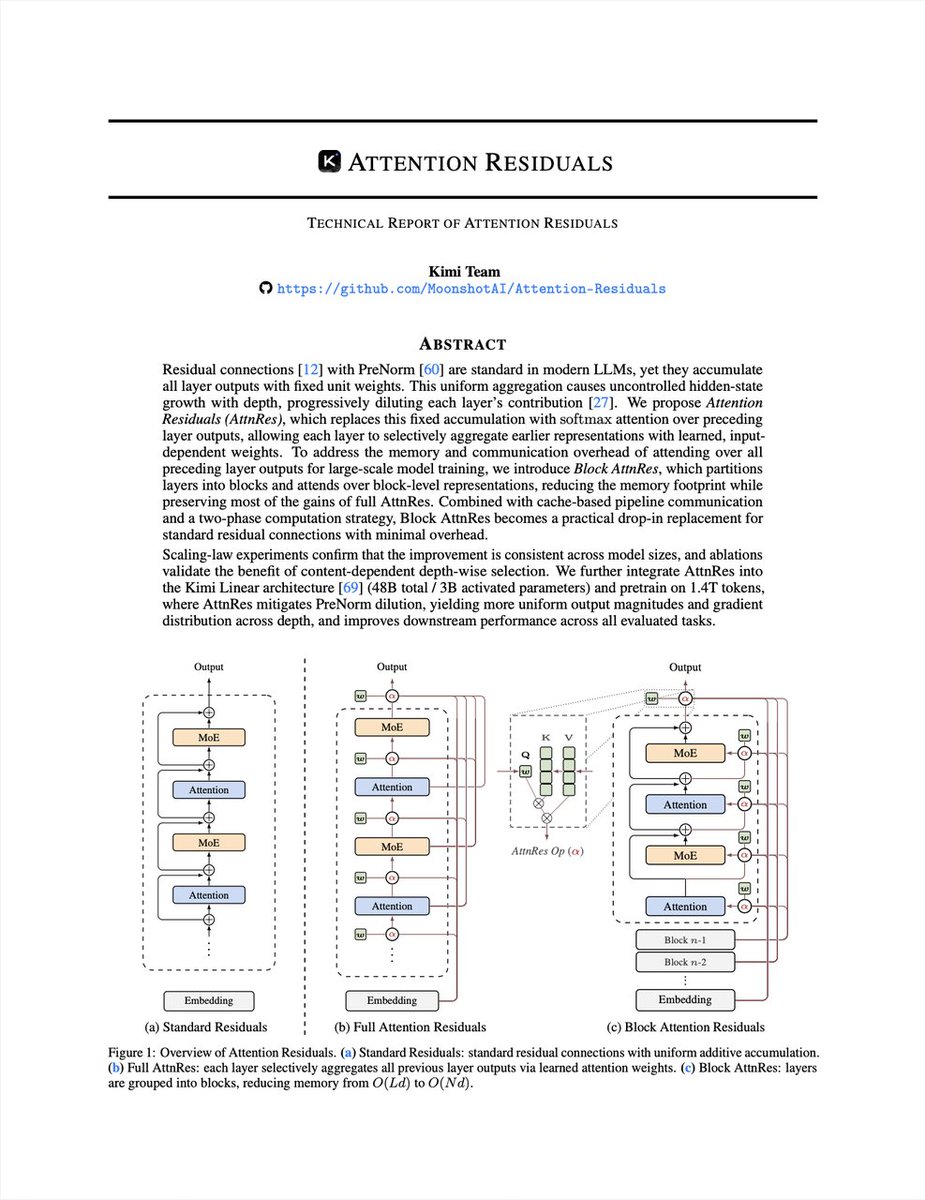
Attention Residuals: Understanding the Hidden Signals Inside Transformer Models In this episode of Artificial Intelligence: Papers and Concepts, we explore Attention Residuals, a concept that reveals how transformer models preserve and refine information as it flows through multiple layers. Instead of each layer completely replacing previous representations, residual connections allow models to carry forward earlier signals while attention mechanisms add new contextual understanding. We break down how residual pathways stabilize deep neural networks, why they are essential for training large transformer models, and what they reveal about how information evolves inside systems like modern language and vision models. If you’re interested in transformer architecture, representation learning, or the internal mechanics of large AI models, this episode explains why attention residuals are a key ingredient behind the power and scalability of today’s foundation models. Resources: Paper Link: github.com/MoonshotAI/Att… Interested in Computer Vision and AI consulting and product development services? Email us at contact@bigvision.ai or visit us at bigvision.ai
English
1
0
5
1.6K
Victor
Victor@victor_UWer·
@LearnOpenCV ngl the residual stream framing completely changed how i think about what attention is actually doing — less 'routing info' more 'running commentary that keeps getting edited' lol
English
1
0
0
37
Kimi.ai
Kimi.ai@Kimi_Moonshot·
Introducing 𝑨𝒕𝒕𝒆𝒏𝒕𝒊𝒐𝒏 𝑹𝒆𝒔𝒊𝒅𝒖𝒂𝒍𝒔: Rethinking depth-wise aggregation. Residual connections have long relied on fixed, uniform accumulation. Inspired by the duality of time and depth, we introduce Attention Residuals, replacing standard depth-wise recurrence with learned, input-dependent attention over preceding layers. 🔹 Enables networks to selectively retrieve past representations, naturally mitigating dilution and hidden-state growth. 🔹 Introduces Block AttnRes, partitioning layers into compressed blocks to make cross-layer attention practical at scale. 🔹 Serves as an efficient drop-in replacement, demonstrating a 1.25x compute advantage with negligible (<2%) inference latency overhead. 🔹 Validated on the Kimi Linear architecture (48B total, 3B activated parameters), delivering consistent downstream performance gains. 🔗Full report: github.com/MoonshotAI/Att…
Kimi.ai tweet media
English
330
2.1K
13.5K
4.9M