Litmaps

1.3K posts

Litmaps banner
Litmaps

Litmaps

@LitmapsApp

Your literature review assistant. Visualize research, find papers, and stay ahead. 🚀

New Zealand Beigetreten Şubat 2021
268 Folgt11.5K Follower
Angehefteter Tweet
Litmaps
Litmaps@LitmapsApp·
Starting a literature review? Try this 5-step approach in Litmaps: 🔎 Add one paper 📖 Explore its map 🌱 Grow your network 🏷️ Tag sub-topics 🤳 Visualize & share Full 5-min tutorial 👉 youtube.com/watch?v=gxm3ah…
YouTube video
YouTube
English
0
1
6
1.2K
Litmaps
Litmaps@LitmapsApp·
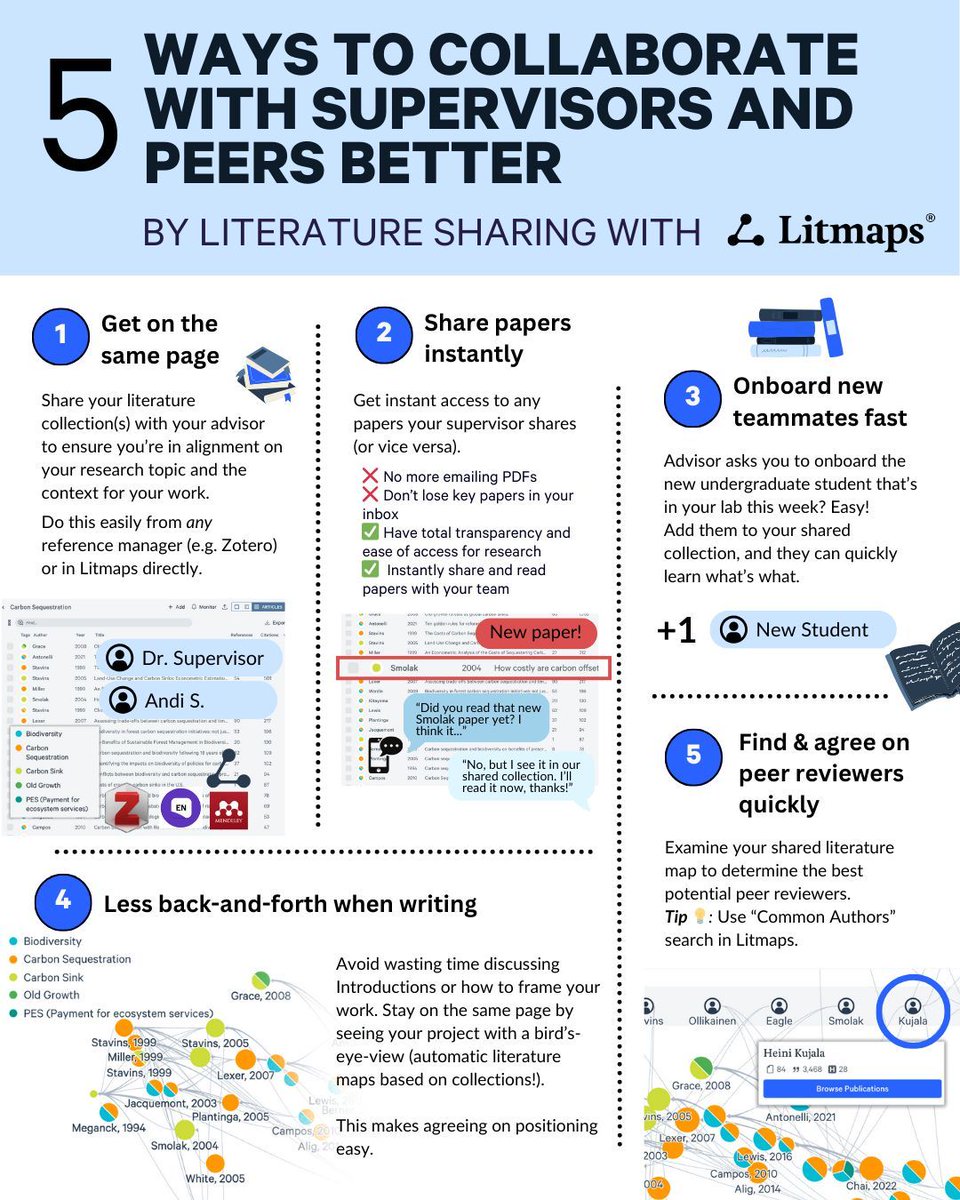
What's harder: Getting your paper done, or getting your advisor to read it? Let's face it, miscommunication with supervisors is painful (and common). 👉 The [surprising] fix? Literature sharing. 📚 A shared library = ✅ Alignment on what matters ✅ Easy paper sharing (no lost PDFs) ✅ Less back-and-forth when writing ✅ Quick agreement on peer reviewers Better communication isn’t more meetings. It’s a shared foundation. How do you stay on the same page with your advisor? 👋 Follow @LitmapsApp | 🧪 litmaps . com #PhDLife #ResearchTips #LiteratureReview
Litmaps tweet media
English
0
2
4
790
Litmaps
Litmaps@LitmapsApp·
That’s it. You’re no longer buried under millions of results! You’ve built a focused, credible, research foundation. ✨ You’ll never read 2,629,995 papers. But with the right system, you don’t need to. You only need to read the right papers that shape your field. Try it for yourself with Litmaps. How many papers did you read for your literature review? Share with us below!
Litmaps tweet media
English
0
0
0
373
Litmaps
Litmaps@LitmapsApp·
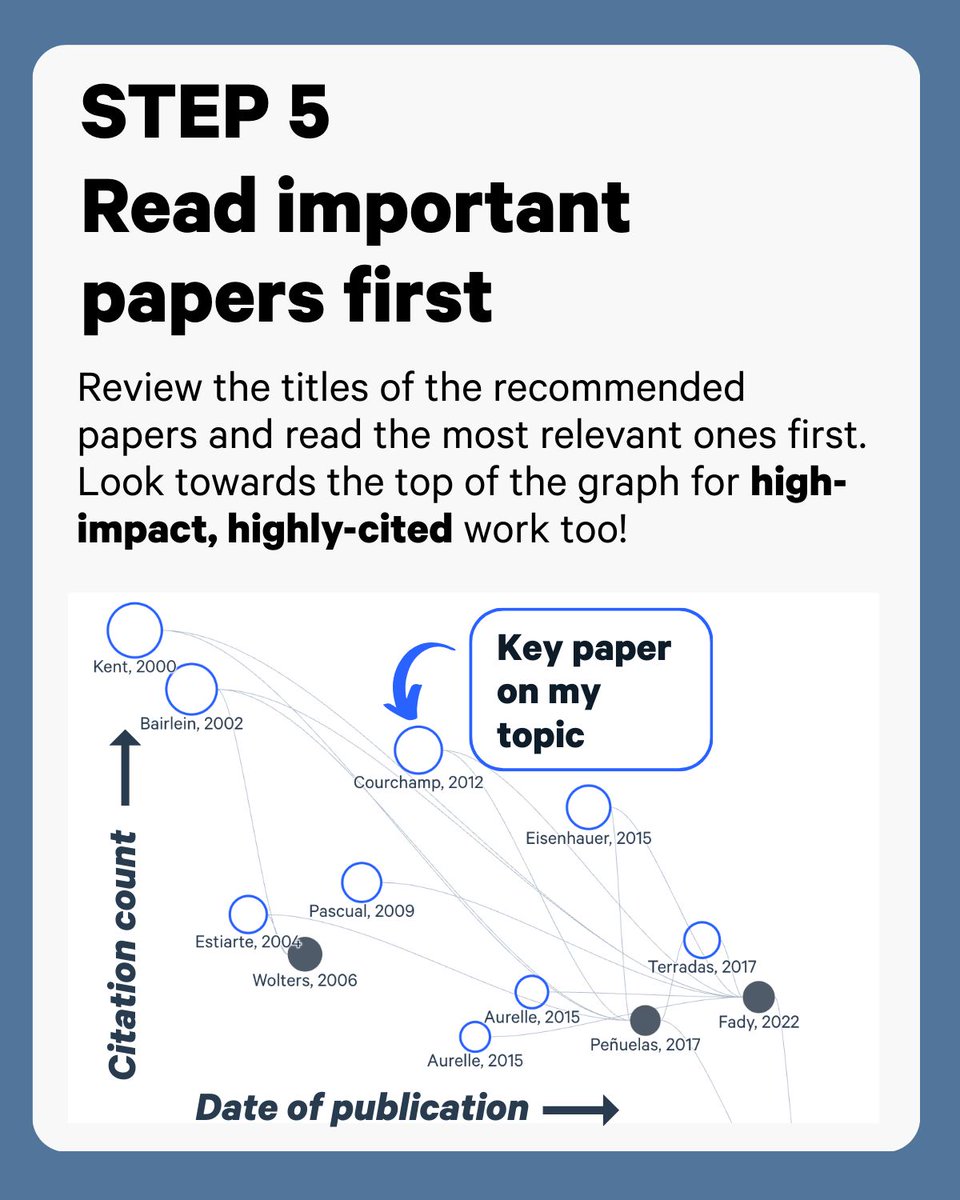
5️⃣ Step 5: Review recommendations smartly 👀 Skim titles. If relevant, scan the abstract. Still relevant? Open the PDF, read, and save. Always check: ✅ Journal quality, ✅ Author reputation, ✅ How it links back to your seed papers. HINT: Look at papers towards the top. Those have the most citations (sorted on the y-axis). It's a quick way to find high-impact work in your field.
Litmaps tweet media
English
1
0
0
435
Litmaps
Litmaps@LitmapsApp·
You open Google Scholar, type in your research topic, and… 💥 2.63 million results. (literally) The top five look useful, but what about the other 2,629,995? 🤔 Are you missing something important? 😥 Could skipping a key paper undermine your credibility? 😰 How could you ever know when you’ll never read even a small fraction? But, there's a better way. 5 steps to finding the most important papers first: 👇
Litmaps tweet media
English
1
1
6
623
Litmaps
Litmaps@LitmapsApp·
😵 Understanding how a field has developed is overwhelming. Even advanced researchers struggle to: 🔹 Trace how ideas evolved 🔹 Identify key contributors & papers 🔹 See how it all connects over time The result? Endless reading lists + messy notes… but no clear picture. That’s where Litmaps helps. We let you map, visualize, and connect the literature so you can actually see the field. 👇 🔹 Missing the big picture? → Map every paper in one interactive view. 🔹 Don’t see how topics connect? → Tag by topic, method, or theory. Colors show interactions. 🔹 Can’t track change over time? → Papers sorted by publication date show the evolution instantly. 🔹 Want the lineage of ideas? → Citation + timeline views reveal the intellectual “family tree.” 🔹 Afraid of reinventing the wheel? → Find all potential papers, ensure total coverage. With Litmaps, the story of a field becomes visible. 👋 Follow us at @LitmapsApp #PhDLife #ResearchTips #AcademicWriting #Litmaps
Litmaps tweet media
English
0
0
7
618
Litmaps
Litmaps@LitmapsApp·
Your biggest research mistake? Choosing the wrong topic. Most think once they “pick” a topic, they’re done. Not true. ⚡ Fields move fast. Today’s topic can be outdated tomorrow. ⚡ Reading more can collapse your topic entirely. ⚡ A good idea isn’t enough. It has to fit a journal or conference. ⚡ Too broad = drowning. Too narrow = no one cares. ⚡ Feasibility matters: time, data, resources. This is why so many researchers get stuck at the start. Or hit a brick wall later. Selecting & refining your topic is the most important step. Get it right → everything else gets easier. Get it wrong → months (or years) wasted. Here’s our step-by-step guide to finding the best research topic. 👇 🔗👍Share to help a fellow researcher.
Litmaps tweet media
English
0
2
9
628
Litmaps
Litmaps@LitmapsApp·
🚨 Struggling to write your introduction? The intro of your research paper isn’t about genius. It’s about structure. That’s where the C.A.R.S. Model (Creating A Research Space) comes in. It’s the cheat code researchers use to nail their introductions. 3 simple moves 👇 1️⃣ Establish a territory Show why your topic matters. 👉 “Climate change is reshaping ecosystems worldwide…” 2️⃣ Establish a niche Expose the gap/problem. 👉 “But little is known about how urban pollinators adapt to heatwaves…” 3️⃣ Occupy the niche Show your contribution. 👉 “This study examines how bee populations in mid-sized cities respond to rising summer temps.” 💡 Reviewers love this flow. Follow it → your intro writes itself. 🔗Share to help a fellow researcher 👋 Follow for more tips @LitmapsApp #PhDLife #ResearchTips #AcademicWriting #Litmaps
English
0
1
8
690
Litmaps
Litmaps@LitmapsApp·
🔍 Most researchers cite the same small cluster of papers & miss hidden, relevant studies outside their bubble. No big deal... until a reviewer catches it. 👀 Here’s why it happens: ▪️ You start with the papers you know ▪️ You follow their references ▪️ You circle the same network everyone else cites But the most impactful insights often come from outside that bubble. The key? Change how you search. With Litmaps you can change the search algorithm to find papers based on: 1️⃣ Connection → Trace citation networks. See who cites or is cited by the papers you know. 2️⃣ Similarity → Find conceptually related papers not even connected by citations. That’s how you uncover hidden gems that can change your project. 👋 Follow @Litmaps 🧪 Try it free: litmaps . com #PhDLife #ResearchTips #Litmaps #AcademicTwitter
Litmaps tweet media
English
0
1
14
801
Litmaps
Litmaps@LitmapsApp·
🤫 Here’s something your supervisor won’t tell you… You don’t need to read everything for your literature review. And it doesn’t have to be overwhelming. 💡 A lit review is a process, not an end product. Here’s the strategy: 1. Define your topic ✍️ ❌ Too broad: “Why do birds migrate?” ✅ Specific: “How is avian migration influenced by light pollution in South America?” 2. Search strategically 🔍 Don’t just plug in your whole question. ✔️ Search keywords (“light pollution,” “bird migration”) ✔️ Explore connections between papers (tools like Litmaps help). 3. Organize & evaluate 🧐 Group sources by themes, methods, or findings. Stay organized with Litmaps, Zotero, or Mendeley. 4. Synthesize 📚 Compare, contrast, highlight gaps. This is where your insight emerges. 5. Write 📜 Now writing is just assembling what you’ve already mapped out. Your review should position your work, not just summarize. 🔄 Bonus: Keep it alive with alerts, journals, and Litmaps Monitor. 📚 Lit reviews done with strategy aren’t just faster. They’re better. 👉 What’s YOUR lit review strategy? #PhDLife #ResearchTips #LiteratureReview #AcademicWriting #Litmaps
Litmaps tweet media
English
0
28
98
6.1K
Litmaps
Litmaps@LitmapsApp·
Struggling to pick a research topic? It’s easy to get buried in PDFs with no clear direction. The better approach? 👉 Map the field first. Here’s a simple 5-step process to do it 👇 Step 1: Start with a seed paper Pick one paper you know. Map its connections with Litmaps to see who it cites & who cites it. Step 2: Review the signals Look at the authors, methods, and ideas that dominate this paper's local network. Step 3: Expand your map Add more papers. You’ll learn not just by reading, but by seeing how papers connect. Step 4: Map the whole field Track sub-topics, spot different directions, and notice the gaps no one has filled. Step 5: Choose your topic with confidence From this bird’s-eye view, you’ll know what’s exciting, relevant, and meaningful. 💡 Why this works: By building a structured overview of the field you can see what matters, what’s missing, and where you can contribute. 👉 How did you choose your research topic: by accident, advice, or strategy? #PhDLife #ResearchTips #LiteratureReview #AcademicWriting #Litmaps
Litmaps tweet media
English
0
5
21
1.7K
Litmaps
Litmaps@LitmapsApp·
🚨 Think you’re done with your literature review? Here’s how to check in 10 seconds (and avoid Reviewer 2’s wrath): ❓ Did you cover ALL relevant papers? ❓ Did you miss key citations? ❓ Will you get called out for forgetting something? 👉 Run a “done-check” ON your papers with Litmaps (free). 1️⃣ Import your papers 2️⃣ Run "Explore" 3️⃣ Review your Litmap to spot anything you missed ✅ No second-guessing. When you’re done, you’ll know. What’s your trick for finishing a lit review? 👇
English
0
1
7
593