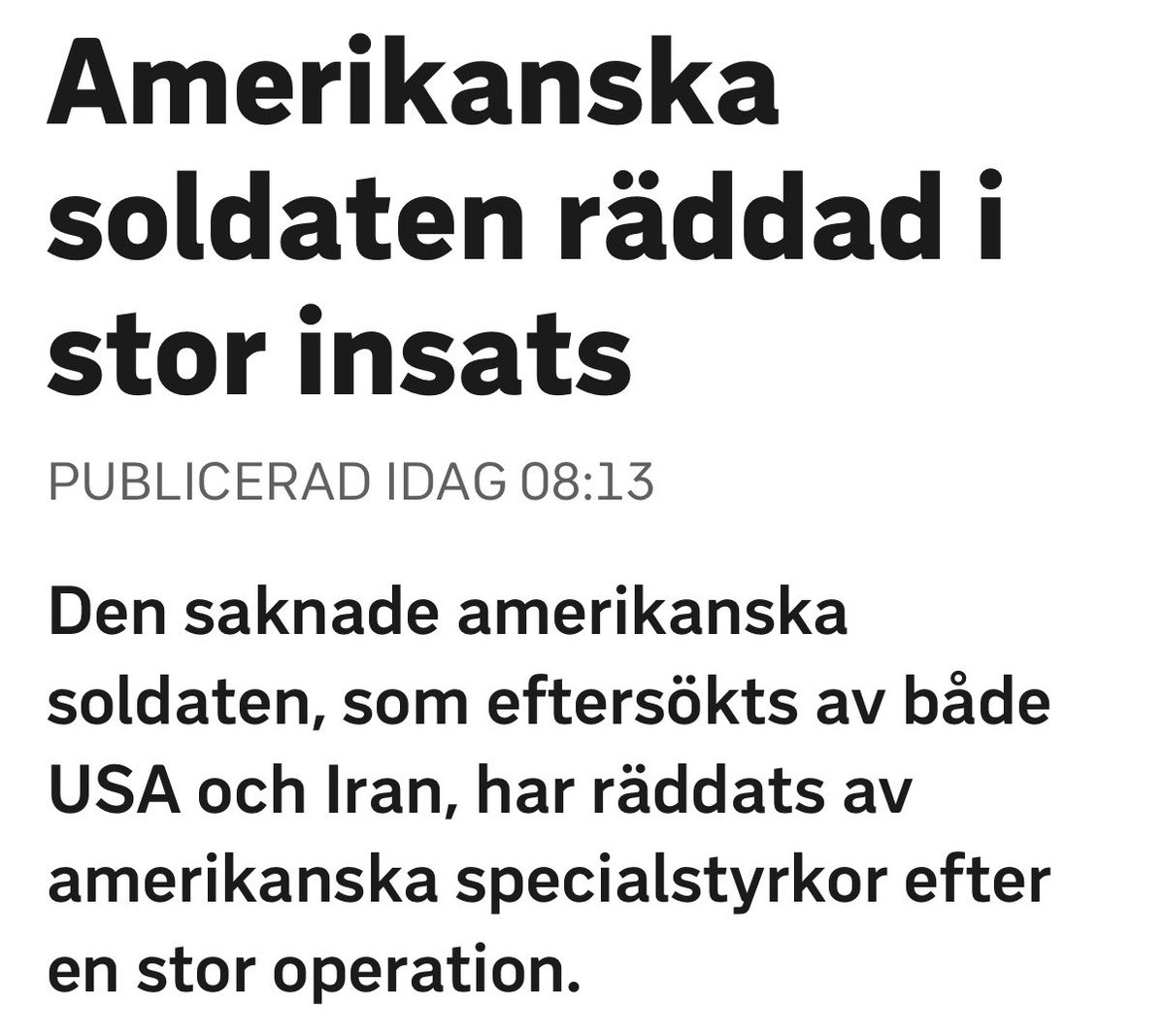
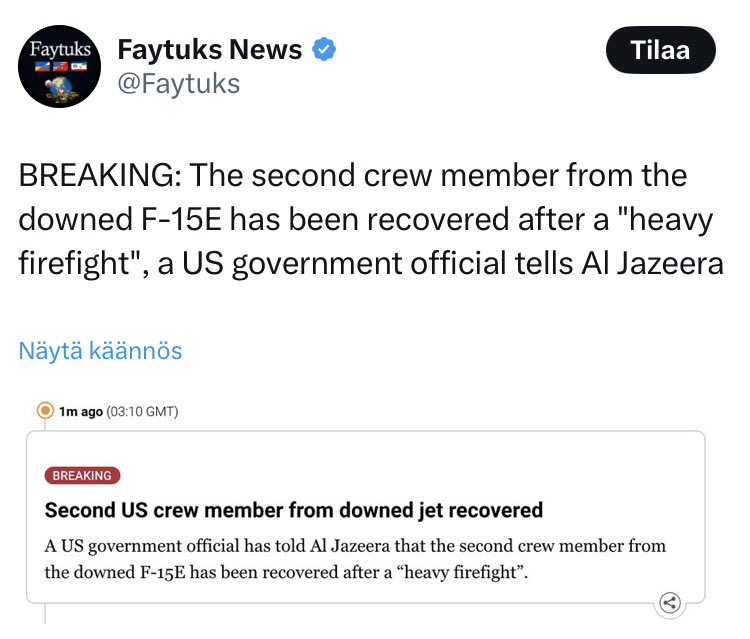
@RichardHerrey Skönt för honom. Men du har haft väldigt mycket fokus på 1 (!) Amerikansk militär. Hur mycket har du skrivit om den bombade flickskolan med 170 dödade barn. Hur mycket var deras liv vört för dig?
Svenska
Magnus
3.8K posts






BREAKING: All young men between the ages of 17 and 45 are now no longer allowed to leave Germany for more than three months without permission.
















Israel Has Hit Nearly Everything It Planned To. Now What?... 🚨 OPERATIONAL UPDATE: ISRAEL U.S. WAR WITH IRAN - Reporting Window: Last 24 Hours Israel has now largely completed its preplanned strategic strike package inside Iran, while Iran’s response continues to degrade in scale but not in intent. At the same time, the northern front is heating back up, and regional actors are positioning for what comes next rather than what comes now. ✈️ STRATEGIC AIR CAMPAIGN OVER IRAN Israel has effectively finished its target list. The IDF now confirms that nearly all “vital and strategic” targets have been struck. Over the past 24 hours, operations focused on depth and completeness rather than expansion. Strikes hit a wide geographic spread including Tehran, Shiraz, Kermanshah, and Ahvaz, with particular emphasis on military-industrial infrastructure. Key targets included: *⃣ Approximately 20 weapons production and R&D fa cilities in Tehran *⃣ Mehrabad Airport and adjacent regime-linked infrastructure *⃣ A chemical supply node tied to SPND, Iran’s weapons development apparatus At the same time, Israel continued its shift into economic warfare. The destruction of major components of Mobarakeh Steel, Iran’s largest industrial complex, is not tactical. It is strategic degradation of long-term national capacity. What changed here is straightforward. This is no longer a shaping campaign. This is a completion phase. Israel has moved from identifying targets to executing them, and now toward locking in the strategic outcome. 🚀 IRANIAN MISSILE ACTIVITY Iran is still responding, but the character of that response has changed. In the latest barrage, roughly 10 ballistic missiles were launched in the opening wave. That makes it one of the larger salvos in recent weeks, but still far below earlier peak volumes. Most were intercepted, and physical damage was limited, though civilian impact remains real, particularly through panic, injuries, and indirect casualties. The important distinction is this: Iran still has the stockpile, but not the operational tempo. Its retaliation doctrine remains intact. It continues to mirror categories of targets struck inside Iran, expanding at times to civilian and economic infrastructure in Israel and across the Gulf. But the scale is no longer overwhelming. It is calibrated. 🔥 NORTHERN FRONT: LEBANON ESCALATION While Iran slows, the northern front is doing the opposite. Hezbollah resumed intense rocket fire into northern Israel, including a direct hit in Kiryat Shmona that caused multiple injuries. In response, Israeli operations intensified significantly. In the last 24 hours: *⃣ Over 40 Hezbollah fighters were killed *⃣ A senior Hezbollah commander was eliminated in Beirut *⃣ The IDF began systematically destroying homes used for launch positions and surveillance This marks a clear doctrinal shift. Israel is no longer just responding to fire. It is shaping the battlefield, likely toward a buffer-zone model similar to early phases of Gaza operations. 🌍 REGIONAL AND GLOBAL DIPLOMATIC MOVEMENT Diplomatic activity is accelerating for one reason. The military phase is stabilizing. President Trump again stated that the war is nearing completion, though notably without offering a clear timeline or exit structure. That ambiguity is now a central feature of the conflict’s political layer. At the same time: *⃣ Pakistan has emerged as a potential mediator between the U.S. and Iran *⃣ Gulf and European states are pushing for de-escalation frameworks *⃣ Discussions are increasingly focused on maritime security and the Strait of Hormuz The UAE, in particular, has highlighted the scale of Iranian regional attacks, reporting hundreds of intercepted missiles and drones while framing Iran’s actions as violations of sovereignty and international law. This is no longer just about the battlefield. It is about shaping the post-war order. ⚠️ INTERNAL IRAN PRESSURE Inside Iran, pressure is building across multiple fronts. The economy is entering a wartime shock phase, with inflation rising sharply and essential goods becoming harder to access. At the same time, the regime continues internal crackdowns, including executions tied to earlier protests. There are also signs of instability at higher levels. The reported assassination attempt on former foreign minister Kamal Kharazi adds another layer of uncertainty, whether internal or externally driven. Public trust is eroding. Information control is weakening. The internal environment is becoming more volatile, not less. 🧭 THE BIG PICTURE What changed in the last 24 hours is not the scale of the war. It is the clarity of its trajectory. Israel has largely completed its strategic objectives inside Iran. Iran continues to respond, but at a reduced and more controlled pace. The center of gravity is shifting away from large-scale strikes and toward political positioning. At the same time, the Lebanon front is emerging as the most active and unpredictable theater. 🧠 MY ASSESSMENT This is the phase most observers misread. The war is not ending because Iran has collapsed or because stability has been achieved. It is moving toward an endpoint because the core objectives have been demonstrated. Israel and the United States have shown that they can penetrate Iran at will, dismantle critical infrastructure, and do so without being pulled into a prolonged ground conflict. That changes the strategic equation. Even if the regime remains in place, the message is now unmistakable. Military dominance does not require occupation. Deterrence no longer depends on long wars. And that lesson will not be lost on Iran, Hezbollah, the Houthis, or any actor watching how this conflict unfolded.