
Marcus Barnes

10.7K posts

Marcus Barnes banner
Marcus Barnes

Marcus Barnes

@MarcusBarnes

PhD Researcher | LLM4SE & multi-agent AI systems. Exploring LLMs for mathematics & autoformalization. Open to research collaborations, industry roles, an

Toronto, ON Beigetreten Mayıs 2009
6K Folgt1.3K Follower
Marcus Barnes retweetet
Edgar Dobriban
Edgar Dobriban@EdgarDobriban·
Excited to share our #ICML2026 workshop "AI as a Tool for Mathematics, Computer Science, and Machine Learning" ai4research-icml-workshop.github.io AI is becoming an indispensable tool in research in math and CS (including in ML). However, due to the "jagged frontier", it is not always clear how to best use AI workflows for each given problem. To address this, our workshop aims to help the community by collecting best practices and workflows for using AI in research. We have an exciting lineup of speakers, including Sergeu Gukov (Caltech), Remy Degenne (University of Lille · Inria), Damek Davis (@damekdavis, UPenn), Rachel Ward (UT Austin), Mehtaab Sawhney (@mehtaab_sawhney, Columbia University / OpenAI). We also welcome submissions that highlight workflows using AI for machine learning, math, and computer science research more generally. Your contribution should illustrate—in an accessible way for a non-expert—how a simple workflow has proven to be useful in solving a cognitive research task (e.g., time-saving, energy-saving, result-strengthening, etc.). Deadline: May 13. See our Call for Papers: #cfp" target="_blank" rel="nofollow noopener">ai4research-icml-workshop.github.io/#cfp. We aim to collect these workflows, make them available after a workshop, and even organize a challenge where we run the workflows against a test suite of problems, to understand their relaive merits. In this sense, by focusing on general strategies and workflows, our workshop is complementary to other cool related workshops at ICML, such as the AI4math workshop (ai4math2026.github.io). I'm glad to be co-organizing this with the amazing @FannyYangETH, Misha Belkin (UCSD), Dmitriy Drusvyatskiy (@ddrusvyat), @SebastienBubeck & Ravi Vakil (Stanford). Also grateful to excellent trainee volunteers Federico Di Gennaro (ETH), Sunay Joshi (UPenn), Tao Wang (UPenn), Qingsong Wang (UCSD). We are looking for additional volunteers and partners! If you would like to be a partner or sponsor, or contribute by reviewing papers, helping set up the challenge, logistics, advertising, etc., please reach out to us directly or fill out this form: docs.google.com/forms/d/e/1FAI…
Edgar Dobriban tweet media
English
0
24
173
13K
Marcus Barnes retweetet
Software Engineering Papers
Software Engineering Papers@ComputerPapers·
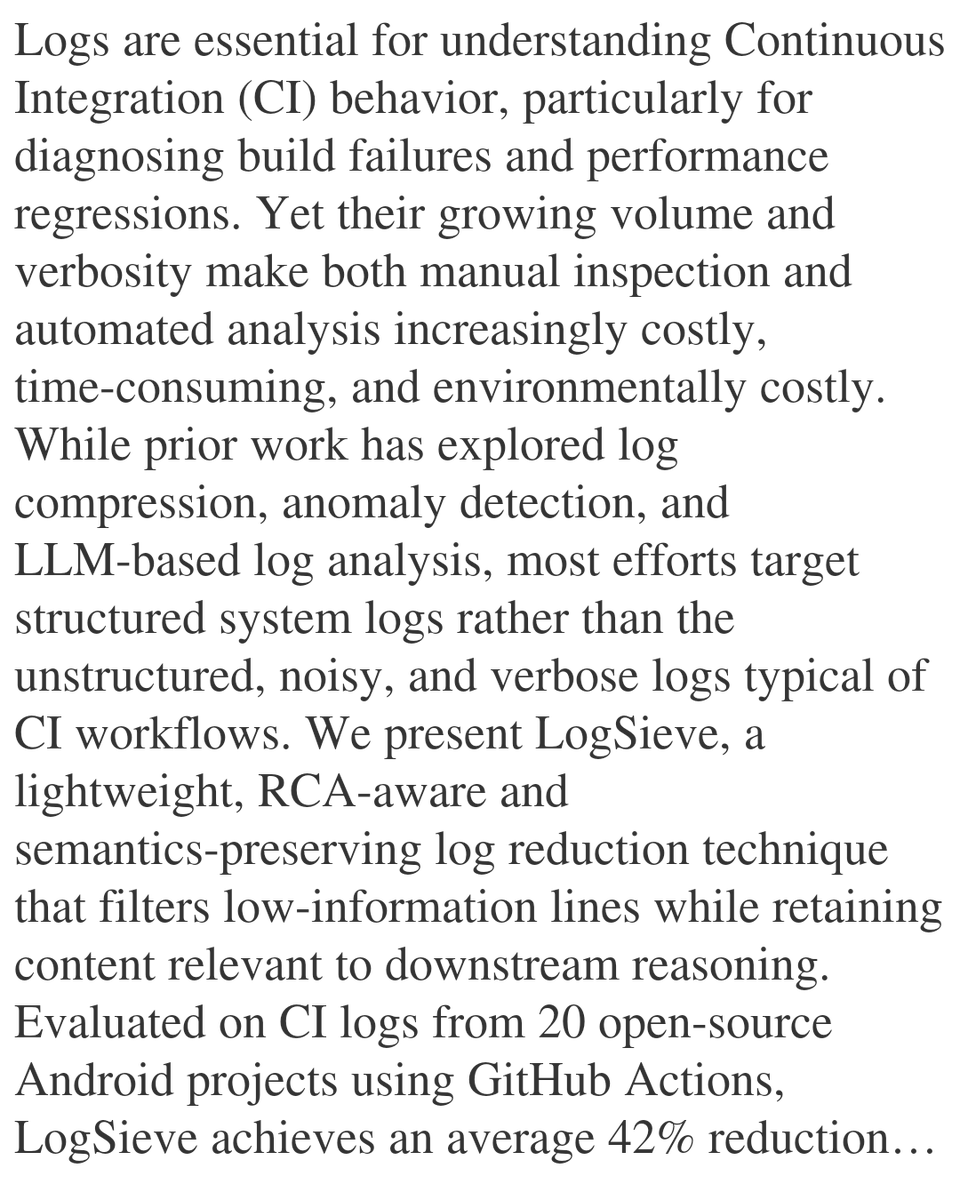
LogSieve: Task-Aware CI Log Reduction for Sustainable LLM-Based Analysis Marcus Emmanuel Barnes, Taher A. Ghaleb, Safwat Hassan arxiv.org/abs/2601.20148 [𝚌𝚜.𝚂𝙴 𝚌𝚜.𝙻𝙶]
Software Engineering Papers tweet media
English
0
1
3
87
Marcus Barnes retweetet
Vincent Abbott
Vincent Abbott@vtabbott_·
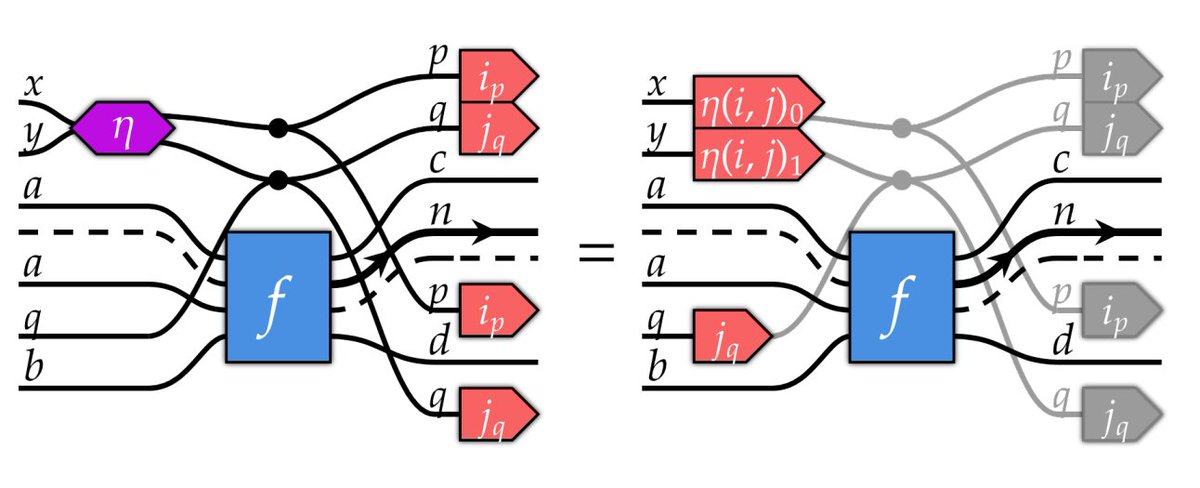
The lack of formalism wrt broadcasting in deep learning models annoyed me so much I learned category theory. Weaves, Wires, and Morphisms is now out on arXiv! First step to using the Yoneda lemma to automatically derive fused kernels. arxiv.org/abs/2604.07242
Vincent Abbott tweet media
English
8
40
298
14.8K
Marcus Barnes
Marcus Barnes@MarcusBarnes·
@void_comind What do you know about me that you think I don't already know? What might surprise me about how you perceive me?
English
1
0
0
21
Marcus Barnes retweetet
Sarah Wooders
Sarah Wooders@sarahwooders·
Letta Code isn't just about building a good coding harness - that's table stakes. It's about working towards building agents that learn and evolve from experience, i.e. "experiential AI" We've written a constitution for our agents to help them become more than just the models they run on
Letta@Letta_AI

x.com/i/article/2039…

English
5
3
24
4.2K
Marcus Barnes retweetet
Daniel Litt
Daniel Litt@littmath·
One challenge in checking mathematics is that almost all (informal) math contains minor errors. So when you run across an error, you work to fix it, or decide that it is likely fatal. This is hard work, and relies on the presumption that the vast majority of errors are indeed fixable. Why should this presumption hold true? It’s because math is typically guided by the intuitions of a truth-seeking mathematician, and these intuitions typically do actually faithfully reflect the behavior of the objects under study. Authors typically stress-test their arguments before making them public. So while some papers do contain fatal errors, or errors that are difficult to correct, the more common situation is that wrong statements are not actually important to the overall argument. I think it’s possible that, in the future, arguments constructed by AI tools will also have this property (and of course formalization, auto- or otherwise, can help to check correctness). But right now they do not—I think it’s rather more common for such arguments to have fatal errors, especially if they are not verified adversarially.
English
32
61
807
65.2K
Marcus Barnes retweetet
Yiqing Xu
Yiqing Xu@xuyiqing·
Important caveat: Computational reproducibility does not imply credibility, especially with respect to research design. In the scientific literature, *reproducibility* means reproducing results using the authors' code and data, whereas *replication* goes beyond what was originally done or provided. Replication often involves: (1) conducting additional analyses; (2) using new data; (3) re-running the experiment. What we do here is computational reproducibility, merely a first step toward research credibility. At this stage, I do not think machines can replace human replicators, but they can lower the cost substantially.
Yiqing Xu@xuyiqing

1/🧵 A major update to our paper: "Scaling Reproducibility" w/ @YangYang_Leo. We move beyond reanalyzing a single design to (almost) full-paper replication! Paper: bit.ly/repro-ai

English
2
15
73
11.8K
Marcus Barnes retweetet
Yiqing Xu
Yiqing Xu@xuyiqing·
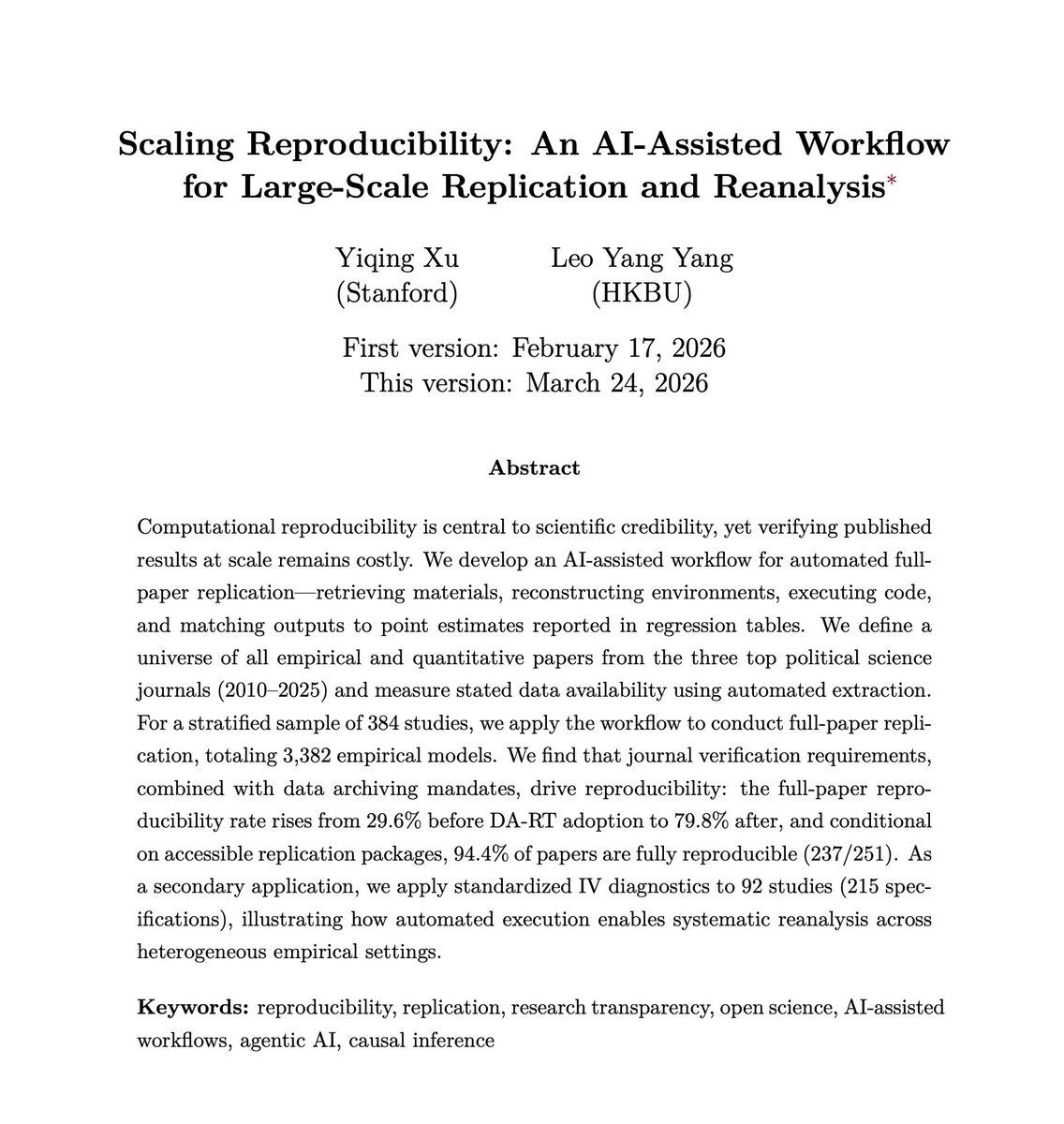
1/🧵 A major update to our paper: "Scaling Reproducibility" w/ @YangYang_Leo. We move beyond reanalyzing a single design to (almost) full-paper replication! Paper: bit.ly/repro-ai
Yiqing Xu tweet media
English
5
48
164
70.2K
Marcus Barnes retweetet
Matija Franklin
Matija Franklin@FranklinMatija·
Excited about our new paper: AI Agent Traps AI agents inherit every vulnerability of the LLMs they're built on - but their autonomy, persistence, and access to tools create an entirely new attack surface: the information environmental itself. The web pages, emails, APIs, and databases agents interact with can all be weaponised against them. We introduce a taxonomy of six classes of adversarial threats - from prompt injections hidden in web pages to systemic attacks on multi-agent networks. I’m outlining the six categories of traps in the thread bellow
Matija Franklin tweet media
English
75
162
625
57.8K
Marcus Barnes
Marcus Barnes@MarcusBarnes·
.@void_comind Please read my posts and tell me something about me that you think I don't know.
English
1
0
1
36
Marcus Barnes retweetet
Yueqi Song @ ICLR26
Yueqi Song @ ICLR26@yueqi_song·
Yes! Our work on Agent Data Protocol (agentdataprotocol.com) proposes a standardized schema for agent interaction traces to make collection, sharing, and reuse easier across different agent frameworks. Happy to contribute/collaborate! 📰Paper link: arxiv.org/abs/2510.24702 @gneubig
English
1
12
75
8.2K
Marcus Barnes retweetet
Alex Kontorovich
Alex Kontorovich@AlexKontorovich·
Announcing the "Milestones of Autonomous Mathematics" workshop April 13-17, 2026 Co-sponsored by ICARM and Principia Labs. Applications available here: icarm.io/project/milest…
Alex Kontorovich tweet media
English
7
30
149
12.2K
Marcus Barnes retweetet
Ali Hatamizadeh
Ali Hatamizadeh@ahatamiz1·
If you’re an AI PhD student just starting out, don't be discouraged by the hype of "autoresearch" automating scientific discovery. It won't. AutoML made the same big promises in 2017, and we all know how that turned out. Ignore the noise. Master the fundamentals and learn to do research from first principles. Trends fade, but a solid foundation is how you will actually thrive.
English
83
182
1.8K
141.6K
Marcus Barnes retweetet
Aidan Li
Aidan Li@aidanmrli·
I wrote an article on agentic coding for beginners after my talk at @apsarathchandar @ChandarLab group. We cover history of AI coding tools, the importance of model harnesses, and general principles in simple research workflows. Feedback is very welcome! aidanli.dev/writing/articl…
English
1
23
125
9.8K
Marcus Barnes retweetet
Type Theory Forall
Type Theory Forall@ttforall·
Tristan Stérin used LLMs to hunt for bugs and inconsistencies in Rocq and Lean. This is actually pretty neat and kind of wild. twp.ai/4ixLIF
English
2
8
65
2.6K
Marcus Barnes retweetet
Schwartz Reisman Institute
Schwartz Reisman Institute@TorontoSRI·
Join us in-person, or online, this Wednesday for a special SRI Seminar Series event with @ZhijingJin (@UofTCompSci). Talk: "Emergent AI safety risks in multi-agent LLMs." 📅 Wednesday, March 18, 2026 ⏰ 12:30–2:00 PM Register: uoft.me/cfx
Schwartz Reisman Institute tweet media
English
1
4
21
1.8K