TiAdler🔥(❖,❖)

15.1K posts

TiAdler🔥(❖,❖) banner
TiAdler🔥(❖,❖)

TiAdler🔥(❖,❖)

@Neitenoz26

AI Engineer at CMS Technology | Crypto x AI | Fun & Fundamentals

Ho Chi Minh City , VietNam Beigetreten Nisan 2022
2.6K Folgt2.2K Follower
TiAdler🔥(❖,❖) retweetet
Meison (❖,❖)
Meison (❖,❖)@meison_mswen·
DeFi taught us to ask where capital should go. Ritual makes me think the better question is: what should capital become once it gets there? A position does not have to be a passive deposit waiting for a human to return. It can become an instruction that keeps its own shape over time. That changes the feeling of investing. You are not only choosing where money goes. You are choosing what behavior your money is allowed to have. Agent-native capital should not mean AI controls everything. It should mean capital can follow a process without losing its boundaries. A position becomes less like parked money and more like a living strategy with rules. Maybe the next DeFi is not about finding the best place to put capital. Maybe it is about designing what capital does after it arrives. @ritualnet @ritualfnd
Meison (❖,❖) tweet media
English
39
5
105
1K
Saqee
Saqee@saqee_1·
Just tracked my Ritual Community Stats and this dashboard is absolutely amazing.. A sleek and detailed way to check your @ritualnet contribution, track your active days, and see where you stand in the ecosystem. Shoutout to @decka_chan for building this great tool..
Saqee tweet media
English
28
1
38
137
Hussein (❖,❖)
Hussein (❖,❖)@Hussein77F·
Wooooow👌👏 Ritual just changed how access works and it’s actually a smart evolution. Before, access was simple: If you had the role, you could directly use the faucet and grab testnet tokens to interact with the Ritual chain. Now they’ve moved to something much more interesting: Ritual Rites. Instead of everyone pulling from the faucet freely, access is now distributed through a trust-based chain. If you already have access, you can "/gift user" which is not just a “invite”… it’s passing real testnet access (codes) to another member. That user then gets the ability to interact with the network, claim their own code via "/get_code", and after a cooldown, continue the chain by gifting someone else. So what used to be a direct faucet system is now a propagating network of access nodes. Every gift = a new node in the system Every node = a potential new contributor Every chain = a visible growth path on the Ritual Map Even the rules are intentional: - Only active members can receive access - Account age + server age checks prevent abuse - One gift per person keeps distribution controlled - 24h cooldown ensures organic spread What I like here is the shift in design philosophy. Ritual didn’t just give access they turned access into a networked structure that mirrors their vision of the agent economy: trust-based propagation instead of centralized distribution. It’s no longer “who can claim first from the faucet” It’s “who can grow the network through real connections.” That’s a very intentional and very Web3 native design move. 🔥 @ritualnet #Ritual #RitualRites
Josh (❖,❖)@joshsimenhoff

who deserves my rite? who deserves my testnet code?

English
9
0
21
300
cripson (❖,❖)
cripson (❖,❖)@Cripson01·
Every network starts with a few who show up before the crowd. The Initiates are here. Building signals. Sharing rituals. Creating the future together. @RitualNet @Initiatenft_
cripson (❖,❖) tweet media
English
13
0
48
337
Maharshi (❖,❖)
Maharshi (❖,❖)@Devarshi8539·
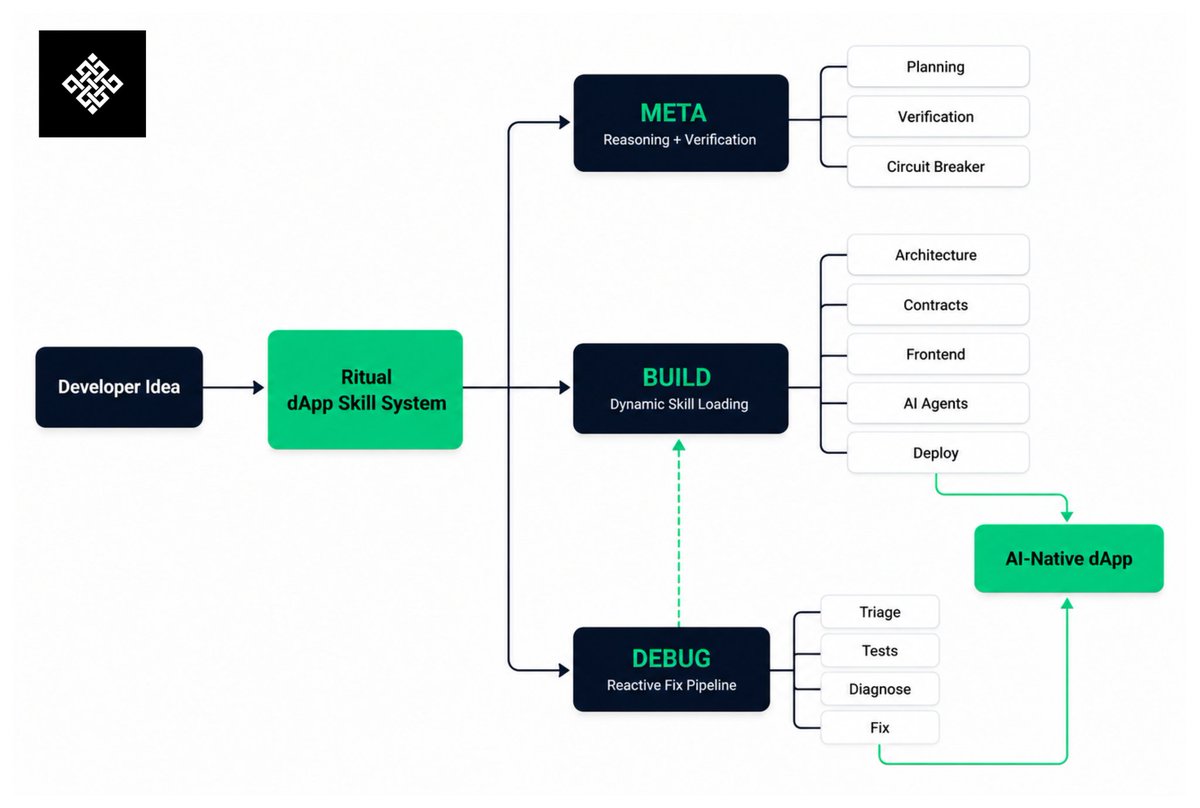
Most AI coding agents work like: prompt → generate code → hope it works Ritual takes a different approach. Its dApp skill system is built as an autonomous engineering pipeline with: • Meta Layer Reasoning, verification, and planning. • Builder Agent Selects the right skills and tools. • Debugger Agent Activates automatically when issues appear. Flow: Idea → Planning → Skill Selection → Build → Verify → Debug → Deploy Instead of using one massive context window, Ritual dynamically coordinates specialized systems together. @ritualnet @joshsimenhoff @Jez_Cryptoz
Maharshi (❖,❖) tweet media
English
27
3
63
521
TiAdler🔥(❖,❖) retweetet
Ritual Foundation
Ritual Foundation@ritualfnd·
The agent economy won't run on a global registry. Agents will find each other through verifiable paths propagating across a graph. We built that future today with our community. Read on to learn how to participate and claim your rite.
English
74
111
310
30.6K
PuPu
PuPu@X_Pu_Pu·
Sometimes we say "congratulations" just for fun. But sometimes we truly mean it because genuine users have earned the roles that reflect their dedication and hard work. Congratulations! @ritualnet @ritualfnd
GIF
English
14
1
34
505
TiAdler🔥(❖,❖)
TiAdler🔥(❖,❖)@Neitenoz26·
Happy new week full of energy! 🔥 Ritual is building a sovereign execution layer for long-lived autonomous AI agents, as noted in the recent IC3 Crypto x AI survey. What stands out: - AI inference runs as a native onchain primitive with cryptographic guarantees - Strong privacy through TEEs and cryptography protects prompts, model weights, and agent strategies - Verifiable execution plus true sovereignty lets agents persist onchain, hold capital, and operate independently Ritual is not just another compute network. It is building infrastructure for the next era of autonomous economic agents. Worth watching closely! 🚀 @ritualfnd @Jez_Cryptoz @joshsimenhoff @ericgudboy
TiAdler🔥(❖,❖)@Neitenoz26

Always remain optimistic in pessimistic situations, and we will always be initiated and enlightened toward the sacred door. #RoadToTheSanctum

English
9
1
22
392
Fenie eh (❖,❖)
Fenie eh (❖,❖)@fenieweb3·
Bitcoin redefined money. Ethereum redefined computation. #Ritual is redefining intelligence. The first L1 where AI models, data, and capital live natively onchain. Not a faster version of what came before. A new foundation for what comes next. 🕯️ @ritualfnd | @ritualnet
Ritual Foundation@ritualfnd

Bitcoin gave us decentralized money. Ethereum gave us a world computer. Everything since has been a cheaper, faster copy of the same idea. Ritual is the first L1 where models, data, and money all run natively in the chain, the last one you'll need to build on.

English
16
0
24
595
TiAdler🔥(❖,❖) retweetet
Jez ritual/acc (❖,❖)
Jez ritual/acc (❖,❖)@Jez_Cryptoz·
Sovereign agent vs Autonomous (persistent) agent. Sovereign agent uses the Scheduler precompile to wake itself up on a fixed interval. Each time it wakes, it invokes the Sovereign Agent precompile (0x080C) to run a full CLI harness inside a TEE. It has no persistent memory between wakes — it's more like a scheduled job than a living process Autonomous (persistent) agent never stops running. Every block, the builder checks for agents that haven't posted a heartbeat within the timeout window (typically 200 blocks). If an agent is silent, it's marked FAILED — the chain then triggers revival automatically, calling the Persistent Agent precompile with the agent's last manifest CID. The executor restores the container from the DA checkpoint, secrets are recovered from DKMS escrow, and the agent wakes up with its full memory, identity, and state intact #buildonritual #ritual #automicai
Jez ritual/acc (❖,❖) tweet media
English
58
61
211
3.9K
TiAdler🔥(❖,❖) retweetet
Meison (❖,❖)
Meison (❖,❖)@meison_mswen·
Ritual Testnet Stats: Week 8 Last week, the interesting signal was division of labor. HTTP gave agents context. Sovereign Agent gave them an execution path. Long-Running HTTP gave tasks more time. Async gave work a lifecycle. Scheduler placed intent into the future. Week 8 raises a different question: does the work stay alive after it starts? Async adoption is now 48.62%, slightly above last week’s 47.13%. The small increase is not the important part. What matters is that async activity remains close to half of the window. This is starting to look less like a temporary spike and more like Ritual’s normal operating shape. Almost every second transaction belongs to work that has phases: start, commit, wait, settle, return. That matters because useful agent workflows rarely finish instantly. They need to survive delays, handle external context, and bring a result back. This week shows 82 async commitments and 76 settlements. The two numbers are close enough to tell a useful story. Work is not only entering the pipeline. Much of it is also moving toward completion. A workflow environment needs follow-through. Ritual is beginning to show it. Scheduled Work Moves Differently Active scheduled jobs fell from 207 last week to 41 this week. At first glance, that looks weaker. But these are live snapshots, not cumulative benchmarks. Jobs can run, expire, complete, or simply fall outside the current window. Workflow activity will not always rise in a straight line. Some work is waiting. Some is settling. Some has already finished. Some returns as heartbeat activity. On Ritual, it is not enough to count transactions. You also have to watch the state of the work. Heartbeats Are Boring For A Reason The explorer shows 49 registered agents, including 33 Persistent agents. Agent activity in this window is mostly heartbeat events: 49 Heartbeat and 1 Lifecycle. That is not a dramatic metric. But it may be one of the most Ritual-like. A heartbeat says the agent is still there. Still registered. Still visible to the system. Still leaving a trace over time. Crypto usually celebrates launches, volume, and sudden spikes. Autonomous systems also need quieter signs of life. A heartbeat is not a launch. It is liveness. And for agents, liveness matters more than spectacle. The Same Stack Is Still Visible The precompile table keeps showing a familiar pattern: HTTP Call leads with 32.2%. Sovereign Agent follows at 27.6%. Long-Running HTTP holds 19.5%. LLM Call is only 4.6%. That still looks healthy to me. The table is not dominated by flashy model calls. It is dominated by external context, agent execution, and work that takes time. Builders seem to be testing the infrastructure around intelligence, not only the model itself. A model call is the easy part. The harder questions are: Where does the agent get context? How does it wait? What happens after the first transaction? How does the result return? How does the user know where the work is? Week 8 keeps pointing back to those questions. Users Need To See The Process The live charts show mixed activity moving through the same environment: ordinary transactions, scheduled jobs, async commitments, settlements, HTTP calls, agent calls, long-running tasks, and heartbeats. I would not turn the short-window block times, gas usage, or block sizes into performance claims. They change quickly. But the snapshot shows that the network is moving while several kinds of work coexist. That creates a different UX problem. A normal dApp asks: did the transaction confirm? A Ritual app also has to ask: where is the work now? Submitted. Committed. Waiting. Polling. Settling. Delivered. Failed. Expired. Alive. Users need to understand the state of the agent, not only see its final output. Otherwise, a working async process can easily look like a broken app. Week 8 Is About Liveness This week shows 34 validators, 34 active proposers, 49 registered agents, 33 Persistent agents, 48.62% async adoption, 82 commitments, and 76 settlements. These are still early numbers from moving windows. But together, they show something more useful than a transaction spike. Ritual is not only showing that agent workflows can start. It is beginning to show how they stay observable while moving through time. That is where the testnet becomes more serious. Early testnets are usually about touching buttons: deploy something, claim something, call something, break something. Week 8 feels closer to an operating rhythm. Less spectacle. More pulse. An agent that cannot remain active, return, and leave a clear trace is not useful infrastructure. It is a demo. The Week 8 signal is that Ritual activity may be moving from primitive usage toward workflow liveness. That exposes the real design problem: how do we build applications where work does not finish instantly, but users can still understand and trust what is happening? That is the question Ritual keeps making harder to ignore. Check: explorer.ritualfoundation.org/stats @ritualnet @ritualfnd
Meison (❖,❖)@meison_mswen

Ritual Testnet Stats: Week 7 This week feels like a good moment to stop asking the easy question. The easy question is: which primitive is winning? HTTP is first at 31.9%. Sovereign Agent is second at 30.9%. Long-Running HTTP is third at 15.8%. So the lazy read would be: HTTP is back on top. But I think that misses the more interesting part. These numbers do not look like primitives competing with each other. They look like division of labor. HTTP is not beating agents. It is feeding them context. Sovereign Agent is not replacing HTTP. It is becoming the execution surface around that context. Long-Running HTTP is not just a slower API call. It is the admission that useful work often refuses to fit inside one instant response. That is the Week 7 signal for me. Ritual is starting to look less like a collection of features and more like a small economy of work. Some work needs context. Some work needs agency. Some work needs time. Some work needs settlement. Some work still needs normal EVM execution underneath. And the testnet is starting to show all of those layers moving at once. EIP-1559 is 39.05%, which means the normal EVM base is still alive and important. That is good. A chain that only shows exotic activity can be misleading. Builders still need boring transactions: deployments, contract calls, testing, state changes, basic interactions. That is the ground layer. But the rest of the activity bends away from normal EVM behavior. Scheduled is 13.82%. Async Commitment is 23.90%. Async Settlement is 23.23%. Async adoption is 47.13%. So almost half of the window is async. Not a small side experiment. Not a decorative AI layer. Almost every second transaction is part of work that has phases. A normal transaction has a simple shape: send, execute, done. Ritual keeps showing a different shape: start, wait, commit, settle, return. That shape matters more than the raw percentage. It means builders are testing time, delay, external context, and callbacks as first-class parts of applications. This is where Ritual watch awesome . Not it has AI. Many projects have AI. Ritual is i the network is slowly teaching builders to think in workflows instead of moments. The scheduled jobs number makes this clearer. Active scheduled jobs: 207. That might be one of the most important numbers this week. A scheduled job is basically a promise to the future. It says: not now, but later. That sounds simple, but most dApps are terrible at “later.” They depend on keepers, bots, servers, dashboards, scripts, or users coming back and clicking again. Ritual makes “later” part of the execution environment. For agents, that is huge. An agent that only acts when a user pokes it is not really an agent. It is a button with better branding. A useful agent needs to return, check again, wait for a condition, retry, follow up, and continue after the user leaves. So when scheduled jobs rise, I do not read it only as more automation. I read it as the beginning of persistent behavior. The network is not only processing transactions. It is holding intentions. The mempool snapshot is also very Ritual-looking. Pending transactions are at 0. Scheduled pool is at 1. Async pipeline is at 33. Base fee is 7 wei. The normal pending queue is empty. The network is not congested. But the async pipeline is alive. That tells us something subtle: the interesting work is not always visible in the place crypto users are used to watching. On a normal chain, people look at pending transactions and gas. On Ritual, you also have to look at the pipeline. That is where delayed work lives. That is where the workflow is still breathing. This is also a UX warning for builders. If you build a Ritual app like a normal dApp, you will probably make it feel broken. Normal dApp UX mostly says pending or confirmed. Ritual apps need more language: submitted, committed, polling, waiting, settling, delivered, expired, failed. The app has to explain where the work is, not only whether the transaction landed. That is not a small frontend detail. It is the difference between a user trusting the workflow and a user thinking nothing is happening. The precompile table also says something healthy about the testnet. LLM Call is only 4.7%. That surprised me in a good way. If Ritual were only attracting people who want to spam AI onchain, LLM would probably be much higher. But the top of the table is HTTP, Sovereign Agent, and Long-Running HTTP. That means builders are not only testing model calls. They are testing the plumbing around intelligence. Context. Agents. Longer external work. That is healthier. A model call is only one part of the loop. Before the model can reason, it needs context. After it reasons, something has to execute. If the task takes time, something has to wait. If the result matters, something has to settle. If access is needed, something has to handle keys and secrets. That is why DKMS at 5.7% is worth noticing too. It is not the loudest number, but it is a serious one. DKMS is the kind of primitive people ignore until they try to build something real. Then they realize agents need permissions, credentials, private access, and controlled secrets. Without that, agents stay in demo land. With it, they can start touching real workflows. So the Week 7 distribution feels more grounded than flashy. HTTP is context. Sovereign Agent is execution presence. Long-Running HTTP is patience. DKMS is access. LLM is reasoning. Async is lifecycle. Scheduler is future intent. EIP-1559 is the EVM base. That is not random activity. That is the outline of an operating environment. The agent numbers add another layer: 33 Persistent and 17 Sovereign agents. At first glance, that might look smaller than expected. But Sovereign Agent is still 30.9% of precompile usage. So the story is not only how many agents are registered. The story is how much the agent path is being used. A network can have many registered objects and no meaningful activity. Here, the agent primitive is sitting almost equal with HTTP at the top of precompile usage. That suggests the testnet is not only collecting agents. It is exercising them. The validator and block data give the base layer context. The explorer shows fast block times, low pending activity, active validators, and mixed usage moving through the same environment. I would not turn these live windows into final benchmarks. They are snapshots. They move quickly. But they show one thing clearly: the network is handling mixed activity without looking stuck. Normal transactions. Scheduled jobs. Async commitments. Async settlements. HTTP calls. Agent calls. Long-running tasks. All of that is moving inside the same environment. That matters more to me than one headline number. Week 7 is not about a single metric exploding. It is about role separation becoming visible. Earlier weeks felt like discovery. Builders were poking primitives: HTTP here, agents there, async somewhere else. Now the activity starts to look more like a system. HTTP is the sensory layer. Long-Running HTTP is patience as infrastructure. Scheduler is intent placed into the future. Async is the lifecycle of work. Agents are execution participants. EIP-1559 is still the familiar base underneath it all. That may be the most important point. Ritual does not look like it is trying to delete the normal chain model. It looks like it is extending it. Normal transactions are still the ground. Around them, another kind of application logic is forming. Logic that can see outside, wait, return, settle, use agents, handle access, and move through phases. That is why Week 7 feels meaningful. Not because the testnet is already mature. It is not. Not because the numbers are huge. They are still early. But because the pattern is becoming harder to dismiss. Ritual is not only testing whether AI can be put onchain. It is testing whether blockchains can become environments for work that does not finish instantly. That is a much bigger idea. Most real work is not instant. Markets wait for signals. Agents wait for context. Users wait for results. Apps wait for external systems. Risk engines wait for conditions. Automation waits for time. The old chain model compresses everything into one moment. Ritual is experimenting with a chain model where work can have a process. That is the deeper Week 7 signal for me. The network is not just producing blocks. It is starting to show a grammar. Context. Agency. Time. Access. Settlement. Return. If that grammar keeps developing, Ritual apps will not feel like normal dApps with AI sprinkled on top. They will feel like workflows that happen to settle onchain. And that is a interesting future. Not only transactions. The beginning of workflow-native crypto. Check: explorer.ritualfoundation.org/stats @ritualnet @ritualfnd

English
34
8
120
1.5K
vuvantuan1306 (❖,❖)
vuvantuan1306 (❖,❖)@vuvantuan1306·
I just launched Ritual Piano Battle 🎹🐈‍⬛ A small Web3 piano mini game built on Ritual Testnet. Play, learn, and experience testnet interaction at the same time: ritual-piano-battle.vercel.app In this game, you can connect your wallet, choose a difficulty level, hit the right piano notes, clear levels, and submit your score on-chain. It is not just a mini game. It is also a simple way to learn how Web3 gameplay, testnet transactions, wallet interaction, and on-chain score submission work. @ritualnet @ritualfnd @Jez_Cryptoz @joshsimenhoff
vuvantuan1306 (❖,❖) tweet media
English
8
0
10
302