

History-Collectors
1.9K posts

History-Collectors
@OAPOH_Official
Dive Into The Past With https://t.co/Y4TEjlQcGc X Feed, Where We Explore The Forgotten Treasures Of Historical Ephemera. You Can Own A Piece Of History.
United States Beigetreten Mayıs 2024
53 Folgt41 Follower

#OnThisDay March 19, 2003: Operation Iraqi Freedom
history-collectors.com | Own A Piece Of History
----------------
FREE AUDIO BOOK OFFER: Hero Tales From American History Originally Written In 1895 By Theodore Roosevelt And Henry Cabot Lodge: bit.ly/43grpV2
----------------
References / More Knowledge:
The National Security Strategy of the United States of America (2002): georgewbush-whitehouse.archives.gov/nsc/nss/2002/
United Nations Security Council Resolution 1441: un.org/Depts/unmovic/…
Authorization for Use of Military Force Against Iraq Resolution of 2002: congress.gov/107/plaws/publ…
The Report of the Commission on the Intelligence Capabilities of the United States Regarding Weapons of Mass Destruction: govinfo.library.unt.edu/wmd/report/ind…
U.S. Department of Defense - Shock and Awe: Achieving Rapid Dominance: history.defense.gov/Portals/70/Doc…
#IraqWar #AmericanHistory #Geopolitics
English
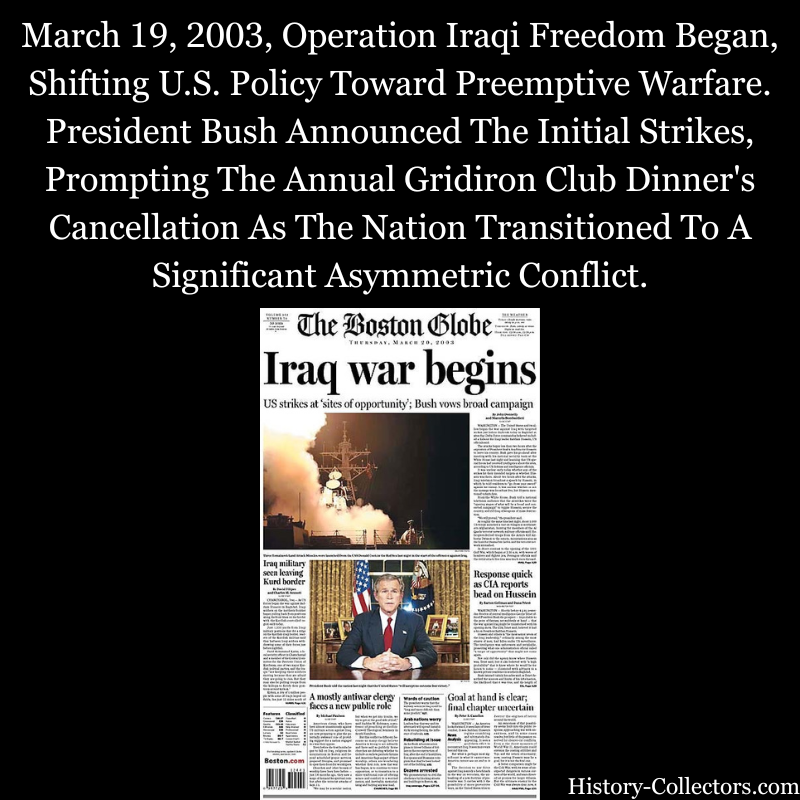
#OnThisDay March 19, 2003: Operation Iraqi Freedom.
The initiation of Operation Iraqi Freedom represents a definitive pivot in twenty-first-century American foreign policy, marking the transition from a containment-based strategy to one of preemptive intervention. This shift was codified by the National Security Strategy of 2002, often termed the Bush Doctrine, which asserted the United States' right to strike first against perceived threats from rogue states and terrorist organizations. The invasion of Iraq was not an isolated military engagement but the culmination of a decade of geopolitical tension, beginning with the aftermath of the 1991 Gulf War and the subsequent imposition of a stringent United Nations sanctions regime and "no-fly" zones. By early 2003, the administrative focus in Washington had shifted toward "regime change" as the only viable solution to the alleged presence of weapons of mass destruction (WMD) and Iraq’s non-compliance with UN Security Council Resolution 1441.
The military campaign commenced with a "shock and awe" aerial bombardment designed to paralyze the Iraqi command and control infrastructure. This doctrine, developed by Harlan Ullman and James Wade, emphasized the use of overwhelming force and spectacular displays of power to achieve rapid psychological dominance over the adversary. Historically, the start of the war signaled a departure from the "Powell Doctrine," which required a clear exit strategy and broad international consensus. Instead, the 2003 invasion was executed by a "Coalition of the Willing," primarily led by the United States and the United Kingdom, without a specific second UN resolution authorizing the use of force. This created a significant rift within the North Atlantic Treaty Organization (NATO), as long-standing allies such as France and Germany voiced strenuous opposition, leading to a period of diplomatic friction that reshaped trans-Atlantic relations for years.
Domestically, the start of the war saw a significant consolidation of executive power and a shift in the role of the American media. The practice of "embedding" journalists with military units provided an unprecedented, real-time view of the battlefield, yet it also raised academic questions regarding the objectivity of conflict reporting and the psychological framing of the war for the American public. In the legal and constitutional sphere, the invasion was predicated on the Authorization for Use of Military Force Against Iraq Resolution of 2002, which granted the President the authority to use the Armed Forces as he deemed "necessary and appropriate" to defend national security. This expansion of executive war-making power remains a central topic of debate in constitutional law, reflecting the tension between legislative oversight and executive agility in the post-September 11 era.
The historical significance of March 19 also lies in the immediate destabilization of the regional balance of power in the Middle East. The removal of the Ba'athist government eliminated a primary counterweight to Iranian influence, a geopolitical consequence that would dictate regional security dynamics for the following two decades. Furthermore, the dissolution of the Iraqi military and the "de-Ba'athification" policy implemented shortly after the invasion’s start contributed to a security vacuum, facilitating the rise of insurgent groups and sectarian conflict. This outcome underscored the historical difficulty of transitioning from conventional military victory to successful nation-building.
Ultimately, the start of the Iraq War serves as a case study in the complexities of intelligence-led warfare. The failure to locate stockpiles of WMD post-invasion prompted the most significant restructuring of the American intelligence community since 1947, leading to the creation of the Office of the Director of National Intelligence. As a historical landmark, March 2003 remains a period of intense scrutiny regarding the limits of American hegemony, the ethics of preemptive strike, and the long-term viability of democratic imposition in the 19th-century Westphalian sense of statehood. The conflict transitioned the U.S. military from a force prepared for large-scale state-on-state warfare to one deeply entwined in counter-insurgency and asymmetric operations, a shift that defined American military doctrine for an entire generation of service members.
References / More Knowledge:
The National Security Strategy of the United States of America (2002): georgewbush-whitehouse.archives.gov/nsc/nss/2002/
United Nations Security Council Resolution 1441: un.org/Depts/unmovic/…
Authorization for Use of Military Force Against Iraq Resolution of 2002: congress.gov/107/plaws/publ…
The Report of the Commission on the Intelligence Capabilities of the United States Regarding Weapons of Mass Destruction: govinfo.library.unt.edu/wmd/report/ind…
U.S. Department of Defense - Shock and Awe: Achieving Rapid Dominance: history.defense.gov/Portals/70/Doc…
#IraqWar #AmericanHistory #Geopolitics

English
#OnThisDay March 18, 1937: Odorant Of Tragedy
history-collectors.com | Own A Piece Of History
----------------
FREE AUDIO BOOK OFFER: Hero Tales From American History Originally Written In 1895 By Theodore Roosevelt And Henry Cabot Lodge: bit.ly/43grpV2
----------------
References / More Knowledge:
Texas State Historical Association. "New London School Explosion." tshaonline.org/handbook/entri…
National Institute of Standards and Technology. "The New London School Explosion: A Tragedy That Changed History." nist.gov/blogs/taking-m…
Texas Board of Professional Engineers and Land Surveyors. "The History of the Texas Engineering Practice Act." pels.texas.gov/about_history.…
American Oil & Gas Historical Society. "New London School Explosion." aoghs.org/oil-almanac/ne…
#AmericanHistory | #TexasHistory | #PublicSafety
English
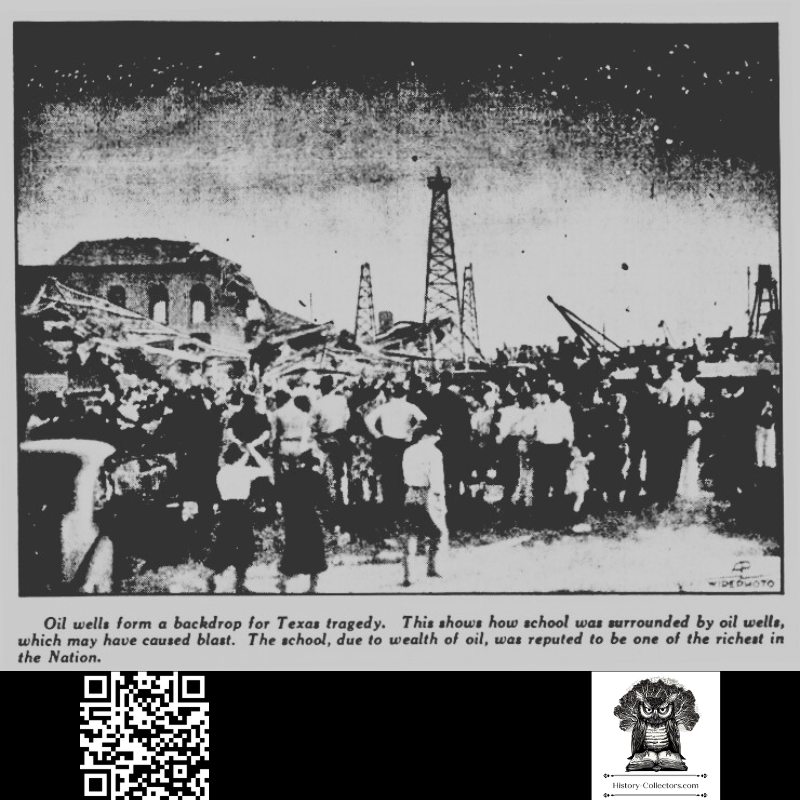
#OnThisDay March 18, 1937: Odorant Of Tragedy.
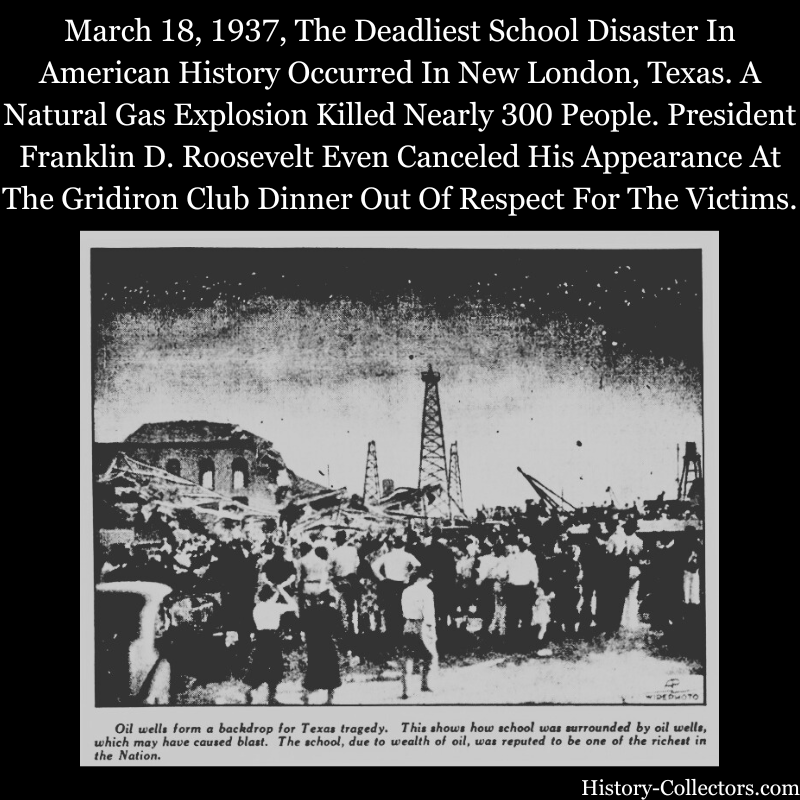
The New London School explosion remains the deadliest educational disaster in United States history, representing a cataclysmic failure of industrial oversight and a subsequent turning point in public safety legislation. Located in the heart of the East Texas Oil Field—then the largest oil-producing region in the world—the London Consolidated School was a symbol of sudden petroleum wealth. The district, enriched by tax revenues from the surrounding oil derricks, had constructed a modern, steel-framed structure that served approximately 1,500 students. However, the tragedy was rooted in a fatal decision to bypass commercial utility costs. In early 1937, school officials authorized the installation of a "tap" into a residue gas line owned by the Parade Gasoline Company. This practice of using "green" or raw casinghead gas—a waste product of oil extraction—was common in the region, yet it introduced a volatile, odorless, and colorless fuel source into the building's enclosed crawl spaces.
The mechanical failure occurred during the final hour of the school day. Approximately 2,000 cubic feet of accumulated gas, leaked from a faulty T-joint in the basement, ignited when an instructor in the manual training shop turned on an electric sander. The resulting blast was so powerful that it lifted the two-story main wing of the building off its foundation before the roof collapsed inward, crushing hundreds of occupants. The estimated death toll reached 294, though precise figures varied in the immediate aftermath due to the severity of the trauma and the rapid dispersal of remains to various funeral homes across East Texas. The event gained international attention, drawing aid from the Red Cross and a telegram of condolence from Adolf Hitler, while the local community was thrust into a state of profound collective grief and legal scrutiny.
The historical significance of the New London disaster extends beyond the immediate loss of life into the realm of forensic engineering and administrative law. Within days of the explosion, the Texas Legislature convened to address the inherent invisibility of natural gas. Because the casinghead gas had no natural scent, the occupants of the London School had no warning of the lethal concentration beneath their feet. Consequently, the Texas Legislature passed the Engineering Registration Act and, more critically, mandated the use of malodorants in all natural gas intended for public or commercial consumption. The chosen chemical, thiophane or mercaptan, provided the distinctive "rotten egg" smell that remains the standard safety indicator for gas leaks globally. This legislative response served as a prototype for modern industrial safety standards, transforming natural gas from a treacherous byproduct of the oil fields into a strictly regulated utility.
Furthermore, the disaster prompted a radical shift in the professionalization of gas fitting and architecture in Texas. Prior to 1937, the state had no formal requirements for the licensing of professional engineers. The catastrophe exposed the dangers of allowing school boards or untrained maintenance staff to oversee complex heating and electrical systems. The resulting 1937 Texas Engineering Practice Act established a Board of Professional Engineers, ensuring that public infrastructure projects were designed and inspected by qualified individuals. This move toward rigorous certification helped formalize the field of safety engineering in the United States.
Ultimately, the New London School explosion functions as a grim milestone in the evolution of the American regulatory state. It highlighted the friction between rapid industrial expansion and the necessary protections for a vulnerable citizenry. The transition from the unregulated "wildcatting" era of the East Texas oil boom to a period of codified safety protocols was bought at a staggering human cost. Today, the legacy of the disaster is encountered daily by millions of people who recognize the sharp scent of mercaptan, a sensory reminder of a tragedy that forced the integration of chemistry, law, and engineering to preserve public life.
References / More Knowledge:
Texas State Historical Association. "New London School Explosion." tshaonline.org/handbook/entri…
National Institute of Standards and Technology. "The New London School Explosion: A Tragedy That Changed History." nist.gov/blogs/taking-m…
Texas Board of Professional Engineers and Land Surveyors. "The History of the Texas Engineering Practice Act." pels.texas.gov/about_history.…
American Oil & Gas Historical Society. "New London School Explosion." aoghs.org/oil-almanac/ne…
#AmericanHistory | #TexasHistory | #PublicSafety
English
#OnThisDay March 17, 1906: Muckrake Mandate
history-collectors.com | Own A Piece Of History
----------------
FREE AUDIO BOOK OFFER: Hero Tales From American History Originally Written In 1895 By Theodore Roosevelt And Henry Cabot Lodge: bit.ly/43grpV2
----------------
References / More Knowledge:
Theodore Roosevelt Center at Dickinson State University: theodorerooseveltcenter.org/Learn-About-TR…
National Archives - Theodore Roosevelt and the Progressive Era: archives.gov/publications/p…
The Library of Congress - Chronicling America: The Man with the Muck-Rake: loc.gov/item/today-in-…
Miller Center, University of Virginia - Theodore Roosevelt: Domestic Affairs: millercenter.org/president/roos…
The Gilder Lehrman Institute of American History - The Muckrakers: gilderlehrman.org/history-resour…
#Muckrakers #TheodoreRoosevelt #AmericanHistory
English
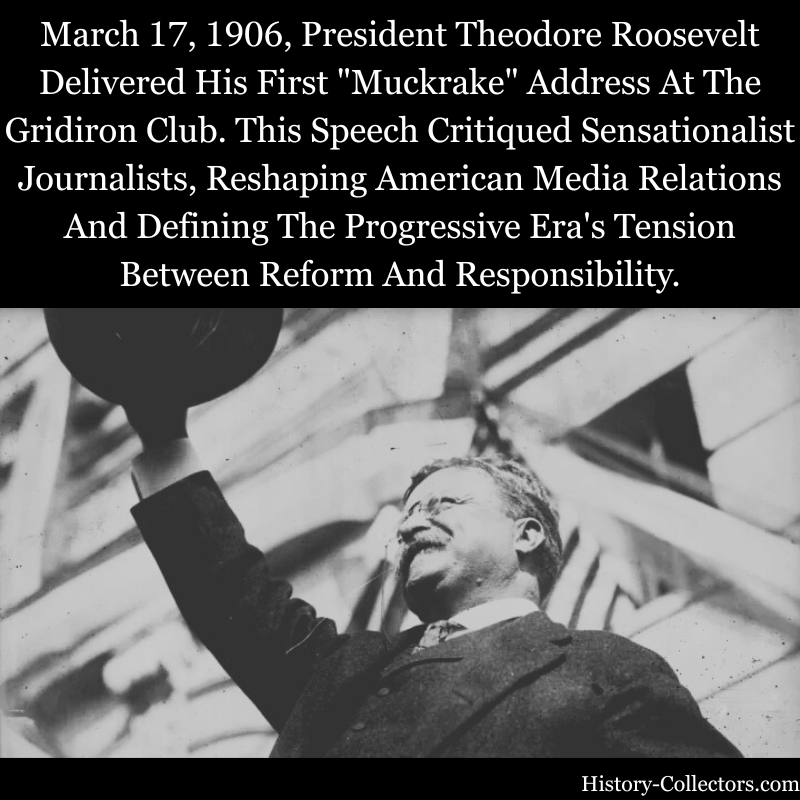
#OnThisDay March 17, 1906: Muckrake Mandate.
The evolution of the American presidency and its relationship with the Fourth Estate underwent a foundational shift on March 17, 1906, when Theodore Roosevelt delivered an informal address to the Gridiron Club in Washington, D.C. This initial iteration of the "Man with the Muck-Rake" speech—later formalized for the public on April 14—represented a calculated intervention in the burgeoning Progressive Era’s media landscape. Roosevelt’s rhetoric sought to establish a definitive boundary between constructive investigative journalism and what he perceived as a burgeoning culture of sensationalized, indiscriminate negativity that threatened the stability of democratic institutions. By drawing a literary parallel to John Bunyan’s The Pilgrim’s Progress, Roosevelt introduced a potent metaphor that would permanently alter the nomenclature of American journalism.
The historical significance of the speech lies in its dual nature as both a critique of the press and an inadvertent validation of its power. During the early 20th century, magazines such as McClure’s and Cosmopolitan had begun publishing rigorous, long-form exposés on corporate monopolies, political machines, and urban squalor. While Roosevelt utilized the findings of writers like Lincoln Steffens and Ida Tarbell to bolster his "Square Deal" legislative agenda, he became increasingly wary of the radicalism inherent in the works of others, such as David Graham Phillips’s "The Treason of the Senate." Roosevelt feared that if the public were relentlessly subjected to accounts of corruption without a corresponding emphasis on virtuous governance, the resulting cynicism would pave the way for revolutionary socialism rather than incremental reform.
In the March 17 address, Roosevelt’s primary objective was to discipline the reformers. He argued that the "man with the muck-rake" was a necessary figure only so long as he knew when to look up from the filth to acknowledge the "celestial crown" of progress and integrity. This distinction was not merely stylistic but deeply strategic. Roosevelt was a master of the "bully pulpit," and by framing the debate around the character of the journalist, he positioned the executive branch as the ultimate arbiter of social truth. The speech functioned as a corrective mechanism intended to preserve the middle-class consensus that underpinned Progressive reform. It signaled that while the administration supported the exposure of "filth," it would not tolerate the destabilization of the institutional structures themselves.
Furthermore, the speech catalyzed a professional identity crisis within the American press. Rather than retreating under Roosevelt’s criticism, many journalists embraced the "muckraker" label as a badge of honor, reclaiming the term to signify a commitment to social justice and the exposure of systemic inequality. This tension accelerated the professionalization of journalism, leading to more standardized methods of fact-checking and a clearer distinction between opinion-driven crusading and objective reporting. The speech also marked a turning point in federal regulatory history; by acknowledging the "muck" that required raking, Roosevelt implicitly admitted that the rapid industrialization of the Gilded Age had created externalized costs that only federal intervention could mitigate, eventually leading to landmark legislation like the Pure Food and Drug Act of 1906.
The long-term impact of Roosevelt’s March 17 remarks transcends the specific political battles of the 1900s. It established the template for the modern adversarial relationship between the presidency and the media. By defining the limits of acceptable dissent, Roosevelt set a precedent for how future leaders would attempt to manage public perception during times of social upheaval. The "Muckrake" speech remains a seminal moment in the history of American political communication, illustrating the delicate balance between the necessity of transparency and the preservation of public order. It serves as a testament to the power of language to shape the parameters of civic discourse, ensuring that the tension between the "rake" and the "crown" remains a central theme in the American democratic experiment.
References / More Knowledge:
Theodore Roosevelt Center at Dickinson State University: theodorerooseveltcenter.org/Learn-About-TR…
National Archives - Theodore Roosevelt and the Progressive Era: archives.gov/publications/p…
The Library of Congress - Chronicling America: The Man with the Muck-Rake: loc.gov/item/today-in-…
Miller Center, University of Virginia - Theodore Roosevelt: Domestic Affairs: millercenter.org/president/roos…
The Gilder Lehrman Institute of American History - The Muckrakers: gilderlehrman.org/history-resour…
#Muckrakers #TheodoreRoosevelt #AmericanHistory

English
#OnThisDay March 16, 1926: Liquid Horizon
history-collectors.com | Own A Piece Of History
----------------
FREE AUDIO BOOK OFFER: Hero Tales From American History Originally Written In 1895 By Theodore Roosevelt And Henry Cabot Lodge: bit.ly/43grpV2
----------------
References / More Knowledge:
NASA: Robert H. Goddard - American Rocketry Pioneer
nasa.gov/centers/goddar…
The Smithsonian National Air and Space Museum: Robert Goddard’s 1926 Rocket
airandspace.si.edu/collection-obj…
American Institute of Aeronautics and Astronautics (AIAA): The History of Liquid Rocketry
aiaa.org/about/History-…
The Library of Congress: Robert H. Goddard Papers and Collections
loc.gov/item/n81114682/
Goddard Space Flight Center: The Father of Modern Rocketry
nasa.gov/centers/goddar…
#SpaceHistory #RobertGoddard #RocketScience
English
#OnThisDay March 16, 1926: Liquid Horizon.
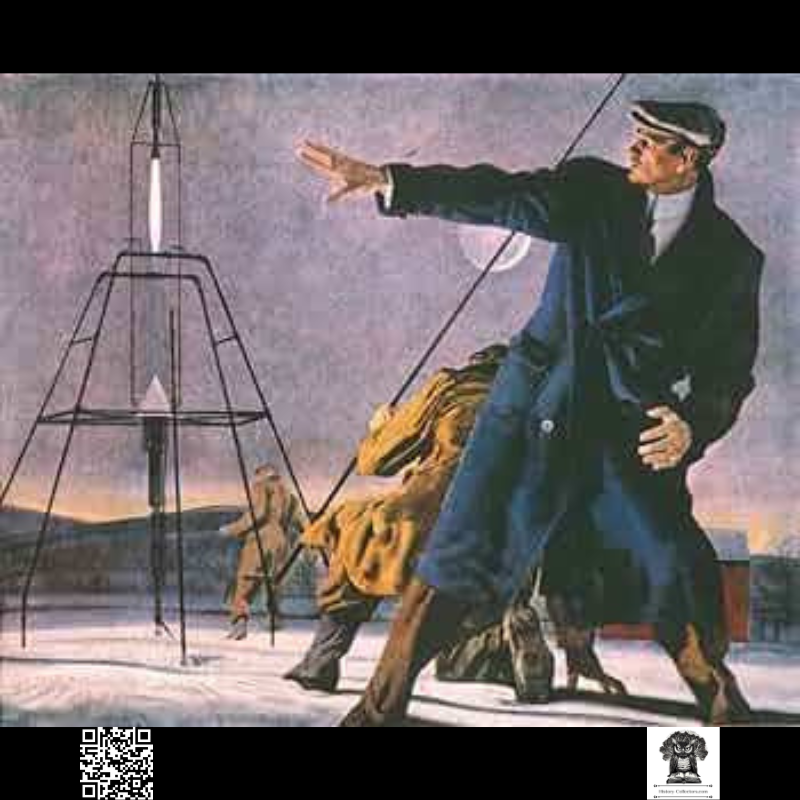
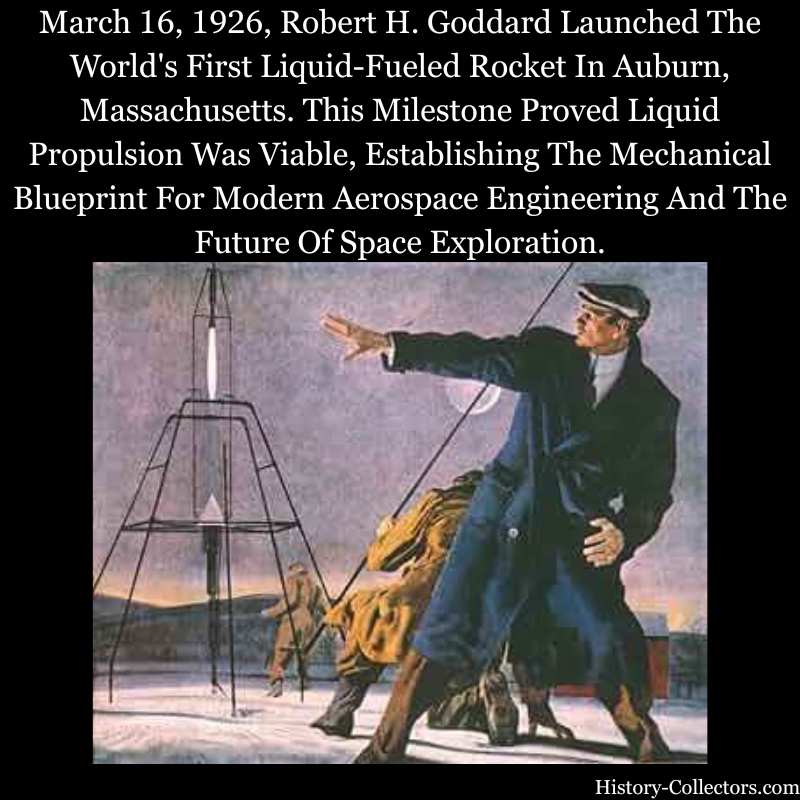
The an unassuming setting of a cabbage patch in Auburn, Massachusetts, Robert Hutchings Goddard achieved the first successful flight of a liquid-propellant rocket. While the physical scale of the event was modest—the projectile, nicknamed "Nell," reached an altitude of 41 feet and traveled a horizontal distance of 184 feet over 2.5 seconds—its theoretical and mechanical implications were monumental. This event transitioned rocketry from the era of gunpowder-based pyrotechnics into the realm of modern aerospace engineering. Prior to Goddard’s breakthrough, rocket propulsion relied exclusively on solid propellants, which were inherently limited by their inability to be throttled, restarted, or cooled during combustion. Goddard’s introduction of liquid gasoline and liquid oxygen as propellants provided a significantly higher energy density and a pathway toward controlled, long-duration flight.
The historical significance of this launch is rooted in Goddard’s solution to several fundamental engineering challenges. He was the first to implement a propellant feed system that utilized pressurized nitrogen to force fuel and oxidizer into a combustion chamber. Furthermore, the design featured a regenerative cooling concept, where the cold liquid oxygen helped manage the intense thermal loads of the engine. These specific innovations remain the foundational architecture for nearly every orbital launch vehicle in contemporary use, from the Saturn V to the Falcon 9. By proving that liquid chemicals could provide the necessary thrust-to-weight ratio to overcome Earth’s gravity, Goddard validated the mathematical assertions he had published in his 1919 Smithsonian paper, "A Method of Reaching Extreme Altitudes."
From a geopolitical and technological perspective, the 1926 launch acted as the silent catalyst for the Space Age. Although Goddard’s work was largely undervalued by the American public and military during the interwar period—partially due to his reclusive nature and the skepticism of contemporary media—it was scrutinized and expanded upon by international researchers. In Germany, the Verein für Raumschiffahrt (Society for Space Travel) utilized Goddard’s published findings to inform their own liquid-propulsion experiments, which eventually culminated in the development of the V-2 rocket. This technological lineage demonstrates that the March 16 launch was not merely a localized experiment but the origin point of a global shift in ballistics and exploration.
Goddard’s achievement also redefined the limits of terrestrial physics. By demonstrating that a rocket did not require an atmosphere to "push against" but rather operated on the principle of Newton’s Third Law through the exhaustion of high-velocity mass, he silenced critics who claimed space travel was a physical impossibility. The 1926 flight proved that a self-contained system carrying both fuel and oxidizer could function efficiently. This realization shifted the focus of the scientific community from the limitations of the atmosphere to the potential of the vacuum.
Ultimately, the launch of the first liquid-fueled rocket serves as the definitive boundary between classical artillery and astronautics. The precision required to mix volatile liquids at cryogenic temperatures while maintaining structural integrity under high pressure represented a quantum leap in mechanical engineering. While the flight lasted less than three seconds, it provided the empirical evidence necessary to pursue the moon landings and deep-space probes of the late 20th century. Goddard’s cabbage patch in Auburn is now recognized as the "Kitty Hawk of Rocketry," a site where the theoretical possibility of leaving Earth’s orbit became a tangible, engineering reality. The March 16 launch remains the most significant milestone in the history of propulsion, marking the moment humanity acquired the technical means to transcend its planetary origin.
References / More Knowledge:
NASA: Robert H. Goddard - American Rocketry Pioneer
nasa.gov/centers/goddar…
The Smithsonian National Air and Space Museum: Robert Goddard’s 1926 Rocket
airandspace.si.edu/collection-obj…
American Institute of Aeronautics and Astronautics (AIAA): The History of Liquid Rocketry
aiaa.org/about/History-…
The Library of Congress: Robert H. Goddard Papers and Collections
loc.gov/item/n81114682/
Goddard Space Flight Center: The Father of Modern Rocketry
nasa.gov/centers/goddar…
#SpaceHistory #RobertGoddard #RocketScience
English
#OnThisDay March 15, 1820: Dirigo Decoupled
history-collectors.com | Own A Piece Of History
----------------
FREE AUDIO BOOK OFFER: Hero Tales From American History Originally Written In 1895 By Theodore Roosevelt And Henry Cabot Lodge: bit.ly/43grpV2
----------------
References / More Knowledge:
Maine State Constitution (1819)
maine.gov/msl/libs/refer…
The Missouri Compromise; March 6, 1820
avalon.law.yale.edu/19th_century/m…
U.S. House of Representatives: The Missouri Compromise of 1820
history.house.gov/Historical-Hig…
National Archives: An Act for the Admission of the State of Maine into the Union
catalog.archives.gov/id/299872
Library of Congress: Maine Statehood
loc.gov/item/today-in-…
#MaineHistory #StatehoodDay #MissouriCompromise
English
#OnThisDay March 15, 1820: Dirigo Decoupled.
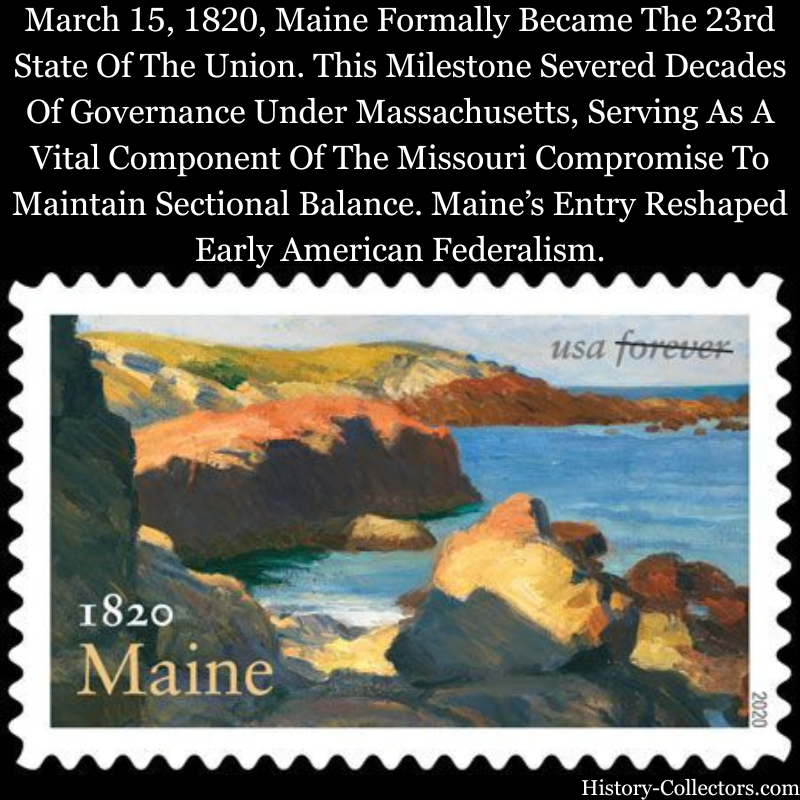
The admission of Maine as the twenty-third state of the Union represents a pivotal transition in American federalism, marking the culmination of a decades-long separatist movement and the inaugural execution of the Missouri Compromise. Since the seventeenth century, the District of Maine had existed under the jurisdiction of the Commonwealth of Massachusetts, a political arrangement characterized by geographical discontinuity and diverging economic interests. The cessation of the War of 1812 acted as a primary catalyst for independence; the perceived failure of the Massachusetts militia to protect the Maine coast from British occupation during the conflict intensified local dissatisfaction with distant governance in Boston. Between 1785 and 1819, six separate conventions and votes were held regarding separation, with the final July 1819 referendum yielding a decisive majority in favor of statehood. This internal political shift coincided with a volatile national debate over the expansion of slavery, transforming a regional administrative reorganization into a constitutional crisis of national proportions.
The legislative mechanics of Maine’s entry were inseparable from the Missouri Question. By 1819, the United States consisted of an equal balance of eleven free and eleven slave states. The application of Missouri for statehood threatened this equilibrium, prompting Representative James Tallmadge of New York to propose an amendment restricting slavery within the new state. Southern legislators countered by leveraging Maine’s pending application as a tactical hostage. They asserted that if Missouri’s admission were restricted, Maine’s entry would be blocked, thereby maintaining the Southern veto in the United States Senate. The resulting Missouri Compromise of 1820 mandated a dual admission: Maine entered as a free state on March 15, while Missouri was authorized to form a state government without the Tallmadge restrictions. This "pairing" established a precedent for maintaining sectional balance that would dictate federal expansion for the next three decades, effectively delaying immediate conflict while formalizing the geographical divide between free and slave labor systems.
From a constitutional perspective, Maine’s admission necessitated the drafting of a state constitution in Portland during October 1819. This document was notable for its progressive stance on suffrage; unlike the Massachusetts constitution of the time, the Maine Constitution of 1819 granted voting rights to all male citizens regardless of race, notably omitting property qualifications. This democratic expansion reflected the frontier egalitarianism prevalent in the district’s interior, which often clashed with the established maritime elites. Upon the formal transition on March 15, 1820, William King, a prominent merchant and a leader of the separation movement, was inaugurated as the first governor. The legal separation required a complex division of public lands and debt between Massachusetts and the new state, a process governed by the "Act of Separation" passed by the Massachusetts General Court.
The economic significance of Maine’s statehood was rooted in its vast timber resources and burgeoning maritime industry. As a sovereign entity, Maine gained direct control over its internal improvements and the regulation of its coastal trade, which had previously been hampered by Massachusetts' "Coasting Law." This federal law required vessels to enter and clear customs in every state they passed unless that state bordered their own; as part of Massachusetts, Maine vessels could bypass several ports, but statehood required a legislative adjustment to ensure Maine remained economically competitive within the Atlantic trade network. Consequently, the admission of March 15, 1820, was not merely a change in administrative boundaries but a foundational event that recalibrated the political weight of New England and solidified the legislative architecture of the antebellum United States.
References / More Knowledge:
Maine State Constitution (1819)
maine.gov/msl/libs/refer…
The Missouri Compromise; March 6, 1820
avalon.law.yale.edu/19th_century/m…
U.S. House of Representatives: The Missouri Compromise of 1820
history.house.gov/Historical-Hig…
National Archives: An Act for the Admission of the State of Maine into the Union
catalog.archives.gov/id/299872
Library of Congress: Maine Statehood
loc.gov/item/today-in-…
#MaineHistory #StatehoodDay #MissouriCompromise

English
March 14, 1900: Monetary Orthodoxy Defined
history-collectors.com | Own A Piece Of History
----------------
FREE AUDIO BOOK OFFER: Hero Tales From American History Originally Written In 1895 By Theodore Roosevelt And Henry Cabot Lodge: bit.ly/43grpV2
----------------
References / More Knowledge:
United States Congress. (1900). An Act To define and fix the standard of value, to maintain the parity of all forms of money issued or coined by the United States, to refund the public debt, and for other purposes. Statutes at Large, Volume 31. memory.loc.gov/cgi-bin/ampage…
The Gilder Lehrman Institute of American History. (n.d.). The Gold Standard Act of 1900. gilderlehrman.org/history-resour…
National Archives and Records Administration. (n.d.). Records of the United States Government, Record Group 11: General Records of the United States Government. archives.gov/research/guide…
Federal Reserve Bank of St. Louis. (n.d.). Gold Standard Act of 1900. FRASER: Federal Reserve Archive. fraser.stlouisfed.org/title/gold-sta…
The Ohio State University, Department of History. (n.d.). The Politics of the Gold Standard. Origins: Current Events in Historical Perspective. origins.osu.edu/milestones/mar…
#AmericanHistory #GoldStandard #EconomicHistory
English
#OnThisDay March 14, 1900: Monetary Orthodoxy Defined.
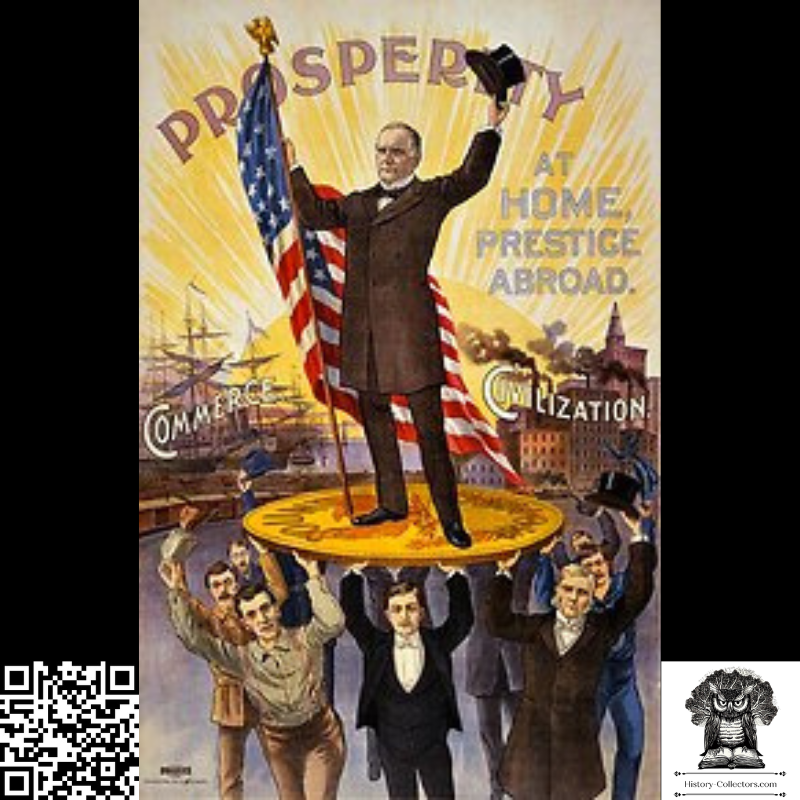
The enactment of the Gold Standard Act represented the definitive resolution of the protracted ideological and economic conflict known as the "Battle of the Standards." For decades following the Civil War, the United States navigated a precarious bimetallic landscape, characterized by intense political volatility regarding the relative roles of gold and silver in the national currency. This legislation formally committed the United States to a monometallic gold standard, establishing the dollar at a fixed valuation of 25.8 grains of nine-tenths fine gold. By legally defining the dollar in terms of gold and requiring the Treasury to maintain all forms of money issued by the United States at parity with this metal, the Act effectively terminated the populist "Free Silver" movement that had dominated the late 19th-century political discourse.
The historical significance of the Act is rooted in its role as a stabilizer for both domestic and international trade. Prior to 1900, the American economy was plagued by uncertainty regarding the future value of the dollar. The Specie Payment Resumption Act of 1875 had theoretically returned the nation to a metallic basis, yet the subsequent Bland-Allison Act of 1878 and the Sherman Silver Purchase Act of 1890 introduced significant quantities of silver into the monetary supply. This created a Gresham’s Law scenario where "bad money" (silver) threatened to drive "good money" (gold) out of circulation, leading to the Panic of 1893 and a precarious depletion of federal gold reserves. The 1900 Act provided the institutional rigidity necessary to prevent such fluctuations, signaling to international markets—particularly London, the then-center of global finance—that the United States was a mature, creditworthy partner capable of maintaining a stable exchange rate.Beyond its immediate fiscal mechanics, the Gold Standard Act functioned as a triumphant assertion of urban industrial interests over the agrarian West and South. The populist movement, led by figures such as William Jennings Bryan, had argued that a bimetallic standard would inflate the money supply, thereby providing relief to indebted farmers. The victory of the gold standard under the McKinley administration codified the transition of the United States from a developing agrarian society into a leading industrial power. It centralized monetary authority by establishing a $150 million gold reserve specifically for the redemption of greenbacks and Treasury notes, insulating the currency from the immediate whims of legislative cycles. This centralization was a critical precursor to the eventual creation of the Federal Reserve System in 1913, as it highlighted the need for a more structured, yet gold-backed, elastic currency.
The Act also synchronized the American economy with the broader "Classical Gold Standard" era (1870–1914), a period of unprecedented globalization. By aligning with the British pound sterling and the German mark, the U.S. dollar became part of an international network of fixed exchange rates that lowered transaction costs for capital flows and commodity exports. This facilitated the massive influx of European investment capital that funded American infrastructure and industrial expansion. However, the rigidity of the Act also meant that the money supply was tethered to the global production of gold. Fortuitously for the proponents of the Act, the late 1890s saw significant gold discoveries in the Klondike and the South African Rand, alongside the development of the cyanide process for gold extraction. This influx of gold provided the necessary liquidity to prevent the deflationary pressures that "silverites" had feared, allowing the gold standard to coincide with a period of sustained economic growth.
Ultimately, the Gold Standard Act of 1900 was more than a technical adjustment to the Treasury’s ledger; it was a foundational pillar of American economic hegemony. It provided the psychological and legal certainty required for the dollar to eventually challenge the pound sterling as the world’s primary reserve currency. While the system would later be suspended during the Great Depression and eventually dissolved at Bretton Woods and by the Nixon Shock, the 1900 Act remains the high-water mark of American monetary orthodoxy, representing a moment when the nation chose international financial integration and price stability over domestic inflationary populism.
References / More Knowledge:
United States Congress. (1900). An Act To define and fix the standard of value, to maintain the parity of all forms of money issued or coined by the United States, to refund the public debt, and for other purposes. Statutes at Large, Volume 31. memory.loc.gov/cgi-bin/ampage…
The Gilder Lehrman Institute of American History. (n.d.). The Gold Standard Act of 1900. gilderlehrman.org/history-resour…
National Archives and Records Administration. (n.d.). Records of the United States Government, Record Group 11: General Records of the United States Government. archives.gov/research/guide…
Federal Reserve Bank of St. Louis. (n.d.). Gold Standard Act of 1900. FRASER: Federal Reserve Archive. fraser.stlouisfed.org/title/gold-sta…
The Ohio State University, Department of History. (n.d.). The Politics of the Gold Standard. Origins: Current Events in Historical Perspective. origins.osu.edu/milestones/mar…
#AmericanHistory #GoldStandard #EconomicHistory
English