Ocean

241 posts

Ocean banner
Ocean

Ocean

@OceanVulcano

Expect the Unexpected.

Beigetreten Aralık 2023
48 Folgt36 Follower
Ocean
Ocean@OceanVulcano·
The Dojo is truly on fire. Zero and @studentoffew are constantly pushing to make it better, and it's inspiring to see. This new feature adds even more value to the group. It's such an accessible resource too. If there is anyone out there who has been on the fence about joining, now is really the time to jump in.
English
1
0
2
103
ZERO IKA 🗡️
ZERO IKA 🗡️@IamZeroIka·
⭕️ Announcement/product release: DTT ⭕️ I have another huge announcement to make. This is the new implementation that the Dojo will receive. I’ve always thought about how to improve and give people the opportunity to better themselves. From this idea came the development of this new terminal, which is designed to track all trades and help members to grow through: 1. Dashboard Analyze all your performances with key components like: P&L, consistency, setup/strategy, best&worse days and let the "Sensei" help you to improve your game 2. Trades Check your "battle record", add your trades manually 3. Import Import your trades through your exchange of reference 4. Terminal Check long/short ratio, funding fees, market news and more 5. Traders (bonus) Add your nationality and discover from which countries Dojo traders are from (national "battles" in the future?) All of this is being built for people who want to level up and want to put commitment. If you’re interested, I recommend joining the channel now, as this incredibly low price won't last forever.
English
23
14
130
4.4K
Ocean retweetet
Lucky Chart Ape
Lucky Chart Ape@luckychartape·
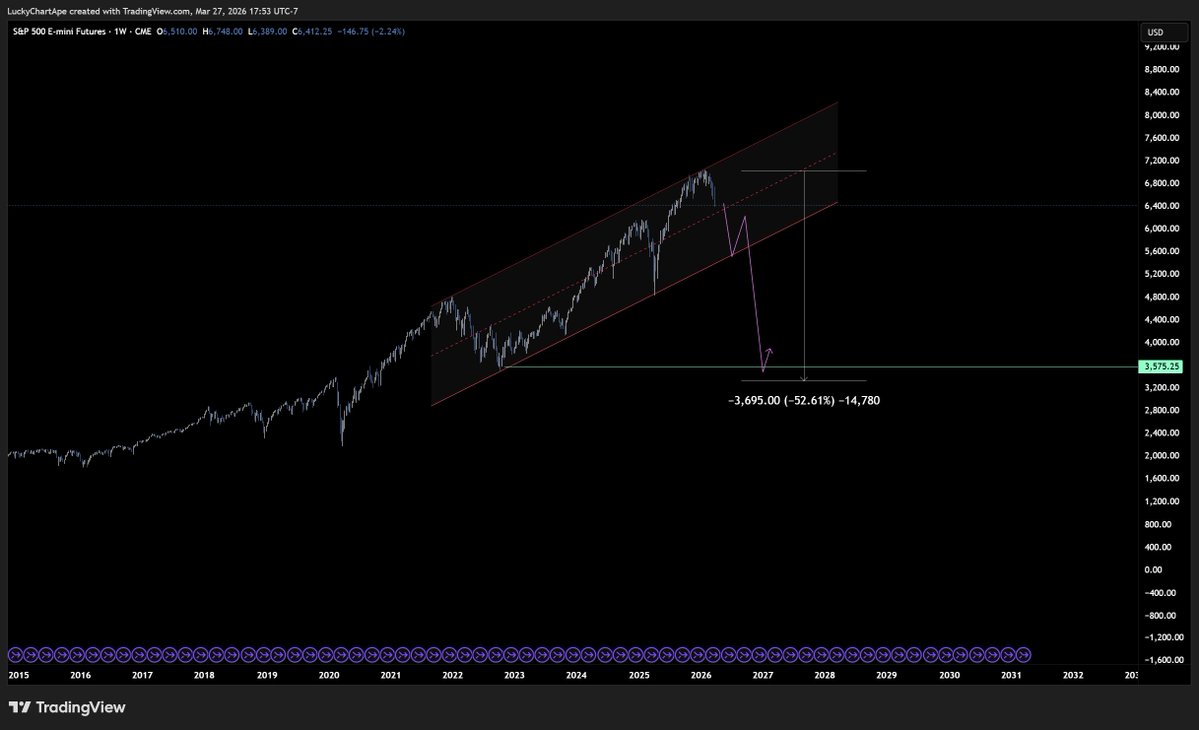
The index has massive correlated risk. I will break down why I think a 50%+ sell off or worse is not only possible, but likely. 60%+ of Americans own equities, with 45% directly holding index ETFS. The SP500 has concentrated 40% of its value into the top 10 companies. That means for every $1,000 that goes into an index etf, $400 goes to 10 companies, while $600 gets split between the other 490 companies. If we look outside of the top 10 companies, about 40% of stock ownership for the bottom 490 companies is from index/passive positions. Lets think this through. Right now there are $45.8 Trillion in U.S retirement assets. Roughly 35% of that is held directly in Index ETFS, and about 50% tracks the index. The majority of directly owned stocks by retail investors are also the top 10 companies. When someone diversifies their passive index investing, they are just putting more money into the same trade. Index funds now represent 52.7% of the total U.S investment market, and U.S about 65% of equities are held by individuals (accounting for mutual funds). There is a massive Cohort in the market that has their retirement savings in the market. With 80% being held by people 55+ years old. What happens when people are forced into selling off their index positions, or scared into selling them off? The strength in equities is in large part built over 15-20 years of undying confidence in the market. Passively contribute, grow, retire. What happens when all of these participants retirements are threatened and they lose confidence, and all start trying to get out at the same time. Decades of passive investment, all trying to get out at once? The door isn't big enough for everyone to fit through. I believe we will find out that when people sell off their individual stocks (which are in large part the top 10 companies), those make up 40% of the value of the index.. so it drags the index.. when people sell of index, it drags the top 10, along with the entire market. Remember, 40% of the ownership in the top 490 companies are just passive index positions. The selling will cascade through the entire market, and this market is constructed so that selling anything is selling everything. I could be wrong but that's what I think.
Lucky Chart Ape tweet media
English
28
34
289
61.6K
Ocean retweetet
ZERO IKA 🗡️
ZERO IKA 🗡️@IamZeroIka·
⭕️FULL EDUCATIONAL ARCHIVE⭕️ This is the complete "archive" of all the most important educational post I created during these years. Hours and hours of intense work condensed into 1 single post, so you'll be able to study this free material that I think will truly take you to the next level. 1. Liquidity related technical concepts: x.com/IamZeroIka/sta… 2. Way of charting from scratch: x.com/IamZeroIka/sta… 3. The importance of candle closures: x.com/IamZeroIka/sta… 4. The importance of candle closures pt.2: x.com/IamZeroIka/sta… 5. The truth behind supply & demand levels: x.com/IamZeroIka/sta… 6. Fibonacci reverse sequence: x.com/IamZeroIka/sta… 7. Fibonacci extensions in play: x.com/IamZeroIka/sta… 8. Setting targets based on data: x.com/IamZeroIka/sta… 9. The truth behind fundamentals: (in crypto) x.com/IamZeroIka/sta… 10. How influencers scam you: x.com/IamZeroIka/sta… 11. How influencers scam you pt.2: x.com/IamZeroIka/sta… 12. Reprogramming your mind for taking profits: x.com/IamZeroIka/sta… 13. Order blocks guide: x.com/IamZeroIka/sta… 14. HTF distribution in play (no fundamentals): x.com/IamZeroIka/sta… 15. Fair Value Gaps: x.com/IamZeroIka/sta… 16. Distribution at Fair Value Gap: x.com/IamZeroIka/sta… 17. Fibonacci insights: x.com/IamZeroIka/sta… 18. Fibonacci settings: x.com/IamZeroIka/sta… 19. Compound game: x.com/IamZeroIka/sta… 20. Taking profits & strategies: x.com/IamZeroIka/sta… 21. The game of inefficiency, liquidity and orders: x.com/IamZeroIka/sta… 22. Backtesting a strategy: x.com/IamZeroIka/sta… 23. The quintessential mental model of a real trader: x.com/IamZeroIka/sta… 24. Using volume areas to form a bias + repricing and migration of value + using defensive levels to place the stop + execution of a MTF long inside an HTF range: x.com/IamZeroIka/sta… 25. Value migration theory + understanding market's behavior and placing trades + protection levels: x.com/IamZeroIka/sta… 26. AMT full framework: x.com/IamZeroIka/sta… 27. Understanding capital rotation: x.com/IamZeroIka/sta… 28. Intermarket analysis: x.com/IamZeroIka/sta… 29. Intermarket cheat sheet: x.com/IamZeroIka/sta… 30. How to form a bias with intermarket analysis + spotting opportunties + capital rotation + alpha & beta plays: x.com/IamZeroIka/sta… 31. Continuation of the post above: x.com/IamZeroIka/sta… 32. Qualifying ranges + VP: x.com/IamZeroIka/sta… 33. Scalp on NYO to understand liquidity dynamics: x.com/IamZeroIka/sta… 34. Scalp on NYO & explanation: x.com/IamZeroIka/sta… 35. 9-steps psychological framework to not sabotage yourself: x.com/IamZeroIka/sta… 36. VSA analysis HTF example: x.com/IamZeroIka/sta… 37. VSA pt. 2: x.com/IamZeroIka/sta… 38. Qualifying supply & demand based on MA: x.com/IamZeroIka/sta… 39. Orders absorption at levels: x.com/IamZeroIka/sta… 40. The importance of trading less assets + TAO example: x.com/IamZeroIka/sta… 41. Mini price action + volume live mastercalss: x.com/IamZeroIka/sta… 42. Isolating price action with FRVP: x.com/IamZeroIka/sta… 43. Price discovery methodology: x.com/IamZeroIka/sta… 44. Failed Auction: x.com/IamZeroIka/sta… 45. How to survive to an economic downturn: x.com/IamZeroIka/sta…
English
53
118
764
33.6K
Ocean retweetet
🎯 Master
🎯 Master@Moneytaur_·
Before elaborating on it, i'd just say this: people will always have money available at some point, whether every month or every couple of weeks, which means they can always keep gambling. There are people with gambling addiction who have been going to casinos almost daily for years. Crypto is simply a casino disguised as investing, airdrops are the "comps" to keep people playing, which allows many to hide behind the "investor" label while continuing to feed the exact same addiction. It's not really about how many times the herd will fall for it. It's about how long whales can keep the machine effective enough to extract from them. Not how many mistakes retail can make, but how long the system remains efficient at monetizing those mistakes. As long as enough people still believe, still hope, still think the next cycle will "make it all back" the game can continue. But once enough people learn the hard way, once enough capital is destroyed, once enough trust is gone, the efficiency of the trap declines. There'll be the people who got wrecked for life, and there will be the people who never played the game but is aware of the majority getting wrecked over several years playing the game, thus scared. And that's when the real strategic question appears: Do whales keep milking the same game with lower efficiency, or do they gradually shift attention to the next shiny object, the next narrative, the next scam large enough to absorb mass hope? Bitcoin gives them a unique advantage in this regard. With the "last coin mined" roughly a century from now the dream can technically be kept alive for decades. That long timeline is not just a feature. It's also the perfect psychological weapon. It allows people to project wealth far into the future, to build life plans around eventual riches to remain emotionally invested for years, sometimes for life. And that's where the trap becomes deeper than price, because now they’re not just holding bags. They're holding identity, belief, future expectations, and the hope that one day all the pain will be justified. If you think like a whale, why would you rush to end that? Why would you kill a system that can keep people voluntarily attached to the dream for decades? A dream that keeps them buying, holding, waiting, and explaining away every rug as "part of the cycle" That's the brilliance of it, not the tech. Not that people lose once, but that they can be conditioned to lose repeatedly while believing they're still on the path to winning. So the real danger isn't that people get rugged once. It's that they spend the rest of their lives planning around a future that never arrives. What can you use to understand whether crypto cycles will keep playing out? 1] In my opinion, everything changes dramatically once whales turn openly pro-Bitcoin. I said that many times before, and then they did. That matters because by the time whales are publicly bullish, the game is no longer early accumulation, but positioning, narrative control, and distribution into belief. 2] You need to find ways to measure whether there is still enough belief, hope, and deployable capital in the system. Not just money, but money willing to sit through volatility for the promise of insane gains. You also need to ask whether whales are even interested in playing a game where the herd is already poor. If the crowd is too drained, too traumatized, and too broke, the upside of running the same cycle becomes weaker. Sometimes whales "give away" money first. Incentives, rewards, grants, random pumps, sudden strength across the board. People read that as opportunity, but often it is preparation. They create conditions that make people feel early again, confident again, hopeful again. Then the herd chases, leverage returns, greed comes back, and the rug becomes much more effective. In that sense, the money they "gave" was never kindness. It was bait, or more precisely, a temporary redistribution designed to be reabsorbed later at scale. It is also important to understand how much whales may have extracted over certain periods, because that tells you how financially comfortable they are, how aggressively they can build in the real world, and how patient they can afford to be before needing another major harvest. They may be extracting constantly through normal market behavior, but that is different from the large extraction events, the real resets, the violent crashes, the moments presented as random when in reality they function as massive wealth transfers. So the question is not just whether crypto cycles still exist. The real question is whether the ingredients for an effective cycle are still there: enough belief, enough fresh or recycled capital, enough patience from whales, and enough despair in the herd to make them chase the next breadcrumb as if it were salvation.
English
4
32
341
15.4K
Ocean retweetet
🎯 Master
🎯 Master@Moneytaur_·
Trade less > Earn more. More trades doesn't mean more money. It means exposing yourself to more risk. Learn to find major key-reversal levels by reading where whales buy/sell, master fibs as algorithms use them, understand liquidity and that it acts as "fuel" on the markets, master ranges and avoid trading mid-range (if you want higher % probability to succeed), understand fair-value-gaps (the proper way), learn to identify breaks of market structure (especially on HTF's), learn to identify H&S and Three Drives Pattern... Success in Trading is hard-work and Mindset + you really must think outside the box, because the real understanding of this game will show you what our world actually is, and it's not pretty, but we must accept, adapt, and not fall on the traps the elites place in every corner 🤝
English
18
83
515
41.3K
Ocean retweetet
🎯 Master
🎯 Master@Moneytaur_·
At this stage, most people in this community already understand the importance of critical thinking, so this may not need to be said. But when governments suggest keeping a few days' worth of essentials, it's usually wise to think in terms of weeks to months, not days. Resilience is rarely regretted. Over the coming years, instability, whether economic, geopolitical, technological, or social, is unlikely to disappear. Systems are becoming more complex, more interconnected, and therefore more fragile. That means disruptions can spread faster and last longer than many expect. Millions of people understand the importance of preparing for turbulence. Even if that sounds like a large number, it's still a tiny fraction of the global population. Preparation doesn't require panic. It requires foresight. Practical steps are simple: ▫️Maintain a reserve of essential supplies [food, water, basic necessities] ▫️Keep cash, for when digital systems fail temporarily. ▫️Maintain a financial buffer and stay ahead on bills where possible. ▫️Reduce dependency on systems that require constant connectivity. Modern society runs on continuous connections such as power, internet, banking, logistics. If those systems are disrupted, even temporarily, many people will struggle simply because they never considered the possibility. Major cyber attacks on critical infrastructure are not a matter of if, but when. Preparation is simply choosing not to rely on everything working perfectly all the time. Hashtag: Cybersecurity.
English
6
51
590
26.7K
Ocean retweetet
Ocean retweetet
🎯 Master
🎯 Master@Moneytaur_·
Most people spend their lives in quiet desperation. Working for scraps under someone else’s vision, making poor financial choices, and reacting emotionally to strangers' thoughts online. They posture with loud opinions on topics they barely understand, fueled not by wisdom, but by a need to feel seen, to feel right. Jealousy and bitterness masquerade as moral superiority. Rarely do they pause to ask: What am i really building? Who am i serving? What am i missing while i argue with shadows? The truth is uncomfortable: for many, it's easier to critique than create, to scroll than to strive, to hate than to heal. Why? - Because facing your own insignificance without a plan to rise above it, hurts. It hurts to admit you're not living your potential. It hurts to see others move ahead while you're stagnant. And it hurts to confront the fact that time, not opinions, is the most expensive currency. Yet most burn it on distractions instead of using it to build, love, explore, and grow. Loneliness, mediocrity, and failure turn people bitter instead of better. And unless they choose awareness over comfort, most will die with their best still locked inside them.
English
18
73
673
25.2K
Ocean retweetet
🎯 Master
🎯 Master@Moneytaur_·
Imagine acquiring the skills to generate consistent profits from these 24/7 markets where trillions of dollars are constantly in motion. You can then use these profits to experiment with your wildest ideas, gradually building valuable and profitable sources of income, all at little to no cost to you because you have extracted the funds from the markets. Achieving this goal is possible if you commit to learning the necessary skills and remain persistent in pursuing this life-changing opportunity. You may believe that becoming a top trader, with truly exceptional skills, is difficult, especially given the abundance of misleading information circulating on the internet. However, the truth is that it can be done. By devoting sufficient time and following the correct process, you can cultivate the necessary skills to achieve consistent results. This will not happen quickly/easy as plenty of gurus out there want to make you believe, but with perseverance and dedication, you can ultimately live the life of your dreams. Just because you haven't achieved your financial freedom so far, doesn't mean you can't find the right path to success now. The reality is that the system is designed to keep you in the rat race and prevent you from venturing outside the norm. However, there's much more to life than simply following the crowd. It's up to you to break free from the confines of the system and forge your own path towards a more fulfilling life. Before diving into this world and studying the right strategies + working on your midset, it's essential to have confidence in your ability to achieve your full potential. But if you truly believe that your ultimate destiny is to work for someone else and never attain true freedom, then that's exactly what you will get. If you approach it with a defeatist attitude, it's highly unlikely that you will achieve success. It's crucial to have confidence in your ability to turn things around and take control of your financial future. Fortunately, there are numerous resources available to help you learn the necessary skills, despite the abundance of shit information. You could be financially free in the next 3 years, and this would allow you to avoid being another victim of whatever's coming... You decide. Opportunity is here. You're reading this from one of your best tools to improve yourself. Look around... Everyone's in survival mode. That environment is keeping you grounded. Make the needed changes. If people around you are keeping you grounded, you must let go. You only have one life.
English
11
40
281
10.2K
Ocean retweetet
ZERO IKA 🗡️
ZERO IKA 🗡️@IamZeroIka·
Trailing stop loss is one of the most valuable tools you can use to manage your risk and maximize profits. "Some" considerations and insights: For those who don't know, it provides a balance between allowing a trade to run while protecting you from losing too much of my gains. Unlike a traditional stop loss, which is fixed at a predetermined price, a trailing stop loss moves with the market when the price is moving in my favor but stays in place when the price starts to decline. This allows you to capture as much profit as possible while avoiding the emotional stress of deciding when to exit. Over the years, I’ve found that the ability to manage my exit strategy is just as important as choosing the right entry point. Many traders, including myself when I first started, focus too much on when to buy that they neglect to plan when and how to sell. But the exit is where profits or losses are truly locked in, and a trailing stop loss helps me execute that part of my strategy without hesitation. When I enter a trade, I immediately consider how I will protect my capital and secure profits. A trailing stop loss allows me to stay in a trade as long as the trend remains strong while automatically adjusting my stop level as the price moves in my favor. For example, let’s say I buy something at $100 and set a 10% trailing stop loss. My initial stop loss would be at $90 (10% below $100). If the price rises to $120, my stop loss moves up to $108 (10% below $120). If the prices continues climbing to $150, my stop moves up to $135, but if, at some point, reverses and drops to $135, my stop loss triggers, and I exit the trade automatically. The most important aspect of this system is that the stop loss only moves up; it never moves down. This means that as long as the stock is moving in my favor, my stop loss keeps adjusting to protect more of my gains butq the moment the price starts to drop, my exit is locked in, preventing me from giving back too much profit. “Bro, I don't trade, I'm a spot holder and I don't care..” Ask spot holders how much happier they would have been if they had trailed their bags instead of hoping for the moon train. The longer they held, the farther their journey… but the problem? They never jumped off when the train arrived at its destination, only to end up back at the main station. SPOT OR LEVERAGE, IT DOESN'T MATTER. I usually set my trailing stop loss based on a percentage and manually, depending on my trading strategy and the type of asset I’m trading. I don’t use the same trailing stop loss strategy for every trade. Instead, I adjust my approach based on market conditions and the timeframe of my trade: - Percentage- based TSL This is the simplest and most common type. I set my stop at a fixed percentage below the highest price reached. For example, if I set a 5% trailing stop, my stop loss will always be 5% below the highest price. This method works well for steady trends where I want to capture gains while avoiding normal price fluctuations. • Fixed dollar amount TSL Instead of a percentage, I set my stop at a fixed dollar amount below the highest price. If I set a $5 trailing stop, my stop loss will always be $5 below the highest price. This approach gives me more control over the exact amount I’m willing to risk. • Manual Most of the time, I move my TSL manually because I spend a lot of time on the charts. This allows me to assess market conditions in real time, and given my accumulated experience, I definitely prefer this approach for myself. Each of these approaches has its strengths and weaknesses, therefore proper contextualization is key. Why I rely on trailing stops: 🎯They help me to lock in profits Once my trade moves in my favor, I don’t want to risk giving back all my gains. A trailing stop ensures that I capture a portion of my profits even if the market reverses. 🎯They allow me to stay in winning trades longer One of the biggest mistakes I used to make was selling too soon out of fear that the price might drop. With a trailing stop, I let my trade run as long as the trend remains strong. 🎯They remove my stress Instead of constantly watching the price and wondering when to sell, I set my trailing stop and let the market do the work. If the price keeps rising, I stay in. If it falls back, I exit automatically. Stopped out? I don't care, I can always re-enter later if conditions are favorable, but it’s way better to be stopped out rather thank risking to lose much. Extra sauce: The decision of manually trade my stop losses is not only due to the fact that I can assess market conditions as a whole, but also looking deeper at the "mechanisms" behind it. If a bearish OB I was looking gets melted becoming a BB, I adjust the TSL outside the BB region to account for potential liquidity sweeps before continuation. If price invalidates the BB, it often signals a deeper retracement or MSS, warranting an exit. I also consider FVGs in placing a TSL because within or too close to an FVG can result in being wicked out before price resumes in the original direction. Both empty and full FVGs matter in my strategy because sometimes you'll notice that the price fills even empty ones, therefore placing the TSL below or above in case of a short (if it's not too distant from the entry point) is something I do. Although trailing stop losses are a great tool, they aren’t perfect, and I’ve learned that they don’t work in every situation. As said before, one issue is that if I set my trailing stop too tight, I might get stopped out too early due to normal market fluctuations. For example, if I set a 2% trailing stop on a stock that moves 3% daily, my stop will likely trigger before the price has a chance to continue its upward trend. On the other hand, if I set my trailing stop too wide, I might give back too much profit before my stop is triggered. For example, if I use a 20% trailing stop in a slow-moving market, I could end up losing a significant portion of my gains before exiting. Another challenge is that trailing stops don’t work well in choppy or sideways markets. In these conditions, the price moves up and down within a range without a clear trend. If my stop is triggered too often, I could end up exiting trades unnecessarily and missing out on potential gains. To avoid these problems, I always adjust my trailing stop strategy based on: • The market trend: In a strong uptrend, I can afford a tighter trailing stop. In a choppy market, I may avoid using a trailing stop altogether. • The trade timeframe: Short-term trades require tighter stops, while long-term trades need more room to move. This ain't all, but if you've been massacred during the last downtrend, this is already a huge start for you.
English
39
73
669
40.8K
Ocean retweetet
ZERO IKA 🗡️
ZERO IKA 🗡️@IamZeroIka·
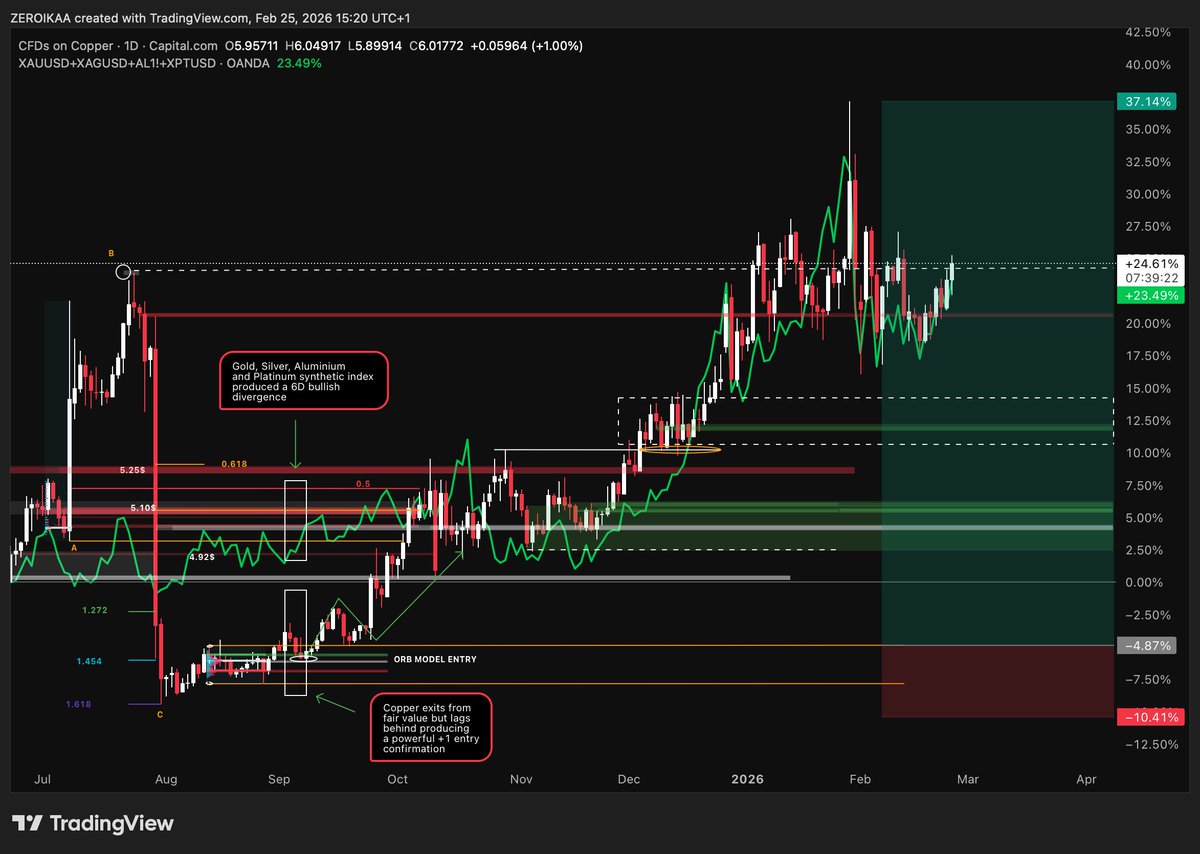
- Educational content: intermarket analysis - Pay attention because I'm gonna show you something really interesting that might help you to boost your profitability. One of the most valuable ways to spot undervalued assets is through intermarket relationships, so understanding how capital flows between asset classes and how relative performance reveals mispricing. As you know, markets do not move in isolation. Stocks, bonds, commodities, and currencies are interconnected through liquidity, growth expectations, interest rates and, therefore, capital rotation. When one market diverges from its typical relationship, it may signal a nice opportunity about to flourish. Intermarket analysis helps you to answer key questions: - "Is this asset cheap relative to macro conditions?" - "Is this move confirmed or isolated?" - "Is capital flowing into or out of this sector?" - "Is the trend supported by the broader environment?" "Can you make an example, mate?" If equities are falling while bond yields are also falling, liquidity is probably improving and equities may thus be temporarily undervalued. If the USD weakens while commodities are lagging, commodities may be underpriced relative to currency conditions. But let's see a clean one on charts. I discussed a few times about the entry on copper from a technical standpoint -> x.com/IamZeroIka/sta… but I also want to show you the counterpart on intermarket analysis. At that time, several metals were performing well and I created a synthetic index by picking the most important ones: XAU, XPT, AL1! and XAG in order to have a reference for capital rotation. As you can see, they were creating a strong bullish divergence in a 6D time window against copper - Metals were rising - Copper was lagging behind There was misalignment with the rest of the sector meaning that the probabilities for seeing it catching up were quite high. Price of copper in that divergence period exited from the fair value creating a clean ORB model and, after a clean test of the entry area, caught up "filling" the divergence. This is exactly how intermarket analysis and structure execution complement each other. Copper was not simply bought because price moved but because it was cheap relative to its sector. So, for the future, build a simple composite of related assets: - Metals → XAU + XAG + XPT + AL - Tech → NQ + SOX + XLK - Energy → Oil + XLE + NatGas - Rates → Bonds + Gold - Crypto -> BTC + Large caps ---------------------------------- Overlay target asset vs sector composite looking for: - Sector ↑ while asset <--> - Sector ↑ while asset ↓ - Sector breaks first --------------------------------- Find the divergence, you bias and your entry model -> execute In practice, intermarket analysis helps you to relative misalignment, moments when one market has not yet adjusted to the signal coming from another. These are often the highest-quality HTF opportunities.
ZERO IKA 🗡️ tweet media
English
5
18
206
10.5K
Ocean retweetet
🎯 Master
🎯 Master@Moneytaur_·
In trading, most people would do way better by just chilling and waiting for those solid key levels to get hit, then scooping up assets on the spot market instead of jumping into high-risk high-leverage longs. The real game-changer anyone can achieve success with: using dollar-cost averaging at smart, strategic points. Over time, it can seriously build your wealth. You don't need to nail every single level with pinpoint accuracy. You can let some of that go and focus on the bigger picture. A lot of times, just buying spot when price touches a monthly BB is a smarter move than trying to long the 10% range, especially if you're not great at ultra-refining it alongside finding confluence with majors, and understanding whales psyops. Bottom line: play it smart, check your ego at the door, and you'll have a real shot at coming out ahead in this wild, rigged game.
English
22
122
1.2K
115.7K
Ocean retweetet
🎯 Master
🎯 Master@Moneytaur_·
Everyone will get their chance to see their altcoin bags show bigger numbers in 2025. My suggestion: move profits [though most won’t even reach profits…] into established companies positioned to explode over the next decade. I've shared some. The potential % returns can be life-changing if you start gradually DCA’ing into those plays well before the decade closes. Study institutional portfolios. Most cryptos won’t survive. Most cryptos are just shameless scams. Valhalla is waiting for the majority. Ps:. Many of you know my macro targets for altcoins.
English
43
72
1.2K
82.2K
Ocean retweetet
ZERO IKA 🗡️
ZERO IKA 🗡️@IamZeroIka·
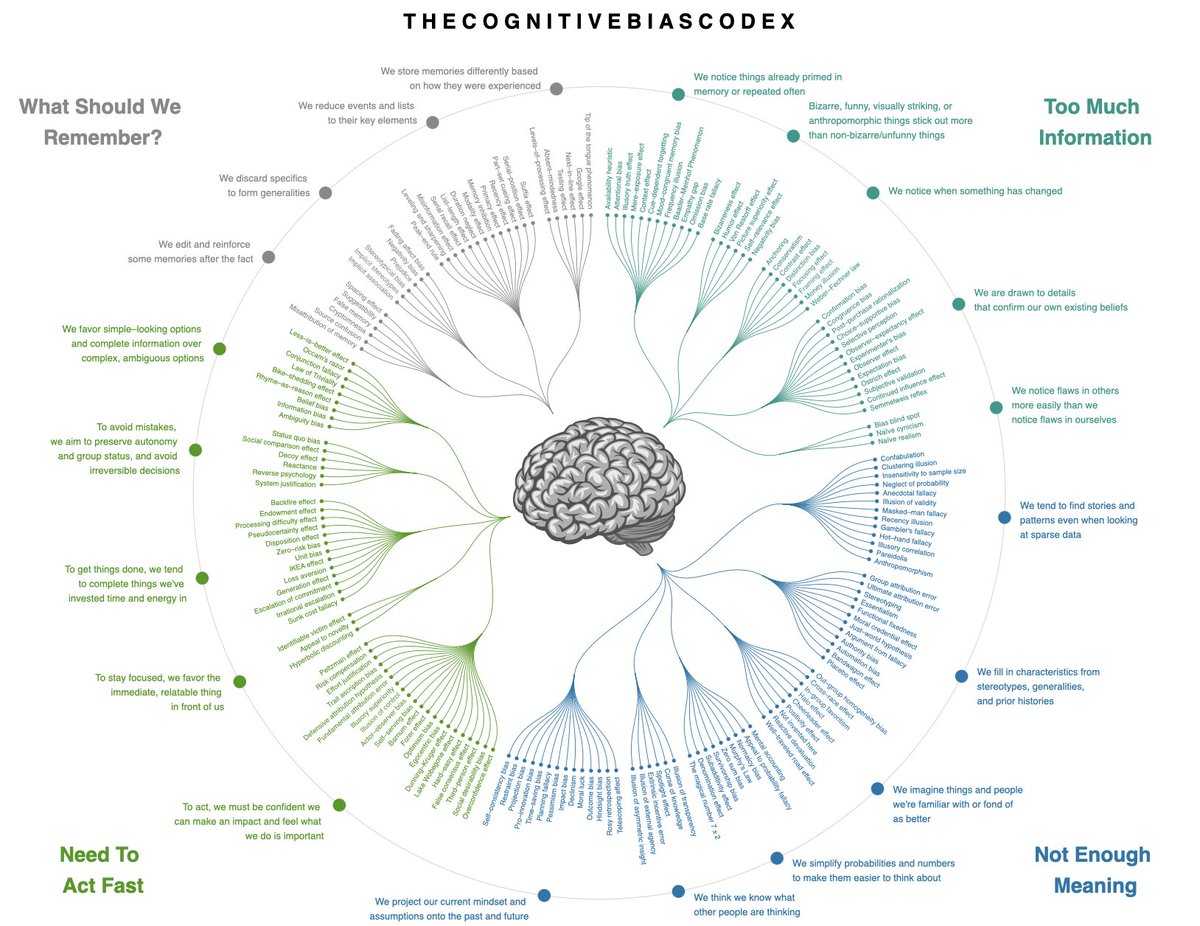
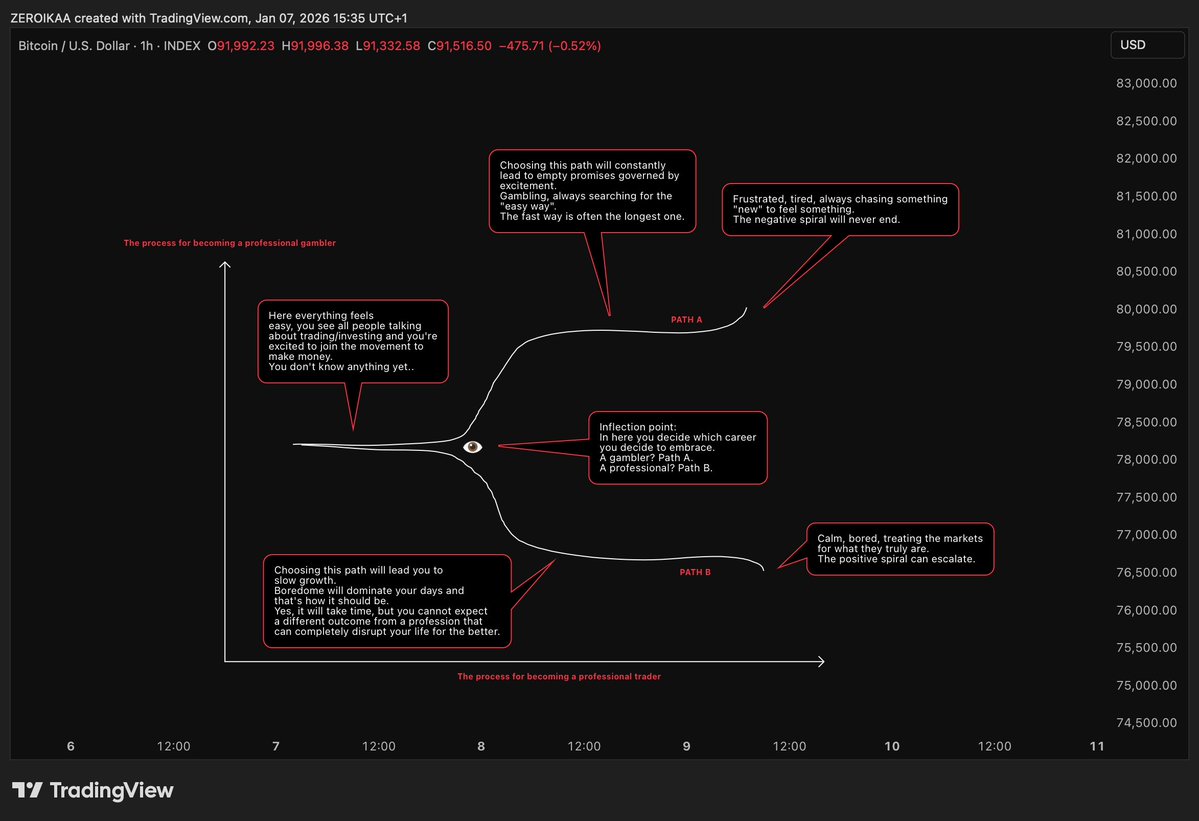
"Mate, how do you stop sabotaging yourself in trading? Why do I always end up breaking my own rules?” Time to drop my whole🧠"9-steps" psychological framework + end bonuses with the hope that you may find interesting ideas for your journey. Disclaimer: before starting, it’s important to remember that psychology is highly individual. There is no universal fix. The goal isn’t perfection, but building a process that offers the highest statistical probability of correct behaviour over time, aligned with your goals, timeframe, personality, and the amount of emotional energy you can realistically sustain. (Long post, if your attention timespan is level "Tiktoker", skip it as this post isn't for you) 👁️ First step 👁️ Identify where self-sabotage actually starts. Most people think self-sabotage starts inside the trade but this is far from true. It starts before the chart is even opened. The first thing I do is a state check, not a market check. I ask myself: - Am I bored? - Am I frustrated from a previous loss? - Am I trying to “make something happen”? - Am I trading to feel productive, in control, or validated? If the answer to any of these is yes, then I already know one thing: my edge is compromised, regardless of how good the setup looks. Self-sabotage is rarely technical, it’s contextual. 👁️ Second step 👁️ Separate execution from emotional regulation. This is a hard pill to swallow: If I’m using trading to regulate emotions, I’m not trading..I’m coping. Common emotional drivers behind rule-breaking: - Entering early to relieve impatience - Oversizing to feel confident - Revenge trading to restore self-esteem - Overtrading to escape boredom - Holding losers to avoid being wrong The market is not a therapist. It amplifies emotional imbalances instead of fixing them. So my rule is simple: I only trade when I don’t need the trade. Neutral state > confident state. 👁️Third step 👁️ Redefine discipline (this is crucial) Discipline is not willpower. If discipline were willpower, everyone would be profitable after reading one book. In reality, discipline fails when it conflicts with identity. A slow, repetitive, boring execution style threatens people who: - Associate value with intensity - Confuse action with progress - Need stimulation to feel engaged - Seek validation through performance That’s why many traders unconsciously sabotage consistency: consistency feels empty to an ego addicted to highs. The solution isn’t “try harder”. The solution is learning to tolerate boredom without acting. 👁️Fourth step 👁️ Build rules that protect you from future you. Under stress, nobody becomes more rational. We rationalize worse decisions. That’s why rules must be: - Predefined - Written - Mechanical - Non-negotiable in the moment What do you mean? - Fixed risk per trade - Max trades per session - Mandatory cooldown after a loss - No re-entries without a full reset - No size increase after red days Rules exist to protect you from the version of yourself that shows up under pressure. If a rule can be “reinterpreted”, it will be. If a rule will be "reinterpreted", your profitability will be. 👁️Fifth step 👁️ Treat boredom as a performance indicator. This was a game changer for me. High-quality trading feels: - Uneventful - Repetitive - Emotionally flat - Yes, sometimes disappointing If I feel excitement, urgency, or adrenaline, that’s valuable information, not motivation. Usually it means: - I’m forcing something - I’m anticipating instead of reacting - I’m trading emotion, not structure The market rewards restraint, not stimulation. If you need excitement, trading will punish you until you don’t. 👁️ Sixth step 👁️ Losses must be operational, not psychological. A loss should not change behaviour. If it does, then: - Risk was too high - Expectations were unrealistic - Identity was attached to outcome Rules I live by: - No “making it back” - No immediate revenge trades - No size adjustments to fix emotions - No narrative after a loss Losses are part of the whole distribution. The moment I try to fix them, I step outside the system. 👁️Seventh step 👁️ Reduce outcome relevance to near zero. No single trade matters. No single day matters. No single week matters. The brain wants meaning while trading runs on probability. The urge to “make today count” creates: - Overtrading - Forcing setups - Emotional execution My only real question is: “Did I behave like someone who plans to still be here in 6 months?” If yes → good day, regardless of PnL. 👁️ Eighth step 👁️ Stop mistaking intelligence for edge. This one hurts. ❗️Understanding the market does not equal profitability ❗️ Smart traders often fail because: - They override rules - They reinterpret setups - They seek confirmation - They believe insight should be rewarded The market doesn’t care how smart you are. It rewards consistency, not cleverness. If you need to feel smart, trading will humble you repeatedly. Try to remain as humble as possible. Try to stick to your idea with an open mind. In this specific context I help myself with the "Cognitive Bias Codex" developed by Dr. Gary Fox, something extremely useful. 👁️ Ninth and final step 👁️ Make trading impersonal. Auto-sabotage fades when trading stops being personal. When it becomes: - A process, not a proving ground - A routine, not an escape - Execution, not something to identify yourself with The market will never judge you, test or challenge your intelligence. It’s simply exposing how you behave when money, uncertainty, and time pressure collide. Master that and I promise you, strategy becomes the last thing you will think about. 👁️End bonuses 👁️ These are posts that you should save, print and attach on your wall: - My trading routine: x.com/IamZeroIka/sta… - Probabilistic mindset: x.com/IamZeroIka/sta… - Breaking the rules: x.com/IamZeroIka/sta… - Rules to follow: x.com/IamZeroIka/sta… If you found this useful, the like and repost buttons are just a few centimeters below. If you didn’t, you probably weren’t meant to read it anyway.
ZERO IKA 🗡️ tweet mediaZERO IKA 🗡️ tweet media
English
19
67
358
13.4K
Ocean retweetet
Phoenix
Phoenix@phoenix_cr47·
As I made some additional learnings based on my own experiences and on comments made by @Moneytaur_ I would like to expand a bit on the topic of Quality of a hidden liquidity level. When I talk about the quality I specifically mean the probability that price will reverse at a certain liquidity level giving you an optimal trade entry. This quality of a hidden liquidity level depends on several factors: 1) Mitigation Was the level mitigated already earlier by wicks into the zone? The more wicks into the level the weaker the HOB. If a HOB Zone was mitigated by more than 50% (0.5 fib) I don‘t consider it anymore. 2) Fully or partial hidden? Is the BB fully or just partially hidden behind a FVG? If it’s just partial that makes it a partial HOB = pHOB. If the BB is fully hidden behind the FVG it’s stronger. 3) Timeframe matters The biggest money is found on HTF. HTF HOBs are in General stronger than MTF and LTF HOBs. >1D or even >1W tend to be quite powerful. 4) Are multiple TF HOBs at same level? Are there multiple HOBs stacking above each other on different TFs? Can you refine a HTF hidden liquidity level into a lower timeframe one? If yes this increases their strength. 5) Understanding the HTF trend In a HTF downtrend HOBs acting as resistance work better than those as support - and in bullish trend vice versa. In bearish trends bullish HOBs are often ignored and you can short a 2x HOB later. In a HTF downtrend the most reliable HOBs are close to HTF demand zones, which brings me to the next point. 6) Is the Hidden Liqudity Zone Close to HTF Demand or Supply? Liquidity zones „in the middle“ are frequently ignored as long they don’t have powerful confluence coming from fib levels. The closer they are to HTF Demand / Supply the more powerful they are. 7) Fib Confluences Of the Hidden Liquidity level has confluences with relevant fib levels (5, .618, .705, .786, .886) it’s stronger, ideally the fib levels can be found on HTF swings. 8) Multiple FVGs Are there multiple FVGs behind the BB? If yes this becomes a 2-n x HOB and those are likely stronger. Note that the existance of those levels means that HOBs don’t always lead to a reaction but can be ignored initially. You can find reasons why they can be ignored initially in one of the points above. 9) Volume of the coin Liquidity concepts work better on high volume coins such as $BTC and $ETH. Those two are leading and be careful about liquidity levels on alts that do not align with liquidity levels on those majors. 10) Confluences Do not trade altcoins in isolation - if they reach key levels look for confluences coming from USDT.D BTC ETH TOTAL TOTAL2 Did they reach key levels as well? If yes this increases chances of a reversal. Bonus As additional metric for entering a trade in a hidden liquidity zone you can check the Volume Spread. High Volume and high Spread Events can give confluence for an upcoming reversal. Might write more on that later. This might be the most valuable post I‘ve ever written, hope you appreciate :)
Phoenix@phoenix_cr47

I wanted to take the time to explain some additional thoughts around Breaker Blocks behind FVGs (also referred to as liquidity blocks, hidden liquidity and Hidden Order Blocks - HOBs). During my trading the last few months I realized that the quality, or in other words the r/r on those Hidden Order Blocks (HOBs) depends on different factors. I wanted to share my personal learnings behind those. IMO what follows is real alpha, so consider bookmarking. 1) What is an Hidden Order Block? It’s an area in the chart where a Breaker Block (BB) overlaps with a Fair Value Gap (FVG). These areas often hold hidden liquidity and can this be relevant levels for price to reverse. Originally this concept was mainly braught up by @Moneytaur_ (again, thank you) and it was picked up and times for own needs by several traders I respect a lot like for example @TraderDune. 2) Hidden in unusual timeframes Often you will find those HOBs on timeframes where many just don’t look. Fit example 23h, 17h, 3 days, etc Often you might find dich a level on HTF and k side that Range you might find another one on LTF, this finetuning your potential entry and SL. 3) Additional factors Not all HOBs are equally strong. Their strength depends mainly on those factors: - Was the Level mitigated already earlier by wicks into the zone? The more wicks it the Level had the weaker the HOB - Is the BB fully or just partially hidden behind a FVG (partial HOB = pHOB)? If the BB is fully hidden behind the FVG it’s stronger. - Does the level have confluences with relevant fib levels (5, .618, .705, .786, .886)? If yes it’s stronger. - Are there multiple FVGs behind the BB? If yes this becomes a 2x HOB and those are likely stronger. Note that the pure existance of these levels means that HOBs don’t always lead to a reaction but can be ignored first time. Example: 20h HOB on $SOL at 195$ 0.5 fib confluence Unmitigated Fully hidden -> Strong Note that this DOES NOT mean that price needs to go to these levels, but it means that IF it goes there you got a favorable risk/reward long, especially if it is in confluence with resistance on USDT.D Chart or support on TOTAL charts. If you should have trouble understanding what I wrote study until it clicks, it‘s all there.

English
66
97
728
103.6K