NishatZaidi

911 posts

NishatZaidi banner
NishatZaidi

NishatZaidi

@ProfNZaidi

Author/ Translator/ Hindi-Urdu literature/ Oceanic Literature/ Women's Writing/ Postcolonial Lit/ Professor of English, Jamia Millia Islamia, ND https://t.co/HF0gKk0QGj

New Delhi Beigetreten Nisan 2023
338 Folgt654 Follower
Angehefteter Tweet
NishatZaidi
NishatZaidi@ProfNZaidi·
I am delighted to share that the special issue of the Journal of Urdu Studies (Brill) on Jamia’s Women and Beyond, put together by Margrit Pernau and me has been published. Do give it a read: brill.com/view/journals/…
English
3
31
88
5.2K
NishatZaidi retweetet
Duncan Bell
Duncan Bell@DrDuncanBell·
POST-DOC! 3-year job in history of political thought / visual culture / art history Department of Politics & International Studies University of Cambridge jobs.cam.ac.uk/job/54724/
English
1
77
212
23.2K
NishatZaidi
NishatZaidi@ProfNZaidi·
jab ishq sikhātā hai ādāb-e-ḳhud-āgāhī khulte haiñ ġhulāmoñ par asrār-e-shahanshāhī ā.īn-e-javāñ-mardāñ haq-goī o be-bākī allāh ke sheroñ ko aatī nahīñ rūbāhī
Latviešu
0
0
3
48
NishatZaidi
NishatZaidi@ProfNZaidi·
My review of Mohammad Naushad’s book Alvida Nehru published in The Book Review February issue examines the relevance of Nehru in the context of Muslims/ Urdu poetry in post-independence India
NishatZaidi tweet mediaNishatZaidi tweet media
English
4
6
60
2.1K
NishatZaidi
NishatZaidi@ProfNZaidi·
Call for contributions: Archiving Oceans in Fiction: As part of a JPN - IIT Indore funded project we are building an open-source literary archive focused on representations of oceans, seas, and other water bodies in fiction. google form link: docs.google.com/forms/d/1IZQjC…
English
0
21
45
2.9K
NishatZaidi retweetet
Jamia Millia Islamia (NAAC A++ Grade Central Univ)
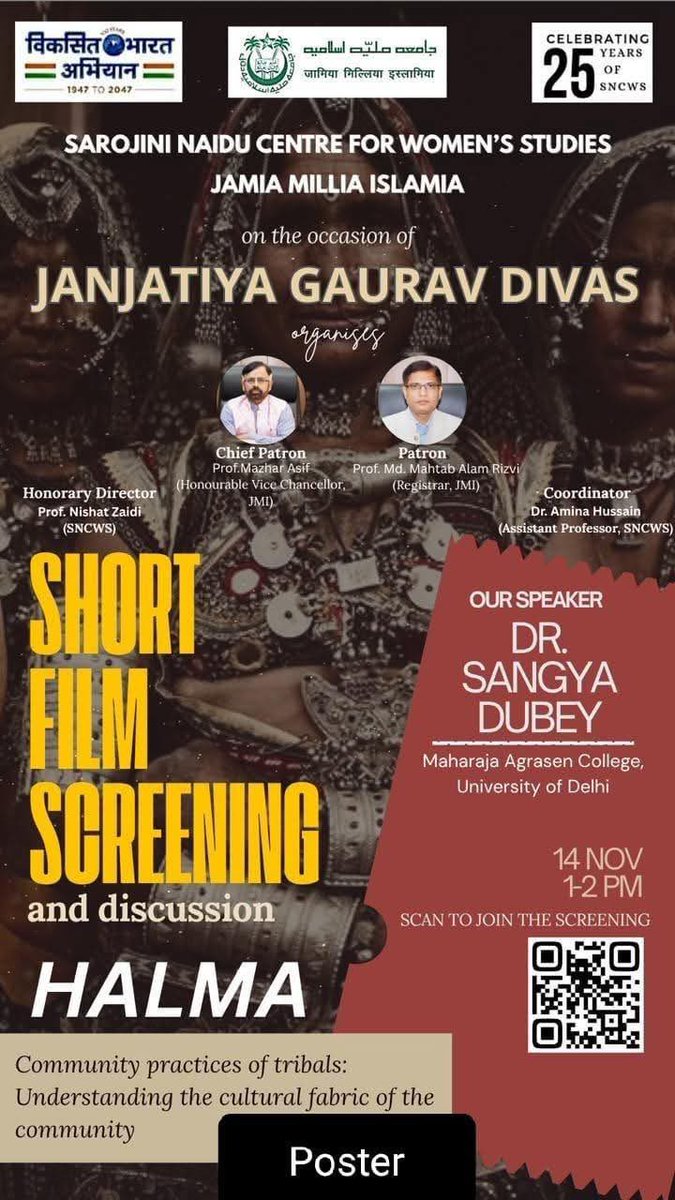
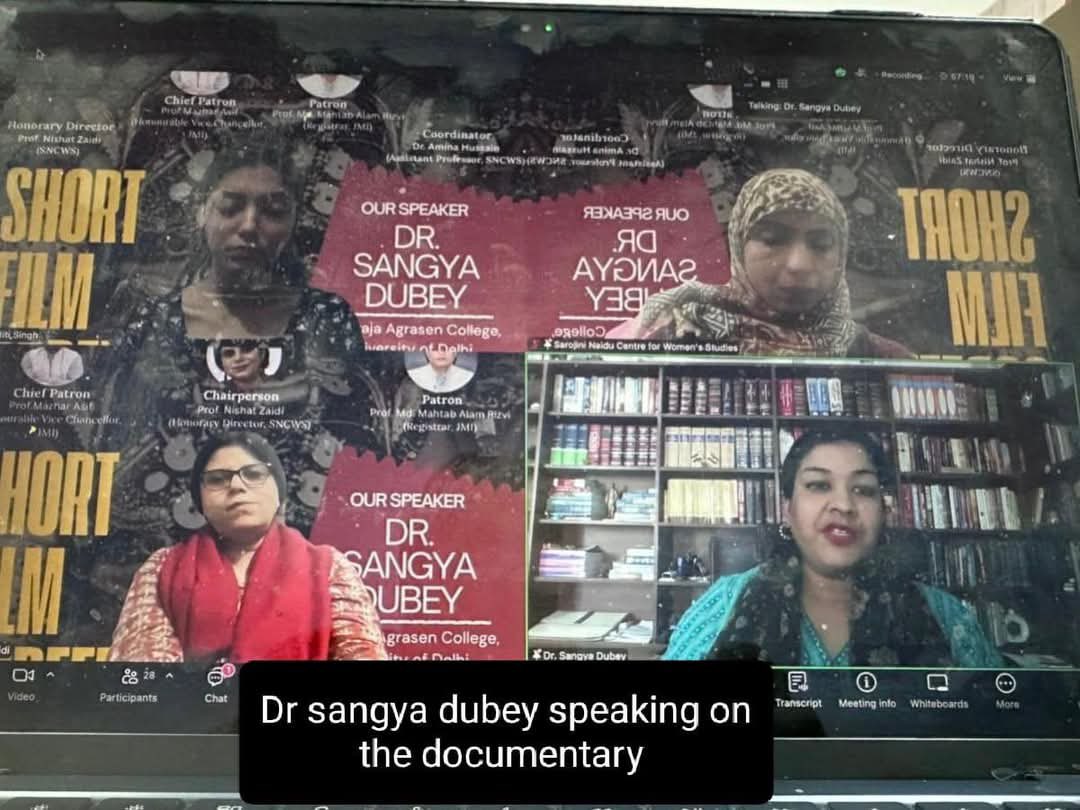
The Sarojini Naidu Centre for Women’s Studies (SNCWS), Jamia Millia Islamia, organised a special online screening and discussion of the short film Halma on the occasion of Janjatiya Gaurav Divas, November 14, 2025. The film offered an engaging and thoughtful portrayal of the Bhil community’s collective tradition of coming together to address shared concerns, particularly issues related to water scarcity. Through compelling visuals and narratives, Halma showcased how traditional methods foster unity, collective responsibility, and a deep sense of community belonging. The film further highlighted the continued relevance of indigenous practices in the modern world. It underscored the importance of traditional approaches not only in community coordination but also in everyday life, including food practices and sustainable living. As contemporary society rapidly moves toward modernisation, the documentary served as a reminder of the value embedded in age-old customs that sustain both ecological balance and cultural identity. Following the screening, Dr. Sangya Dubey from Maharaja Agrasen College, University of Delhi, led an enriching discussion on the cultural and social significance of tribal practices. She emphasised the importance of traditional food systems, community-led methods, and the wisdom inherent in indigenous ways of living. Dr. Dubey’s reflections deepened the audience’s understanding of the film and encouraged further thought on how tribal knowledge systems remain relevant in addressing current social and environmental challenges. Warm appreciation was extended to the guidance and support of Prof. Nishat Zaidi, Director of the Sarojini Naidu Centre for Women’s Studies, whose leadership continues to foster meaningful academic engagements. Appreciation was also extended to Dr. Amina Hussain, Coordinator of the programme, for her efforts in organising the event and ensuring its smooth execution. The programme witnessed active participation from students, scholars, and faculty members, who contributed to an engaging discussion on indigenous heritage and the importance of preserving traditional practices. The event concluded with thanks to the student volunteers and administrative staff of SNCWS for their support and coordination. The screening of Halma successfully drew attention to the richness of tribal traditions and reaffirmed the need to value and preserve these practices, which continue to offer vital lessons in sustainability, cooperation, and community harmony.
Jamia Millia Islamia (NAAC A++ Grade Central Univ) tweet mediaJamia Millia Islamia (NAAC A++ Grade Central Univ) tweet mediaJamia Millia Islamia (NAAC A++ Grade Central Univ) tweet mediaJamia Millia Islamia (NAAC A++ Grade Central Univ) tweet media
English
0
1
3
765
NishatZaidi retweetet
Jamia Millia Islamia (NAAC A++ Grade Central Univ)
The research methods component included lectures by Prof. Polly Vauquline from Guwahati University, who discussed focus groups, and Prof. Tulsi Patel, broadly covered various feminist research methodologies. Prof. Azra Musavi of AMU explored survey data, while Prof. Susan Visvanathan of JNU underlined the importance of reflexivity in feminist research. Prof. Azra Abidi, Head of the Department of Sociology, JMI, discussed the possibilities of collaborative research in feminist studies, and Dr. Nesar Ahmad, Director, Budget Analysis and Research Centre, Delhi addressed the significance of gender-responsive budgeting. Themes shaping the intersections of caste, class, and gender were taken up by Prof. Raj Kumar from the University of Delhi; Prof. Nishat Haider from the Department of English, JMI, analysed gender, caste, and translation through the works of Bama; and Prof. A. K. Ramakrishnan from the Centre for Study of Plural Societies, spoke on gender in relation to religion and civilization. Urban and area studies perspectives were shared by Dr. G. Uma from IGNOU, and by Prof. Taruna Bansal from the Department of Geography, JMI. Dr. Ritu Sharma of Delhi University explained the links between gender and the environment; Prof. Naved Iqbal from the Department of Psychology, JMI, explored self-compassion and self-control as predictors of well-being; Prof. Vijaylakshmi Brara from SNCWS, JMI discussed women’s agency in Northeast India; and Prof. Gomati Bodra Hembrom from the Department of Sociology, JMI, delivered a lecture on stratification among the tribals of Chotanagpur (Bihar). The valedictory address was delivered by Prof. Gopal Guru, eminent political scientist and former Professor at JNU, who underscored the enduring relevance of feminist research methodologies and encouraged participants to incorporate these approaches into both research and classroom teaching. All the participants submitted rigorous assignments, took an MCQ test and made group presentations on themes related to gender issues and feminist methodologies. During the feedback session, participants commended the course for its innovative design, interdisciplinary strength, and transformative learning experience. The assured the organizers that the programme would significantly inform their future academic work and deepen their engagement with gender-related research and teaching. The Refresher Course not only facilitated meaningful scholarly exchange but also bridged theoretical frameworks with field-based insights, reaffirming MMTTC’s commitment to fostering critical, inclusive, and future-ready academics.
Jamia Millia Islamia (NAAC A++ Grade Central Univ) tweet media
English
0
1
2
318
NishatZaidi retweetet
Jamia Millia Islamia (NAAC A++ Grade Central Univ)
The Malaviya Mission Teacher Training Centre (MMTTC), JMI concludes Two-Week, Interdisciplinary Refresher Course on “Gender Issues and Feminist Research Methodologies” on 24th November, 2025. The Malaviya Mission Teacher Training Centre (MMTTC) at Jamia Millia Islamia, Centre University, New Delhi, successfully concluded a two-week Online Refresher Course on “Gender Issues and Feminist Research Methodologies (Interdisciplinary)” held from Nov 11 to Nov 24, 2025 on the theme, “Gender Issues and Feminist Research Methodologies”. The course brought together a vibrant and intellectually diverse group of educators, policy-makers, and practitioners to engage in critical dialogue on the future of feminist research in India. In her inaugural address, Prof. Kulwinder Kaur, Hony. Director of MMTTC, welcomed all participants and introduced the Course Coordinators - Prof. Nishat Zaidi, Hony. Director, Sarojini Naidu Centre for Women’s Studies and Dr. Suraiya Tabassum, Assistant Professor, Sarojini Naidu Centre for Women’s Studies, JMI. In her introductory remarks, Prof. Kaur shared the vision behind conceptualizing the course on ‘Gender Issues and Feminist Research Methodology’. She emphasized its objective of creating a critical, inclusive, and reflexive academic space where participants could engage with contemporary debates, rethink conventional research paradigms, and strengthen their methodological approaches to studying gender in diverse contexts. Prof. Nishat Zaidi, Course Coordinator, in her address, highlighted steadfast commitment of Sarojini Naidu Centre for Women’s Studies to fostering rigorous and interdisciplinary gender research. This was followed by a concise overview of the entire programme by Dr. Suraiya Tabassum. Over the span of the next twelve days, the programme saw enthusiastic participation from 127 faculty members from 48 disciplines, representing universities across 26 Indian states, ranging from central and state institutions to deemed and private universities. The sessions drew insights from gender studies, development studies, history, literary and media studies, urban studies, and other allied fields, making the programme richly interdisciplinary. The component on feminist epistemologies featured lectures by Prof. Savita Singh of IGNOU and Prof. Rajesh Gill from Panjab University, who discussed feminist epistemology and interdisciplinary methodological approaches. Sessions on feminist readings and writings were delivered by Prof. Rukmini Sen of Ambedkar University who spoke on Life Writings as Feminist Method; Prof. Simi Malhotra of the Department of English, JMI, discussed Reading Literary and Media Texts from Feminist Critical Standpoints; while Prof. Meher Faima of SNCWS, JMI, and Dr. Firdous Azmat Siddiqui from SNCWS, JMI spoke on themes of Reading women’s history through literature, memory and oral narratives. Dr. Prashant Negi from the Centre for Dalit and Minorities Studies, JMI, deliberated upon integrating evidence into research framework design. (Contd….)
Jamia Millia Islamia (NAAC A++ Grade Central Univ) tweet mediaJamia Millia Islamia (NAAC A++ Grade Central Univ) tweet mediaJamia Millia Islamia (NAAC A++ Grade Central Univ) tweet media
English
1
1
3
426
NishatZaidi retweetet
Jamia Millia Islamia (NAAC A++ Grade Central Univ)
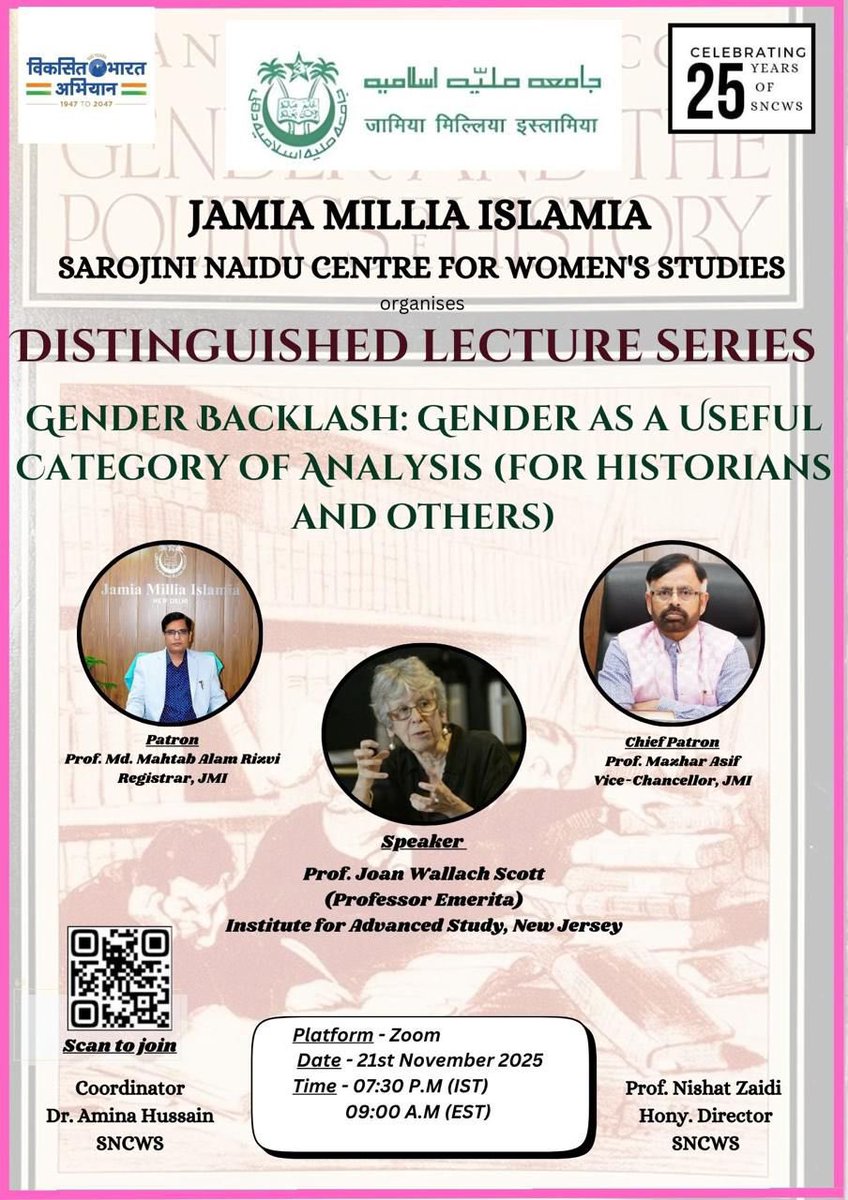
Prof. Joan W. Scott delivers lecture in Sarojini Naidu Centre for Women’s Studies, JMI's Distinguished Lecture Series As a part of its distinguished lecture series, the Sarojini Naidu Centre for Women’s Studies (SNCWS), Jamia Millia Islamia (JMI) hosted eminent scholar Prof. Joan Scott, Professor Emerita, Institute of Advanced Study in Princeton, New Jersey, for an online lecture titled, ‘Gender Backlash: Gender as a Useful Category of Analysis (For Historians and Others)’. Scholars from various countries and universities attended the lecture and participated enthusiastically in the discussion following it. The event began with Dr Amina Hussain, Coordinator of the Distinguished Lecture Series, presenting the welcome address, followed by the speaker's introduction by Prof. Nishat Zaidi, Honorary Director of SNCWS. The lecture commenced with Prof. Scott outlining her monumental article on gender as a tool of historical analysis, published 40 years ago. The correlation between politics and gender was frequently emphasised along with recent backlash against the academic interrogation of gender, sex and sexuality. Administrative push for re-accepting gender binaries and the aspiration for hyper-masculinisation under contemporary authoritarian regimes were analysed from a critical and theoretical approach. The insightful session was followed by concluding remarks by Prof. Nishat Zaidi and an engaging Q&A session moderated by Preeti Maurya, scholar at SNCWS. The set of questions from the audience revolved around the themes of danger to transgender lives, subjectivity in academia, political construction of gender and contemporary developments in the feminist movement. The lecture officially ended with a vote of thanks given by Dr Amina Hussain and the centre’s objective to continue creating spaces for critical engagement with gender discourse. Prof. Saima Saeed Chief Public Relations Officer
Jamia Millia Islamia (NAAC A++ Grade Central Univ) tweet mediaJamia Millia Islamia (NAAC A++ Grade Central Univ) tweet mediaJamia Millia Islamia (NAAC A++ Grade Central Univ) tweet mediaJamia Millia Islamia (NAAC A++ Grade Central Univ) tweet media
English
0
4
22
1.4K
NishatZaidi
NishatZaidi@ProfNZaidi·
Glad to share this interview done by the Doon Valley School (Dehradun) kids when they invited me for their Literature Festival. The kind of questions they asked reflects the maturity of their mind and understanding. It was published in their Founder’s Special issue
NishatZaidi tweet media
English
0
0
6
203
NishatZaidi retweetet
Jamia Millia Islamia (NAAC A++ Grade Central Univ)
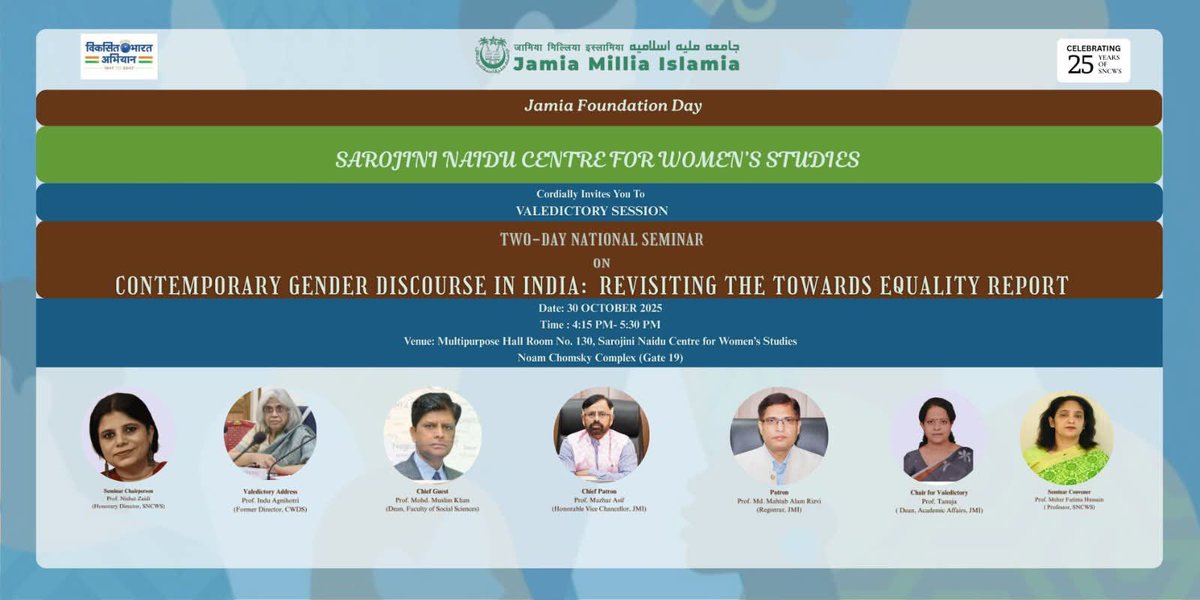
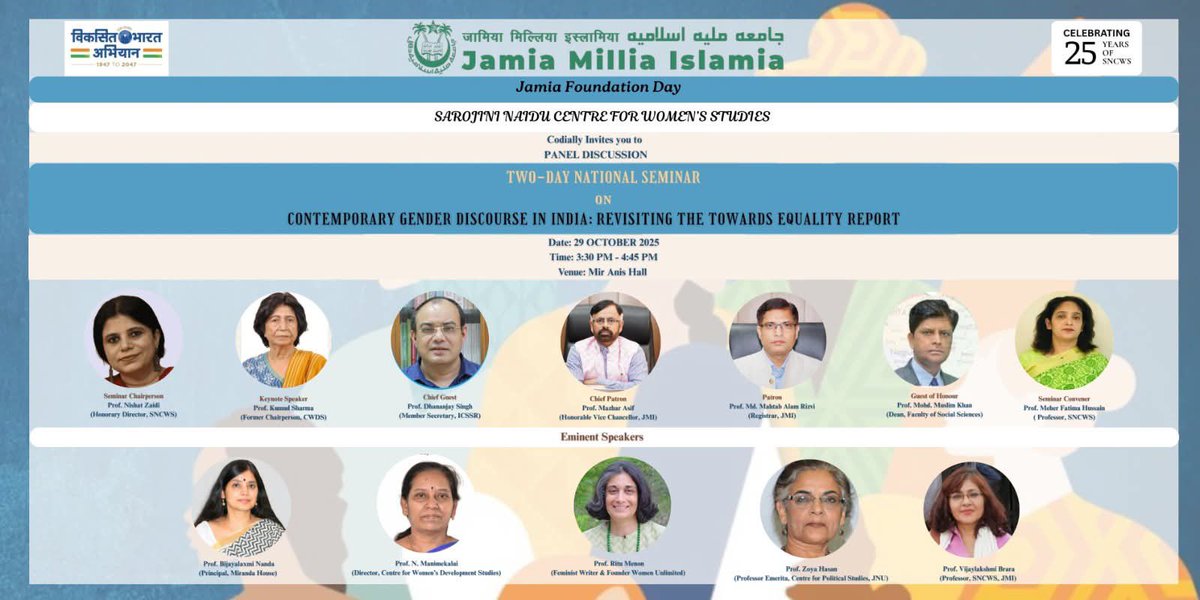
The Inaugural session was followed by a panel discussion by distinguished scholars including Prof. Bijayalaxmi Nanda, Principal, Miranda House, Delhi University, Prof. N. Manimekalai, Director, Center for Women’s Development Studies, Prof. Zoya Hasan, Professor Emerita, Center for Political Science, Jawaharlal Nehru University and Prof. Vijayalakshmi Brara from the SNCWS. Connecting thematically were the various technical sessions engaged by academicians, researchers, scholars, students from within Jamia Millia Islamia, JNU, Delhi University, Aligarh Muslim University and from across the country. The comprehensive two-day seminar featured an extensive and meaningful academic engagement and concluded with an insightful Valedictory Address by Prof. InduAgnihotri, Former Director of CWDS, thatoffered a critical appraisal of the historical trajectory of gender studies and its evolving intersections with policy and practice. The Chief Guest, Prof. Mohd. Muslim Khan, Dean- Faculty of Social Sciences, emphasized the imperative of intersectional and grassroots engagements, underscoring the need to strengthen community connections both within Jamia and beyond its institutional boundaries. The Valedictory Session was Chaired by Prof. Tanuja, Dean -Academic Affairs, JMI and she affirmed the need of bridging academic inquiry with lived realities, ensuring that scholarship remains responsive to social transformation. The dignitaries lauded and acknowledged the SNCWS’s forward-looking vision of mainstreaming women’s issues, research and outreach. The seminar concluded on a note of renewed resolve to advance gender justice through research, dialogue, and institutional collaboration.The seminar underscored the university’s unwavering commitment to advancing gender studies and women's empowerment as integral components of its academic mission with SNCWS playing pivotal role.
Jamia Millia Islamia (NAAC A++ Grade Central Univ) tweet mediaJamia Millia Islamia (NAAC A++ Grade Central Univ) tweet mediaJamia Millia Islamia (NAAC A++ Grade Central Univ) tweet mediaJamia Millia Islamia (NAAC A++ Grade Central Univ) tweet media
English
0
2
4
402
NishatZaidi retweetet
Jamia Millia Islamia (NAAC A++ Grade Central Univ)
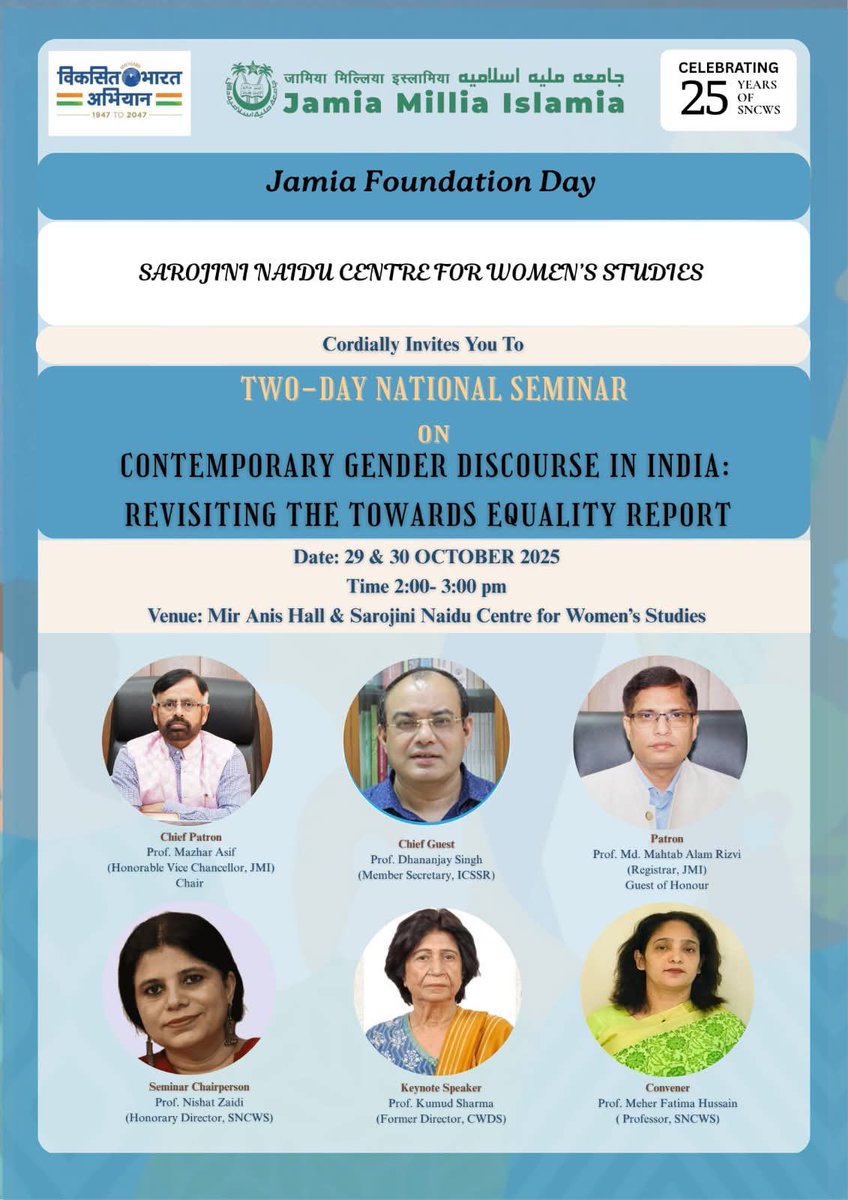
The Sarojini Naidu Centre for Women's Studies (SNCWS) Jamia Millia Islamia organised a National Seminar on "Contemporary Gender Discourse in India: Revisiting the Towards Equality Report." The Sarojini Naidu Centre for Women's Studies (SNCWS) at Jamia Millia Islamia organised a prestigious two-day National Seminar on 29-30th October, 2025 at Mir Anis Hall and SNCWS. The seminar was organised marking the five decades of unveiling of the historic Towards Equality Report -1975 and was heldduring the university’s105th Foundation Day events also celebrating 25 years of the establishment of theSNCWS in the university. The seminar started with the recitation from the Holy Quran by Dr. Mohd. Sayeed Anwar. The Hon’ble Vice Chancellor and Chief Patron, Prof. Mazhar Asif inaugurated the seminar and felicitated the Chief Guest Prof. Dhananjay Singh, Member Secretary, Indian Council of Social Science Research (ICSSR) with a memento. Prof. MazharAsif lauded the SNCWS’s efforts in advancing research and studies on women’s issues and gender concerns and his leadership in higher education lent gravitas to the proceedings.He reiterated the university's commitment to women’s studies as a cornerstone of academic excellence and towards building women’s leadership. His patronage underscored Jamia's vision of creating inclusive educational frameworks that prioritise women's empowerment and equality. Elucidating further, the Chief Guest Prof. Dhananjay Singh, appreciated the SNCWS’s pioneering role in shaping critical gender scholarship and deliberated on the efforts and research interventions of ICSSR in promoting research on health, gender and tribes among many other core issues. He emphasised the enhanced institutional collaboration to address contemporary challenges faced by women in India's rapidly transforming society. Prof. Md. MahtabAlam Rizvi, the Patron and Registrar Jamia Millia Islamia felicitated the Keynote Speaker Prof. Kumud Sharma, (Former Chairperson CWDS) with a memento and Prof. Nishat Zaidi Honorary Director SNCWS formally welcomed all the dignitaries, delegates and participants.Prof. Zaidi’s thoughtful observations were on the SNCWS 25-years journey and ongoing academic activities reflecting pride in the past achievements and a clear vision for future. Prof. Meher Fatima Hussain gave a thematic introduction to the seminar in which she encapsulated the report’s findings while also assessing the prospects.Prof. Hussain’s observations set the intellectual tone for the seminar, emphasising the need to bridge historical analysis with contemporary gender challenges. Prof. Md. MahtabAlam Rizvi while locating the centre’s relevance in mainstreaming women’s issues particularly emphasised on gender equality and the pivotal role of women in peace-building processes both nationally and globally. The Gender Audit Research “Report Gender Audit (2024-25) series III” prepared by Dr. Tarannum Siddiqui under the supervision of Prof. Nishat Zaidi was unveiled during the inaugural session. In her Keynote Address, Prof. Kumud Sharma offered profound insights into the historical significance of the Towards Equality Report as she herself was part of its writing. Drawing from decades of experience in feminist research and policy advocacy, she traced the evolution of gender discourse in India and outlined emerging priorities for the next generation of scholars.
Jamia Millia Islamia (NAAC A++ Grade Central Univ) tweet mediaJamia Millia Islamia (NAAC A++ Grade Central Univ) tweet mediaJamia Millia Islamia (NAAC A++ Grade Central Univ) tweet mediaJamia Millia Islamia (NAAC A++ Grade Central Univ) tweet media
English
1
4
25
913
NishatZaidi
NishatZaidi@ProfNZaidi·
Please consider submitting proposal for this special issue of GSLS (Taylor ans Francis journal) I am guest-editing on the theme “Oceanic Fictions in Indian Languages and Beyond.” Here is the cfp: think.taylorandfrancis.com/special_issues…
English
0
4
12
1.5K