Prue Plummer retweetet

A Boston photographer was setting up for a photoshoot on Saturday evening when she accidentally captured a proposal on Acorn Street in Beacon Hill and she is looking to find the couple and share this photo to them.
🤍

English
Prue Plummer
2.8K posts


@PruePlummer
Clinician scientist (PhD, physio, MS, stroke). Wannabe sommelier. Australian in Boston. Love animals & shoes. Perpetually homesick. Addicted to learning.

Christmas and New Year’s should never fall on a Wednesday again




Key Takeaways from “Regression Modeling Strategies” by Frank Harrell (@f2harrell) A must-read for anyone working with predictive modeling. Here’s what you need to know: Plan your model with clear goals—whether prediction, effect estimation, or hypothesis testing. Avoid arbitrary categorization of continuous variables, as it leads to information loss and reduced statistical power. Use flexible techniques like restricted cubic splines to relax linearity assumptions while maintaining interpretability. Avoid stepwise selection, which often results in overfitting. Instead, rely on penalized regression methods such as ridge or elastic net. Handle missing data effectively through multiple imputation rather than case deletion. Reduce dimensionality using redundancy analysis, variable clustering, or principal component analysis to make models more efficient and interpretable. Validate models rigorously using bootstrap resampling rather than splitting data into arbitrary training and testing sets. Focus on calibration and discrimination metrics like concordance indices to assess predictive performance. Communicate results clearly with visualization tools such as diagnostic plots and nomograms. Simplify models thoughtfully through approximations rather than haphazardly dropping predictors. This book combines theoretical depth, practical advice, and reproducible R code, making it essential for statisticians, data scientists, and researchers in fields like biostatistics and machine learning. Thoughts? #Statistics #DataScience #Research #Science #Rstats
My brilliant med student asked me to explain correlation, causation, confounding &collider bias. I used the following ex… so sharing here in case anyone finds it helpful! PS -I have learned much from @dnunan79 @Catalogofbias - a great resource for EBM. hopefully he approves😅
The Curse of Knowledge: Experts assume everyone knows what they know. But they struggle to teach or lead effectively for those still learning. Simplicity is an art.
Parkinson's Law: work expands to fill the time given. When we have more time, we tend to procrastinate and become inefficient. A good reminder to track your tasks duration and energy level.
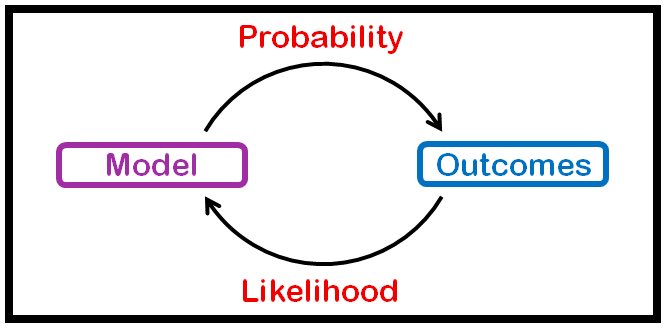
Let’s clear up the confusion between probability and likelihood in statistics. Probability is forward-looking. It starts with known parameters or a model and predicts the likelihood of an outcome. For example, with a fair coin, the probability of flipping heads is 0.5. It helps answer: “What are the chances this event will happen?” Likelihood, however, is backward-looking. It starts with observed data and asks, “Which parameter values best explain what I’ve seen?” If you observe many coin flips, you use likelihood to estimate if the coin is fair or biased. Probability is about predicting future outcomes given known conditions. Likelihood is about using data to infer unknown parameters. This distinction is important for statistical inference and applying the right models. #Statistics #DataScience #Research #Science