Different horn antennas aren’t just passive components—they’re precision tools for shaping electromagnetic waves in real-world communication systems.
Each design delivers a unique beam pattern tailored to specific applications. Here’s how they compare:
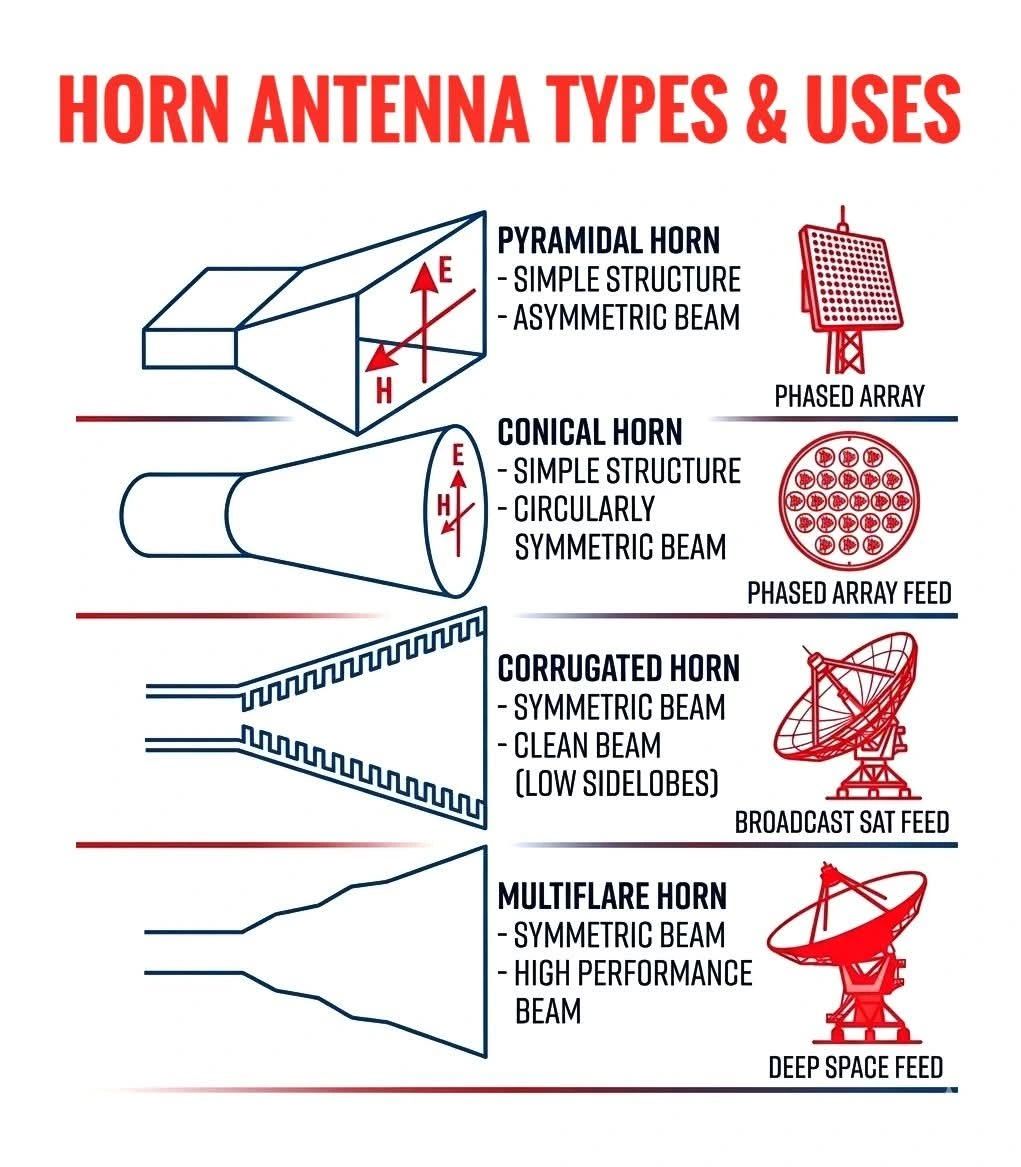
🔹 Pyramidal Horn – Formed by flaring a rectangular waveguide in both directions. Simple, widely used, and ideal for general-purpose microwave work and antenna measurements. The trade-off? The beam isn’t perfectly symmetric.
🔹 Conical Horn – Derived from a circular waveguide, producing a circularly symmetric beam. A top choice in radar systems and standard gain antennas where uniform coverage matters most.
🔹 Corrugated Horn – Internal grooves reduce sidelobes and improve beam symmetry, resulting in a clean radiation pattern. Perfect for satellite communications and high-precision RF systems.
🔹 Multiflare Horn – Engineered with multiple flare angles for superior beam control. Offers excellent symmetry and minimal distortion, making it suitable for advanced applications like deep-space communication.
📡 Where you’ll find them
Horn antennas serve as critical feeds in phased arrays, satellite dishes, and space communication systems—ensuring efficient radiation and precise signal direction over long distances.
Which horn type has been most useful in your RF or antenna work? Let’s discuss below. 👇
#AntennaDesign #RFEngineering #MicrowaveTechnology #SatelliteCommunications #ElectromagneticWaves
English