Olivier Marre

2.3K posts

Olivier Marre banner
Olivier Marre

Olivier Marre

@RetinaGeek

Interested in retinal circuits and computations, vision and neuroscience. Researcher at the @InstVisionParis @[email protected]

Paris, France Beigetreten Eylül 2018
157 Folgt701 Follower
Olivier Marre retweetet
Stéphane Deny
Stéphane Deny@StphTphsn1·
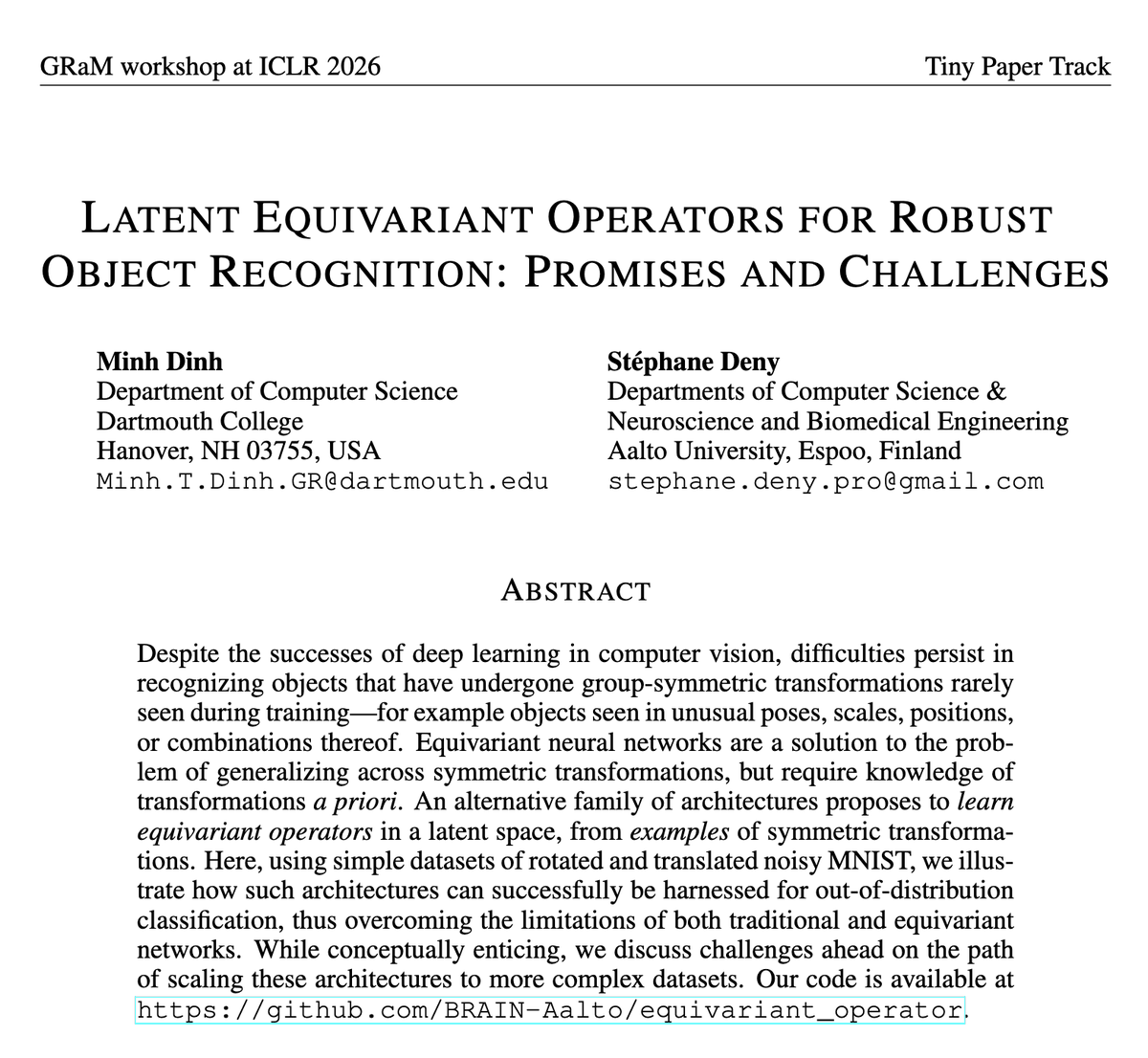
In this short piece we make the case for latent equivariant operators methods✨, an alternative to classical and equivariant nets that shows promise for out-of-distrib classif. We lay out the challenges ahead for scaling these methods to larger datasets 🧐 follow @minhinhtrng 👀
Minh Dinh@minhinhtrng

Modern vision models lacks robustness when objects appear in unusual poses. @StphTphsn1 and I study latent equivariant operators as a remedy and discuss caveats of these operators. Below is a summary of the work, accepted at the GRaM Workshop at ICLR @iclr_conf 2026. 🧵

English
2
10
58
8.1K
Olivier Marre retweetet
Minh Dinh
Minh Dinh@minhinhtrng·
Modern vision models lacks robustness when objects appear in unusual poses. @StphTphsn1 and I study latent equivariant operators as a remedy and discuss caveats of these operators. Below is a summary of the work, accepted at the GRaM Workshop at ICLR @iclr_conf 2026. 🧵

Minh Dinh tweet media
GIF
English
1
13
57
10K
Olivier Marre retweetet
Science girl
Science girl@sciencegirl·
Focus on the black cross and the red dots will appear to follow waves even though they move straight.
English
105
944
7.1K
1.1M
alex rubinsteyn
alex rubinsteyn@iskander·
If any ants follow me: is there any kind of "Claude for an academic bio lab" deal? I want to buy Max subscriptions for everyone in the lab, but can't tell if there's anything simpler than buying them all individually (neither whole-university Academia or Team plans seem right)
English
6
4
58
16.4K
Olivier Marre
Olivier Marre@RetinaGeek·
Enjoy the read !
English
0
0
0
47
Olivier Marre
Olivier Marre@RetinaGeek·
A citation from 1744 (no typo !).
English
1
0
1
49
Olivier Marre
Olivier Marre@RetinaGeek·
How does our visual system process natural scenes ? How can we approach this question ? Happy to share this recent review written with Samuele Virgili where we ask these questions at the level of the retina. sciencedirect.com/science/articl…
English
1
0
2
86
Olivier Marre retweetet
Fenil Doshi
Fenil Doshi@fenildoshi009·
🧵 What if two images have the same local parts but represent different global shapes purely through part arrangement? Humans can spot the difference instantly! The question is can vision models do the same? 1/15
GIF
English
6
117
605
77.4K
Olivier Marre retweetet
Simone Azeglio
Simone Azeglio@simoneazeglio·
Our approach: introduce 4 core axioms any meaningful decomposition should satisfy: ✓ Completeness: recovers total mutual information ✓ Locality: local changes have local effects ✓ Positivity: information ≥ 0 ✓ Additivity: combines measurements properly
Simone Azeglio tweet media
English
1
1
4
256
Olivier Marre retweetet
Simone Azeglio
Simone Azeglio@simoneazeglio·
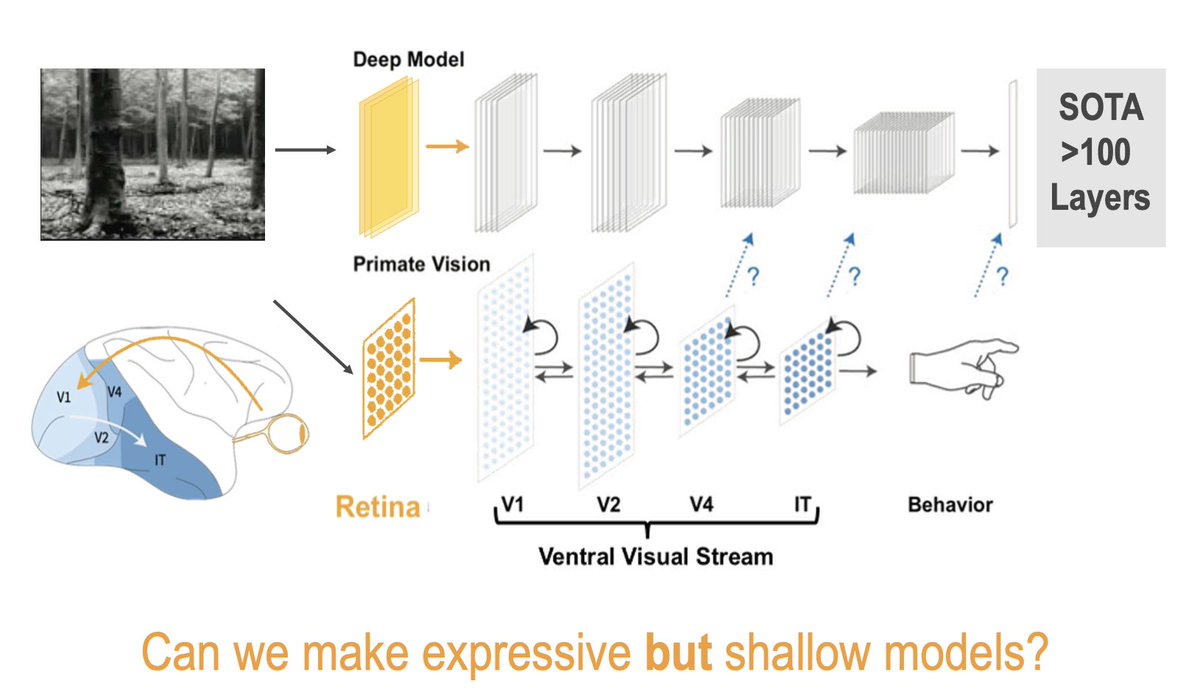
🧠🔬 Excited to share our #NeurIPS2025 paper: "Convolution Goes Higher-Order"! We asked: Can shallow networks be as expressive as deep ones? Inspired by biological vision, we introduce higher-order convolutions that capture complex image patterns standard CNNs miss. 🧵👇
Simone Azeglio tweet media
English
1
30
193
7.8K
Olivier Marre retweetet
Simone Azeglio
Simone Azeglio@simoneazeglio·
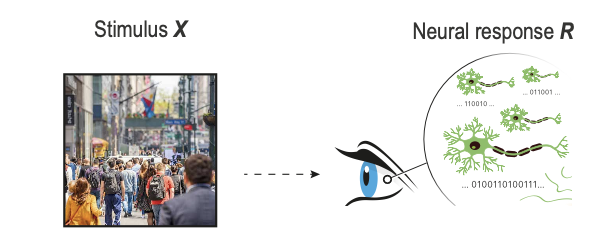
🧠 How do neurons encode information? We know HOW MUCH, but what about WHAT information they encode? Our new work uses diffusion models to decompose neural information down to individual stimuli & features! 🎯Spotlight at #NeurIPS2025 🌟📄 arxiv.org/abs/2505.11309
Simone Azeglio tweet media
English
3
27
137
7.6K
Stéphane Deny
Stéphane Deny@StphTphsn1·
@TrueAIHound very nicely put. In bonus, and to paraphrase my mentor, working in the retina is neat because nobody thinks it is the seat of consciousness @RetinaGeek
English
2
0
12
441
AGIHound
AGIHound@TrueAIHound·
Neuroscience bits from my research. I'm neither a fake-AGI accelerationist nor a weirdo doomer. Still, I believe that a breakthrough can happen at any time. I base my argument on neuroscience research. Here it is. Knowing that the retina is perfectly designed for the visual cortex and vice versa, and realizing that it's almost impossible, given the daunting complexity of the task, to unlock the hidden principles of the visual cortex, it makes sense to focus on the design of the retina. The architecture and operation of the retina is very well understood. I believe that trying to understand exactly why it operates the way it does is the best way to flesh out most of the key principles of visual perception. Things like generalization, recognition, on-the-fly representations, prediction, etc. all depend on the kind of signals arriving from the retina. Once visual perception is solved, solving the rest of the intelligence puzzle (motivation, motor control/learning, language module, etc.) will be a piece of cake in comparison. I have strong reasons to believe that all the sensory cortices, including the auditory and tactile cortices, work exactly like the visual cortex. Even olfactory and gustatory work the same way. Who knows? At one point in the future, we may want to build robot chefs that can actually "smell" and "taste" the food. So yes. I believe that a breakthrough can happen at any time. 😮
AGIHound@TrueAIHound

I have come to understand that the design of the retina contains more than 90% of the information we need to solve the visual perception and learning problem. My thesis is that the retina is made for the visual cortex and vice versa. The trick is to ask as many why-type questions about the design of the retina as possible. Knowing the why of things is the path to wisdom. Why use edge movement detectors? Why use microsaccades? Why 10 angles? Why 20 directions? Why generate spikes? Why is amplitude time-encoded? Why does every sensor have an opposite? I believe that, if we can correctly answer these questions, we are 90% of the way to a solution. I also believe that understanding perception is 90% of the intelligence problem. The rest is a walk in the park in comparison. Work in progress.

English
6
4
105
8.1K