Sable Systems International 🐭🐀🧝🏼‍♀️

18.3K posts

Sable Systems International 🐭🐀🧝🏼‍♀️ banner
Sable Systems International 🐭🐀🧝🏼‍♀️

Sable Systems International 🐭🐀🧝🏼‍♀️

@SableSys

Thoughts, visions & revisions from John Lighton PhD, president & CIO of Sable Systems International (=the world's most advanced metabolic measurement systems)

Nevada & Washington, USA Beigetreten Haziran 2009
2.5K Folgt1.7K Follower
Dr. Catharine Young
Dr. Catharine Young@DrCatharineY·
Putting science back in science fiction - Project Hail Mary is an amazing example of what happens when storytelling meets science. It conveys astrophysics, orbital mechanics, and engineering with ease and humor. Highly recommended (especially for the future science gen).
Dr. Catharine Young tweet media
English
5
7
64
1.4K
Sable Systems International 🐭🐀🧝🏼‍♀️ retweetet
Simon Maechling
Simon Maechling@simonmaechling·
@SternDrewCrypto No link exists between vaccines, including combination vaccines, and autism according to WHO reviews and large-scale studies involving millions of children; the cited McCullough Foundation report is self-published and not peer-reviewed.
English
29
93
707
4.8K
Sable Systems International 🐭🐀🧝🏼‍♀️ retweetet
Borjammt
Borjammt@borjammt·
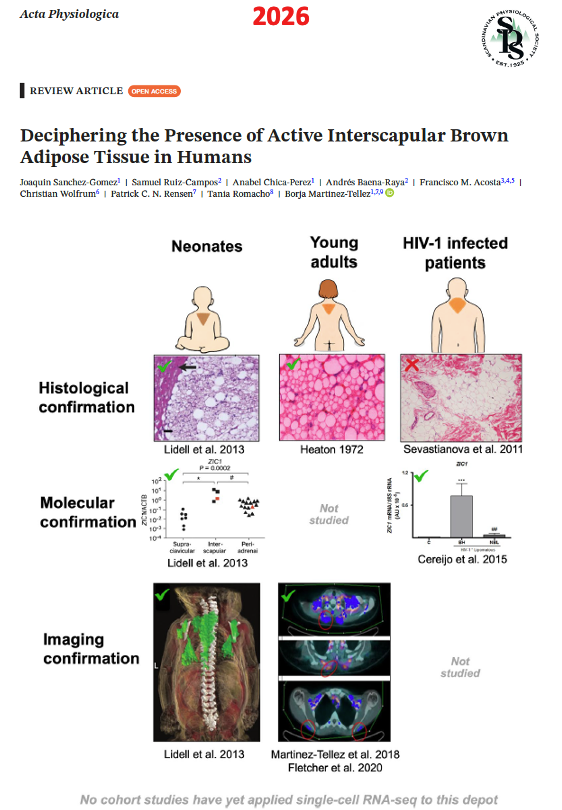
Do adult humans have interscapular brown adipose tissue? 🔬 A question we’ve been asking for ~10 years. Evidence (including ours) suggests this classical BAT depot may persist into adulthood—but it remains speculative.
Borjammt tweet media
English
1
8
21
1.1K
Sable Systems International 🐭🐀🧝🏼‍♀️ retweetet
Daniel Gomez Isaza
Daniel Gomez Isaza@_danielgomez94·
🔥 New paper out now! Do ectotherms actually adjust their physiology to cope with daily temperature swings? Our latest meta-analysis suggests… not really. Check it out now: doi.org/10.1098/rstb... plus others in the special issue #PhilTransB @rodgers_essie @RSocPublishing
Daniel Gomez Isaza tweet media
English
0
2
5
66
Sable Systems International 🐭🐀🧝🏼‍♀️ retweetet
Helen Branswell 🇨🇦
Helen Branswell 🇨🇦@HelenBranswell·
“This is the equivalent of working in a company that feels like it’s on the verge of bankruptcy." A @statnews survey of #NIH funded scientists finds the research community is in chaos a year into the Trump administration. @JonathanWosen reports. statnews.com/2026/03/19/nih…
English
4
40
81
4K
Sable Systems International 🐭🐀🧝🏼‍♀️ retweetet
Pankaj kapahi
Pankaj kapahi@kapahi_pankaj·
All the folks sharing latest scientific advances should also be sharing this ! effects on so many labs and careers have been devastating!! That is after congress ensured there would be no cuts!
Dr. Catharine Young@DrCatharineY

As the world falls apart, so does the U.S. scientific system: >40% of NIH-funded scientists are canceling research >25% are laying off staff Two-thirds are telling students to leave academia The effects of this will be deep and felt for a very long time.

English
0
1
4
385
Sable Systems International 🐭🐀🧝🏼‍♀️
An excellent analysis, worth your time to read in the current climate of ASI worship and/or hysteria
Geoffrey Miller@gmiller

A mini-rant abut AI and longevity. They say "Artificial Superintelligence would take only a few years to cure cancer, solve longevity, and defeat death itself'. This is a common claim by pro-AI lobbyists, accelerationists, and naive tech-fetishists. But the claim makes no sense. The recent success of LLMs does NOT suggest that ASIs could easily cure diseases or solve longevity, for at least two reasons. 1) The data problem. Generative AI for art, music, and language succeeded mostly because AI companies could steal billions of examples of art, music, and language from the internet, to build their base models. They weren't just trained on academic papers _about_ art, music, and language. They were trained on real _examples_ of art, music, and language. There are no analogous biomedical data sets with billions of data points that would allow accurate modelling of every biochemical detail of human physiology, disease, and aging. ASIs can't just read academic papers about human biology to solve longevity. They'd need direct access to vast quantities of biomedical data that simply don't exist in any easy-to-access forms. And they'd need very detailed, reliable, validated data about a wide range of people across different ages, sexes, ethnicities, genotypes, and medical conditions. Moreover, medical privacy laws would make it extremely difficult and wildly unethical to collect such a vast data set from real humans about every molecular-level detail of their bodies. 2) The feedback problem. LLMs also work well because the AI companies could refine their output with additional feedback from human brains (through Reinforcement Learning from Human Feedback, RLHF). But there is nothing analogous to that for modeling human bodies, biochemistry, and disease processes. There are no known methods of Reinforcement Learning from Physiological Feedback. And the physiological feedback would have to be long-term, over spans of years to decades, taking into account thousands of possible side-effects for any given intervention. There's no way to rush animal and human clinical trials -- however clever ASI might become at 'drug discovery'. More generally, there would be no fast feedback loops from users about model performance. GenAI and LLMs succeeded partly because developers within companies, and customers outside companies, could give very fast feedback about how well the models were functioning. They could just look at the output (images, songs, text), and then tweak, refine, test, and interpret models very quickly, based on how good they were at generating art, music, and language. In biomedical research, there would be no fast feedback loops from human bodies about how well ASI-suggested interventions are actually affecting human bodies, over the long term, across different lifestyles, including all the tradeoffs and side-effects. It's interesting that most of the people arguing that 'ASI would cure all diseases and aging' are young tech bros who know a lot about computers, but almost nothing about organic chemistry, human genomics, biomedical research, drug discovery, clinical trials, the evolutionary biology of senescence, evolutionary medicine, medical ethics, or the decades of frustrations and failures in longevity research. They think that 'fixing the human body' would be as simple as debugging a few thousand lines of code. Look, I'm all for curing diseases and promoting longevity. If we took the hundreds of billions of dollars per year that are currently spent on trying to build ASI, and we devoted that money instead to longevity research, that would increase the amount of funding in the longevity space by at least 100-fold. And we'd probably solve longevity much faster by targeting it directly than by trying to summon ASI as a magical cure-all. ASIs has some potential benefits (and many grievous risks and downsides). But it's totally irresponsible of pro-AI lobbyists to argue that ASIs could magically & quickly cure all human diseases, or solve longevity, or end death. And it's totally irresponsible of them to claim that anyone opposed to ASI development is 'pro-death'.


English
0
0
1
164
Sable Systems International 🐭🐀🧝🏼‍♀️ retweetet
News from Science
News from Science@NewsfromScience·
Biomedical researchers breathed a collective sigh of relief after the White House loosened the purse strings that had hindered the U.S. National Institutes of Health from spending its 2026 budget on research grants. scim.ag/4uA29EX
English
0
16
51
7.4K
Sable Systems International 🐭🐀🧝🏼‍♀️ retweetet
Dr. Catharine Young
Dr. Catharine Young@DrCatharineY·
As the world falls apart, so does the U.S. scientific system: >40% of NIH-funded scientists are canceling research >25% are laying off staff Two-thirds are telling students to leave academia The effects of this will be deep and felt for a very long time.
English
25
297
688
23.5K
Sable Systems International 🐭🐀🧝🏼‍♀️ retweetet
Erika 
Erika @ExploreCosmos_·
There are people who speak with absolute confidence about topics they have barely explored, as if a few articles or videos were enough to master a complex field. This phenomenon has a name in psychology: the Dunning–Kruger effect, described by researchers David Dunning and Justin Kruger. Its central idea is uncomfortable but revealing: those with low ability in a given area often lack the very skills needed to recognize their own limitations. In their studies, they found that participants who performed worst in tasks such as logic, grammar, or even humor tended to rate themselves far above their actual level. In other words, the less they knew, the more they overestimated their competence. This is not simply arrogance, but a lack of metacognition, the ability to accurately assess what one knows and does not know. And this is the key point: to evaluate a skill properly, you largely need that same skill. Later research has shown that this effect becomes more pronounced when the subject is particularly complex or when personal or ideological beliefs are involved. In such contexts, it is common to see individuals with very superficial knowledge in areas like medicine, climate science, or economics expressing themselves with disproportionate confidence, while those who have spent years studying the topic tend to be far more cautious, precisely because they understand the depth and uncertainties involved. The most important aspect, however, is that this bias does not only affect “other people.” We are all susceptible to it in some domain. We may be highly competent in our professional field while having a completely distorted self-assessment in others without realizing it. Moreover, the effect also works in the opposite direction: those with greater expertise often underestimate their own knowledge, because they are fully aware of how much they still do not know. At its core, this effect highlights a clear relationship: deep knowledge tends to be accompanied by humility, whereas ignorance, unable to perceive its own limits, often presents itself with a level of certainty that is not always justified.
English
46
36
218
7.4K
Sable Systems International 🐭🐀🧝🏼‍♀️ retweetet
Sable Systems Int'l
Sable Systems Int'l@SableSysInt·
Sable is pleased to be at the Keystone Symposia. We are grateful to be part of the Career Roundtable where Cruz Hinojos, Director of Sales & Marketing, was a panelist. We appreciate the opportunity to support the diabetes research community & the next generation of scientists.
Sable Systems Int'l tweet mediaSable Systems Int'l tweet media
English
0
1
3
76
Sable Systems International 🐭🐀🧝🏼‍♀️ retweetet
Neil Stone
Neil Stone@DrNeilStone·
Meningitis is a horrific infection which kills young people...fast If you are even against a vaccine for THAT then truly you are lost
TheFeralWitch🔮🇬🇧🏴󠁧󠁢󠁥󠁮󠁧󠁿@TheFeralWitchy

Vaccine roll out to start at University of Kent 🤦🏼‍♀️ Anyone allowing their children to inject this poison needs their heads testing! Has Covid taught you nothing!

English
121
609
5.8K
123.2K
Sable Systems International 🐭🐀🧝🏼‍♀️ retweetet
Julia Bohannon
Julia Bohannon@julia_bohannon·
Full-circle: 19 yrs after my 1st student conference presentation, I’ve been elected the 50th President of the @ShockSociety. I’m deeply grateful to have grown up in this incredible community and for the trust my colleagues have placed in me. Honored beyond words! @VUMChealth
Julia Bohannon tweet media
English
3
1
14
462
Sable Systems International 🐭🐀🧝🏼‍♀️ retweetet
Eric Feigl-Ding
Eric Feigl-Ding@DrEricDing·
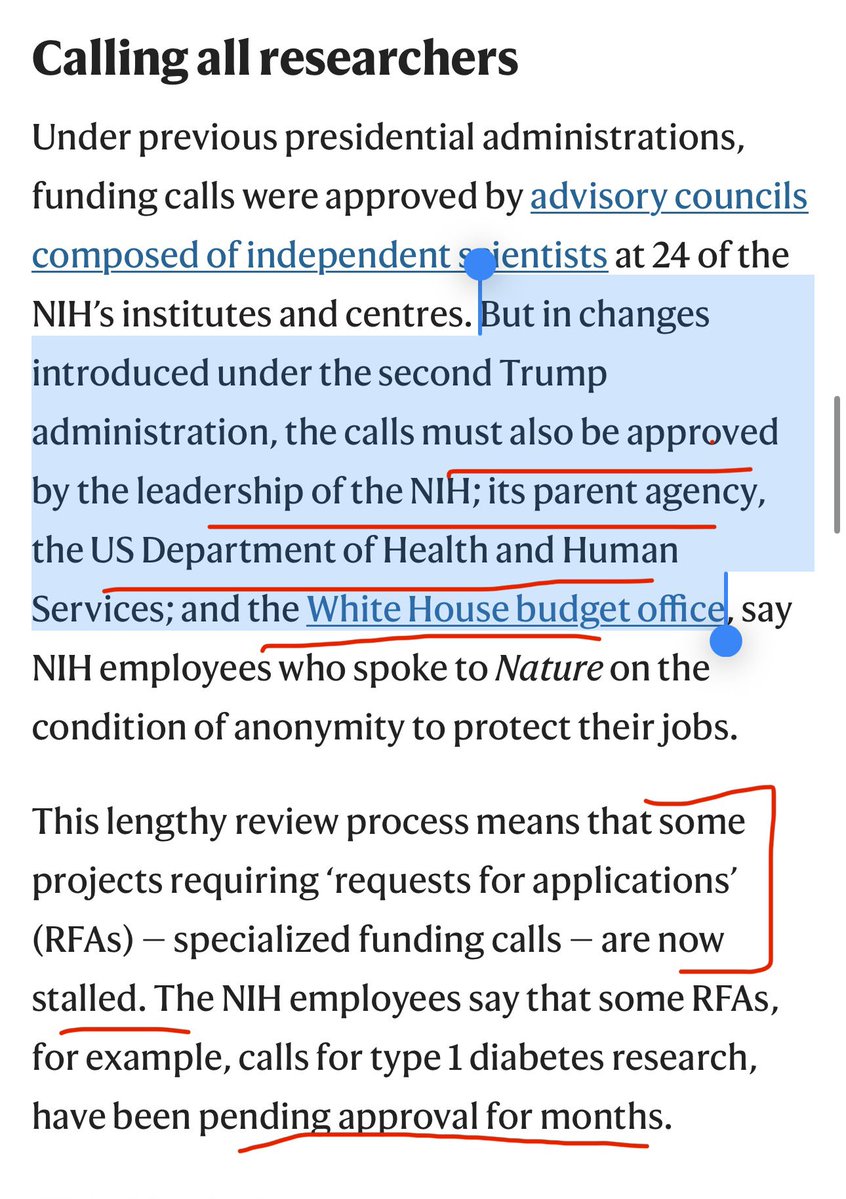
WELP—As result of all NIH grants requiring RFK Jr and White House approval… we now have 90% less funding for medical research. We are sacrificing our children’s future — all for what???
Eric Feigl-Ding tweet mediaEric Feigl-Ding tweet media
English
96
1.6K
3.7K
92.2K
Sable Systems International 🐭🐀🧝🏼‍♀️ retweetet
Dr. Catharine Young
Dr. Catharine Young@DrCatharineY·
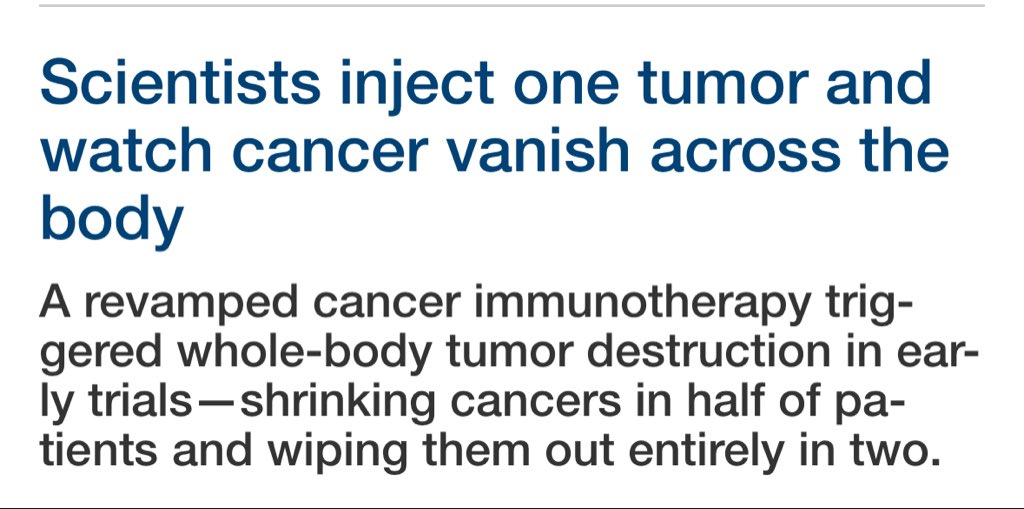
Breakthroughs like this are why sustained investment in biomedical science matters. In an early trial, injecting immunotherapy into one tumor triggered immune responses across the body - with 50% of patients responding and some complete remissions. Science saves lives.
Dr. Catharine Young tweet media
English
19
119
408
10K
Sable Systems International 🐭🐀🧝🏼‍♀️ retweetet
Kristine Willis
Kristine Willis@kristine_willis·
Friends, as many of you know, I recently left the NIH to embark on the next chapter in my career. Today I’m excited to share what I’ve been working on, and what it means for the way we support research and produce scientific advances. 1/
English
2
12
122
30.9K