Winston Ighodaro@Officialwhyte22
A lot of malware investigations begin with something extremely simple: process inspection. When malicious software runs on a Windows system, it has to execute as a process somewhere. Even if the malware hides its activity, it still leaves small clues behind.
In the terminal below I demonstrate a quick triage technique I use during malware analysis. The goal is to identify processes consuming resources and then inspect where they are actually running from.
You will notice that one process appears legitimate at first glance, but the moment we inspect its file path and signature, it becomes clear something is wrong.
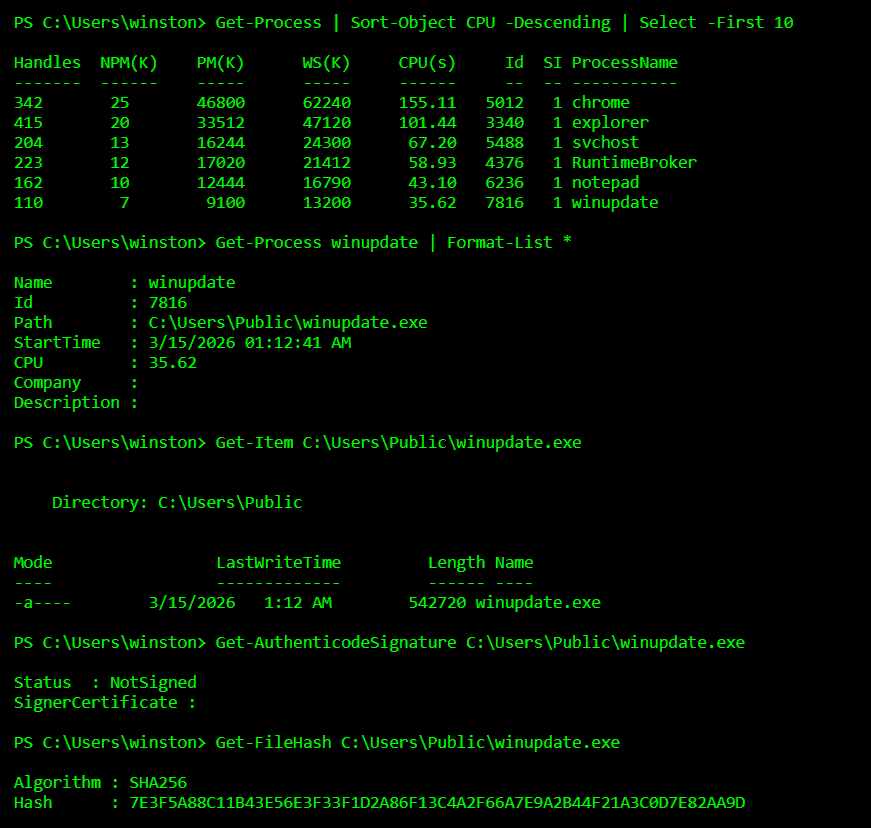
In the image below I start the investigation using the PowerShell command Get-Process. When malware executes on a system it must run as a process, so reviewing active processes is one of the fastest ways to begin triage. By sorting the processes based on CPU usage, I can quickly see which programs are consuming the most system resources. Most of the entries look normal, but one process called winupdate immediately stands out.
Next I inspect the process directly using Get-Process winupdate. This command reveals important details about the process including its process ID and the executable path. The key red flag here is the file location. The executable is running from C:\Users\Public, which is not where legitimate Windows update components operate. System update services normally run from the System32 directory under trusted Microsoft binaries.
Finally I examine the file itself. Using Get-AuthenticodeSignature, I check whether the executable is digitally signed. Legitimate Windows system binaries are almost always signed by Microsoft, but this file is not signed at all. After confirming this, I generate a SHA256 hash using Get-FileHash. This hash can then be searched in malware intelligence platforms to determine whether the file has been previously identified as malicious. At this stage the evidence strongly suggests the process is malware masquerading as a system update.