Simon Wolfgang Fuchs

5K posts

Simon Wolfgang Fuchs banner
Simon Wolfgang Fuchs

Simon Wolfgang Fuchs

@Simon_W_Fuchs

Associate Prof. of Islam in South Asia and the Middle East @HebrewU // Author of "In a Pure Muslim Land" // Global Islam, Shi'ism, the Iranian Revolution

Jerusalem Beigetreten Mayıs 2015
4.5K Folgt4.8K Follower
Simon Wolfgang Fuchs retweetet
Tala Ramadan
Tala Ramadan@TalaRamadan·
Israeli strike severs last bridge linking southern Lebanon to rest of country, senior Lebanese security official tells @Reuters
English
0
9
8
1.7K
Simon Wolfgang Fuchs retweetet
Bader Al-Saif بدر السيف
There is a sense in many Gulf capitals that “Israel is the main culprit; they got us to where we are today,” says Al-Saif. “Yes, the decision to go to war was an American decision, but it has been through the prodding of Netanyahu at the same time…You cannot bulldoze your way into international relations, if they [Israel] want to build relations with countries in the region, they can’t do it by doing what they are doing,” “For the Gulf,” notes al-Saif, the Kuwaiti analyst, “having a tense balance of power in which Israel and Iran are watching and testing one another gives us [the chance] to get to a place where we can vie for a leadership role.” csmonitor.com/World/Middle-E…
English
5
16
45
4.7K
Simon Wolfgang Fuchs retweetet
Alex Rowell
Alex Rowell@alexjrowell·
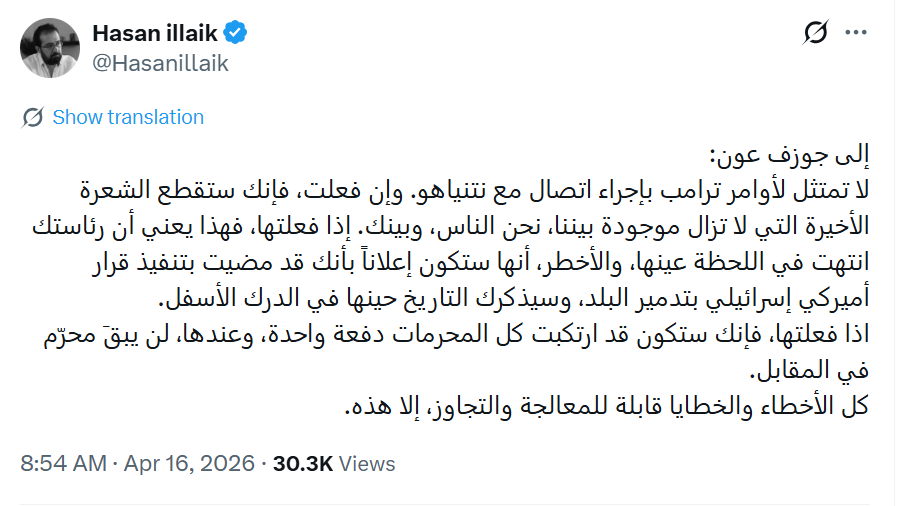
Pro-Hizbullah writer threatens Lebanon's president after reports he will speak to Netanyahu today: "If you do it, it means your presidency is finished ... if you do it, you will have committed all the forbidden sins ... and there will no longer be anything forbidden in response"
Alex Rowell tweet media
English
1
21
36
15.4K
Simon Wolfgang Fuchs retweetet
Joumanna Nasr Bercetche
BREAKING: Trump says Lebanon and Israel “leaders” will have first conversation in 34 years ‘tomorrow’ (which is our today in the region)
Joumanna Nasr Bercetche tweet media
English
3
12
47
12.5K
Simon Wolfgang Fuchs retweetet
Gregory Brew
Gregory Brew@gbrew24·
Just now WH @PressSec clarified that a second round of talks between the US and Iran were likely to take place in Islamabad.
English
0
10
53
5.8K
Simon Wolfgang Fuchs retweetet
Salman Masood
Salman Masood@salmanmasood·
Pakistan’s army chief Syed Asim Munir has landed in Tehran while PM Sharif is making back-to-back stops in Riyadh, Doha, and Türkiye . All synced. All aimed at getting the US and Iran back to the table. In Islamabad.
English
0
11
101
1.9K
Simon Wolfgang Fuchs retweetet
Ali Hashem علي هاشم
Iranians and Americans are close to another round of talks, but not a deal. Pakistanis in Tehran for coordination. Are we close to a deal? Too cautious to express optimism, given the fact it’s not only two sides on the table, at least there’re 3 (Israel), and there might be more. Even if Iran agreed to several years moratorium, on uranium enrichment, it’s very very likely Israel will veto such a deal, sticking by its “end of nuclear program” condition. Trump, just as he walked away from several other commitments, including the Lebanon ceasefire, will walk away and risk the prospects of a deal.
Ali Hashem علي هاشم@Alihashem

Commander of the Pakistan Army has arrived in Iran at the head of a high-level delegation to meet officials, convey a U.S. message, and prepare for a potential new round of talks.

English
8
34
141
81.8K
Simon Wolfgang Fuchs retweetet
Yashar Ali 🐘
Yashar Ali 🐘@yashar·
BREAKING via AP The United States and the Islamic Republic of Iran have an in-principle agreement to extend the ceasefire to allow for more diplomacy.
English
71
310
1.6K
175.9K
Simon Wolfgang Fuchs retweetet
Sophia Saifi
Sophia Saifi@SophiaSaifi·
Pakistan’s PM and FM, two key negotiators of the peace process between Iran and the US are out of the country till the 18th of April for a trip to the KSA, Türkiye and Qatar. Including an appearance at the Antalya Diplomacy Forum where the FMs of Russia & Ukraine are also in attendance.
English
2
39
291
19.1K
Simon Wolfgang Fuchs retweetet
Babak Vahdad
Babak Vahdad@BabakVahdad·
Absolutely agree with Danny here: “Mohammad Bagher Ghalibaf is a senior figure, but he is not the one who truly holds power in Iran”. #Iran #Iranwar
English
0
19
79
53.3K
Simon Wolfgang Fuchs retweetet
Barham Salih
Barham Salih@BarhamSalih·
Just arrived in Beirut after last week’s devastating strikes. Over 1 million people displaced in this small country. I am here in solidarity —and to urgently push for protection of civilians and an end to this spiraling conflict.
English
58
345
1.1K
96.7K
Simon Wolfgang Fuchs retweetet
Bissan بيسان
Bissan بيسان@Bissan_Fakih·
Al-Hosh, Tyre this morning, the street adjacent to ours. Israel levelled a 10-story building with 20 apartments, destroyed a car wash and our local bakery. Hero rescue workers are still running into danger to save the injured. They send news back to the displaced. #Lebanon
English
33
1.7K
1.9K
69K
Simon Wolfgang Fuchs retweetet
Alireza Talakoubnejad
Alireza Talakoubnejad@websterkaroon·
Farhikhtegan Magazine published a 42 minute discussion about the Islamabad Negotiations from an Iranian perspective, featuring Mohamad Amin Imanjani, one of the media members of the Iranian delegation. There were quite a few interesting points illustrating the Iranian perspective on the talks. Here were some of the main ones: - The Iranians believed the US delegation largely lacked the technical expertise to fully understand the issues in depth. They also did not have the authority to make major decisions (he points out Vance himself said he made multiple calls to Trump). - In contrast the Iranian delegation was highly specialized. They included two previous heads of Iran's negotiating teams (Araghchi and Bagheri Kani) along with the head of one of the three branches and were ready to make decisions. - They believed the US delegation led by the Vice President was primarily there to assess the state of Iranian thinking after weeks of war. They intentionally made maximalist demands to see how the Iranians would react. - Despite the very real damage Iran suffered form the war, the Iranian side believed they had a stronger hand than previous rounds of negotiations. Whereas after the 12 Day War Iran's main source of leverage was the 60% enriched uranium, now it has the Strait of Hormoz in addition to that. The Iranian negotiators aimed to maintain those gains. - Iran saw a this meeting as a rare opportunity for a high level encounter with the United States (the head of Iran's Parliament meeting with the US VP) for both systems (IR & USA) to gain a clear understanding of each other. - He affirms there were trilateral meetings with Iran, the US, and the Pakistanis in the same room and on the same table. No one was shuttling between rooms like the previous rounds. - This opportunity of direct dialogue at such a high level was quite valuable in each side getting a precise understanding of each other. He emphasized again that Iran had reached the conclusions from previous rounds that neither Witkoff, nor Kushner had the technical knowledge, experience, or ability to property communicate the main issues with high level US decisionmakers. [At this point a different journalist named Mohammad Sadegh Alizadeh also joins the discussion. He was not present in Islamabad] - The US neither was able to accept Iran's conditions, nor did it want to return to all out war like before. Thus a naval blockade is their attempt at a third path that still maintains pressure on Iran without the pains of all out conflict. Iran has concluded from this that the US strongly prefers not to return to previous war conditions. - Trump's logic is that if Iran is going to try to strangle the world economy then he will strangle the Iranian economy. - Given that over 80% of Iran's oil exports go to China, this will create an additional crisis between China and the US (on top of tariffs and other issues at hand). Iran is keeping a close eye to see if Trump's trip to China gets delayed again - if so they believe that is a sign of a wider gap between them. - Iran believes there is a risk that a blockade will push China to change its stance and more actively seek to put pressure on Iran to end its blockage of the Strait of Hormoz. This is a danger, because China has some leverage over Iran. Additionally up to now China has been friendly to Iran in this conflict and Iran used its veto at the UNSC. That may change. - It was noted that a UAE delegation went to China today and Iran believes this is an attempt to push China towards this direction. - If no agreement is reached and there is longer conflict, then in the next round of talks it is possible that in addition to the new card of the Strait of Hormoz, Iran will also have the card of Bab el Mandeb. He also notes that in normal times it may be possible to make up for a loss of Iranian oil in the market, but if the Strait remains closed, that loss is much more profound. And if Bab el Mandeb is closed that impact is amplified even more. Link to the full discussion (in Persian) is in the first comment
Alireza Talakoubnejad tweet media
English
19
278
646
101.1K
Simon Wolfgang Fuchs
Simon Wolfgang Fuchs@Simon_W_Fuchs·
A very convincing analysis on how we reached the #Islamabad talks!
Babak Vahdad@BabakVahdad

The more details emerge, the clearer it becomes what Iran’s ambassador to Pakistan, Reza Amiri-Moghadam, meant when he said “Islamabad is not an event, but a process.” - This didn’t start last weekend. It goes back to the war phase, when Washington-facing results far below expectations-activated a regional diplomatic track involving Egypt, Turkey, Saudi Arabia and Pakistan. - After some initial CBMs, this led to the March 29 “quartet” meeting in Islamabad. Egypt played a key role in pulling Riyadh into the format at a moment when US assets in the Kingdom were under Iranian pressure. No breakthrough there-but that wasn’t the point. The process had started. - From that moment, the track widened. Pakistan appears to have brought China into the loop-Dar’s trip to Beijing on March 31, the day after the meeting, is a strong indicator and likely reflects an Iranian request. - In the days that followed, contacts continued at multiple levels, with Army Chief Munir playing a particularly active role. That sequence led straight to the April 8 ceasefire and then to last weekend’s high-level talks. - One key point: this process was triggered by the US at a moment when the war was becoming unsustainable. All the regional actors mentioned were pulled into it. Expecting results in 24 hours was always unrealistic-but the objective was to test positions, clarify red lines and start narrowing gaps. - On substance, Tehran was perhaps ready to show some flexibility on the nuclear file, but much less on what it now sees as its real strategic deterrent: the Strait of Hormuz. - Ghalibaf’s return to Tehran was likely not just routine debriefing-it was about testing how much space there really is inside the system, especially with the IRGC, after what emerged in Islamabad. At the same time, Trump’s “naval blockade” looks like an attempt to raise the price of Iranian resistance ahead of the next round. - At the same time Islamabad seemed to be navigating the Tehran-Riyadh axis with notable skill, despite its formal defense pact with Saudi Arabia. Rather than being pulled into a binary alignment, Pakistan has leveraged its ties with both sides to position itself as a credible intermediary-maintaining strategic reassurance toward Riyadh while preserving enough trust with Tehran to host and facilitate dialogue. In this sense, its role in the process was not neutral, but carefully balanced. - Moghaddam’s remarks reads like a precise signal: the Islamabad track is still active, still evolving with the same regional actors and very much designed to continue beyond the first round of talks. #Iran #Iranwar
English
0
4
17
8.6K
Babak Vahdad
Babak Vahdad@BabakVahdad·
The more details emerge, the clearer it becomes what Iran’s ambassador to Pakistan, Reza Amiri-Moghadam, meant when he said “Islamabad is not an event, but a process.” - This didn’t start last weekend. It goes back to the war phase, when Washington-facing results far below expectations-activated a regional diplomatic track involving Egypt, Turkey, Saudi Arabia and Pakistan. - After some initial CBMs, this led to the March 29 “quartet” meeting in Islamabad. Egypt played a key role in pulling Riyadh into the format at a moment when US assets in the Kingdom were under Iranian pressure. No breakthrough there-but that wasn’t the point. The process had started. - From that moment, the track widened. Pakistan appears to have brought China into the loop-Dar’s trip to Beijing on March 31, the day after the meeting, is a strong indicator and likely reflects an Iranian request. - In the days that followed, contacts continued at multiple levels, with Army Chief Munir playing a particularly active role. That sequence led straight to the April 8 ceasefire and then to last weekend’s high-level talks. - One key point: this process was triggered by the US at a moment when the war was becoming unsustainable. All the regional actors mentioned were pulled into it. Expecting results in 24 hours was always unrealistic-but the objective was to test positions, clarify red lines and start narrowing gaps. - On substance, Tehran was perhaps ready to show some flexibility on the nuclear file, but much less on what it now sees as its real strategic deterrent: the Strait of Hormuz. - Ghalibaf’s return to Tehran was likely not just routine debriefing-it was about testing how much space there really is inside the system, especially with the IRGC, after what emerged in Islamabad. At the same time, Trump’s “naval blockade” looks like an attempt to raise the price of Iranian resistance ahead of the next round. - At the same time Islamabad seemed to be navigating the Tehran-Riyadh axis with notable skill, despite its formal defense pact with Saudi Arabia. Rather than being pulled into a binary alignment, Pakistan has leveraged its ties with both sides to position itself as a credible intermediary-maintaining strategic reassurance toward Riyadh while preserving enough trust with Tehran to host and facilitate dialogue. In this sense, its role in the process was not neutral, but carefully balanced. - Moghaddam’s remarks reads like a precise signal: the Islamabad track is still active, still evolving with the same regional actors and very much designed to continue beyond the first round of talks. #Iran #Iranwar
Reza Amiri Moghadam@IranAmbPak

The Islamabad Talks is "not an event but a process." The Islamabad Talks laid the foundation for a diplomatic process that, if trust and will are strengthened, can create a sustainable framework for the interests of all parties. I would like to express my gratitude to the friendly and brotherly county of Pakistan, especially H.E. Prime Minister Shahbaz Sharif and Field Marshal Asim Munir, for their initiative of goodwill and good office for the talks. With the tireless efforts of all sectors in Pakistan, including the government, army, police and security forces to facilitate and manage the talks, talks were held in a dignified and befitting atmosphere for the guests in a calm, orderly and secure environment with equal logistic opportunities for both sides. The Iranian high ranking negotiating team, with dignity, self-confidence and faith in Allah Almighty and attention to the concerns of the people, pursued dignified talks for the great Iranian nation to ensure and secure the national interests and legitimate rights of the people.

English
1
85
249
52.8K
Simon Wolfgang Fuchs retweetet
Joseph Haboush
Joseph Haboush@jhaboush·
Hezbollah SG calls on Beirut to take “historic” stance and cancel tomorrow’s preparatory meeting, saying there must be internal consensus on such a matter. There was no such consensus when Hezbollah unilaterally entered the Gaza and Iran wars.
English
1
10
30
3K
Simon Wolfgang Fuchs retweetet
Arash Azizi آرش عزیزی
BREAKING: Next round of Iran-US direct talks will be held in Islamabad on Thursday, a source in Tehran tells me
English
328
1.3K
6.5K
1.1M
Simon Wolfgang Fuchs retweetet
Kaitlan Collins
Kaitlan Collins@kaitlancollins·
It appears as if Trump has deleted his post portraying himself as Jesus after facing some backlash from his own supporters.
Kaitlan Collins tweet media
English
2.8K
6.1K
36.2K
3.6M