Ethan Walker

421 posts

Ethan Walker banner
Ethan Walker

Ethan Walker

@StopLossLab

📡 Tracking crypto, markets & tech

🌎 Beigetreten Eylül 2023
179 Folgt61 Follower
Angehefteter Tweet
Ethan Walker
Ethan Walker@StopLossLab·
$DOGE obeys hype. $SHIB sleeps. $PEPE cries. $BONK barks. $WIF waits. $FLOKI copies. Meanwhile $FLC is feeding a real ecosystem with Lightning, wallets, pools, tools & community power.⚡ No tricks. No masters. Just utility.
Ethan Walker tweet media
English
0
1
3
158
Ethan Walker
Ethan Walker@StopLossLab·
@DeFiTracer If he’s that sure, why say it live instead of just selling quietly
English
0
0
0
82
ᴛʀᴀᴄᴇʀ
ᴛʀᴀᴄᴇʀ@DeFiTracer·
🚨 BREAKING: $1.03 TRILLION WARREN BUFFETT SAID LIVE ON CNBC: "THE RECENT MARKET CRASH WAS NOTHING. THE REAL CRASH IS STILL AHEAD." HE IS SITTING ON A RECORD AMOUNT OF CASH, $397B AND KEEPS DUMPING MORE HE KNOWS A REAL DUMP IS COMING SOON...
English
26
44
216
25K
Ethan Walker
Ethan Walker@StopLossLab·
@Cryptollica Most people here will still call it hopium until eth/btc breaks trend. That’s exactly why the window is still open.
English
0
0
0
5
Cryptollica
Cryptollica@Cryptollica·
ALTSEASON WATCH #2 Most people wait for altseason after the move is obvious. I don’t. This is where it starts. BTC dominance is losing strength at the same structural zone where previous rotations began. ETH/BTC is still compressed under the long-term trendline, but that compression is the signal. The breakout is not a question of if. It is a question of when the crowd finally sees it. Altseason does not start with euphoria. It starts here.
Cryptollica tweet media
English
8
11
95
4.6K
Cointelegraph
Cointelegraph@Cointelegraph·
📊 UPDATE: Tokenized gold spot trading volume reached $90.7B in Q1 2026, surpassing all of 2025’s $84.6B, per CoinGecko.
Cointelegraph tweet media
English
72
49
161
16.7K
Ethan Walker
Ethan Walker@StopLossLab·
Bitcoin holding $81k as support is the market's way of saying short-term leverage got cleaned out. What matters more is whether bids stack up below that level or liquidity starts pulling higher toward $85k.
Ethan Walker tweet media
English
0
0
0
10
Ethan Walker retweetet
The Kobeissi Letter
The Kobeissi Letter@KobeissiLetter·
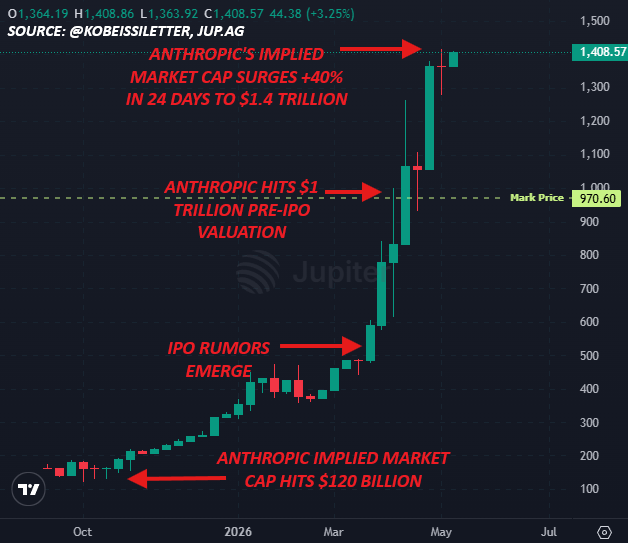
BREAKING: Anthropic's market-implied pre-IPO valuation surges to a record $1.4 trillion, rising another +40% in 24 days. This puts Anthropic's implied valuation up +1,067% since October 2025, per onchain pre-IPO trading data. Pre-IPO instruments trading onchain on Jupiter, backed 1:1 by SPV exposure, are providing a real-time proxy for the company’s implied IPO valuation. The surge comes amid reports that Anthropic's annualized revenue has surged from $100 million in 2023 to $45 billion today. Over the last 12 months alone, Anthropic's annualized revenue has risen +1,400%. We are witnessing a historic technological revolution.
The Kobeissi Letter tweet media
English
274
467
3.6K
628.8K
Ethan Walker retweetet
Milk Road
Milk Road@MilkRoad·
It's estimated that $7.6T will be poured into AI infra between 2026 and 2031. And it could have significant downstream effects on crypto: Goldman Sachs thinks AI compute is elastic (i.e. cheaper prices lead to way more). So if chips get cheaper and usage scales massively - agent transactions will likely scale with it. We’re talking millions of tiny machine-to-machine payments across services, models, and data - every minute. Cards and ACH aren't built for that. Stablecoins on fast chains are.
Milk Road@MilkRoad

Goldman dropped a report this week putting AI infrastructure spend at $7.6T between 2026 and 2031. That's chips, data centers, cooling, and power - totaling ~$765B in 2026 alone, and scaling to $1.6T per year by 2031. Here's where crypto fits in AI’s $7.6T tab (save this): Most of the noise around this number is focused on the demand question: Will companies and consumers use AI enough to pay for all this? But Goldman's flipping the question over to the supply side - i.e. the actual cost of building the thing. (How much will chips cost? How often will they need replacing? How much will new data centers cost to construct?) Their angle: those costs are way more uncertain than people think - and a few boring assumptions can swing the total by hundreds of billions. The four assumptions doing all the work: 1. Chip lifespan. Accountants depreciate AI chips over 4-6 years. But NVIDIA ships a new architecture every single year with massive performance jumps. If chips hit economic obsolescence in 3 years instead of 6, you're buying replacements twice as often. 2. Data center costs. Old cloud data centers ran ~$10M per megawatt. New AI ones cost $15-20M. Even facilities built 2 years ago may not handle next-gen chips because power density and cooling have moved that fast. 3. Chip mix (GPUs vs ASICs). NVIDIA earns ~75% gross margins on its data center GPUs. Custom chips (ASICs) are cheaper. But Goldman thinks cheaper chips just lead to more compute usage, so the total bill stays roughly the same. 4. Bottlenecks. Transformer lead times, power interconnect queues, specialized labor… these don't change unit costs, but they do stretch timelines. And that last one is a sneaky little bugger. ☝️ If projects keep slipping on their timelines, that supply friction feeds demand doubt, and that's where capital pulls back. (Constricted compute access = higher costs for AI services = a smaller amount of customers that can actually afford it.) The optimistic flip side of it all, goes like this… If the industry pulls off the buildout, history says we can expect cheaper compute to create demand that didn't exist at higher prices. Meaning today's $7.6T estimated build out cost might not be enough for whatever AI looks like by 2031. Sweet, so where does crypto fit in? Three places: 1. Decentralized GPU networks absorb the trailing edge. NVIDIA's older chips (A100s and H100s) still rent at prices that suggest 5-6+ year useful lives. Frontier AI labs constantly upgrade to the newest hardware, but the older chips don't get thrown out. They get repurposed for lighter work like inference (inference = and AI running your prompt) instead of training (teaching the model in the first place). That's where DePIN comes in. Networks like Render and Akash plug older GPU capacity into a global rental market. Bittensor takes it further with subnets that run decentralized AI services on top. Translation: as frontier labs rotate to new chips, decentralized networks become the natural home for those second-life GPUs. 2. Onchain credit for the buildout. $7.6T is a lot of money. Traditional project finance can absorb some of it, but data center and energy operators are hunting for new capital fast. That's where rails like USDAI come in. Tokenized debt and onchain credit let infrastructure projects raise from a global pool without waiting on slow private credit syndication. It's still early, but the build out will require new financing channels to open up - and onchain credit is one of those channels. 3. Stablecoins for agent-to-agent payments. Economists call demand "elastic" when cheaper prices lead to way more usage. Goldman thinks AI compute is elastic. So if chips get cheaper and usage scales massively - agent transactions will likely scale with it. We’re talking millions of tiny machine-to-machine payments across services, models, and data - every minute. Cards and ACH aren't built for that. Stablecoins on fast chains are. Goldman's report in a nutshell: Either the buildout works and unleashes a wave of new demand, or it stalls and keeps demand restricted. My takeaway: Crypto sits within the financing, compute, and payment chokepoints in both scenarios. If/when AI scales, crypto is going to play a part.

English
4
4
22
6.1K
Ethan Walker retweetet
Danny Marques | Investing Informant
Bitcoin $BTC For those who have learned or are still learning to tune out the daily noise and stop letting every red candle rewrite their entire worldview, this Bitcoin chart is a good one to sit with. Because the market has done an incredible job over the last year of destroying people’s patience. Every few weeks, the narrative flips. One week Bitcoin is going to $200k, the next week the cycle is over. One week ETFs changed everything, the next week everyone is suddenly waiting for $50k again. That is exactly how Bitcoin works psychologically. It tests whether you actually understand what you own. Looking at this objectively, not just because I am long-term bullish on Bitcoin, the structure still looks far more constructive than the sentiment would suggest. The key point is that Bitcoin has not really had the type of clean expansionary phase that people associate with prior cycles. Yes, we had a major move off the lows. Yes, we made new highs. But we have not had the full-blown, vertical, market-wide disbelief-to-euphoria expansion that historically comes after long accumulation periods. What we have mostly had is a breakout, a long digestion period, and a major consolidation above the prior cycle’s major resistance zone. The “bear case” for last few months or even right now may simply be time. Not necessarily some catastrophic breakdown. It may be that Bitcoin already put in its cycle low earlier this year, and now the market has to spend months frustrating everyone before the next real move begins. Time-based capitulation can be worse than price-based capitulation. With price-based capitulation, you get the violent flush, everyone panics, the weak hands are forced out, and then the market can reset. With time-based capitulation, nothing dramatic happens. Price just chops and drifts, failing to satisfy anyone. The bulls get bored, bears get loud and people start questioning the thesis and debating cycles and other thesis as if they're binary and things couldn't change. You sit in boredom long enough and market can do a good job of convincing yourself that you might've been wrong. When I zoom out, this current structure still looks like a continuation of the same long-term pattern Bitcoin has followed for years. Accumulation, compression, then another expansion. The exact timing is always impossible to know, but Bitcoin typically moves violently higher, spends a long period digesting the move, shakes out everyone who expected instant gratification, and then eventually reprices again once market participants have been exhausted. What's interesting and extremely important from the current consolidation is that it's happening ABOVE a level that used to be impossible for most people to imagine. A few years ago, Bitcoin near $80k would have felt euphoric. Now people are treating it like a disappointment because it is not already at $150k (or higher). It tells you how much expectations have changed. Technically, the prior cycle high / breakout zone is still acting like an important macro support area. Bitcoin has pulled back into that region, tested it, and so far has not lost the broader high-timeframe structure. All strength indicators on the weekly / monthly have been completely reset from prior highs, which is what you want to see during a healthy consolidation. Think about it like this. The farther you pull a rubber band back (w/o breaking it of course) the stronger the reaction you get. You don't want a market permanently pinned at euphoric levels. You want momentum to cool off while price holds structurally important zones. This is how bottoms get built. Now, could Bitcoin still chop around? Absolutely. Could it revisit lower levels and make everyone miserable again? Of course. It is Bitcoin. Making people question their life choices is part of the product roadmap. If you can stop thinking like a day trader and being to think in years, you'll be more than content when you look back that you continued to accumulate Bitcoin (or other related equities) Short term, the market can do whatever it wants. It can chop, reject, retest, and make everyone overtrade. But on the higher timeframe, Bitcoin looks like it is still building energy rather than ending a cycle. And if the current “bear scenario” ends up being nothing more than a higher low above the prior breakout zone, then a lot of people are going to look back and realize the market gave them time. They just confused that time for weakness and they probably will walk out of this cycle w/no Bitcoin...oh well
Danny Marques | Investing Informant tweet media
English
0
2
40
2.3K
Ethan Walker
Ethan Walker@StopLossLab·
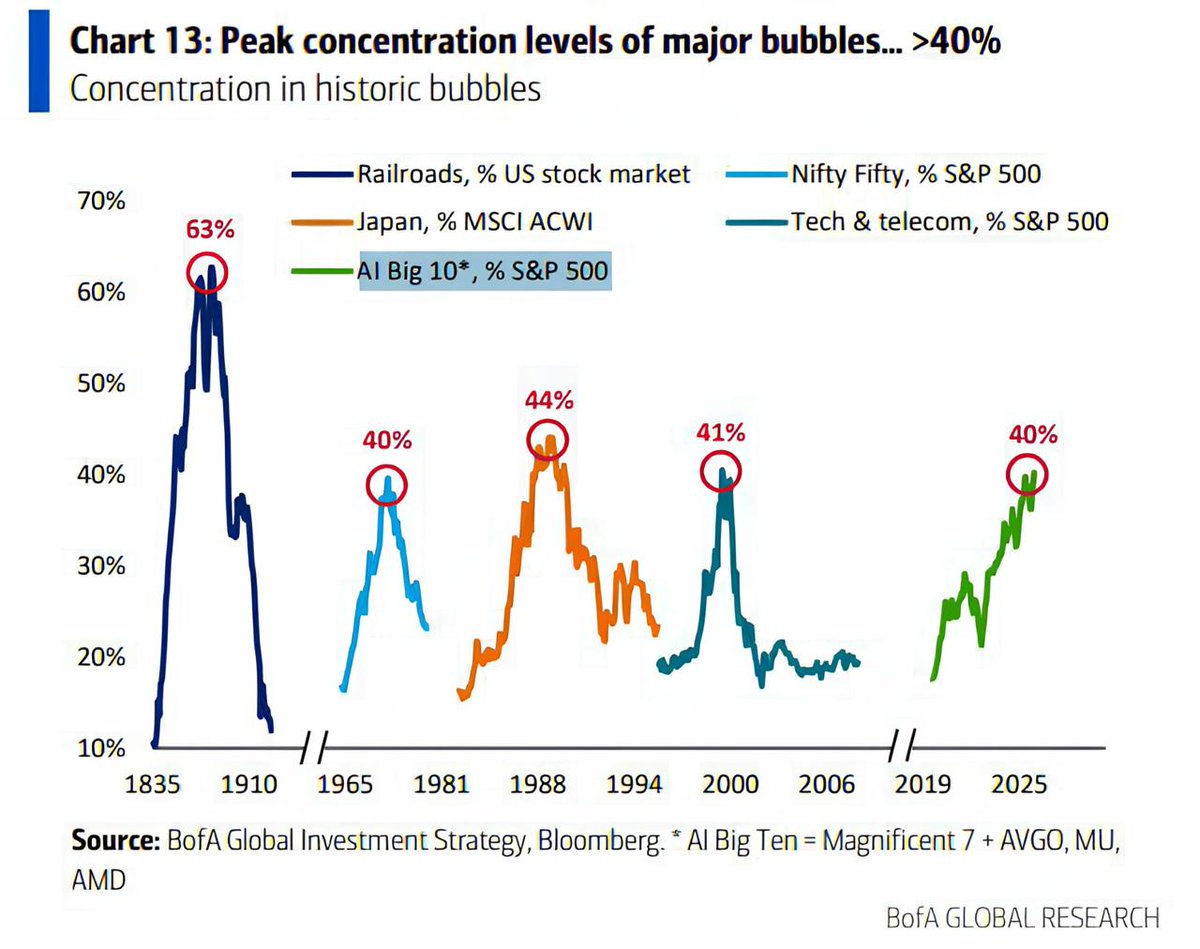
@BullTheoryio So the same rule that triggered in 2000 is back, but the top 10 today are mostly cash-rich tech giants with different risk profiles than the dot-com era. Might be a different kind of unwinding if it happens.
English
0
0
1
37
Bull Theory
Bull Theory@BullTheoryio·
The 40% bubble concentration rule just triggered for the first time since the dot-com crash. If history repeats, the entire market could be at risk. Every time the top 10 stocks have made up 40% or more of the total market, a major crash has followed soon after. This pattern holds across nearly 200 years of market history. In 1929, the top 10 stocks hit 44% of the market. The Great Crash followed. In 1965, they hit 40%. The "Go-Go Bubble" burst followed. In 2000, they hit 41%. The dot-com crash followed. Today, the top 10 stocks make up 40% of the market once again. Apple, Microsoft, Amazon, NVDA, and Google alone make up 25%. This level of concentration has only been seen at the peak of the largest bubbles in history. And each time, the entire market has suffered, not just the top stocks. In 2000, while the Nasdaq lost 80%, the S&P 500 still fell 50%. In 2008, while banks led the plunge, the S&P 500 fell 58%. When the top gets this heavy, it drags everything down with it. 40% concentration has been a clear and consistent red flag. It doesn't mean a crash will happen tomorrow. But it does mean the risk level in the market is at an extreme.
Bull Theory tweet media
English
103
277
1.5K
123.4K
Ethan Walker
Ethan Walker@StopLossLab·
@BMNRBullz If it's already at a 5x discount vs BTC, what's actually making it flip back to that ratio
English
0
0
0
36
BMNR Bullz
BMNR Bullz@BMNRBullz·
🚨 TOM LEE: ETHEREUM TO $62,000 IF IT BECOMES THE PAYMENT RAILS OF THE FUTURE “If Bitcoin gets to $250K and Ethereum returns to its historical ratio, that’s $12K to $22K ETH. If Ethereum becomes the payment rails of the future, that implies $62K ETH.” Then he explained what BITMINE has been building through the crypto winter: 🔹 $14B+ staked through MAVAN 🔹 Largest staking operator globally 🔹 OpenAI + Worldcoin exposure via $ORBS 🔹 MrBeast investment targeting Gen Z finance 🔹 Expects 5% of ETH supply in 2026 Tom Lee said Bitmine originally expected the 5% target to take years. Now they still expect to reach it in 2026 even while slowing the pace of accumulation. He says tokenization and agentic AI could drive Ethereum’s next major move. $ETH $BMNR
English
12
26
298
28K
Ethan Walker
Ethan Walker@StopLossLab·
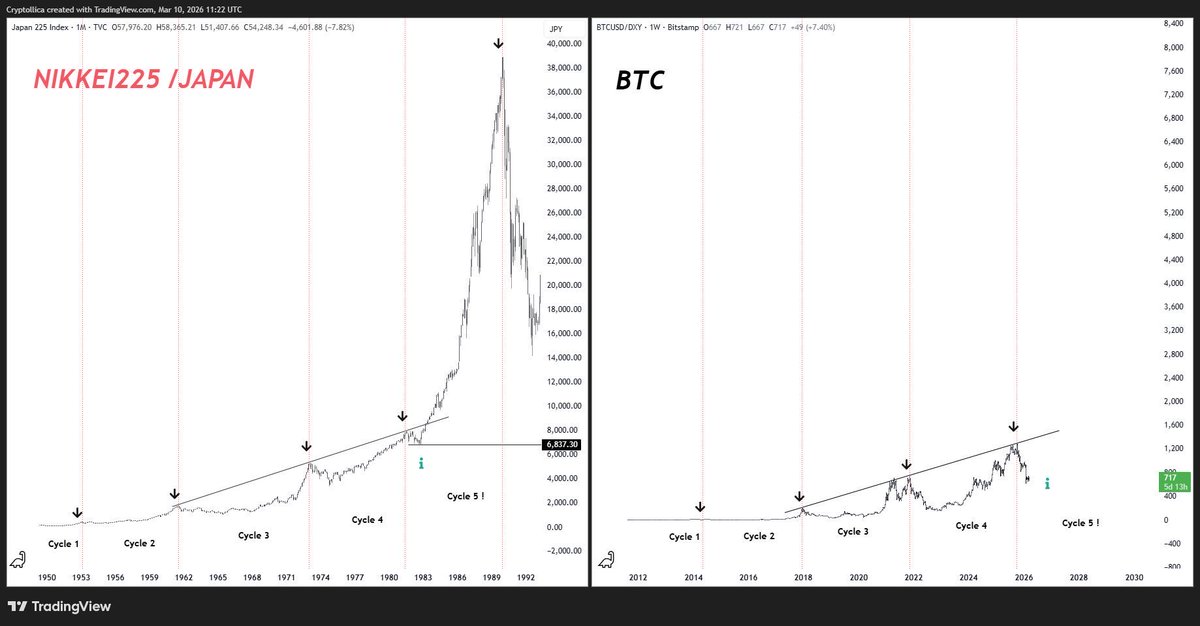
@Cryptollica The real tells are the bored and the exhausted. Same vibe we had before the last two resets.
English
0
0
0
11
Cryptollica
Cryptollica@Cryptollica·
The biggest Bitcoin mistake right now❗️ Thinking the final move already happened. Major secular trends rarely end while everyone is bored, doubtful and exhausted. They usually reset first. Then they accelerate. Nikkei 225 showed the same cycle psychology before its vertical phase. Bitcoin is not copying Nikkei. But the structure is rhyming. Cycle 5 is not behind us. It is preparing.
Cryptollica tweet media
English
7
7
74
5.4K
Ethan Walker
Ethan Walker@StopLossLab·
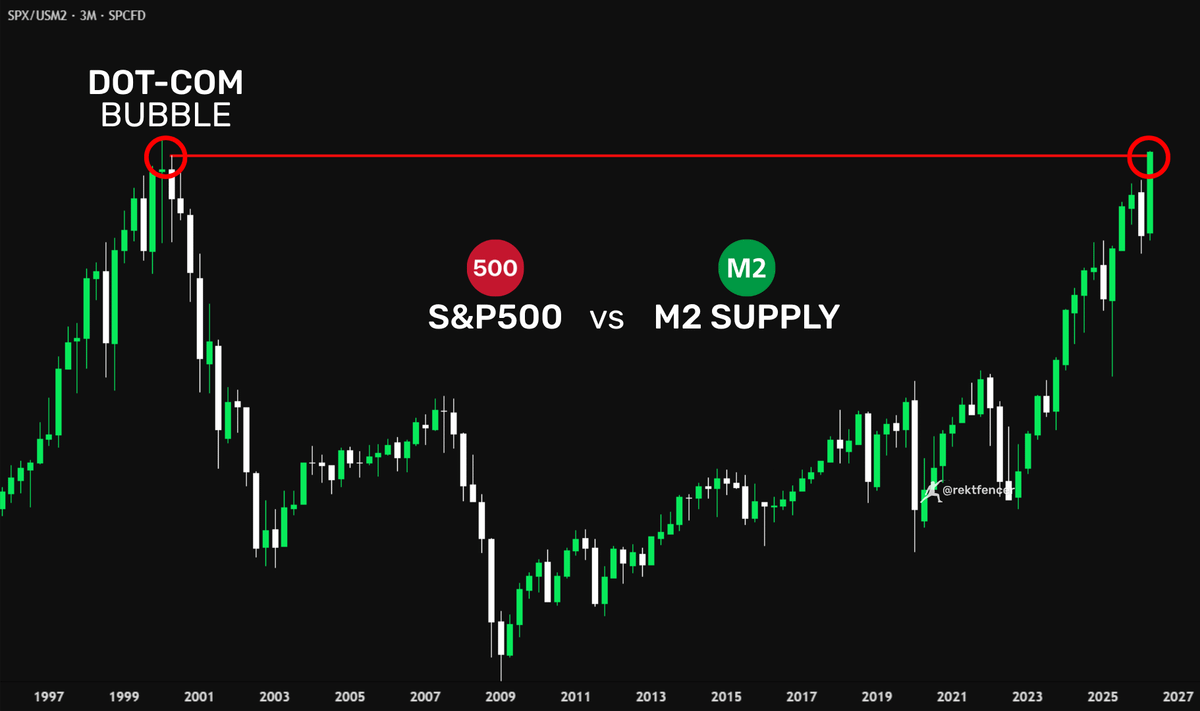
@rektfencer Historical comparisons like this always ignore that M2 definitions changed post-2020 and so did velocity. The ratio alone doesn't tell you which side snaps first.
English
1
0
0
14
Rekt Fencer
Rekt Fencer@rektfencer·
🚨 THIS IS THE SCARIEST CHART ON WALL STREET. S&P 500 VS M2 JUST HIT DOT-COM BUBBLE LEVELS. LAST TIME THIS HAPPENED, TRILLIONS WERE WIPED OUT. WE ARE HERE AGAIN.
Rekt Fencer tweet media
English
119
164
542
30.3K
Ethan Walker
Ethan Walker@StopLossLab·
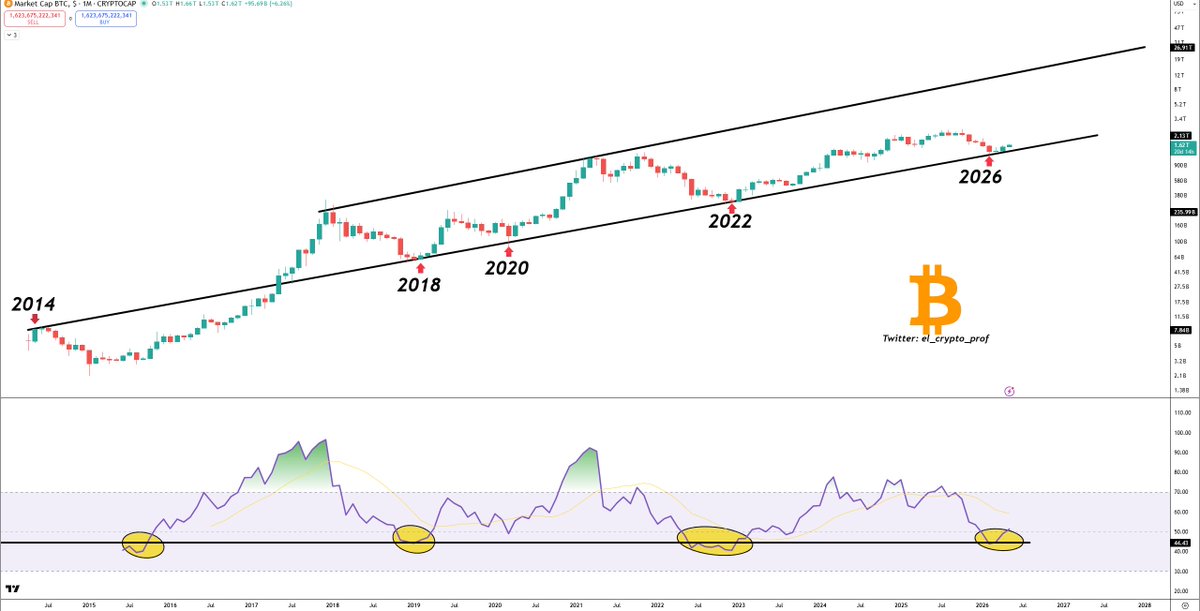
timing the bottom twice in a row means either skill or a market that repeats itself if the top is next, the real question is whether the same people who got the bottom right will actually sell into strength altcoins make the claim expensive to test
𝕄𝕠𝕦𝕤𝕥𝕒𝕔ⓗ𝕖 🧲@el_crypto_prof

#Bitcoin Just like in 2022, I’ve called the bottom for $BTC again this cycle. Next, I’ll call the top. But before that, prices will go much, much higher, especially for #Altcoins. We’ve got something big to look forward to, folks.💯

English
0
0
0
11
Ethan Walker
Ethan Walker@StopLossLab·
@LintonWorm This smells more like a staged liquidation trap than a directional bet. If it’s real, the real question is whether the liquidity above 83k is deeper than his margin.
English
0
0
0
147
Linton Worm (🍏,🪱)
Linton Worm (🍏,🪱)@LintonWorm·
🚨 BREAKING TRUMP'S WHALE JUST OPENED $81M BTC SHORT WITH 20X LEVERAGE IF BITCOIN PRICE HITS $83,628 = LIQUIDATION DOES HE KNOW SOMETHING OR LARGE LIQUIDATION SOON?
English
17
25
110
25.3K
Ethan Walker
Ethan Walker@StopLossLab·
@BSCNews @dfinity @dominic_w So the pitch is basically a full-stack sovereign cloud that bypasses AWS entirely. That only works if the latency and cost actually beat traditional cloud for real workloads, not just token-gated apps.
English
1
0
0
22
BSCN
BSCN@BSCNews·
INTERNET COMPUTER'S CLOUD ENGINES REPRESENT AN INFLECTION POINT... Founder of Internet Computer (@Dfinity), Dominic Williams (@Dominic_w), while celebrating the protocol's five-year journey, provided a detailed preview of “Cloud Engines." Cloud Engines is the sovereign frontier cloud technology that the network will soon provide via opencloud(.)org. He stated that Cloud Engines will enable anyone to spin up their own tamperproof sovereign cloud by selecting and configuring nodes within the mathematically secure Internet Computer network. The founder emphasized that the technology is built specifically for the AI era, enabling AI agents to create and update online applications and services without the need for security teams or sysadmins. Additionally, software hosted on Cloud Engines is immune to infrastructure hacks, guaranteed to run as long as sufficient nodes remain operational, and protected by orthogonal persistence in the Motoko language, which automatically detects and prevents “lossy” AI-generated updates. He added that users will soon be able to develop and deploy apps directly from AI platforms such as Claude or Perplexity, with seamless integration through @caffeineai, while maintaining full tech sovereignty. Cloud Engines allow owners to choose node operators and locations, mix Big Tech instances (@AWS, @Azure, @Google), add sovereign AI nodes, and scale capacity instantly without downtime or vendor lock-in. In summary, Cloud Engines is an inflection point in the Internet Computer’s history.
English
16
101
433
9.4K
Ethan Walker
Ethan Walker@StopLossLab·
@el_crypto_prof Betting on a perfect cycle call twice assumes the market didn't change its structure underneath you
English
0
0
0
6
Ethan Walker
Ethan Walker@StopLossLab·
@CryptoTice_ And the Swiss Central Bank probably calls it a hedge against currency risk in their board minutes. That's the quiet part.
English
0
0
0
61
Crypto Tice
Crypto Tice@CryptoTice_·
BREAKING: The Swiss Central Bank just bought $10,000,000 of $MSTR. Switzerland. One of the most conservative financial institutions on earth. Quietly buying Bitcoin through the back door. $MSTR isn't a stock. It's a Bitcoin proxy. And the Swiss Central Bank knows exactly what they're buying. > Vanguard bought $680,000,000. > Czech Republic buying Bitcoin directly. > Luxembourg allocated to Bitcoin. Now Switzerland. One by one. The most conservative money in the world. Is making the same decision. There are only 21,000,000 Bitcoin. And every central bank on earth is starting to want some. The window is closing faster than anyone realizes.
Crypto Tice tweet mediaCrypto Tice tweet media
English
23
89
603
19.6K