On to the next adventure! Today, I’m starting off the morning as a Principal Design Engineer with @ZephyrCloudIO Cloud.
My almost 4 years at Microsoft were a great journey. Being part of one of the biggest global tech companies out there and seeing how to maintain and build enterprise-level applications was an experience I won’t ever forget. Thank you for making me a better leader.
I haven’t been this excited to start a new job in a long time. I wasn’t looking to go back to a start-up company, but the stars aligned. When folks talk about how building in public worked for them, I didn’t imagine it would work for me in a way where it would reinvigorate me.
I started off on Twitter to build my profile and start a podcast with Andrew Lancaster. I wasn’t supposed to gain 30k+ followers. I was just being me and speaking in Spaces to share my knowledge. This led me to want to speak at conferences. After a handful of speaking engagements, I was asked to speak at RenderATL (Render Atlanta).
Zackary Chapple and I were both at RenderATL, but we never officially met. What’s funny is I got to hang out with Shane Walker and Néstor López after the conference days and had some fantastic conversations. Not knowing they’d eventually become my co-workers, the opportunity to speak at RenderATL made this possible. A week later, Zack sends me this random Twitter DM asking for a free computer. Just kidding. He did send a random DM, but it was asking if I was Hmong. Oddest thing because not many know of the Hmong people. Come to find out, we both grew up in the Midwest. He had grown up with some Hmong friends and even knew some Hmong words I didn’t expect him to. This led him to inviting me to an AI Accelerator week in Miami.
Being in Miami was the icing on the cake. I was able to see firsthand how Zack led a room full of developers, designers, project managers, and leaders. Most importantly, I was capable of seeing the innovative work the team was working on. They were implementing agent skills in workflows 6 months before they were announced as a feature. When I asked a few of the team members what excites them about working at Zephyr, they all said that they get to work on things you cannot Google. I had to take a step back and think about the last time I was working on something I couldn’t Google. Probably when I had to find coding books to reference. I also had the thought of how cool it was for them to innovate things no one else has come up with yet.
I went to Miami questioning how AI could change the industry. I left Miami knowing for a fact that I was behind and AI would take over the industry in some ways.
Today, I’m excited. I know I’m going to a good company, not just a random start-up. I know the co-workers I’m going to work with are going to work hard, and also have fun when work is done. I know that we are going to build the future of AI integration in the tech scene. I know that I’m meant to be here and to make a difference. Let’s go!
I get a lot of complaints from Sr. SWEs frustrated about their job search.
They're passing every coding round only to get rejected in behaviorals, system design, and hiring manager screens.
Here's what nobody tells you: Being technical is half the battle.
At senior level, hiring managers are evaluating things that have nothing to do with your code.
1. Team/Culture fit
Just because you're a great SWE doesn't mean you're a great SWE for them.
We can look at sports for an example. Star NBA players get traded because they don't fit a system. Elite WRs in the NFL bounce between teams.
It was never about talent, but about team chemistry. The same thing happens in companies too.
2. Being a flight risk
Here's what hiring managers are actually thinking:
"If I hire this person and it doesn't work out, in this market, I'm not guaranteed a backfill. I lose the seat. The more seats I lose, the more my own job is at risk."
This is the reality of hiring in a market where companies are actively looking to reduce headcount.
3. Likeability
Nobody wants to say it out loud but here it is:
They're going to spend 40+ hours a week with you. They need to actually enjoy working with you.
If the vibe is off in a 45 min interview, they're not going to roll the dice on 2,000+ hours a year.
4. Contractors don't go on PIPs.
They just get terminated. That's the whole point of hiring contractors outside of cost.
So many people have a victim mentality now that you can win by simply taking accountability and having discipline in your life.
The bar has never been lower.
Most people bomb interviews because they prep for the wrong things.
They'll skim generic listicles from 2019, practice "tell me about yourself" in the shower, then wonder why they can't make it past the first round.
Here's how to fix that with AI:
1: FEED IT THE JOB DESCRIPTION
Copy the entire JD into your favorite LLM and ask something like:
"Based on this job description, give me 15-20 questions a hiring manager would likely ask. Include technical, behavioral, scenario based, and functional questions."
You'll get a tailored question set built from the actual language and priorities of that role.
2: GO DEEP BY CATEGORY
Don't stop at one pass, keep digging deeper:
• Technical: Ask for 10 questions on each specific skill mentioned
• Behavioral: Request STAR format prompts for leadership, conflict, failure
• Scenario based: Get "what would you do if" questions for that exact role
• Domain/industry: Test real expertise, not surface knowledge
Takes 15 minutes. You'll have 50-80 targeted questions.
3: RUN IT ON YOUR RESUME
Hiring managers read your resume before the interview. They spot gaps, transitions, mismatches.
Upload your resume and ask:
"Generate 15-20 questions a hiring manager would ask me. Focus on career transitions, gaps, achievements, and misalignments with typical roles in [industry]."
Then go harder:
"What are the weakest parts of this resume for a [role] position? Where would a skeptical hiring manager push back?"
Prepare for questions you're afraid of, not just the ones you want.
4: SIMULATE THE CONVERSATION
Ask the AI to run a mock interview. Give it the JD and your resume. Tell it to be tough and to follow up on vague answers.
AI won't coddle you like your friend. It'll tell you when your answer missed the point and make you try again.
Ask it to rate your answers 1-10 and explain what was missing. 30 minutes of this beats 95% of candidates.
This is literally what I have my candidates do in IRL. It's worked out pretty well the past couple of years.
You have a tool that simulates the hiring manager's brain, generates custom questions, stress tests your resume, and runs mock interviews on demand.
If you are given AI coding tool and immediately ask “what do I build?” you are thinking in terms of solutions looking for problems. It is very easy to build software that looks impressive but is of no use. Look around, there are so many problems that need attention.
Most RAG systems don’t fail because of the model.
They fail because: • retrieval isn’t aligned to intent • context is treated as infinite • evaluation is missing
RAG is a systems problem, not an embeddings problem.
A lot of teams optimize embeddings before they’ve defined relevance or failure modes.
Retrieval quality is about intent + constraints, not cosine similarity alone.
Sometimes people get promoted because they express their career goals with their leadership team.
Align your career goals with the business impact that can be made.
This is a great way to justify a salary increase.
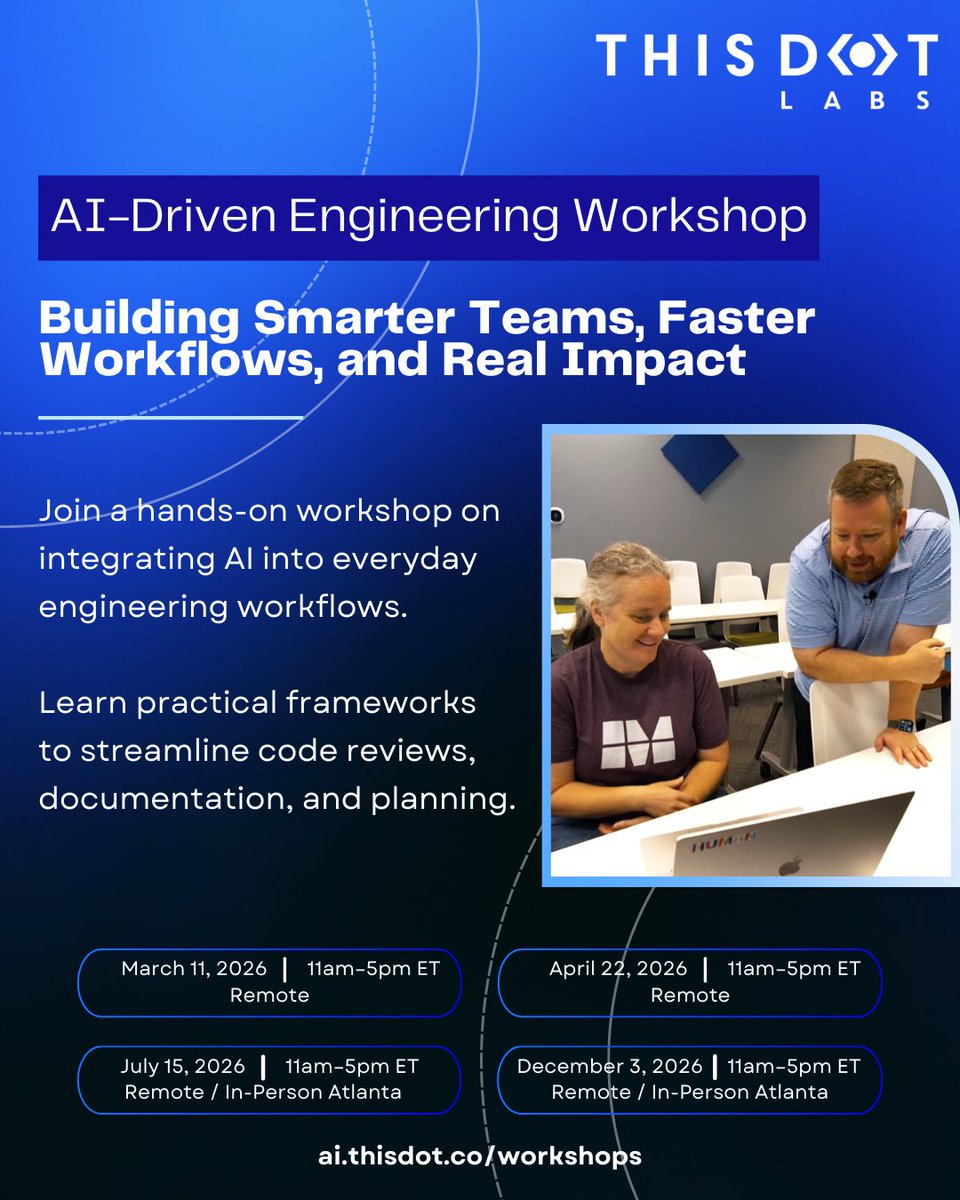
Announcing a new round of the #AI tooling & workflow workshop by @ThisDotLabs on 3/11!
Join this 6 hr long, hands on remote workshop live for just $50! You'll get a plug-and-play AI toolkit for everyday tasks as a software engineer.
Use code THISDOTX at checkout to save! 🔗👇