
Teucrium ETFs

2.9K posts

Teucrium ETFs banner
Teucrium ETFs

Teucrium ETFs

@TeucriumETFs

Independent ETF Issuer & White Label Service Provider | Subscribe: https://t.co/wsfm4zlyNm

Burlington, VT Beigetreten Eylül 2019
4K Folgt6.1K Follower
Angehefteter Tweet
Teucrium ETFs
Teucrium ETFs@TeucriumETFs·
Know what’s in your portfolio. Teucrium’s new Commodities Calculator shows your real-world exposure to bushels of corn, wheat, and soybeans—or to pounds of sugar—based on the number of shares you hold in our single-agriculture ETFs. Built for advisors and self-directed investors who want clarity, not guesswork. Try it now → teucrium.com/agricultural-c…
English
0
3
15
15.7K
Teucrium ETFs
Teucrium ETFs@TeucriumETFs·
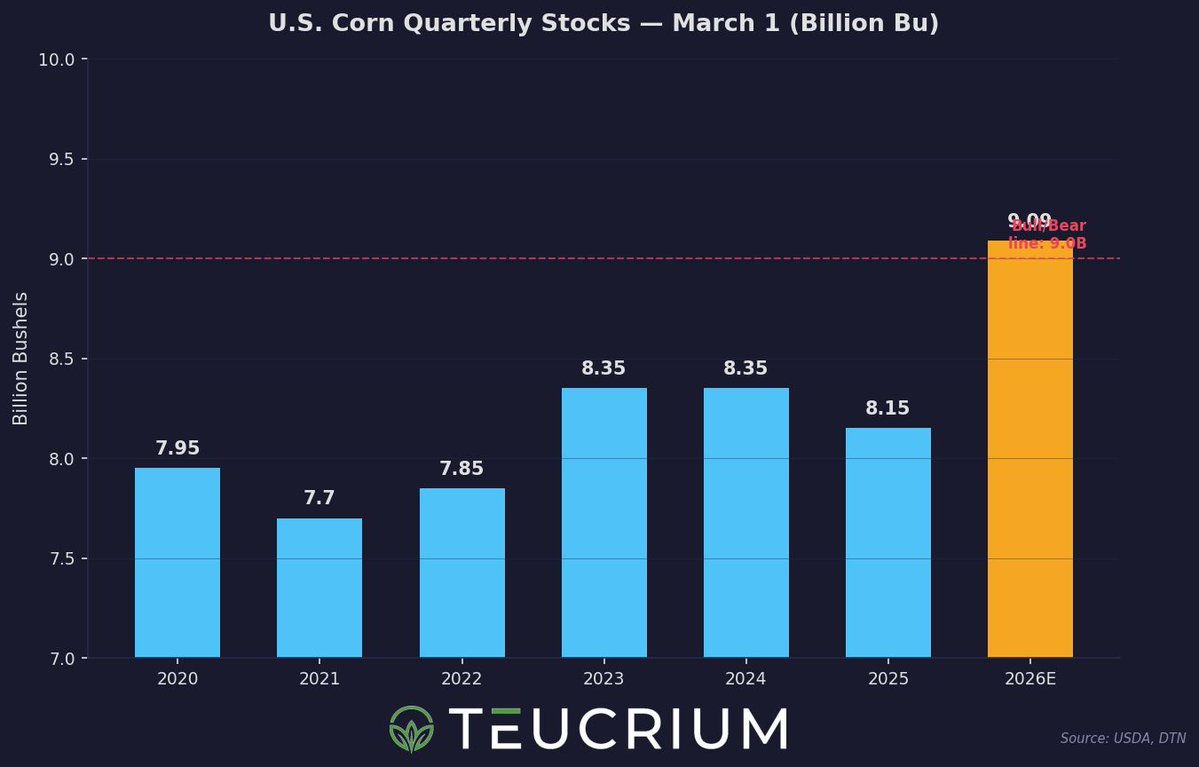
Tuesday’s USDA Grain Stocks report could confirm demand is chewing through the record corn crop. Avg estimate: 9.09B bu (DTN) — up from 8.15B last year but we believe anything below 9B bu would be bullish.
Teucrium ETFs tweet media
English
0
1
8
413
Teucrium ETFs
Teucrium ETFs@TeucriumETFs·
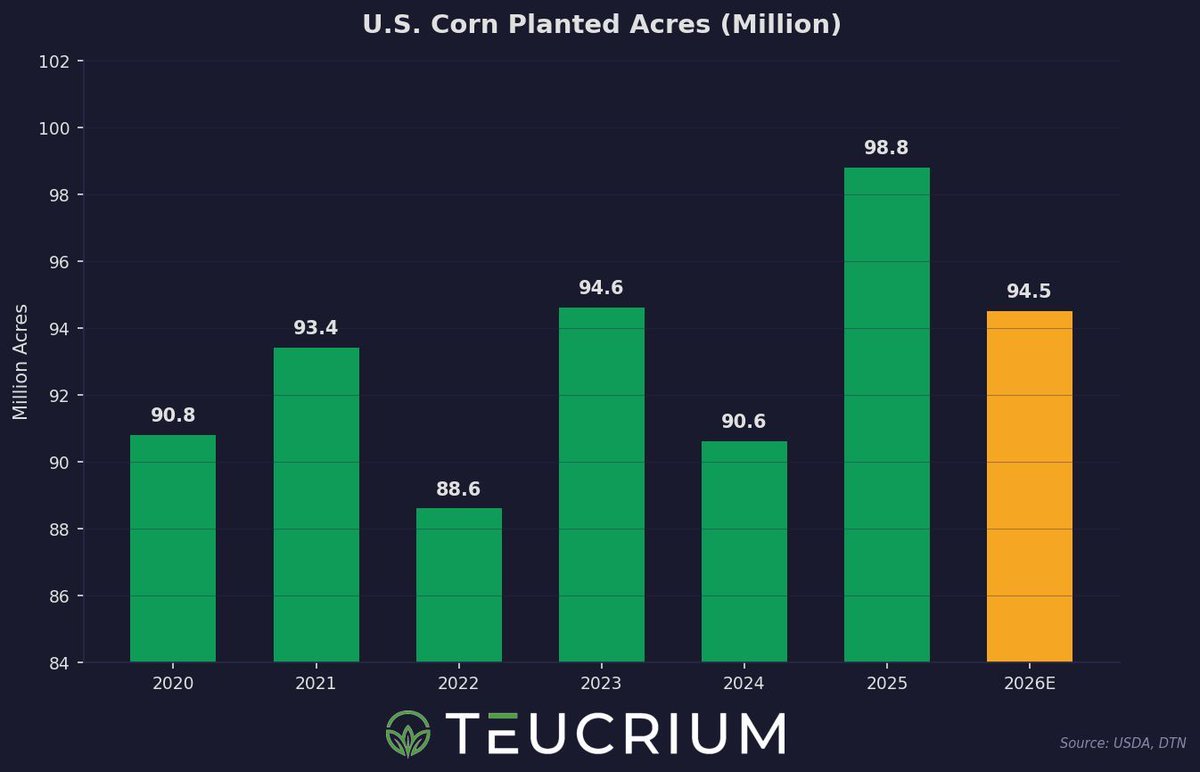
Tuesday’s USDA Prospective Plantings could be the most consequential report day of 2026. Avg estimate: 94.5M corn acres — down 4.3M from last year’s 89-yr high. We believe anything under 94M could provide additional price support (USDA).
Teucrium ETFs tweet media
English
0
1
7
613
Teucrium ETFs
Teucrium ETFs@TeucriumETFs·
1 DTN/Progressive Farmer. "Seven of Eight Major Fertilizers Are Higher Priced to End February." March 4, 2026. dtnpf.com/agriculture/we…. 2 DTN/Progressive Farmer. “Retail Fertilizer Prices Track Higher Fourth Week of March 2026.” March 27, 2026. 3 USDA National Agricultural Statistics Service. “US Farmers Expect to Plant Less Corn and More Soybean Acres.” March 31, 2026. nass.usda.gov/Newsroom/2026/…. 4 The Rio Times. “Brazil Faces Fertilizer Crisis as War and China Choke It.” 2026. riotimesonline.com/brazil-faces-f…. 5 ibid. 6 Gulf Times. "Iran War Threatens Global Food Security as Qatar's Fertiliser Plant Goes Offline." 2026. gulf-times.com/article/723114…. 7 Fox Business. "QatarEnergy Declares Force Majeure After Iran Strikes on Ras Laffan Facility." 2026. foxbusiness.com/economy/irania…. See also: Middle East Eye. "Ras Laffan: How Qatar Gas Hub Attack Is Hitting Asia and Beyond." 2026. middleeasteye.net/news/ras-laffa…. 8 Al Jazeera. "Why Are Iran's South Pars Gasfield, Qatar's Ras Laffan, So Significant?" March 19, 2026. aljazeera.com/economy/2026/3…. 9 CZ App. "Urea Prices Spike as Middle East Conflict Cuts Iranian Production." 2026. czapp.com/analyst-insigh…. 10 SunSirs. “Global Urea Production Capacity Continues to Expand, Prices May Bottom Out and Rebound by 2026.” 2026. sunsirs.com/commodity-news…. 11 Ecofin Agency. "Russia Suspends Fertilizer Exports, Adding Strain to Global Supply." March 2026. ecofinagency.com/news/2503-5406…. 12 S&P Global. "War-Driven Fertilizer Costs Reshape Crop Choices in Europe, Raise Import Risks." March 13, 2026. spglobal.com/energy/en/news…. 13 Discovery Alert / World Fertilizer. "Egypt Urea Production: Supply Stability Analysis." 2026. discoveryalert.com.au/egypt-nitrogen…. See also: World Fertilizer. "Egyptian Urea Production Continues to Run Despite Gas Shortages." March 25, 2026. worldfertilizer.com/materials-hand…. 14 Euronews. "Drones Hit Saudi Ras Tanura Refinery as Iran Strikes Targets Across Region." March 2, 2026. euronews.com/2026/03/02/dro…. See also: The National. "Saudi Aramco Shuts Down Ras Tanura Refinery Following Drone Attack." March 2, 2026.
English
0
0
0
190
Teucrium ETFs
Teucrium ETFs@TeucriumETFs·
Damage Done? A ceasefire today doesn't fix corn's nitrogen problem Announce a ceasefire today, reopen the Strait of Hormuz tomorrow, and the corn market still has a problem that doesn’t resolve until 2027 at the earliest. It is a risk that the market may not fully comprehend. Grain traders are chasing oil prices and ceasefire headlines, treating the nitrogen shock as a geopolitical risk premium that fades when the shooting stops. It won’t. Disappearing Corn Acres? Final corn planting decisions in the United States run from February through early April. The Strait of Hormuz closed on February 28. Anhydrous ammonia averaged $865 per ton nationally that week.1 By the end of March, the national average price of anhydrous ammonia rose to $1,035, with seven of the eight major fertilizers seeing price increases.2 That $185 per ton increase adds roughly $18 per acre at a standard 160-pound nitrogen application rate. At a 180-bushel yield, that’s approximately $0.10 per bushel baked into the cost of production. A ceasefire doesn’t bake it back out. Some farmers will absorb the cost. Others may cut application rates. Some will switch and plant soybeans instead. USDA’s March 31 Prospective Plantings report showed corn intentions down 3% from 2025, with soybeans gaining acreage.3 That survey ran in early March, before the full price spike hit. In our view, the shift will likely be larger than what USDA captured. A ceasefire doesn’t replant those soybean fields as corn. It doesn’t retroactively apply nitrogen that wasn’t purchased. The 2026 US corn crop is set. South American Impacts The corn market is likely to feel the impact most directly in the Southern Hemisphere first. Brazil is the world’s largest corn exporter and imports roughly 85% of its fertilizers.4 Its Agriculture Ministry has classified the fertilizer supply outlook as an "extremely high risk" to the 2026/27 harvest.5 Brazilian safrinha corn, planted February through March across Mato Grosso and Parana, receives nitrogen top-dressing in April and May. Those farmers are finding the Middle East supply gone, and Chinese exports under quota. If application rates fall short, those yields would be decided regardless of any potential ceasefire announcement. 2027: The potential capacity impact The second timeline is where the ceasefire argument fully collapses. One of the world’s largest single-site facilities, QAFCO’s urea and ammonia complex at Ras Laffan, remains offline.6 QatarEnergy CEO Saad al-Kaabi confirmed 17% of Qatar's LNG export capacity is sidelined for 3 to 5 years, with repair costs estimated at $26 billion.7 QAFCO represents roughly 14% of the global seaborne urea trade. A ceasefire today starts a 3-to-5-year clock. It does not skip it. (There is no diplomatic workaround for a destroyed LNG train.) Iran’s situation is no better. Israeli strikes damaged four processing plants at South Pars.8 All seven major Iranian urea producers suspended operations.9 Some catalyst damage from uncontrolled shutdowns may be permanent. Even with a ceasefire, restarts take months at a minimum. Full production recovery is years out. Those two suppliers together represent roughly 25% of globally traded urea. They are not coming back on a diplomatic timeline. Global nitrogen markets will likely still be short in September as farmers start buying inputs for the next crop. They’ll be making the same corn-versus-soybeans calculation under similar cost pressure. The 2026 acreage shift doesn’t end in 2026. China and Russia, the only potential swing suppliers, provide no relief. China has maintained strict urea export controls since mid-2024.10 Russia escalated its own restrictions in late March, suspending ammonium nitrate exports.11 European producers are running well below normal capacity.12 To our knowledge, there is no available backstop. Marginal Reprieve if the Strait Opens and the Shooting Stops Reopening the Strait of Hormuz for regular shipping traffic would be a positive step forward. A ceasefire would help too. The question is how much. Egypt’s nitrogen plants run on Israeli natural gas from the Leviathan and Karish fields, which Israel suspended as a precaution.13 If those fields restart, Egypt’s urea output could recover within weeks. Saudi Arabia’s eastern export terminals could resume within months if the damage to Ras Tanura was limited.14 That is real supply, and it matters for the tail end of 2026. But Egypt and Saudi Arabia together don’t replace Qatar. They narrow the gap. They don’t close it. The Case for Corn December 2026 corn futures closed at $4.81 per bushel on April 3. The market appears to be pricing a ceasefire and increased shipping traffic through the Strait of Hormuz. In our view, the market isn’t yet pricing in two full growing seasons of elevated nitrogen cost, years of lost production capacity from Qatar and Iran, or the Brazil safrinha risk that could show up as early as June. The farmer’s cost structure for 2026 is largely locked in. The supply risk isn’t. If application rates fall short across the U.S. corn belt and Mato Grosso, and corn yields come in below expectations, we’d expect additional upward pressure for corn futures. Watch both the U.S. planting/crop condition reports as well as Brazilian safrinha crop condition reports through June. Signs of stress in either or both crops could be the catalyst that puts the December corn contract on a path to $5.00 or higher. Looking further out, Qatar’s rebuild timeline alone should keep nitrogen costs elevated through at least 2028. With the damage already done, we believe that the corn markets will be dealing with the impacts of this war at least into 2027, and likely beyond. A ceasefire and a return to business as usual through the Strait of Hormuz would be good news. But for corn markets, it might not be a fast fix. Originally published on Substack open.substack.com/pub/teucrium/p… Sources below
Teucrium ETFs tweet media
English
3
8
51
4.7K
Teucrium ETFs
Teucrium ETFs@TeucriumETFs·
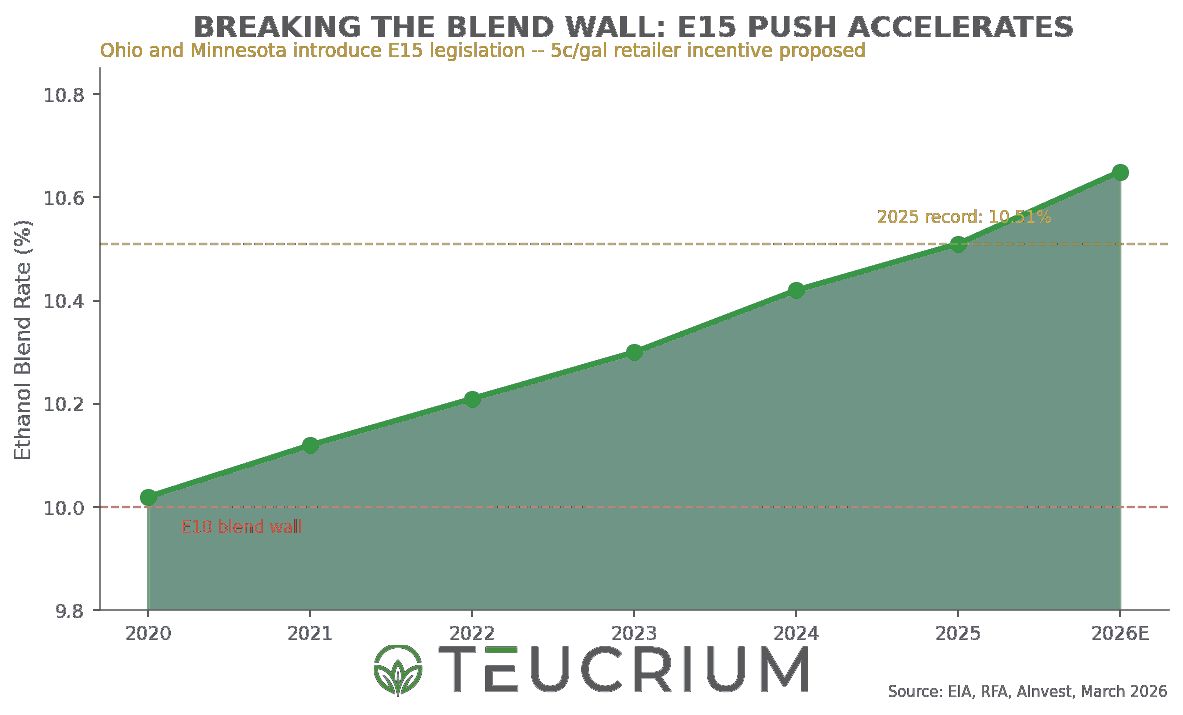
Ohio introduced E15 legislation on March 18. Minnesota followed with a similar bill. 5¢/gal retailer incentive proposed. Blend rate hit 10.51% in 2025 — a record (EIA). We believe year-round E15 could be the next catalyst for corn demand.
Teucrium ETFs tweet media
English
0
2
7
634
Teucrium ETFs
Teucrium ETFs@TeucriumETFs·
USDA projects total U.S. wheat acres at ~44.0M for 2026/27 (Feb Outlook). Canada trending lower. IGC projects global wheat production declining in 2026. Fewer acres + drought + war premium. We believe a structural supply squeeze could be building.
Teucrium ETFs tweet media
English
0
5
23
4.3K
Teucrium ETFs
Teucrium ETFs@TeucriumETFs·
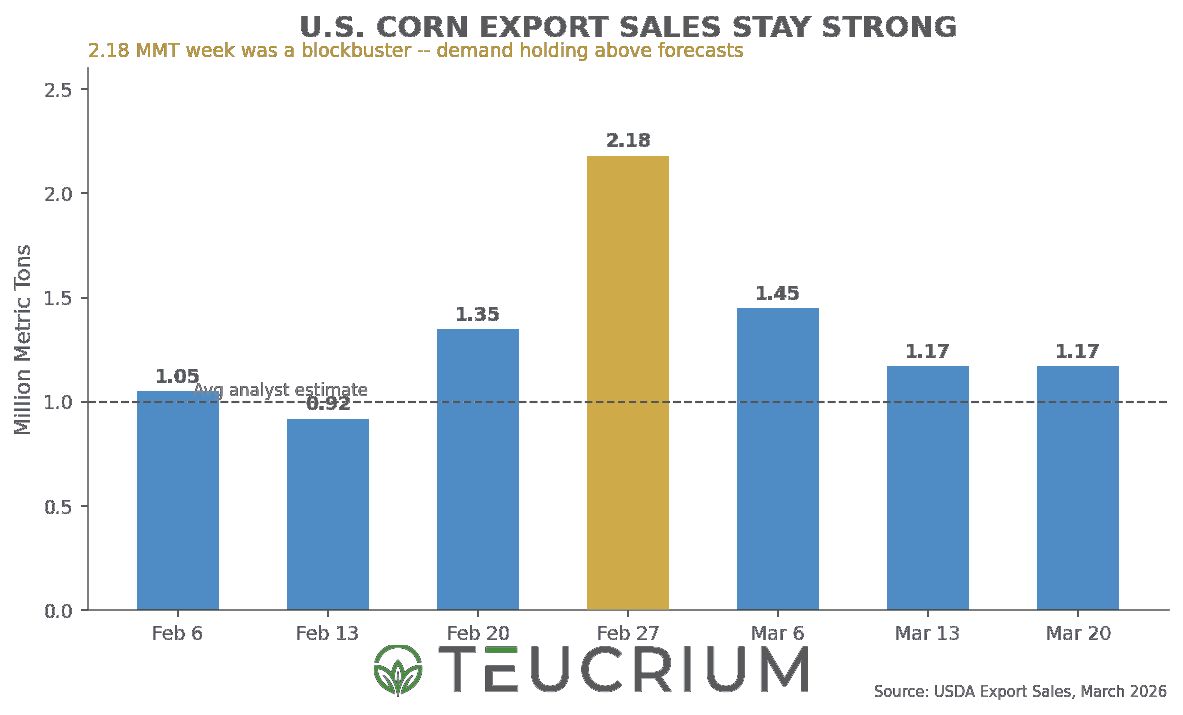
USDA reported corn export net sales of 2.02 MMT for the week ending Feb 27 — up 54% from the prior 4-week average. Demand has been holding well above forecasts. Global buyers may be front-loading before Hormuz disruptions could spread to freight lanes.
Teucrium ETFs tweet media
English
0
0
11
623
Teucrium ETFs
Teucrium ETFs@TeucriumETFs·
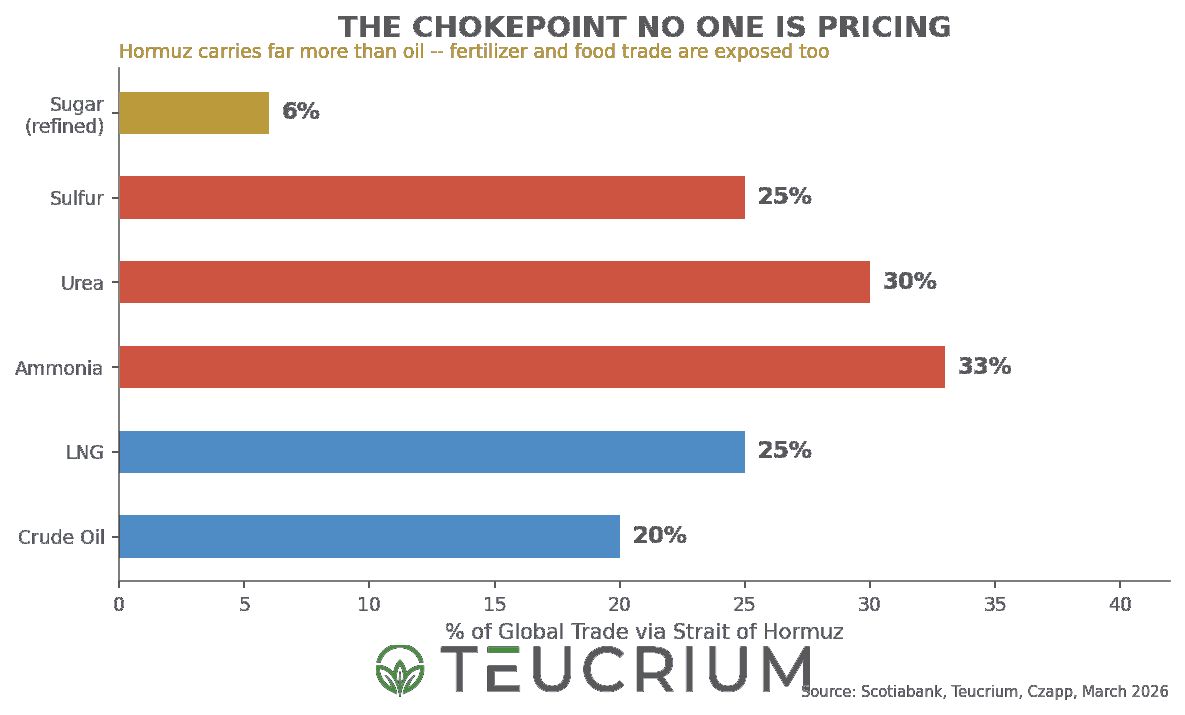
Hormuz carries ~20% of global crude (EIA). But per S&P Global, it also moves ~35% of seaborne urea, ~24% of ammonia, and ~50% of sulfur trade. We believe the market is pricing the oil risk but may be underpricing the fertilizer risk.
Teucrium ETFs tweet media
English
1
14
50
3.8K
Teucrium ETFs
Teucrium ETFs@TeucriumETFs·
The U.S. Drought Monitor (March 19) shows a split picture. Midwest improved: down to 30% in drought (-12 pts). But the S. Plains hit 70% (+5). Southwest at 78%. Winter wheat in Kansas and Oklahoma appears to be taking the hit. The I-states got the rain.
Teucrium ETFs tweet media
English
0
0
13
525
Teucrium ETFs
Teucrium ETFs@TeucriumETFs·
Per CFTC data (week of Mar 17), soy oil net managed-money longs hit 122K contracts — near all-time highs. Biodiesel economics appear to be surging as crude clears $110. We believe the energy-agriculture link could be tightening further.
Teucrium ETFs tweet media
English
0
1
2
3.6K
Teucrium ETFs
Teucrium ETFs@TeucriumETFs·
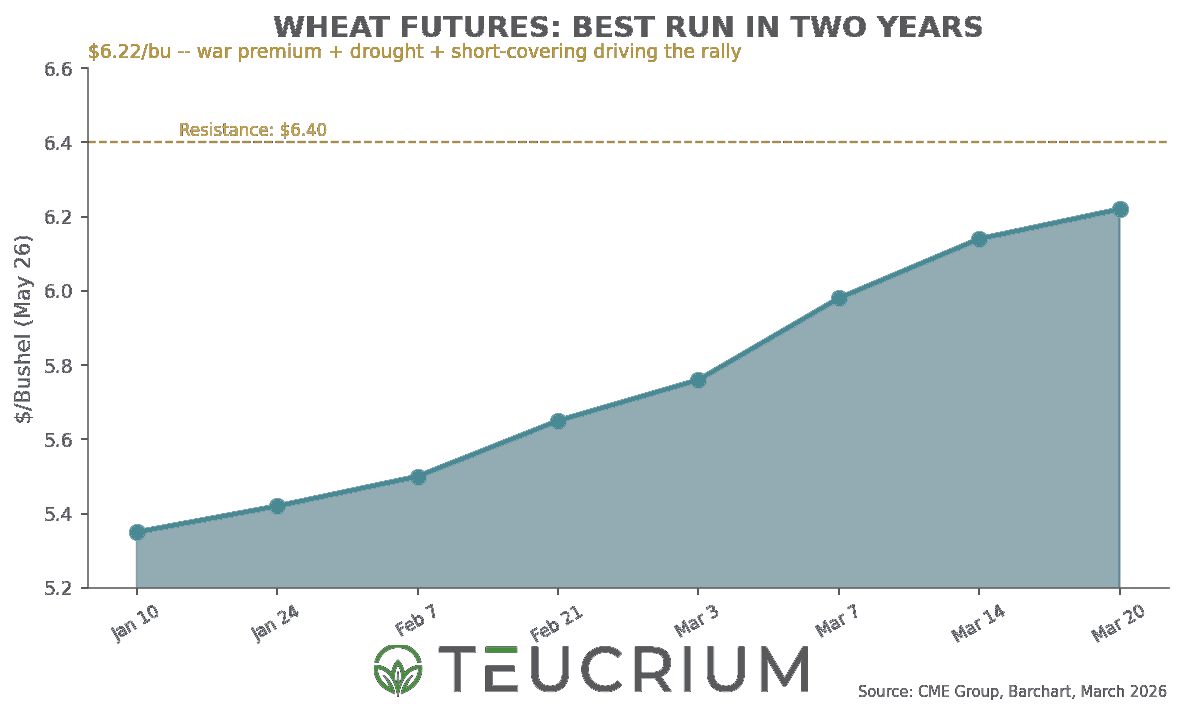
Wheat posted its best run in two years as of March 20. $6.22/bushel (CME). War premium. Drought in the Plains. CFTC data shows funds covering short positions. Resistance sits at $6.40. If it breaks, we could be looking at a different market.
Teucrium ETFs tweet media
English
0
2
8
746
Teucrium ETFs
Teucrium ETFs@TeucriumETFs·
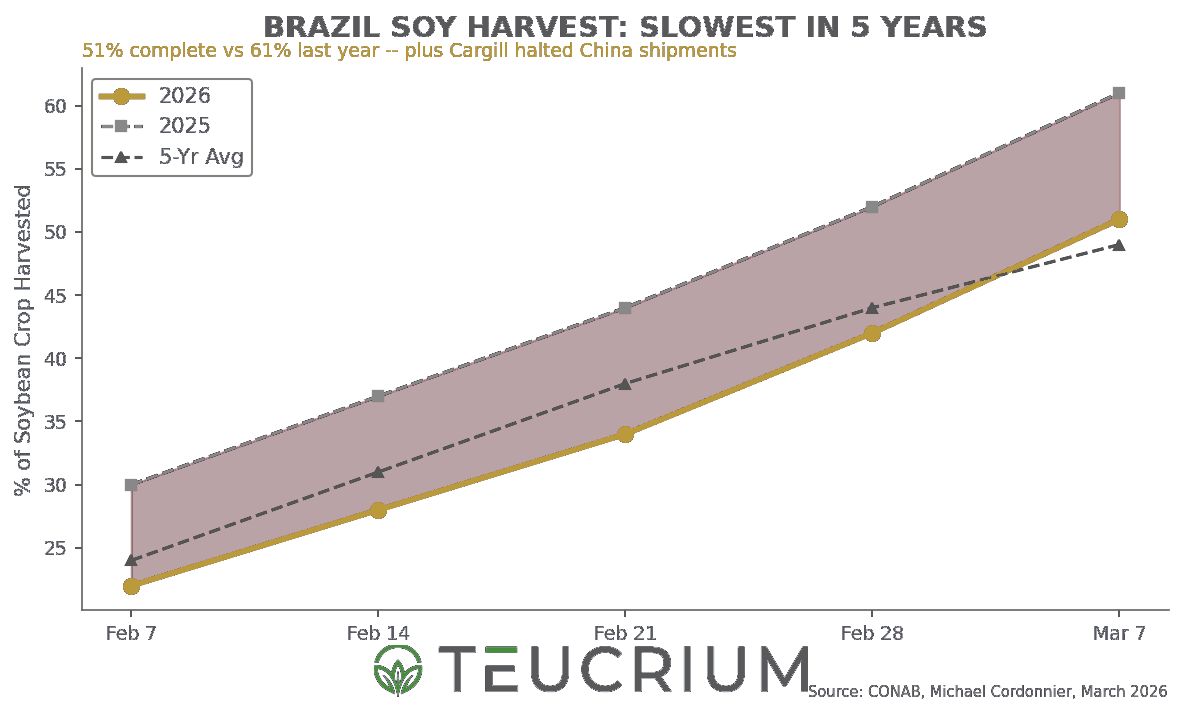
As of March 12, Brazil's soy harvest was 51% complete (CONAB). Last year at this point: 61%. Slowest pace in five years. Cargill halted China shipments in early March over inspections. 177.8 MMT crop, but the logistics chain appears kinked.
Teucrium ETFs tweet media
English
0
0
6
516
Teucrium ETFs
Teucrium ETFs@TeucriumETFs·
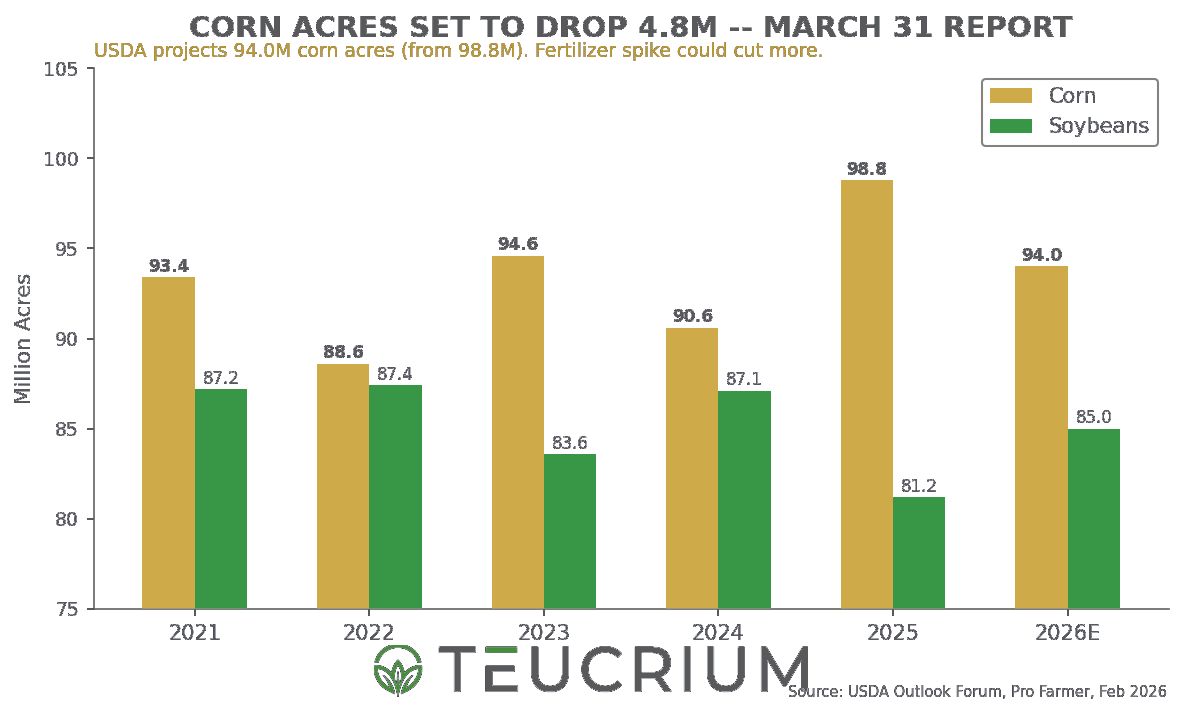
USDA's Feb Outlook Forum projects corn acres dropping to 94.0M from 98.8M. That's 4.8M fewer acres. March 31 Prospective Plantings could cut even more. At $619/ton urea, the economics may get worse. The supply side appears to be tightening before a seed hits the ground.
Teucrium ETFs tweet media
English
3
4
29
5.6K
Teucrium ETFs
Teucrium ETFs@TeucriumETFs·
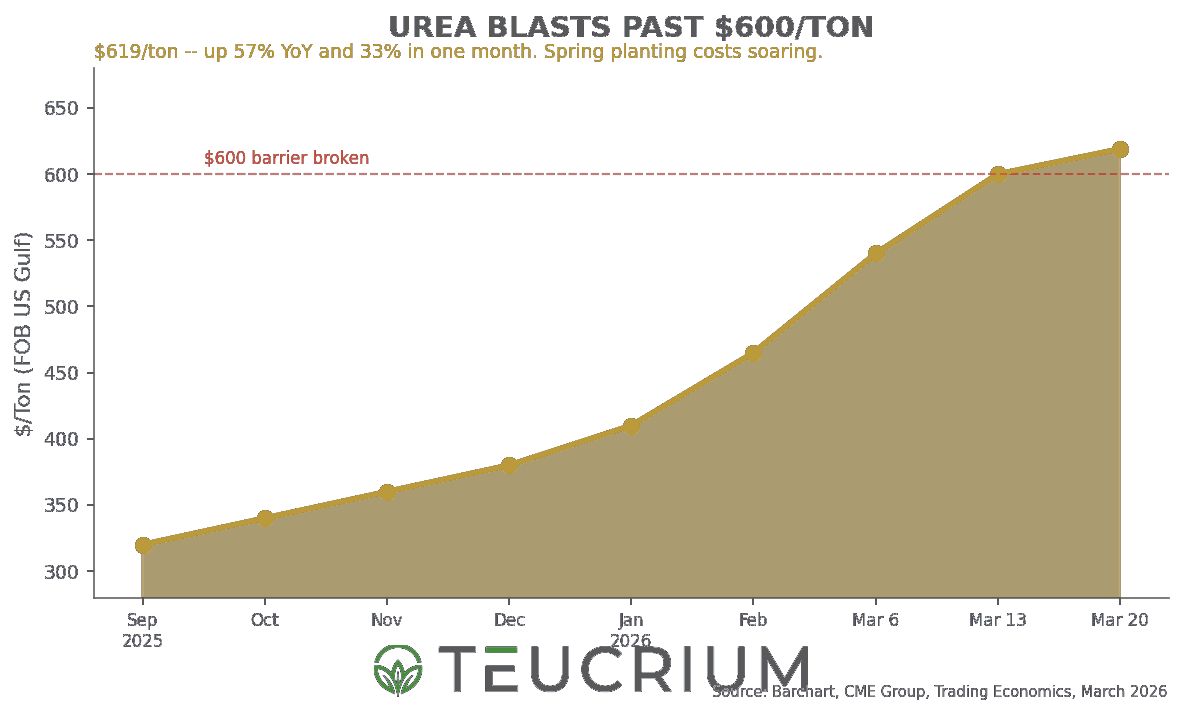
Urea hit $619/ton at the Gulf on March 20 (Barchart). Up 57% YoY and 33% in one month. The Hormuz closure has disrupted an estimated 30% of global urea trade. Spring planting starts now. Farmers appear to be absorbing this in real time.
Teucrium ETFs tweet media
English
1
7
26
8.8K
Teucrium ETFs
Teucrium ETFs@TeucriumETFs·
Sugar may be flipping from surplus to deficit. Reuters projects a 1.5 MMT shortfall for 26/27 in a post-Hormuz scenario. Brazil could divert more cane to ethanol as crude tops $110. Raw sugar rallied to 15.63¢/lb. on March 19. 5-month high.
Teucrium ETFs tweet media
English
1
23
84
7.2K
Teucrium ETFs
Teucrium ETFs@TeucriumETFs·
Brent crude hit $112/barrel on March 20. Highest since 2022. Up 57% year-over-year. The Hormuz closure appears to be repricing energy, agriculture, and freight simultaneously. This isn't just an oil story. We believe it's an input cost story for every bushel planted this spring.
Teucrium ETFs tweet media
English
0
1
10
704
Teucrium ETFs
Teucrium ETFs@TeucriumETFs·
WTI crude above $90. Soybean oil tracking it higher. Net bullish soy oil bets at a 3-year high according to the CFTC. Long-only positions at a record. The energy-agriculture link appears to be tightening. This is not just an oil story.
Teucrium ETFs tweet media
English
0
2
1
321
Teucrium ETFs
Teucrium ETFs@TeucriumETFs·
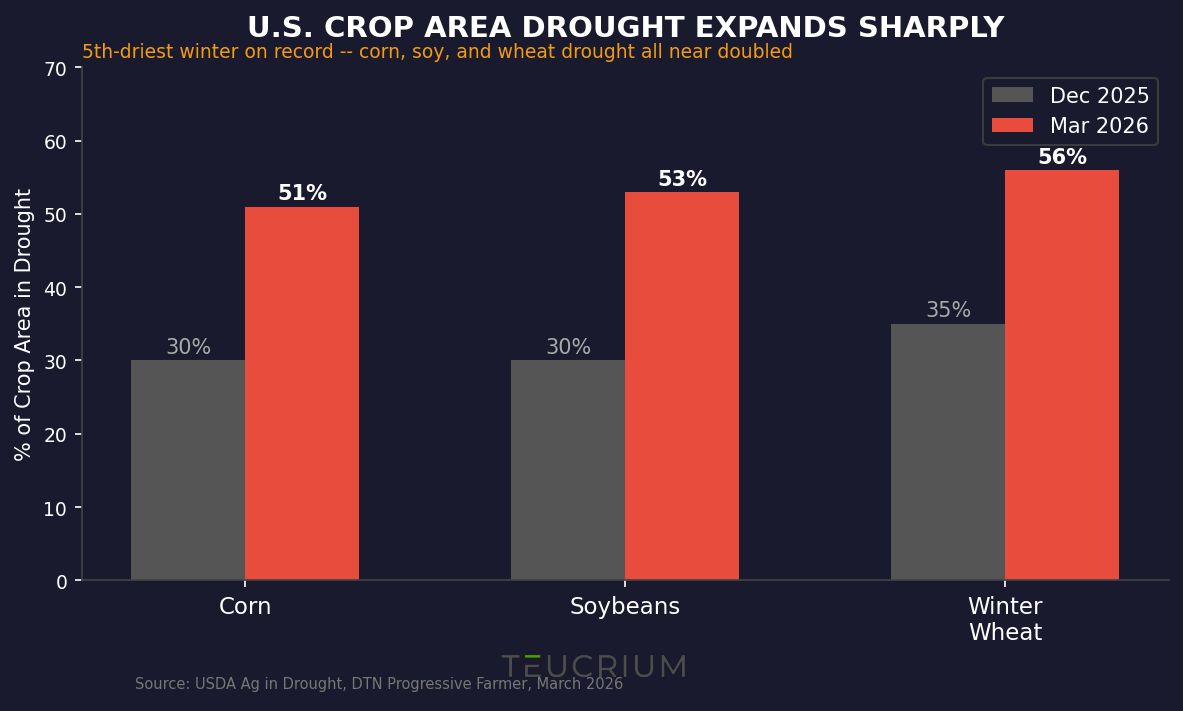
5th-driest winter on record. Corn-area drought: 30% to 51%. Soybeans: 30% to 53%. Winter wheat: 35% to 56%. This happened in three months. Grain and livestock markets may have yet to fully price in the risks.
Teucrium ETFs tweet media
English
0
6
42
2.8K