@IamKostasT You want it to happen? Ngl first time I’ve seen a Greek cuck wanting us to take their nation. Fair enough bud
English
K_sliph
231 posts





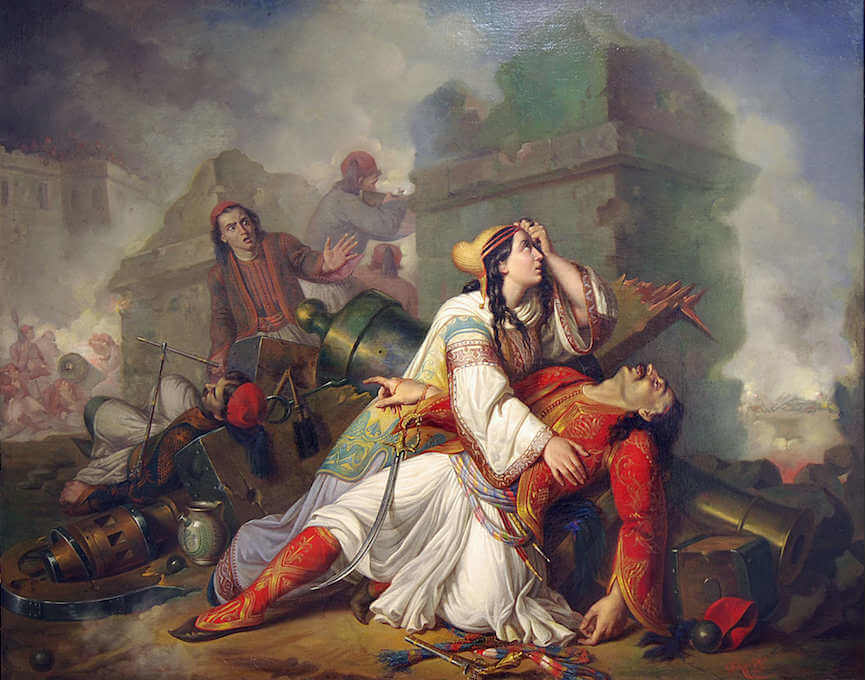
On March 30, 1822, when the massacre in Chios began, the Muslim Turks had clear orders. The Sultan had commanded that all Greek Christians be slaughtered, except for boys aged 3-12 and women from 12 to 40. These would be captured and destined for the slave markets. Young girls were raped publicly in the streets, and newlyweds in front of their husbands, who were then slaughtered. Others were raped in front of their parents, after which the men's genitals were cut off. Women over 40 were set on fire and left to burn alive. Pregnant women had their bellies ripped open and their fetuses pulled out, while small children were thrown forcefully against rocks. The frenzy of the Muslims was unprecedented. Many Turkish soldiers cut off the heads of Greek Christians and then licked their swords. With this act, they believed they would earn a place in paradise. Others were hanged from the island's trees for deterrence. Severed human limbs and corpses were scattered on the streets, while the sea had turned red from the blood. The smoke from the burning houses had covered all of Chios, while the flames made the night look like day.Several women from Chios preferred death over dishonor and slavery. They committed suicide by jumping off cliffs. Some were killed while defending their children, siblings, and husbands. Even among those who were captured, some died on hunger strike.Destitute women and children from the island were crammed into ships and transported to the markets of Smyrna and Constantinople, where they were sold as slaves at humiliating prices. By May 1, 1822, over 41.000 slave ownership documents, known as "teskerés", had been issued in Chios. According to the French-language newspaper of Smyrna, Spectateur Oriental, by May 10, duties had been paid at the Smyrna customs for 40,000 slaves. The priest Welsh from the English embassy in Constantinople recorded what he saw in those days at the city's slave market: "The Turks treated the women from Chios with utmost contempt. They examined them, groped them like butchers do lambs, and bought them for 100 grosia to 3 pounds per head. About 500 women from Chios were sold in the fish market." The tragic events of Chios shocked Europe and America. For many weeks, the European press reported daily information and descriptions about the fate of the inhabitants, the massacres, the plunder, and the sale of women and children in the slave markets. Korais writes in a letter to Varvakis: "Imagine that you see Christ on the Cross, drenched in His blood, and calling out to you these paternal words: My son Varvakis, many thousands of captives baptized in my name are in danger at this hour of renouncing me and embracing the abominable religion of Mohammed. Behold the time, baptized in my name, beloved son, to save your baptized brothers from the Turkish defilement." The horrific images of the crimes of the Muslims against the Greek Christians were never erased from the collective memory of Europeans. Great European artists were so shocked by the descriptions that they created important works inspired by Chios. The famous painting by Delacroix is exhibited to this day in a prominent position at the Louvre. Victor Hugo's poem titled "The Greek Child" is a moving record. But the most famous sculpture of 19th-century America also stands out, named: the "Greek Slave." The sculptor Hiram Powers began carving it about twenty years after the tragic events. The statue depicts a young woman, nude, bound with chains. In one hand, she holds a small cross on a chain. Powers himself describes the subject of his work as follows: "The Slave has been abducted by the Turks from one of the Greek Islands during the Greek Revolution, the history of which is known to all. Her father and mother, and perhaps all her relatives, have been exterminated by her enemies, and she alone was kept alive, as a treasure that could not be thrown away. Now she is among barbarian strangers, under the pressure of the full recollection of the catastrophic events that led her to this state. She stands exposed to the gaze of people she abhors, and awaits her fate with intense anxiety, which is mitigated by her trust in the goodness of God. Gather all these sufferings together, and add to them the strength and resignation of a Christian, and there is no room left for shame." (You can search for the sculpture to see it; I'm not uploading it because X might take down the post for sensitive content.) As a Greek, I will use my weapon, the knowledge of my history, to warn as many as I can about the violent and barbaric invasion of Islam and the war we are experiencing today. I will do whatever I can to warn you. - Homer Pavlos

In Turkey’s Bitlis, the crocuses, harbingers of spring, bloomed through the snow.

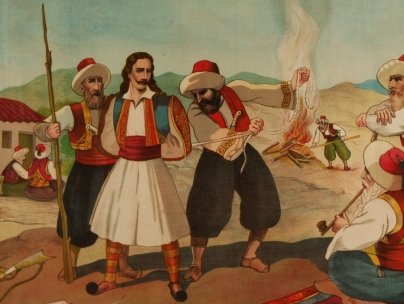
The Muslim Turks loved flaying (skinning) alive Christians. They applied it mainly against Greek rebels to deter and discipline others. As usual, the Christian victim was beaten, publicly humiliated, and tied to a special scaffold for immobilization. Then, skilled executioners removed his skin with sharp knives before the crowd. Here are 3 characteristic cases. The first concerns Dionysios, Greek Bishop of Larisa and Trikki, who lived in the 16th–17th centuries. An enlightened hierarch with brilliant studies in philosophy, medicine, theology, and more at major Western universities, he earned the title "Philosopher." In the early 17th century (1601 and 1611), he initiated two revolutionary movements in Thessaly and Epirus. Both failed, and in 1611 he was captured alive. In Ioannina's central square, before a crowd, he was skinned alive in a martyrdom lasting five hours, aged around 70. The vandalism continued: his flayed body was thrown to dogs, while his skin was stuffed with straw and bran, dressed in archiepiscopal vestments, and paraded through the city with music for days. Finally, it was sent to the Sultan and ended up discarded in the royal stables. Another well-known case is that of Daskalogiannis. On June 17, 1771, he was led to a central square in Chandax (Heraklion). A wooden scaffold with a special seat had been erected. Tied tightly to it, he was flayed starting from the head by a monstrous executioner who threw pieces of skin to the crowd, saying: "Take leather for your boots!" A second executioner periodically showed him his flayed face in a mirror, mocking: "Look, captain, how well the red suits you!" Relatives (brother and daughter) in the crowd went mad at the sight. He endured steadfastly and died when the flaying reached his shoulder blades. His flayed body remained exposed in the June heat for days in that square (now named in his honor) until the stench forced the Turks to bury it. The third case is that of the Venetian Marco Antonio Bragadin. He was executed by flaying in August 1571 in Famagusta, Cyprus, after defending the island alongside the Greeks. They first cut off both of Bragadin’s ears and his nose. While he was in captivity, a massacre of all the remaining Christians in the city took place. After being left in prison for two weeks with his wounds festering, he was dragged around the city walls carrying sacks of earth and stone on his back. Next, he was tied to a chair and hoisted to the yardarm of the Turkish flagship, where he was exposed to the taunts of the sailors. Finally, he was taken to the main square, tied naked to a column, and flayed alive. Bragadin’s quartered body was then distributed as war trophies among the army, while his skin was stuffed with straw, sewn back together, reinvested with his military insignia, and exhibited riding an ox in a mocking procession through the streets of Famagusta. In 1580, his skin was stolen by Girolamo Polidori and brought back to Venice, where it remains today in the Basilica di San Giovanni e Paolo. The martyrdom of flaying (skinning alive) is ancient. Herodotus mentions that it was originally practiced by the Scythians. He describes how Scythian warriors treated conquered foes, using their enemies' skin to manufacture leather trophy items. Archaeology has recently confirmed Herodotus' account. Scalp flaying was called "periskythismos" due to this Scythian custom. It was always a sign of barbarity and fortunately an exception rather than the rule. The punishment was also used by the Romans during persecutions of Christian martyrs, the best-known case being the apostle Bartholomew. - Homer Pavlos


you had the audacity to put TURKISH tea, TURKISH carpet, TURKISH baklava AND TURKISH patterns then write the name balkan above those images???? americans are so fucking stupid lmao

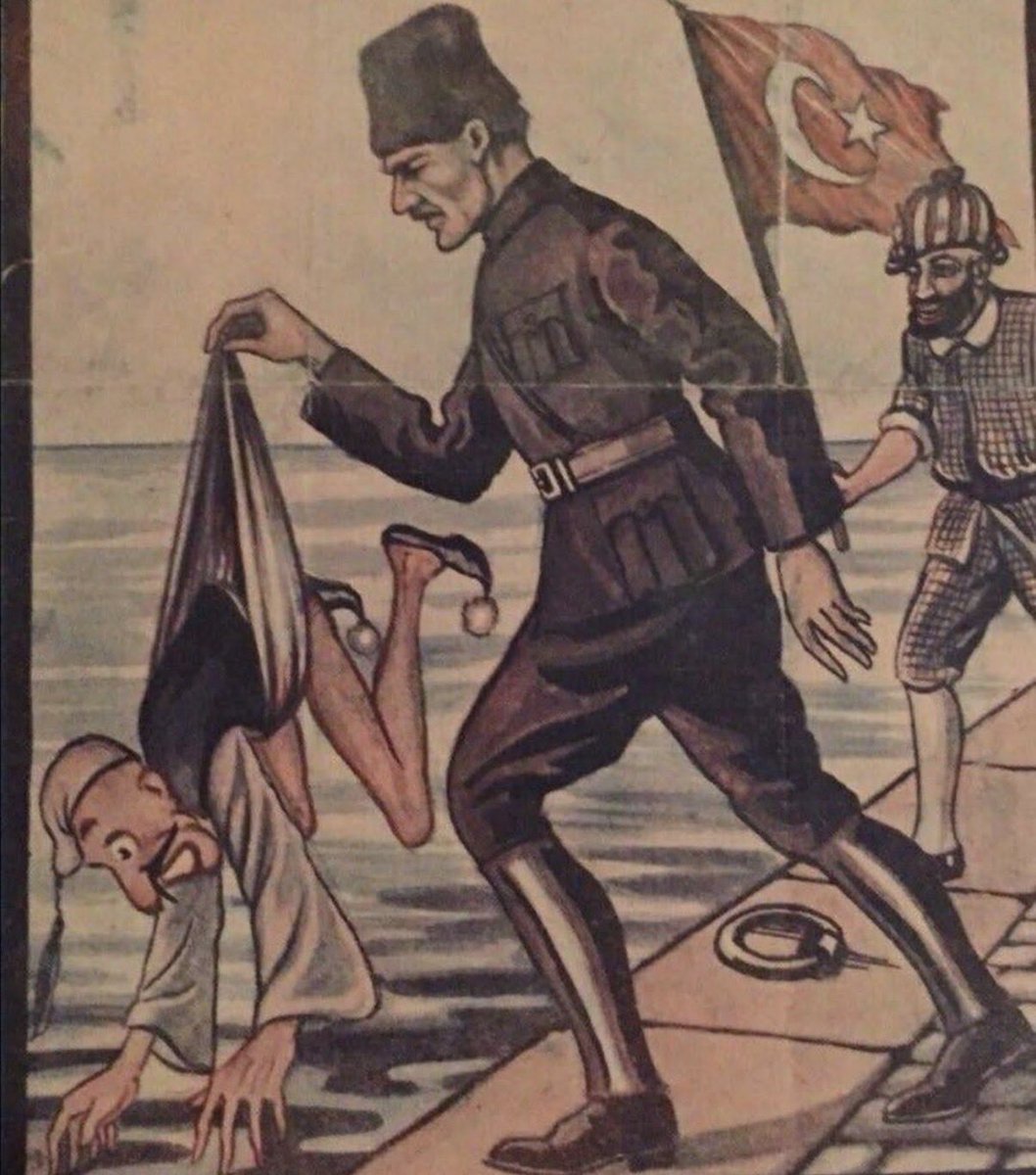


Turkish 🇹🇷


When Muslims killed Greek Bishop Gerasimos of Rethymno in 1821, they opened his chest, removed his heart, and sprinkled their banners with its blood in order to achieve victories against the infidels. The entire description of the incident directly evokes cannibalism from a primitive era. (Theochares Detorakis, "History of Crete") Apart from the official executions, there were also the mass slaughters of Christian populations in cases where the Islamic-Ottoman state wanted to demonstrate its power. The main pretext for the massacres was reprisals against revolutionary movements. Alongside the official figures who were publicly executed (bishops, notables, etc.), unruly hordes of Janissaries would rush into Christian homes, break down doors, kill anyone they found in front of them, and then plunder the house, seizing whatever they liked. When leaving, in many cases they also set the house on fire. Now, the hooks or "tsigkelia", as the Muslim Turks called them. On the walls of cities or on specially erected scaffolds, large hooks with sharp, sharpened points were fixed. The naked victim was thrown onto the hooks from high up on the walls or was hoisted up with special pulleys and dropped onto the hooks of the scaffolds. There he remained impaled for days, tormented by terrible pains until he finally expired. If, moreover, the hooks had not pierced a vital organ, the torture could last several days. Historical accounts mention the presence of such a scaffold with hooks in the central square of Heraklion (Candia), where many Cretans, mainly rebels, met their tragic end. One torture that the Muslim Turks carried out when they had no time for anything else was the breaking of limbs. They usually did this to prisoners they had captured in the countryside and did not want to transport to the city for something "more entertaining," either because they were in a hurry or because they did not want to take on the risks of a possible transfer. With an axe they smashed the main joints of the victim's limbs (shoulder, elbow, hip, knee) and several bones (humerus, femur, tibia). The victim was then unable to move at all, while terrible pains shook his body from the shattered joints. The executioners left him helpless and departed, so that he would die a few hours or at most two days later, or become prey to wild animals in the wilderness. An equally torture is that of beheading. The Ottoman lords even had a well-known proverb on their lips: "A head that does not bow falls." The execution of the sentence was carried out in public view by a specialized executioner called "makelaris" (a Greek-Byzantine word meaning "butcher" that derives from ancient Greek), with the well-known curved Ottoman sword, the "yataghan". The victim arrived at the place of slaughter ridiculed and publicly shamed. Before the execution he had, as a rule, been beaten and often mutilated. The punishment itself was painless and instantaneous, but the entire preceding process made it agonizing. The body and head remained exposed for days, just as in the other tortures we mentioned earlier. Often the victim's head was impaled on a pole and paraded through the city, especially if the victim happened to be an officially wanted person (e.g., Ali Pasha). Other times it was preserved and sent to the Sultan himself, as happened with the head of Ali Pasha. Still other times the head remained hung or impaled in a prominent position for days, until the natural decomposition of its features began. The torture of beheading is naturally connected with the fate of the Four Martyrs. The Synaxarion of the Saints confirms everything I have said so far. After harsh tortures and public humiliation through the streets of Rethymno, the Saints (Manuel, Angelos, George and Nicholas) ended up in the square of the Great Gate, which today bears their name in their honor, to be beheaded. This is recent history. Tortures ended almost 200 years before when we destroyed the Ottoman Empire. And if you think they changed, you should start reading their comments on my posts or the reposts. This is who they are. This is Islam - Homer Pavlos