Vitto@phykdalik
Veda Protocol = Modular Blockchain on Bitcoin?
The Veda Protocol is an EVM extension protocol based on the Ordinals theory.
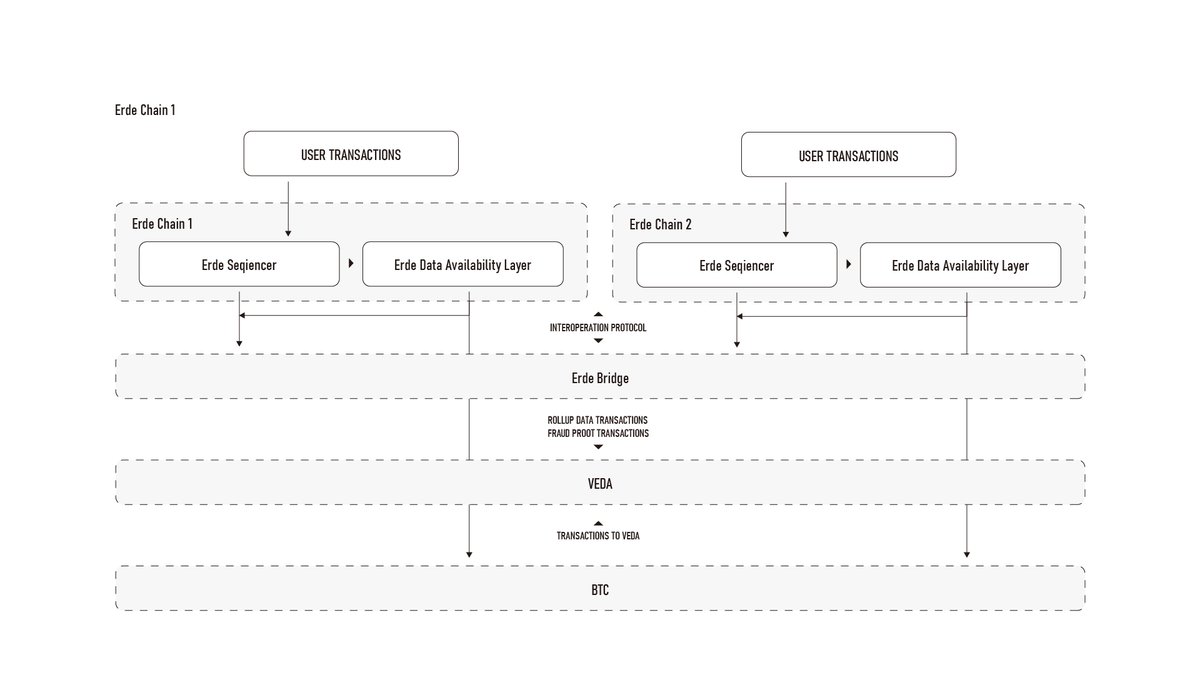
In the BTC ecosystem, @Veda_bitcoin may be heralding a paradigm shift, steering us towards a semi-modular blockchain architecture. This vision diverges markedly from traditional, intertwined models, proposing a nuanced tripartite structure instead. At its foundation, Bitcoin serves as the settlement layer, a bedrock known for unmatched security and decentralization. Built atop this is Veda-BVM, a smart contract execution layer, manifesting the flexibility and computational power necessary for extensive EVM-compatible applications.
Pivotal to this is the Ordinals protocol, a pillar of data availability, interlinking these layers. It safeguards data integrity and accessibility across the network. Through this modular blueprint, where each layer could flourish in its sphere sans the encumbrances of a monolithic design, Veda gained enhanced scalability and efficiency.
This conceptualization of Veda, consolidating Bitcoin’s stalwart settlement capabilities with Veda-BVM’s dynamic execution, all orchestrated by the Ordinals’ reliable data framework, plants it at the vanguard of blockchain evolution. It is a testament to Veda’s ingenuity in expanding the frontiers of blockchain technology.
The Role of Ordinals in Veda Protocol
Ordinals revolutionize Bitcoin’s capabilities.
In the distinct architect of Veda, the Ordinals protocol emerges as a pivotal player, catalyzing the transformation of Bitcoin’s capabilities. Ordinals protocol is not just a mere add-on to the Veda Protocol; rather, it's the linchpin that holds together the modular architecture of Veda. By enabling unique identifiers for each satoshi and storing data in the witness data section of Bitcoin transactions, Ordinals transcends the traditional scope of Bitcoin transactions.
This innovation is akin to providing Bitcoin with a new dimension, one that could communicates intricate details of transactions and contracts, previously unattainable. It's through this new lexicon that Veda can weave complex narratives, enabling the execution of smart contracts directly on Bitcoin’s blockchain. The Ordinals protocol, thus, is not just a tool but a bridge that expands Bitcoin’s utility, connecting it to realms of possibilities hitherto unexplored.
The Impact of Bitcoin's Script Limitations and Veda's Approach
Bitcoin's scripting language, while ensuring robust security and simplicity, falls short in facilitating complex, Turing-complete tasks required for advanced blockchain applications. This inherent limitation presents a substantial challenge in expanding Bitcoin's utility beyond basic transactions. Veda Protocol addresses this limitation by adopting an approach analogous to Ethereum's 'wrapping' concept. This approach allows for the integration of Bitcoin with more sophisticated applications within the Veda ecosystem.
The limitations of Bitcoin's scripting language, primarily its lack of Turing-completeness, present a significant hurdle in its application for complex blockchain functions. This constraint hinders the use of Bitcoin in advanced scenarios beyond simple transactions. Veda Protocol's approach, akin to the Ethereum's concept of 'wrapping' (similar to the ETH and wETH relationship), offers a novel solution. It effectively 'wraps' Bitcoin to extend its utility in the Veda ecosystem, enabling it to participate in more sophisticated blockchain applications. This method preserves Bitcoin's inherent security and trust, while expanding its scope of functionality.
The introduction of @KuveraBridge's bridge within the Veda Protocol exemplifies a crucial step in acticiting Bitcoin's functionality in Veda Protocol. This bridge serves as a critical link, transforming Bitcoin into a more versatile asset capable of participating in complex blockchain applications. It mirrors the process seen in Ethereum's ecosystem, where ETH is wrapped (converted into wETH) for integration into decentralized applications like Uniswap.
Layer 1 vs. Layer 2 Blockchains: Understanding Veda Protocol's Position
The Veda Protocol's integration with Bitcoin's Layer 1 (L1) blockchain could represents a shift in the bitcoin ecosystem landscape. Typically, Layer 1 refers to the base layer of a blockchain network, encompassing its fundamental architecture and consensus mechanism. In contrast, Layer 2 (L2) solutions are secondary frameworks built atop L1 blockchains, designed to improve scalability and efficiency by offloading transactions from the main chain.
Typically, BTC L2 solutions rely on off-chain data validation before reconciliation with the L1, but Ethereum L2 solutions now are able to directly verify L2 data on L1. Veda Protocol's unique approach could enable direct verification of L2 data on Bitcoin’s L1 in the future. This differs from most BTC L2 solutions. This innovative strategy not only enhances the scalability and efficiency of Bitcoin but also elevates the security and trustworthiness of transactions. Veda Protocol's direct verification mechanism sets a new precedent in blockchain technology, demonstrating the potential of Bitcoin beyond its original scope.
Veda's Compatibility with Ethereum Ecosystem
Veda Protocol's ambition to harness Ethereum's extensive development ecosystem represents a strategic move to bring Ethereum's renowned capabilities into the Bitcoin realm. The protocol aims to facilitate the use of Ethereum's robust tools and frameworks, including Solidity, Ethereum's primary programming language for writing smart contracts. However, this integration necessitates certain adaptations in Solidity to accommodate Bitcoin's unique architecture and features.
The strategic alignment with Ethereum's ecosystem enables developers familiar with Ethereum's tools and languages to seamlessly transition to working with Veda Protocol. This compatibility significantly lowers the entry barrier for developers and accelerates the adoption of the Veda Protocol within the developer community. By bridging these two major blockchain ecosystems, Veda Protocol not only enhances Bitcoin's functionality but also enriches the blockchain landscape with greater interoperability and versatility.
Future Outlook: BTC Ecosystem's Potential to Surpass ETH
The future trajectory of the BTC ecosystem, especially in the context of potential adoption surpassing Ethereum (ETH), invites a multifaceted analysis. The advancements like the Taproot upgrade and Ordinals Protocol are pivotal factors that could drive this shift. Taproot's introduction of Schnorr signatures and MAST (Merkleized Abstract Syntax Trees) lays the foundation for Ordinals Protocol and more complex and efficient BTC transactions. This, coupled with the increasing exploration of BTC L2 solutions, indicates a burgeoning BTC ecosystem ripe for diversified applications and enhanced utility.
This possibility becomes even more pronounced with Veda Protocol's endeavor to integrate EVM capabilities into Bitcoin. The synergy between BTC's robustness and EVM's flexibility could lead to a surge in innovative applications and wider adoption, potentially challenging Ethereum's current dominance. As these developments unfold, the BTC ecosystem could evolve into a more versatile and feature-rich environment, attracting a broader range of developers and users.
#Bitcoin #Ordinal #VedaProtocol #EVM #BTCL2 #Ethererum #Celestia #Inscriptions #BRC20 $KUV