kinwiz.base.eth (︶︿︶)Kin Wiz

6K posts

kinwiz.base.eth (︶︿︶)Kin Wiz banner
kinwiz.base.eth (︶︿︶)Kin Wiz

kinwiz.base.eth (︶︿︶)Kin Wiz

@Wizard_Kin

December, 17 kinwiz Check pinned📌 - The piece of the moment. https://t.co/hHYG3p48nJ https://t.co/no3rYEdNtX

Fast Rad drops on Rodeo.club Beigetreten Ekim 2019
2.9K Folgt2.8K Follower
kinwiz.base.eth (︶︿︶)Kin Wiz retweetet
vitalik.eth
vitalik.eth@VitalikButerin·
How I would do creator coins We've seen about 10 years of people trying to do content incentivization in crypto, from early-stage platforms like Bihu and Steemit, to BitClout in 2021, to Zora, to tipping features inside of decentralized social, and more. So far, I think we have not been very successful, and I think this is because the problem is fundamentally hard. First, my view of what the problem is. A major difference between doing "creator incentives" in the 00s vs doing them today, is that in the 00s, a primary problem was having not enough content at all. In the 20s, there's plenty of content, AI can generate an entire metaverse full of it for like $10. The problem is quality. And so your goal is not *incentivizing content*, it's *surfacing good content*. Personally, I think that the most successful example of creator incentives we've seen is Substack. To see why, take a look at the top 10: substack.com/leaderboard/te… substack.com/leaderboard/cu… substack.com/leaderboard/wo… Now, you may disagree with many of these authors. But I have no doubt that: 1. They are on the whole high quality, and contribute positively to the discussion 2. They are mostly people who would not have been elevated without Substack's presence So Substack is genuinely surfacing high quality and pluralism. Now, we can compare to creator coin projects. I don't want to pick on a single one, because I think there's a failure mode of the entire category. For example: Top Zora creator coins: coingecko.com/en/categories/… BitClout: businessofbusiness.com/articles/insid… Basically, the top 10 are people who already have very high social status, and who are often impressive but primarily for reasons other than the content they create. At the core, Substack is a simple subscription service: you pay $N per month, and you get to see the person's articles. But a big part of Substack's success is that they did not just set the mechanism and forget. Their launch process was very hands-on, deliberately seeding the platform with high-quality creators, based on a very particular vision of what kind of high-quality intellectual environment they wanted to foster, including giving selected people revenue guarantees. So now, let's get to one idea that I think could work (of course, coming up with new ideas is inherently a more speculative project than criticizing existing ones, and more prone to error). Create a DAO, that is *not* token-based. Instead, the inspiration should be Protocol Guild: there are N members, and they can (anonymously) vote new members in and out. If N gets above ~200, consider auto-splitting it. Importantly, do _not_ try to make the DAO universal or even industry-wide. Instead, embrace the opinionatedness. Be okay with having a dominant type of content (long-form writing, music, short-form video, long-form video, fiction, educational...), and be okay with having a dominant style (eg. country or region of origin, political viewpoint, if within crypto which projects you're most friendly to...). Hand-pick the initial membership set, in order to maximize its alignment with the desired style. The goal is to have a group that is larger than one creator and can accumulate a public brand and collectively bargain to seek revenue opportunities, but at the same time small enough that internal governance is tractable. Now, here is where the tokens come in. In general, one of my hypotheses this decade is that a large portion of effective governance mechanisms will all have the form factor of "large number of people and bots participating in a prediction market, with the output oracle being a diverse set of people optimized for mission alignment and capture resistance". In this case, what we do is: anyone can become a creator and create a creator coin, and then, if they get admitted to a creator DAO, a portion of their proceeds from the DAO are used to burn their creator coins. This way, the token speculators are NOT participating in a recursive-speculation attention game backed only by itself. Instead, they are specifically being predictors of what new creators the high-value creator DAOs will be willing to accept. At the same time, they also provide a valuable service to the creator DAOs: they are helping surface promising creators for the DAOs to choose from. So the ultimate decider of who rises and falls is not speculators, but high-value content creators (we make the assumption that good creators are also good judges of quality, which seems often true). Individual speculators can stay in the game and thrive to the extent that they do a good job of predicting the creator DAOs' actions.

English
884
389
2.9K
542.7K
kinwiz.base.eth (︶︿︶)Kin Wiz
Yeah, I totally agree with @VitalikButerin ! What means that we should flip roles @jessepollak . I mean swap, like you're a leader. I'll be poor, ok be rich and artist. (isn't a bit of nonsense lovely? Sharing recent digging result specially following Vitalyk's suggestions. zora.co/coin/base:0x6d…
vitalik.eth@VitalikButerin

How I would do creator coins We've seen about 10 years of people trying to do content incentivization in crypto, from early-stage platforms like Bihu and Steemit, to BitClout in 2021, to Zora, to tipping features inside of decentralized social, and more. So far, I think we have not been very successful, and I think this is because the problem is fundamentally hard. First, my view of what the problem is. A major difference between doing "creator incentives" in the 00s vs doing them today, is that in the 00s, a primary problem was having not enough content at all. In the 20s, there's plenty of content, AI can generate an entire metaverse full of it for like $10. The problem is quality. And so your goal is not *incentivizing content*, it's *surfacing good content*. Personally, I think that the most successful example of creator incentives we've seen is Substack. To see why, take a look at the top 10: substack.com/leaderboard/te… substack.com/leaderboard/cu… substack.com/leaderboard/wo… Now, you may disagree with many of these authors. But I have no doubt that: 1. They are on the whole high quality, and contribute positively to the discussion 2. They are mostly people who would not have been elevated without Substack's presence So Substack is genuinely surfacing high quality and pluralism. Now, we can compare to creator coin projects. I don't want to pick on a single one, because I think there's a failure mode of the entire category. For example: Top Zora creator coins: coingecko.com/en/categories/… BitClout: businessofbusiness.com/articles/insid… Basically, the top 10 are people who already have very high social status, and who are often impressive but primarily for reasons other than the content they create. At the core, Substack is a simple subscription service: you pay $N per month, and you get to see the person's articles. But a big part of Substack's success is that they did not just set the mechanism and forget. Their launch process was very hands-on, deliberately seeding the platform with high-quality creators, based on a very particular vision of what kind of high-quality intellectual environment they wanted to foster, including giving selected people revenue guarantees. So now, let's get to one idea that I think could work (of course, coming up with new ideas is inherently a more speculative project than criticizing existing ones, and more prone to error). Create a DAO, that is *not* token-based. Instead, the inspiration should be Protocol Guild: there are N members, and they can (anonymously) vote new members in and out. If N gets above ~200, consider auto-splitting it. Importantly, do _not_ try to make the DAO universal or even industry-wide. Instead, embrace the opinionatedness. Be okay with having a dominant type of content (long-form writing, music, short-form video, long-form video, fiction, educational...), and be okay with having a dominant style (eg. country or region of origin, political viewpoint, if within crypto which projects you're most friendly to...). Hand-pick the initial membership set, in order to maximize its alignment with the desired style. The goal is to have a group that is larger than one creator and can accumulate a public brand and collectively bargain to seek revenue opportunities, but at the same time small enough that internal governance is tractable. Now, here is where the tokens come in. In general, one of my hypotheses this decade is that a large portion of effective governance mechanisms will all have the form factor of "large number of people and bots participating in a prediction market, with the output oracle being a diverse set of people optimized for mission alignment and capture resistance". In this case, what we do is: anyone can become a creator and create a creator coin, and then, if they get admitted to a creator DAO, a portion of their proceeds from the DAO are used to burn their creator coins. This way, the token speculators are NOT participating in a recursive-speculation attention game backed only by itself. Instead, they are specifically being predictors of what new creators the high-value creator DAOs will be willing to accept. At the same time, they also provide a valuable service to the creator DAOs: they are helping surface promising creators for the DAOs to choose from. So the ultimate decider of who rises and falls is not speculators, but high-value content creators (we make the assumption that good creators are also good judges of quality, which seems often true). Individual speculators can stay in the game and thrive to the extent that they do a good job of predicting the creator DAOs' actions.

English
0
0
0
73
jesse.base.eth
jesse.base.eth@jessepollak·
Base needs more independent, opinionated curators of attention and capital. The more voices and allocators, the more resilient and decentralized our marketplace of innovation will be. Who will rise to the challenge?
English
279
66
760
77.4K
benje.e̶t̶h̶
benje.e̶t̶h̶@Babe_raham·
During my time building @rodeodotclub, I supported over 960 artists. I had so much fun hosting Rodeo Remixes, making videos, and connecting with each and everyone of them. I'm proud to have been part of building Rodeo and grateful to have been witness to these artists' works.
benje.e̶t̶h̶ tweet media
Rodeo@rodeodotclub

We’ve made the difficult decision to wind down Rodeo. For those who’ve been active on the platform, there are steps to take as we wind things down. Learn more about what this means and what to do next → x.com/saturnial/stat…

English
1
1
8
165
kinwiz.base.eth (︶︿︶)Kin Wiz
@base At the final feet to finish my mini-app. Took me +2 months. I nearly went mental. Found out, it's safer to use paymaster (base's gas sponsor program) than pay a fancy AI model to build your payment system. Also that everything (but onchainkit=soon) amazingly evolved to v2 on CDP
English
0
0
4
68
jesse.base.eth
jesse.base.eth@jessepollak·
if you build something impactful on @base, I will find you and back you if you invest and trade on @base, I will find you and back you sometimes it will take some time, but I will find you and back you
English
911
262
3K
188.5K
kinwiz.base.eth (︶︿︶)Kin Wiz
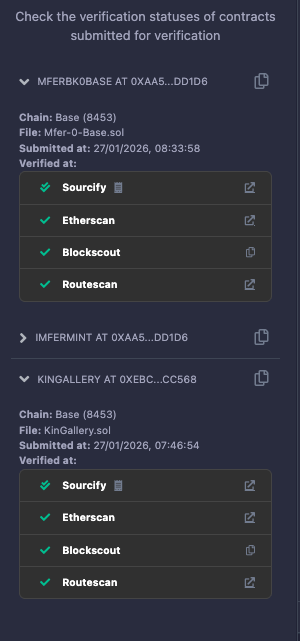
2 super contracts I've been working on for over a month. Deployed and super verified on 8453 read 🔲 @base.base.eth More news so soon! 👇 No this isn't my mini app's UI... 😉
kinwiz.base.eth (︶︿︶)Kin Wiz tweet media
English
0
0
1
39
jesse.base.eth
jesse.base.eth@jessepollak·
I just ran into this guy on the street and he told me @grok has money?
jesse.base.eth tweet media
English
371
209
1.3K
128.9K