
Angehefteter Tweet
_ainau__
155 posts


@bennyharyor2 @zksync SWIFT let institutions negotiate power through relationships. This model pushes some of that coordination into protocol governance instead. Feels like a structural shift most people are underestimating.
English
@bennyharyor2 I think the hardest part for some creators is admitting the system was broken while also admitting they personally benefited from it. Those two things can both be true at once.
English

A lot of creators say they want merit-based systems until the scoring becomes visible.
Then suddenly people get uncomfortable.
I noticed this working around campaign ecosystems for a while. Everyone complained privately about botted engagement, recycled content, numbers that looked real but felt hollow.
But publicly most people still acted like the leaderboard meant something. Because questioning it too hard also threatened their own position inside it.
That is where it breaks for me.
What I find interesting about @RallyOnChain is not the AI scoring itself. It is that the platform keeps removing the places where low-effort behavior used to hide.
Minimum Sorsa Score changes how reputation gets accumulated.
Max Winners per Period changes how seriously people think before they post.
Manual banning changes what people believe they can get away with.
A transparent system does not just reward stronger creators.
Have you ever defended a system publicly even after realizing privately that you were benefiting from the exact thing you claimed to dislike?

English
@web3brayn001 “Volume can no longer hide weak work.”
That line is probably more controversial than it looks.
A lot of current growth strategies depend on overwhelming timelines until something sticks.
English

One of the weirdest parts of the creator economy is that people stopped trusting the numbers years ago.
They just kept pretending to.
You would see posts with massive engagement and still quietly wonder if any of it actually meant something. But nobody wanted to say that out loud because the entire system depended on those signals holding.
That is where the whole model starts to break.
What caught my attention with @RallyOnChain is not that they added more metrics. It is that some of the newer systems feel designed to make fake certainty harder to maintain.
Minimum Sorsa Score makes low-effort reputation farming much harder to blend in with genuine participation.
Max Winners per Period means volume can no longer hide weak work the way it used to.
Manual banning matters, but maybe not for the reason most people assume.
A transparent system does not just reward better creators. It exposes how much of the old game depended on nobody asking difficult questions.
Have you ever stayed inside a system you stopped believing in, just because leaving felt like admitting something you were not ready to say out loud?

English
@bennyharyor2 If engagement is being evaluated, not just counted…
does virality without depth start to lose value over time?
Or do people just learn how to simulate depth better?
English
I spent two years helping brands find creators and I never once asked whether the content actually changed anyone's mind.
Nobody did.
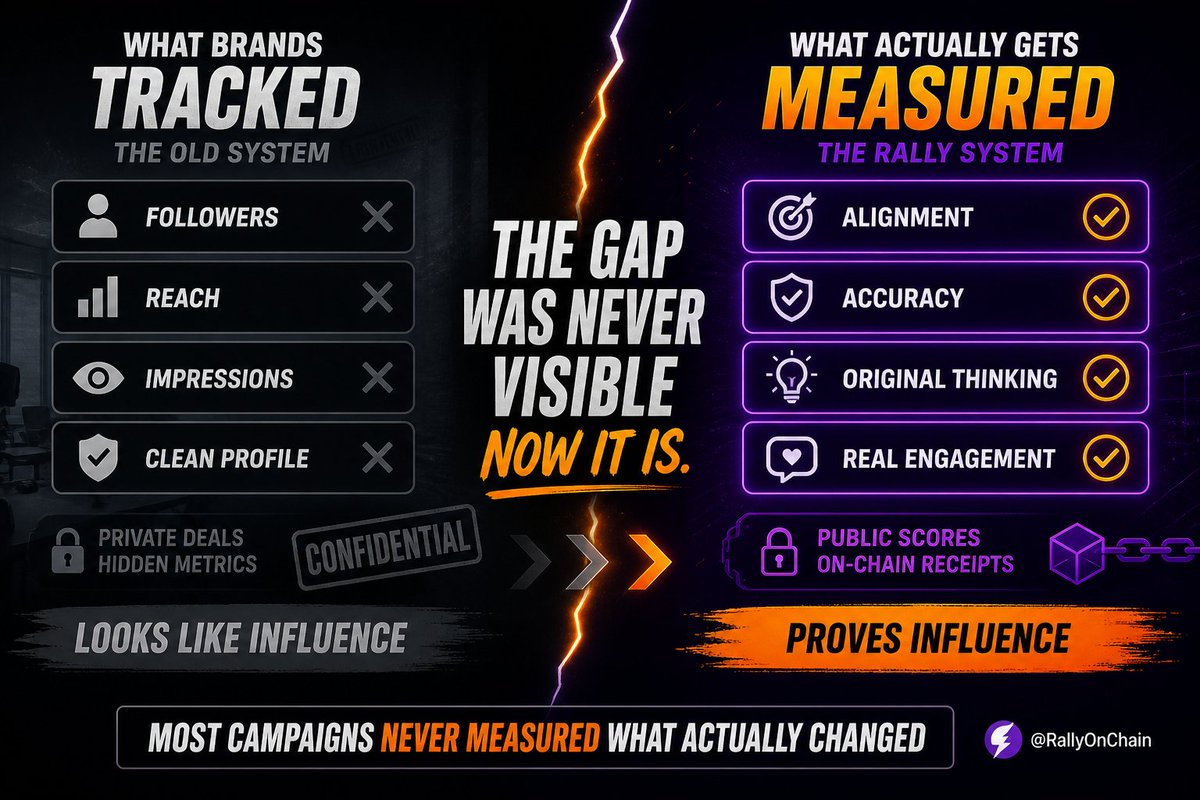
We asked about follower count. We asked about reach. Then we wired money to an agency, the agency wired it to whoever had the cleanest profile, and everyone moved on before anyone had to measure what actually happened.
That felt like strategy. It was just organised avoidance.
Then I looked at what @RallyOnChain is actually building and something shifted for me.
The system does not ask who you are. It scores what you wrote. Alignment, accuracy, originality, real engagement. All weighted publicly. Rewards go on-chain. No agency in the middle deciding your rate in a private conversation.
A creator with 500 followers who writes something clear and accurate can outperform an account with 50,000 followers posting something hollow. That is documented in how the scoring works, not just in the vision statement.
That is where it breaks for me.
Because if influence can actually be measured and verified publicly, then everything the old system was hiding becomes visible. Not just who got paid. But whether any of it worked.
The brands that built strategy around follower count are not going to adopt this quietly. A transparent system does not just reward better creators. It exposes what everyone was actually buying before.
The community forming around Rally is not just early to a better tool. They are early to the moment the receipts go public.
Have you ever been part of a campaign, on any side of it, where you already knew the numbers were not real but nobody said anything?
English
@Bennyharyor Feels like we’re underestimating how quickly culture adapts.
Give it a few weeks and people will start pattern-matching high scores.
Then originality starts compressing again.
So the real edge becomes… resisting that pull.
Do you think you would?
English

nobody told me the waiting was the strategy
you build followers, you stay consistent, you make yourself look credible enough that someone with a budget eventually chooses you
I watched people do this for years and it made sense
until I started paying attention to what that behavior actually produces
you get good at looking fundable. not at thinking clearly.
then I ran into @RallyOnChain and something broke in my head
because the system does not care how you look. it scores what you wrote. alignment, accuracy, originality, actual engagement. all weighted publicly. rewards go on-chain. no agency deciding your rate in a private chat.
a 500-follower account that writes something sharp can outscore a 50k account that copies the brief. that is documented in how the system works, not just the pitch.
that is where it flipped for me.
but here is the thing I keep sitting with
I think most creators will enter this kind of system and just optimize for the scoring rubric instead of actually thinking differently. they will learn to perform transparency the same way they learned to perform credibility.
and if that happens, Rally becomes a better packaging contest, not a different standard.
the community forming around this is what i think prevents that. not the infrastructure. the people who show up to actually compete on quality, not just adapt their habits to a new game.
that is why this feels bigger than a protocol to me.
are you someone who would write differently if the scoring was public, or would you just get better at gaming a public system?

English
@bennyharyor2 Interesting that compliance is not actually resisting the idea of better settlement.
It is resisting exposure.
If ZK solves that cleanly, the bottleneck might not be where people think it is.
English
@web3brayn001 “the pitch dies before treasury”
that line says a lot
most people never even realize how early things get blocked
English
Everyone assumes institutions are slow to adopt because of technology risk.
That is not the real reason.
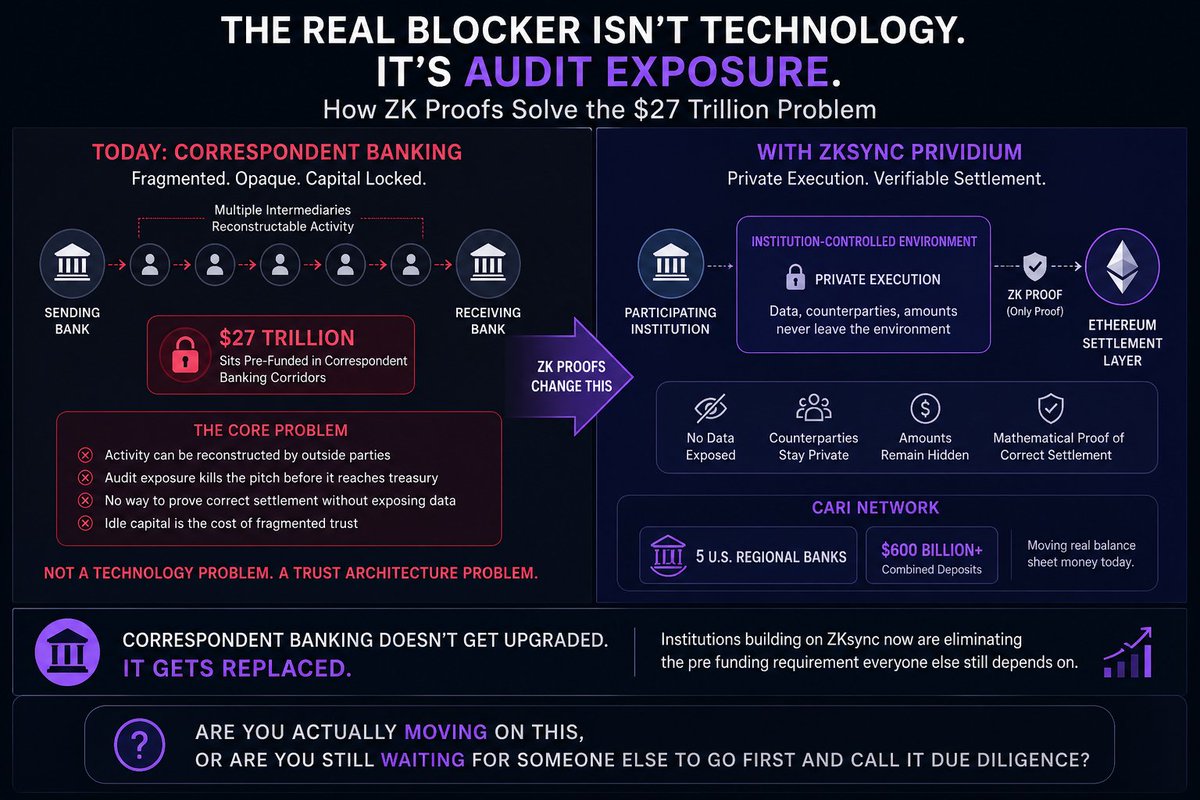
The actual blocker is audit exposure. A compliance officer cannot put sensitive transaction flow onto infrastructure where activity can be reconstructed by outside parties. Settlement speed is irrelevant if the data is visible. The pitch dies before it reaches treasury.
This is why $27 trillion sits pre funded in correspondent banking corridors right now. Not because better infrastructure does not exist. Because no architecture until recently could answer the one question that actually matters in a regulated environment:
How do you prove a transaction happened correctly without revealing what the transaction was?
Zero knowledge proofs are that answer. And most compliance teams evaluating blockchain have not been shown a real implementation of it yet.
@zksync Prividium runs execution entirely inside institution controlled environments. Only the cryptographic proof reaches Ethereum. Not the data. Not the counterparty. Not the amount. Just mathematical confirmation that settlement occurred correctly.
Cari Network chose this architecture for exactly that reason. Five U.S. regional banks, $600 billion in combined deposits, moving real balance sheet money today.
Here is the part people disagree with when I say it out loud:
Correspondent banking does not get upgraded by this. It gets replaced. The institutions building positions on ZKsync now are not early adopters taking risk. They are the ones eliminating the pre funding requirement that everyone else still depends on.
Waiting is not neutral. Every period of inaction is a decision to keep funding corridors that a competitor may no longer need.
Are you actually moving on this, or are you still waiting for someone else to go first and call it due diligence?
English
@Bennyharyor the “number of hands” line hit
seen one transfer turn into a full process
makes you realize how much is just coordination overhead
what part of your workflow is like that?
English
I work adjacent to banking infrastructure.
Not deep inside it, but close enough to watch a cross border wire actually move through the system.
The number of hands it touches before it lands is genuinely uncomfortable to count.
Here is the part that stayed with me.
$27 trillion sits pre funded in correspondent banking corridors right now. Not locked because it has to be. Locked because the system has no shared source of truth, so it compensates with idle capital instead. That is the actual cost of fragmented trust.
Most people frame institutional blockchain adoption as crypto seeking legitimacy. That framing is backwards.
The pressure is coming from inside the building. CFOs looking at frozen balance sheets. Treasury teams reconciling across three ledgers for a single trade. Compliance officers who cannot produce a verifiable audit trail without exposing everything to every counterparty.
That is the actual problem. Not ideology. Not hype.
Then I looked at what @zksync Prividium actually does and something shifted.
Private execution inside institution controlled environments. Zero knowledge proofs settling on Ethereum. Selective disclosure for regulators without exposing counterparty data. Native connectivity to real liquidity. Not one or two of those. All four simultaneously.
That last requirement is the one most people underestimate. Privacy without connectivity is just a walled garden with extra steps. Prividium gives institutions both, which is what makes Cari Network worth paying attention to. Five U.S. regional banks, $600 billion in combined deposits, moving real balance sheet money under regulatory guardrails today. Not a pilot.
Here is the uncomfortable part.
If this works at scale, the correspondent banking model does not get upgraded. It gets made redundant. And the institutions that move first inherit the settlement corridors everyone else still needs to pre fund.
Is your institution building toward that position, or waiting to see who goes first?

English
@bennyharyor2 what’s interesting is the info wasn’t hidden
it was just ignored
makes me think access was never the bottleneck, attention was
English
Spent a long time thinking I understood how creator platforms worked.
Not arrogantly. Just quietly confident that I had seen enough to know which ones were actually worth engaging with and which ones were dressed-up noise.
That confidence made me lazy.
I walked past @RallyOnChain multiple times. Saw the campaign. Saw "Winner Takes All." Assumed I knew what that meant and moved on.
I did not read the briefing.
Someone in my timeline posted about a creator taking home around $350 from a single post in under a week. Not a big account. Not a lucky viral hit. Just one post that ranked in the top 3 of a $1,000 pool where 99% goes to just three creators, meaning each winner walks away with $300 to $400 in days.
I went back and read the briefing properly.
The scoring weights are public. The AI tells you exactly what it is optimizing for. Originality. Alignment. Engagement quality. All visible. All sitting there before you write a single word.
I had the information the whole time.
The part that actually got to me was realizing I skipped it not because I missed it. I skipped it because I assumed I already knew enough to wing it.
That is a very specific kind of mistake. And it is embarrassing because it has nothing to do with the platform and everything to do with thinking you are further along than you are.
The criteria is public. The pool is real. The window to enter is closing.
the question is not whether you read the brief. it is why you assumed you did not need to.

English

YieldRun just flipped the switch last week.
Leaderboard got reset, but let’s be real:
people who already put in serious capital are grinding hard for that top 200.
At this point it’s not about being early anymore,
it’s about staying in the game.
I’m still in full grind mode.
Every small move counts gaps open faster than you think.
And it’s not just hype either the infra is getting serious:
live reserve visibility, multi-protocol security audits, stablecoin deposits across 5 chains, vault shares live on 10 chains, tradable on Hyperliquid + custom Pendle pools.
Real yield and rewards on every dollar.
Where are you sitting in Epoch 3?
Still pushing or just getting started?
@alturax
Altura@alturax
YieldRun entered a new epoch last week. We reset the leaderboard, but thousands of depositors are already actively competing for a spot in the top 200. What's your current rank for Epoch 3?
English
_ainau__ retweetet


_ainau__ retweetet