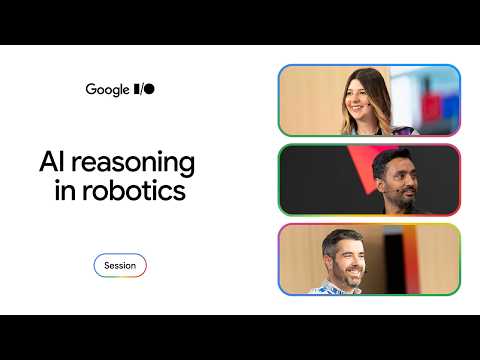
Last week I sat down with @NBTJacklyn and Kanishka Rao from @GoogleDeepMind to talk about the state of robotics and AI at one of the Dialogues at Google I/O.
At some point the conversation touched on the two-system architectures we use to drive robots today. While not a perfect division of roles, one captures the more physical aspects of intelligence, like body control and interaction with the environment, while the other captures the more cognitive and reasoning parts of intelligence.
The act of sitting down is actually an interesting example of physical vs. cognitive. Around 6 to 9 months, children master the physics of sitting, they learn to control their torso, interact with surfaces, and maintain an upright back and head without falling. It isn't until much later, around a year and a half, that they begin developing the common sense of what constitutes a good place to sit, and creatively find novel fun places to sit on.
While eventually the physical and the cognitive complement each other in ways that are difficult to separate, I suspect that the order in which these two are learned matters. Mastering physical intelligence first must be key to developing an understanding of the world that is rooted in physical common sense later.
Thanks to @parada_car88104 and the I/O team for the invitation!
youtu.be/jn3iypY-cN4
I agree @AlexRoseJo. And this applies both to models and hardware. It is incedibly hard to design and manufacture a robot at low cost and at very high reliability. If we build a generalist body, and invest in mass scaling, it will bring big reduccions in cost and increases in reliability, and it will be very difficult to compete with it. At some point the question will turn from “why humanoid?” to “do we really need to use something different?” In most cases the answer will be no.
@_albertorod_ Same reason general purpose LLM won out over specialized systems! It’s easier to concentrate all efforts on one shared base and eventually it will outperform even specialists tools.
Here is my take on one of the questions that I’ve heard most often recently: why humanoid?
The thing that drives the current bet on humanoids is the perceived potential value of a generalist solution to physical work. Outside of some applications that have very large and very stable volumes, for all other physical work, automation becomes unfeasibly expensive if we have to specialize hardware, or models or deployment strategies.
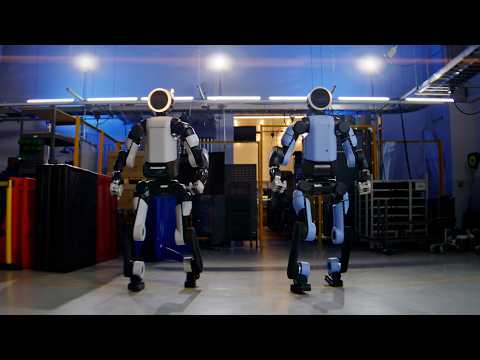
Another key departure from human morphology is the infinite rotation of the actuators by removing all cables across joints. Eliminating all cables across joints gets rid of one of the key hardware failures and gives Atlas its unique superhuman mobility. Atlas can move backwards simply by inverting its legs and flipping its torso, rather than wasting steps and time turning around.
One of my favorite things is seeing Atlas stand up. It makes it clear we have not built Atlas to be a human replica. To me it looks like it belongs in the Star Wars or Transformers universes. Meant to be intentional, effective, and useful.
Something core to humanoid platforms today are also the strategic departures from the human form factor.
For example, we’ve moved entirely to rotary actuators, leaving behind linear actuators that more closely mimic the form factor of our musculo-skeletal system, because rotary actuators are more efficient and have a smaller sim2real gap. This has negative implications, for example for distal mass at the ankles and wrists, but the benefits from focusing on designing just two highly efficient actuator types have brought important gains.
The actuator efficiency allows us to rely on implicit proprioception to adapt to unexpected loads, without any force/torque sensors. And the increased reliability and smaller sim2real gap has increased our development speed.
(you'll see at the end of the video an unexpected load doubling the weight of the fridge)
Good observation :) It took a couple iterations to get the domain randomization in simulation to be good enough for the behavior to work reliably on hardware. During that week of practice, the fridge and Atlas had a complicated “relationship”, from falling on each other, leading to dents. We thought that using the fridge that Atlas practiced with in the video was more compelling. The dents tell a more complete story.
@GrutconTechno@_albertorod_@BostonDynamics Look at the grip marks... how many tries do you think it took before they got it right. Still great work but it certainly took some trial and error and some metal twisting lol!
You can’t lift a fridge with just your hands. Your whole body needs to conform to its shape, and bear the load between your arms and torso.
Here, @BostonDynamics' Atlas uses proprioception to manage the whole-body interaction and adapt to a shifting 100+ lb load. Enabling this type of high performance manipulation is exactly why we walked away from what was arguably the world’s best implementation of MPC for humanoids, and shifted entirely to RL without looking back.
This level of whole-body controls is a fundamental building block of physical intelligence and key to the value proposition of humanoids.
More technical details in:
Blog: bostondynamics.com/blog/training-…
Behind the scenes video: youtu.be/xKK5ze3FukQ