Anish Moonka

20.4K posts

Anish Moonka banner
Anish Moonka

Anish Moonka

@AnishA_Moonka

Building @10MinuteGita @10MinuteNotes | Investor → 10 YoE | Ex CoS @Kavinbm | IIT KGP | AI assisted Builder/Writer | https://t.co/I1nW6MgCLW (new)

Learn AI → Beigetreten Mayıs 2018
745 Folgt51.4K Follower
Angehefteter Tweet
Anish Moonka
Anish Moonka@AnishA_Moonka·
Sure, your eyes aren’t tricking you. That clip looks better than the new trailer, and the reason has nothing to do with talent. The VFX supervisor on Amazing Spider-Man 2 in 2014? Jerome Chen. The VFX supervisor on Brand New Day? Also Jerome Chen. Same person. Completely different system around him. In 2014, Chen had 50 effects artists at Sony Imageworks, the largest VFX crew the studio had ever put on a single project. They handled about 1,000 of the film’s 1,600 VFX shots on a $255 million budget. The crew shot on real film (not digital), on location in actual New York City, scanned Times Square with 36,000 photographs of over 100 billboards, and built physical lighting rigs on set so the CGI would match the real world. Now look at how Marvel makes Spider-Man movies. No Way Home had 2,500 VFX shots spread across 12 studios and about 3,000 artists. The budget was $200 million, $55 million less than TASM2 despite having 56% more VFX shots. Digital Domain, one of the VFX vendors, was delivering final shots days before the December 17, 2021, release. They kept reworking shots into mid-January, after the movie was already in theaters. Zoom out, and the math gets worse. Marvel released 6 films between 2008 and 2012. From 2023 to 2025, they pushed out 7 films and 7 TV shows. The Hollywood union representing VFX workers reported that Marvel pays artists about 20% below industry average and staffs one person where other studios hire three. Artists described 64-hour weeks and breakdowns on the job. Then, in February 2025, Technicolor, the parent company of MPC (three-time Oscar winner for Life of Pi, The Jungle Book, and 1917), collapsed almost overnight. 4,500 jobs gone globally. The studio had been actively working on Disney and Paramount films when the lights went out. Brand New Day has four months before release, and trailers routinely show unfinished shots. But the gap between a 2014 Spider-Man and a 2026 Spider-Man has nothing to do with technology going backwards. The industry has been asked to do three times the work for less money per shot while its biggest studios are going under.
Best Movie Moments 🍿@BestMovieMom

Someone explain how this looks better than the new Spiderman trailer. This movie is 12 years old.

English
227
8K
72K
4.9M
Anish Moonka
Anish Moonka@AnishA_Moonka·
Charlie Munger explained why AI will solve diseases faster than anything in human history. He did it two weeks before he died, at 99. In 1954, his eight-year-old son Teddy was diagnosed with leukemia. There was no treatment. The survival rate for childhood leukemia in the 1950s was close to zero. Munger was 31, freshly divorced, nearly broke. His friend Rick Guerin said Munger would go to the hospital, hold Teddy, then walk the streets of Pasadena alone, crying. Teddy died in 1955 at the age of 9. A reporter asks how he got through it. He says, "You can't bring back the dead. You can't cure the dying child. You have to soldier through. If you have to walk through the streets crying for a few hours a day, it's part of soldiering. You go ahead and cry away. But you can't quit." Then he says, "In those days, the fatality rate with childhood leukemia was 100%. That's gone away. Now the cure rate is way up in the 90s." He's right. The five-year survival rate for the most common childhood leukemia (called ALL, acute lymphoblastic leukemia) was close to zero before 1950. By the 1960s, it was under 15%. Today, it's about 90%, according to the American Cancer Society. It took 70 years of researchers running clinical trials and developing combination drug therapies to get there. That was without AI. Human researchers work on one hypothesis at a time. There are now over 170 AI-discovered drug programs in clinical trials. AI is compressing early drug discovery timelines by 30 to 40%, turning what used to take three to four years of preclinical work into 12 to 18 months. No AI-discovered drug has yet received FDA approval, but the first is expected in 2026 or 2027. The pipeline is real and growing fast. What took seven decades for leukemia, AI could compress into years for diseases we haven't cracked yet. Munger said it plainly: "What mankind did, what civilization did, was soldier through those tough years that took away my cousin Tommy from meningitis, and then took away my son Teddy from leukemia. Imagine pretty well fixing that disease for families who came into life later. It's a huge achievement." He lost his son 68 years before this interview. He watched civilization solve the thing that took his boy. He died two weeks later, at 99. AI is about to make civilization progress much faster.
English
0
0
1
118
Anish Moonka
Anish Moonka@AnishA_Moonka·
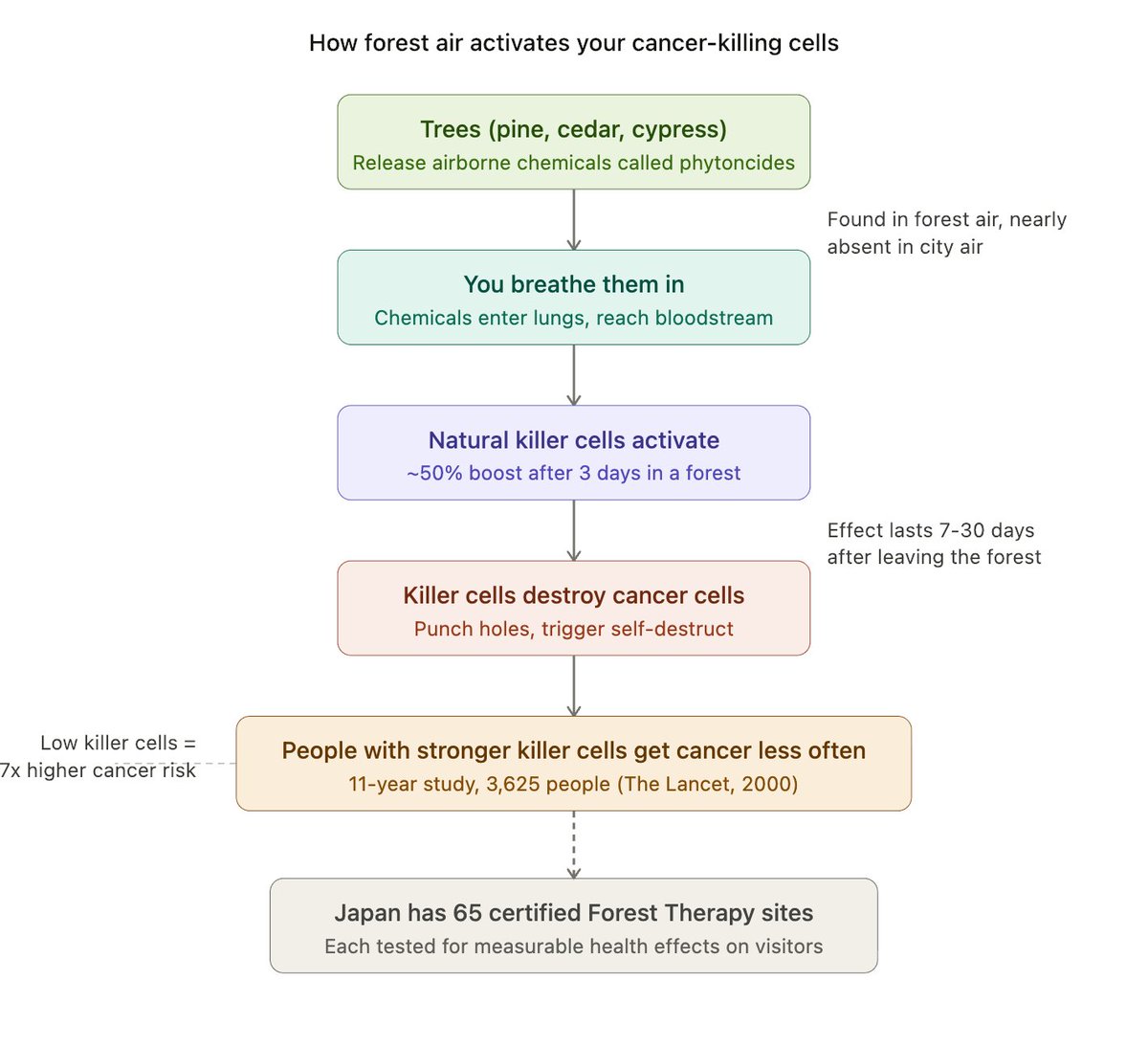
Trees release invisible chemicals into the air to protect themselves from bugs and disease. Turns out those same chemicals also switch on your body's cancer-fighting cells. They're called natural killer cells. They're a type of white blood cell that patrols your bloodstream looking for cancer cells and virus-infected cells. When they find one, they punch a hole through its outer wall and inject proteins that force the cell to self-destruct from the inside. You're born with them. Unlike most of your immune system, they don't need to be "trained" on a specific threat first. They just attack anything that looks wrong. The 50% number in this tweet comes from Dr. Qing Li at Nippon Medical School in Tokyo, who has been studying the effects of forests on the human body since 2004. His original 2007 study took 12 men on a 3-day, 2-night forest trip, walking two hours a day. Blood tests showed 11 of 12 had roughly 50% more cancer-killing cell activity afterward. A follow-up with 13 female nurses found the same thing. But the part the tweet leaves out: the boost didn't vanish when they went home. It lasted over 7 days in both groups, and in men, it was still detectable in blood work 30 days later. Li's conclusion is that one forest trip per month could keep these cells running at a higher level year-round. The obvious next question is whether it's the forest itself or just the vacation. Li tested this directly. A separate group took a city tourist trip with the same amount of walking. No boost to killer cells. No stress hormone drop. Zero effect. Then he ran an even more controlled test: 12 men stayed in a regular Tokyo hotel room for three nights while a humidifier pumped tree oil (from Japanese cypress) into the air overnight. Their killer cells still went up. Their stress hormones still dropped. That isolates the cause to those tree chemicals, called phytoncides. Pine, cedar, and cypress trees release the most. These chemicals were found in forest air but were nearly absent in city air. A 2021 lab study showed that one of these tree chemicals directly switches on killer cells and slows colon tumor growth in mice. The bigger picture connects these cells directly to cancer risk. An 11-year study published in The Lancet (one of the world's top medical journals) tracked 3,625 Japanese people and found that those with weaker natural killer cells developed cancer at significantly higher rates. A separate study screening for bowel cancer found that people with low killer cell levels were 7 times more likely to be diagnosed. Li's own research across all 47 regions of Japan showed that areas with less forest had higher cancer death rates for lung, breast, uterine, prostate, kidney, and colon cancers, even after accounting for differences in smoking rates and wealth. The caveats: Li's original studies used small groups (12 and 13 people), and the regional data show a pattern but don't directly prove that forests prevent cancer. No large-scale clinical trial has confirmed that yet. But the chain is consistent: trees release chemicals, those chemicals wake up the cells in your blood that kill cancer, the effect lasts weeks, not hours, and people with more active killer cells get cancer less often. Japan now has 65 government-certified Forest Therapy sites across the country, each tested and approved based on the physical effects they have on visitors.
Anish Moonka tweet media
All day Astronomy@forallcurious

🚨: Research suggest that just 3 days of camping in the forest can increase the production of cells that kill cancer by more than 50%.

English
2
3
19
1.4K
Anish Moonka
Anish Moonka@AnishA_Moonka·
The largest buyout fund in history raised $28 billion. Jeff Bezos is reportedly raising $100 billion, more than 3x that record, to buy manufacturing companies and automate them with AI. The Wall Street Journal broke the story today. Bezos has been meeting sovereign wealth fund managers (government-owned investment pools in the Middle East and Singapore), pitching what investor documents call a "manufacturing transformation vehicle." The targets: chipmaking, defense, and aerospace. The money flows through Project Prometheus, the AI startup Bezos co-founded in November 2025 with physicist Vik Bajaj, formerly of Google X. Prometheus launched with $6.2 billion and over 120 employees poached from OpenAI, DeepMind, and Meta. The company says it builds "AI for the physical economy," meaning AI that learns from real-world environments and physical materials, not just text and images. Prometheus is the brain. The $100 billion fund is the body. Bezos is worth about $234 billion. This fund would represent roughly 43% of his entire fortune. Most of the capital would come from outside investors, but there is only one precedent at this size: SoftBank's Vision Fund, which also raised $100 billion in 2017 ($45 billion from Saudi Arabia's sovereign fund, $15 billion from Abu Dhabi). That fund posted a $32 billion loss in a single year. Masayoshi Son publicly said he was "embarrassed" and "ashamed" of the results. U.S. manufacturing is a $3 trillion sector with 113 million workers. Its share of GDP has dropped from 11% in 2012 to 9% today. The bet is that AI can reverse that decline by making factories radically more productive. Just last week, Travis Kalanick (former Uber CEO) came out of 8 years of stealth to launch Atoms, a robotics company targeting factory automation. Multiple billionaires are converging on "physical AI" this month. Bezos is just doing it with a checkbook 3x the size of anything the buyout industry has ever seen.
Polymarket@Polymarket

BREAKING: Jeff Bezos reportedly in talks to raise $100 billion for new fund that will acquire manufacturing companies and automate them with AI.

English
1
6
49
16.6K
Anish Moonka
Anish Moonka@AnishA_Moonka·
Andrej Karpathy left an AI agent running for two days. It made 700 changes to his code. Found 20 improvements he'd missed over two decades of manual work. Cut his benchmark by 11%. The whole thing is 630 lines of Python code and runs on a single GPU. I spent a week digging into how it works and what it means. Wrote it all up here.
Anish Moonka@AnishA_Moonka

x.com/i/article/2034…

English
1
0
13
847
Anish Moonka
Anish Moonka@AnishA_Moonka·
Part 2 on this because the financial structure behind the movie is even wilder than the estate numbers. John Branca, the attorney who runs Michael Jackson’s estate, is also a producer on the film. The only A-list actor in the entire cast, Miles Teller, plays John Branca. The man controlling the $2 billion business is also the guy deciding how his own role gets portrayed on screen in a $155 million movie funded, in part, by estate assets. Paris Jackson noticed. In a November 2025 court filing, she accused Branca of using “his position as an Executive Producer, a role he has never before performed in connection with any dramatic feature film, to cast the sole A-list actor in the production, Miles Teller, to play himself.” She claims the estate has become “the vehicle for John Branca to enrich and aggrandize himself.” Her filing also alleges the executors earn a 15% commission on entertainment projects like this one, and that $464 million in estate assets sits idle because the executors “do not share in the upside” from long-term investments. The incentive, she argues, is to keep funneling money into new productions. Branca’s history with MJ goes deep. He helped Jackson buy the Beatles catalog in 1985 for $47.5 million. Jackson fired him in 1990. When Branca came back in 1993, he negotiated a 5% personal stake in the catalog as his fee. He resigned again in 2006. Jackson’s 2002 will, the one that controls everything, names Branca as executor. Jackson was also the best man at Branca’s wedding. And there’s the IRS angle. After Jackson died, the estate filed a tax return valuing his image and likeness at $2,105. Not $2 million. Two thousand dollars. The IRS countered at $434 million and sent a bill for $500 million in unpaid taxes plus $200 million in penalties. The case went to Tax Court, where the IRS’s own expert witness was caught lying under oath about his involvement in the Whitney Houston estate case. The judge sided mostly with the estate, ruling the three disputed assets were worth $111.5 million total. The IRS’s $700 million claim collapsed to a fraction of that. The estate executors told the court their strategy was unconventional. Instead of the standard playbook (sell everything, pay debts, distribute what’s left), they held onto assets, built new revenue streams, and turned $500 million in debt into $3.5 billion in total earnings. The cost of that strategy, according to Paris: a machine that keeps producing and keeps earning commissions for the people running it.
English
1
2
11
4.2K
Anish Moonka
Anish Moonka@AnishA_Moonka·
If you like breakdowns like this, I regularly do deep dives into interesting topics. Follow along → @AnishA_Moonka Attaching all links, if you'd like to dive deeper → 1. MJ estate $500M debt court filing (NBC News) — nbcnews.com/news/us-news/m… 2. Forbes highest-earning deceased celebrity 2025 / $3.5B total (Complex) — complex.com/music/a/markel… 3. Beatles catalog purchase and Sony/ATV deal history (Billboard) — billboard.com/pro/michael-ja… 4. Michael biopic details, trailer views, $155M budget (Wikipedia) — en.wikipedia.org/wiki/Michael_(… 5. Box office tracking and opening weekend projections (Box Office Theory) — boxofficetheory.com/box-office-tra…
English
1
3
8
10K
Anish Moonka
Anish Moonka@AnishA_Moonka·
Michael Jackson was $500 million in debt when he died. His estate has since earned $3.5 billion. This $155 million movie is the latest bet from the most profitable dead-celebrity business operation in entertainment history. The estate's executors, attorneys John Branca and John McClain, turned 65+ creditor claims and half a billion in unpaid debt into a $2 billion enterprise. The film's producer, Graham King, made Bohemian Rhapsody on a $52 million budget, and it went on to gross $903 million. Same playbook, bigger subject. The whole empire traces back to one bet. In 1985, Jackson bought the ATV catalog (251 Beatles songs, plus thousands of others) for $47.5 million. Paul McCartney, who'd told Jackson to invest in publishing, couldn't match the bid. In 1995, Jackson sold half to Sony for $95 million. After his death, the estate sold the other half for $750 million in 2016. A $47.5 million purchase returned over $800 million across two sales. Then in 2024, the estate sold half of Jackson's own masters and publishing rights (the royalties artists earn when their songs are played, streamed, or licensed) to Sony for another $600 million. The biopic is one line item in a much longer receipt. This Is It, a concert documentary, made $267 million. A Cirque du Soleil tour grossed $160 million. The Vegas show Michael Jackson ONE has run 5,000+ performances and is booked through 2030. MJ: The Musical has pulled in around $300 million since opening on Broadway in 2022. Forbes named Jackson the highest-earning deceased celebrity of 2025, with earnings of $105 million in a single year. The film's trailer hit 116 million views in 24 hours, beating every music biopic trailer in history, including Taylor Swift's Eras Tour, which reached 96 million. Analysts are tracking a $52-65 million opening weekend. Worldwide projections range from $700 million to over $1 billion. Not everyone in the family is on board. Paris Jackson called an early script "sugar-coated." Katherine Jackson tried to block the $600 million Sony deal in court, arguing it violated her son's wishes. She lost on appeal. The man who died half a billion dollars in debt now earns more per year than most living artists, and his estate just bet $155 million that his life story will become the biggest music biopic ever made.
DiscussingFilm@DiscussingFilm

New teaser for the Michael Jackson biopic. In theaters on April 24.

English
49
437
4.9K
1.1M
Anish Moonka
Anish Moonka@AnishA_Moonka·
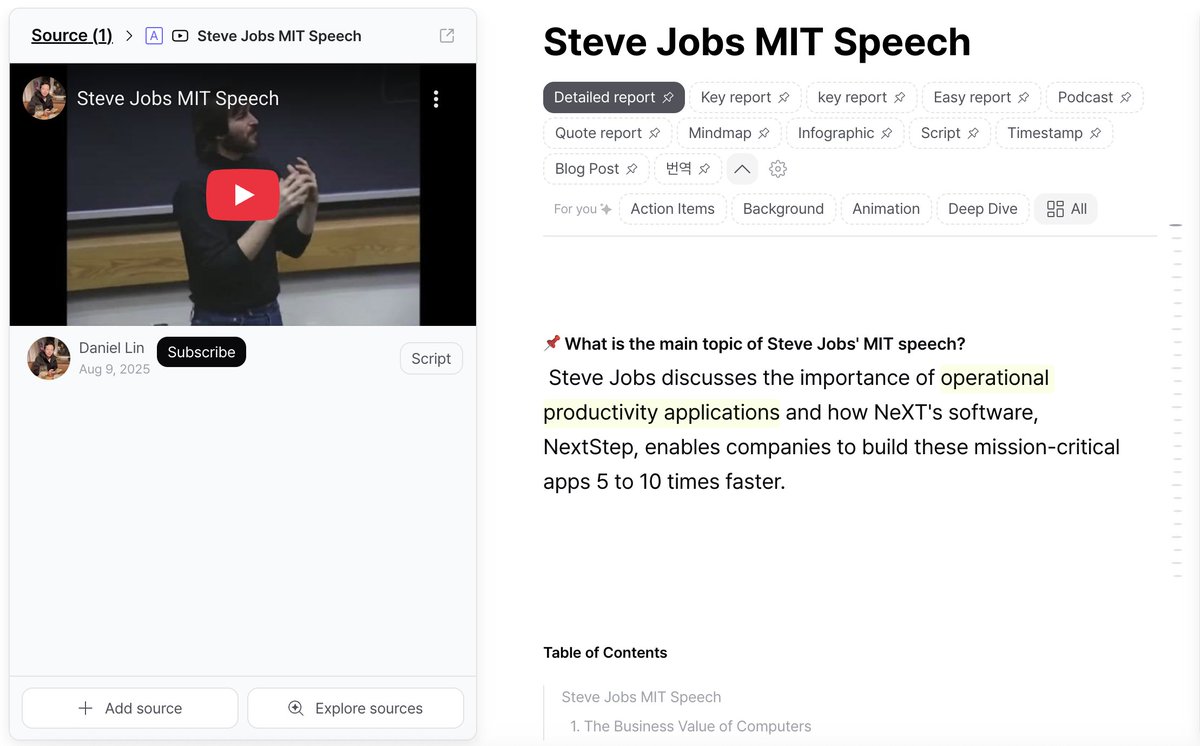
Video: Steve Jobs, MIT Sloan Distinguished Speaker Series, Spring 1992. he was the CEO of NeXT computer. full 70-minute talk, released by MIT Video Productions. If you like breakdowns like this, I regularly do deep dives into interesting topics/people. Follow along → @AnishA_Moonka
English
1
1
5
1.7K
Anish Moonka
Anish Moonka@AnishA_Moonka·
Spring 1992. Steve Jobs stands in front of a room of MBA students at MIT, pitching a computer that almost nobody bought. The company was called NeXT. It sold about 50,000 machines in its entire existence. By every measure, it was a failure. The software inside it became the foundation of every Apple product ever made, and the platform on which the World Wide Web was invented. He's 37. He's been fired from Apple, the company he co-founded. He spends 70 minutes talking. He tells a room full of future consultants that consulting is a waste of talent. "Without owning something over an extended period of time, where one has to see one's recommendations through all action stages and accumulate scar tissue for the mistakes, one learns a fraction of what one can." He compares consulting to looking at a picture of a banana. "You might have a lot of pictures on your wall. You can say, I've worked in bananas, I've worked in peaches, I've worked in grapes. But you never really taste it." He says, "I think everybody lost" about being pushed out of Apple. "I think I lost. And I wanted to spend my life there. I think Apple lost. I think customers lost." Then: "Having said all that, so what? You go on. It's not as bad as a lot of things. Not as bad as losing your arm." He says hardware can never be a lasting competitive advantage. "Hardware churns every 18 months. You can make something one and a half or two times as good as your competitor, and it only lasts six months." But software, he says, is a different game. "You can make something five or even ten times as good as your competitors in software. And it's very, very hard to copy. I watched Microsoft take eight or nine years to catch up with the Mac." Then he makes a claim that almost nobody in the room would have believed: "Object-oriented technology is the biggest technical breakthrough I have seen since the early 80s with graphical user interfaces. And I think it's bigger actually." He was describing NeXTSTEP, the software his "failed" company had built. Object-oriented programming, in plain terms, means building software from reusable building blocks rather than writing everything from scratch. Jobs said developers could build apps on NeXTSTEP in about a third to a quarter of the time it took on other systems. Almost nobody cared. By industry standards, NeXT was a flop. But four years after this talk, Apple was nearly bankrupt. They bought NeXT for $427 million. Jobs came back. NeXTSTEP became Mac OS X in 2001. The same code became iOS when the iPhone launched in 2007. Every Mac, every iPhone, every iPad, every Apple Watch runs on what Jobs was selling while Sun was trying to put him out of business. One more thing. In 1990, at a physics lab in Switzerland, Tim Berners-Lee needed a computer to build a prototype for something he called the World Wide Web. He chose a NeXT. He built the first web browser and the first web server. The internet, as you know it, was born on a machine that couldn't find a market. When asked what he learned from being fired from Apple, Jobs pauses. Then he says, "I now take a longer-term view on people. When I see something not being done right, my first reaction isn't to go fix it. It's to say, we're building a team here, and we're going to do great stuff for the next decade, not just the next year." He was 37, running a company most people thought was dead, standing in a room full of MBA students. Apple is now worth $3.7 trillion. Every dollar of it runs on the thing he built when nobody was watching.
English
44
228
1K
200.1K
Anish Moonka
Anish Moonka@AnishA_Moonka·
You're probably eating enough protein to build muscle right now. The average American man already eats 97 grams a day. The average woman, 69 grams. That's well above the government's minimum recommendation, and closer to the ideal amount for building muscle than most people think. The real gap is at the gym. A 2022 CDC analysis found that only 24% of American adults meet the federal guidelines for both cardio and strength training. Nearly half, 46.5%, don't do either one. The exercise is the bottleneck, not the protein. The most cited research review on this, published by McMaster University in 2018, combined 49 studies and 1,863 participants. It found a ceiling: once you eat enough protein, more doesn't build more muscle. For most people, the ceiling is about 128 grams a day for a 176-pound man. The average American man already eats 97. That gap is roughly the size of a chicken breast. The training gap is a canyon. A 2026 study went even further. Researchers combined 78 studies and data from 4,755 people to test 13 types of protein supplements against a sugar pill. Most supplements made no real difference to strength. Whey protein, the most popular supplement on earth, produced a measurable but tiny effect. The global protein supplement industry hit roughly $30 billion in 2025. North America accounts for about $12 billion of that. Three-quarters of American adults don't meet the basic exercise threshold that would make protein supplements worth taking. One important detail: adding protein supplements to regular weight training boosts muscle size by about 27% compared to training alone, according to research Dr. Patrick herself has cited previously. So protein matters. But 27% more of zero training is still zero. The exercise has to come first. A single weight-training session keeps your muscles in a building mode for 24 to 48 hours. That's the window where your body actually uses the protein to build muscle instead of just burning it for energy. Without the workout, the protein has nowhere to go. Most people are much closer to eating enough protein than to training enough. A $5 gym visit would do more for them than a $50 tub of whey.
Dr. Rhonda Patrick@foundmyfitness

Most people don't need more protein to build muscle. They need to train more. Protein isn’t the main driver of adaptation, training is. Muscle growth, strength, and metabolic health are primarily stimulated by mechanical tension and progressive overload, not just a higher protein intake. Protein’s role is supportive. It helps repair and build after you’ve given your body a reason to adapt. But without a meaningful training stimulus, more protein doesn’t translate into better outcomes (e.g., more strength, greater lean mass).

English
1
0
12
3.4K
Anish Moonka
Anish Moonka@AnishA_Moonka·
@ratickle exactly right. and what jobs layered on top of that unix foundation, the object-oriented frameworks and development tools, is what made the difference. macOS and iOS still sit on that same Mach/BSD core today.
English
0
0
2
390
Robert Alan Tickle
Robert Alan Tickle@ratickle·
@AnishA_Moonka The OS used by NeXT was derived from the Mach microkernel and BSD Unix. Linux was derived from Unix which is the OS that is now used everywhere.
English
2
0
2
415
Quarktoro
Quarktoro@Quarktoro1·
@AnishA_Moonka Reminder - they are banking on this being a success and will make a sequel (called Jackson)
English
4
0
99
20.3K
Anish Moonka
Anish Moonka@AnishA_Moonka·
pixar almost was. jobs poured close to $50 million of his own money into it over a decade. he nearly went broke keeping it alive. then toy story came out, pixar IPO’d the same week, biggest IPO of 1995, and jobs became a billionaire at 40. same pattern as NeXT honestly. the product everyone could see failed. the thing underneath it changed everything.
English
1
0
3
478
Anish Moonka
Anish Moonka@AnishA_Moonka·
@rfrederick_pmp that’s an unreal piece of history. the SSC was the superconducting super collider in texas right?
English
4
0
0
655
AI Survivalist
AI Survivalist@rfrederick_pmp·
@AnishA_Moonka FunFact: I worked at the SSC Labs where we got the "other" NeXT computer from Tim Berners-Lee to create the Hyperlink to CERN. My friend set it up and nobody knew then what was it would ultimately amount too. 😂😎
English
1
0
1
721
Rizwan Virk
Rizwan Virk@Rizstanford·
I was actually at this talk at MIT in 1992. One of the most memorable things he said was about consulting, which was all the rage at the time, vs running a startup. "A consultant puts a picture of a banana up on the wall, but doesn't really know what the banana tastes like ... You need to build something for a few years to know what it's really like."
English
1
0
13
1.5K
Anish Moonka
Anish Moonka@AnishA_Moonka·
@Mousewrangler2 that's incredible that you still have it. as mentioned there were only about 50,000 ever made. yours might genuinely belong in a museum.
English
0
0
1
913
Mousewrangler
Mousewrangler@Mousewrangler2·
In 1991, not long out of college, I bought a NeXT cube from a local computer store going out of business. It ran PostScript on the screen - saved me a lot of paper and toner for the printing/formatting software I was writing. For its day, it was an amazing machine. Ran a version of Unix, long before Linux became popular. The first modern Integrated Development Environment - software was text files and command lines for everyone else. I still have it, though it hasn't been turned on in almost 20 years.
English
1
0
8
1.1K
Anish Moonka
Anish Moonka@AnishA_Moonka·
@NKR33765 it does. MIT Sloan School of Management has offered an MBA since 1914. this talk was part of the MIT Sloan Distinguished Speaker Series.
English
0
0
4
407
Anish Moonka
Anish Moonka@AnishA_Moonka·
Did you know that jobs almost didn't give this talk? NeXT was struggling so badly by 1992 that he was basically doing speaking tours to keep the brand alive while the hardware business collapsed. The MIT students were future consultants, and he spent half the talk telling them consulting was a waste of talent. Nobody in that room thought they were watching the guy who'd come back and build the most valuable company on earth.
English
0
0
7
1.2K
Anish Moonka
Anish Moonka@AnishA_Moonka·
@parnell_ian One of the best books every written, attaching my notes x.com/10minutenotes/…
10 Minute Notes@10minutenotes

We just finished the entire 656-page Steve Jobs biography by @WalterIsaacson. 40+ interviews with Jobs. 100+ with his family, friends, rivals, and enemies. Here are 12 lessons from the life of the man who built the most valuable company on earth: 𝟭. 𝗛𝗲 𝘁𝗿𝗲𝗮𝘁𝗲𝗱 𝗿𝗲𝗮𝗹𝗶𝘁𝘆 𝗮𝘀 𝗻𝗲𝗴𝗼𝘁𝗶𝗮𝗯𝗹𝗲. His colleagues called it the "Reality Distortion Field," borrowed from Star Trek. Jobs would declare impossible deadlines, deny obvious problems, and insist that features ship in half the estimated time. The strange thing: his engineers found themselves building what they swore couldn't be built. We've seen this pattern in every great founder we've studied. The line between delusion and vision is only visible in hindsight. 𝟮. 𝗛𝗶𝘀 𝗿𝗲𝗮𝗹 𝘀𝗸𝗶𝗹𝗹 𝘄𝗮𝘀 𝘁𝗮𝘀𝘁𝗲, 𝗻𝗼𝘁 𝘁𝗲𝗰𝗵𝗻𝗼𝗹𝗼𝗴𝘆. Jobs could not write code. He could not design circuits. Wozniak built the Apple I and II. Jony Ive designed the iMac and iPhone. What Jobs contributed was a near-pathological sensitivity to whether something felt right. He rejected thousands of beige shades for the Apple II case. He demanded the inside of the Mac look beautiful, even though no customer would ever open it. His reasoning: "A great carpenter doesn't use cheap wood for the back of a cabinet." That single line explains Apple's success better than any business school case study. 𝟯. 𝗚𝗲𝘁𝘁𝗶𝗻𝗴 𝗳𝗶𝗿𝗲𝗱 𝗳𝗿𝗼𝗺 𝗔𝗽𝗽𝗹𝗲 𝘄𝗮𝘀 𝘁𝗵𝗲 𝗯𝗲𝘀𝘁 𝘁𝗵𝗶𝗻𝗴 𝘁𝗵𝗮𝘁 𝗵𝗮𝗽𝗽𝗲𝗻𝗲𝗱 𝘁𝗼 𝗵𝗶𝗺. At NeXT, Jobs indulged every perfectionist impulse without commercial discipline. He spent $100,000 on a logo, hired I.M. Pei to design a staircase, and built a computer so expensive that almost no one bought it. At Pixar, he learned to trust creative teams and step back from daily decisions. The NeXT operating system eventually became the foundation for Mac OS X and iOS. His most expensive mistake became his most important legacy. Sometimes the long way around is the only way through. 𝟰. 𝗛𝗲 𝘀𝗮𝘃𝗲𝗱 𝗔𝗽𝗽𝗹𝗲 𝗯𝘆 𝗸𝗶𝗹𝗹𝗶𝗻𝗴 𝟳𝟬% 𝗼𝗳 𝗶𝘁𝘀 𝗽𝗿𝗼𝗱𝘂𝗰𝘁𝘀 𝗼𝗻 𝗱𝗮𝘆 𝗼𝗻𝗲. When Jobs returned in 1997, Apple was 90 days from bankruptcy with 40+ products on the market. He drew a simple two-by-two grid on a whiteboard (consumer/pro, desktop/portable) and killed everything that didn't fit. Newton PDA, gone. Licensed clones, gone. Dozens of software projects, gone. "Deciding what not to do is as important as deciding what to do." Most people know this quote. Almost nobody actually practices it. 𝟱. 𝗧𝗵𝗲 𝗶𝗣𝗼𝗱 𝘄𝗮𝘀 𝗮 𝘁𝗿𝗼𝗷𝗮𝗻 𝗵𝗼𝗿𝘀𝗲, 𝗻𝗼𝘁 𝗮 𝗺𝘂𝘀𝗶𝗰 𝗽𝗹𝗮𝘆𝗲𝗿. In 2001, Apple had 5% of the computer market. Wall Street said it should stick to Macs. Jobs saw that digital music was the entry point: get people using iPod with iTunes, and they'd start trusting Apple for everything else. iPod led to iTunes Store, which led to iPhone, which led to App Store, which led to iPad. Each product opened the door for the next one. The sequence looks obvious now, but in 2001, it was a $400 million gamble on a music player from a computer company. 𝟲. 𝗛𝗲 𝗸𝗶𝗹𝗹𝗲𝗱 𝗵𝗶𝘀 𝗼𝘄𝗻 𝗯𝗲𝘀𝘁 𝗽𝗿𝗼𝗱𝘂𝗰𝘁 𝗯𝗲𝗳𝗼𝗿𝗲 𝗮𝗻𝘆𝗼𝗻𝗲 𝗲𝗹𝘀𝗲 𝗰𝗼𝘂𝗹𝗱. Jobs initially hated the idea of making a phone. He thought carriers like AT&T were "orifices" and didn't want to be beholden to them. But he realized that phones were going to eat the iPod. If Apple didn't cannibalize its own best seller, someone else would. This is one of the hardest things in business. Killing the thing that's working while it's still working. Very few founders can stomach it. 𝟳. 𝗛𝗲 𝗰𝗼𝗻𝘁𝗿𝗼𝗹𝗹𝗲𝗱 𝘁𝗵𝗲 𝗲𝗻𝘁𝗶𝗿𝗲 𝘀𝘁𝗮𝗰𝗸, 𝗮𝗻𝗱 𝗲𝘃𝗲𝗿𝘆𝗼𝗻𝗲 𝘀𝗮𝗶𝗱 𝗶𝘁 𝘄𝗮𝘀 𝘀𝘂𝗶𝗰𝗶𝗱𝗮𝗹. From chip to screen to case to OS to apps to retail store. Every competitor in the 1990s said the integrated approach was dead. Microsoft licensed its OS and dominated the PC wars. But when computing moved from desktops to pockets, vertical integration won. The iPod worked because iTunes worked. The iPhone worked because the App Store worked. We keep seeing this same dynamic play out in AI right now. The companies that own the full stack will have the same kind of advantage. 𝟴. 𝗛𝗶𝘀 𝗱𝗲𝘀𝗶𝗴𝗻 𝗽𝗵𝗶𝗹𝗼𝘀𝗼𝗽𝗵𝘆 𝘄𝗮𝘀 𝘀𝘂𝗯𝘁𝗿𝗮𝗰𝘁𝗶𝗼𝗻, 𝗻𝗼𝘁 𝗮𝗱𝗱𝗶𝘁𝗶𝗼𝗻. He killed the floppy drive (1998). The CD drive (2008). The physical keyboard on the iPhone (2007). Flash support on the iPad (2010). Every time, the tech press said he was insane. Every time, the industry followed within two years. We think about this every time we edit our notes. The temptation is always to add more. The skill is knowing what to cut. 𝟵. 𝗧𝗵𝗲 "𝗧𝗵𝗶𝗻𝗸 𝗗𝗶𝗳𝗳𝗲𝗿𝗲𝗻𝘁" 𝗮𝗱 𝘄𝗮𝘀 𝗮𝘂𝘁𝗼𝗯𝗶𝗼𝗴𝗿𝗮𝗽𝗵𝘆. "Here's to the crazy ones. The misfits. The rebels." Jobs wept when he first saw the finished ad. Apple was 90 days from bankruptcy at the time. He wasn't just selling computers. He was telling himself, and the world, who he planned to be. The best marketing always comes from someone telling the truth about themselves. Everything else is just noise. 𝟭𝟬. 𝗛𝗲 𝘄𝗮𝘀 𝗮𝗱𝗼𝗽𝘁𝗲𝗱, 𝗮𝗻𝗱 𝗶𝘁 𝗱𝗿𝗼𝘃𝗲 𝗲𝘃𝗲𝗿𝘆𝘁𝗵𝗶𝗻𝗴. His biological parents were unmarried graduate students who gave him up at birth. Jobs oscillated between two reactions his entire life: a relentless drive to prove himself worthy, and an abandonment wound that surfaced as a compulsive need to control every person and situation around him. The book makes it clear that most of what we admire about Jobs and most of what we find repulsive came from the same wound. That's worth sitting with for a while. 𝟭𝟭. 𝗛𝗶𝘀 𝗰𝗿𝘂𝗲𝗹𝘁𝘆 𝗵𝗮𝗱 𝗮 𝗺𝗲𝘁𝗵𝗼𝗱, 𝗯𝘂𝘁 𝗜𝘀𝗮𝗮𝗰𝘀𝗼𝗻 𝗿𝗲𝗳𝘂𝘀𝗲𝘀 𝘁𝗼 𝗲𝘅𝗰𝘂𝘀𝗲 𝗶𝘁. He told employees their work was "shit" in front of entire teams. He made grown engineers cry. He stole credit for ideas and then, months later, presented them as his own while genuinely believing he'd invented them. Many of his victims later said he pushed them to do the best work of their lives. We've read many biographies of difficult founders. This one makes the strongest case that the cruelty and the genius were inseparable, while also making it clear that a kinder version of Jobs was probably possible. He just never tried. 𝟭𝟮. 𝗛𝗶𝘀 𝗹𝗮𝘀𝘁 𝘄𝗼𝗿𝗱𝘀 𝘄𝗲𝗿𝗲: "𝗢𝗵 𝘄𝗼𝘄. 𝗢𝗵 𝘄𝗼𝘄. 𝗢𝗵 𝘄𝗼𝘄." Jobs once said he liked to think something survives after you die, "but on the other hand, perhaps it's like an on-off switch. Click. And you're gone." He paused, then smiled. "Maybe that's why I never liked putting on-off switches on Apple devices." He died on October 5, 2011, at 56. His sister Mona Simpson was at his bedside. The only book on his iPad was "Autobiography of a Yogi," which he reread every year. Copies were handed out at his memorial. Full book is worth reading. Link in Thread.

English
0
0
2
60
Ian Parnell
Ian Parnell@parnell_ian·
recommend reading Jobs bio ... beats most business courses
Anish Moonka@AnishA_Moonka

Spring 1992. Steve Jobs stands in front of a room of MBA students at MIT, pitching a computer that almost nobody bought. The company was called NeXT. It sold about 50,000 machines in its entire existence. By every measure, it was a failure. The software inside it became the foundation of every Apple product ever made, and the platform on which the World Wide Web was invented. He's 37. He's been fired from Apple, the company he co-founded. He spends 70 minutes talking. He tells a room full of future consultants that consulting is a waste of talent. "Without owning something over an extended period of time, where one has to see one's recommendations through all action stages and accumulate scar tissue for the mistakes, one learns a fraction of what one can." He compares consulting to looking at a picture of a banana. "You might have a lot of pictures on your wall. You can say, I've worked in bananas, I've worked in peaches, I've worked in grapes. But you never really taste it." He says, "I think everybody lost" about being pushed out of Apple. "I think I lost. And I wanted to spend my life there. I think Apple lost. I think customers lost." Then: "Having said all that, so what? You go on. It's not as bad as a lot of things. Not as bad as losing your arm." He says hardware can never be a lasting competitive advantage. "Hardware churns every 18 months. You can make something one and a half or two times as good as your competitor, and it only lasts six months." But software, he says, is a different game. "You can make something five or even ten times as good as your competitors in software. And it's very, very hard to copy. I watched Microsoft take eight or nine years to catch up with the Mac." Then he makes a claim that almost nobody in the room would have believed: "Object-oriented technology is the biggest technical breakthrough I have seen since the early 80s with graphical user interfaces. And I think it's bigger actually." He was describing NeXTSTEP, the software his "failed" company had built. Object-oriented programming, in plain terms, means building software from reusable building blocks rather than writing everything from scratch. Jobs said developers could build apps on NeXTSTEP in about a third to a quarter of the time it took on other systems. Almost nobody cared. By industry standards, NeXT was a flop. But four years after this talk, Apple was nearly bankrupt. They bought NeXT for $427 million. Jobs came back. NeXTSTEP became Mac OS X in 2001. The same code became iOS when the iPhone launched in 2007. Every Mac, every iPhone, every iPad, every Apple Watch runs on what Jobs was selling while Sun was trying to put him out of business. One more thing. In 1990, at a physics lab in Switzerland, Tim Berners-Lee needed a computer to build a prototype for something he called the World Wide Web. He chose a NeXT. He built the first web browser and the first web server. The internet, as you know it, was born on a machine that couldn't find a market. When asked what he learned from being fired from Apple, Jobs pauses. Then he says, "I now take a longer-term view on people. When I see something not being done right, my first reaction isn't to go fix it. It's to say, we're building a team here, and we're going to do great stuff for the next decade, not just the next year." He was 37, running a company most people thought was dead, standing in a room full of MBA students. Apple is now worth $3.7 trillion. Every dollar of it runs on the thing he built when nobody was watching.

English
1
0
1
66