Rizwan Virk

12.2K posts

Rizwan Virk banner
Rizwan Virk

Rizwan Virk

@Rizstanford

ASU, LCFI, Play Labs@MIT, Simulation Hypothesis, Wisdom of a Yogi, Startup Myths, Zen Entrepreneurship; Knights of Badassdom; Griffin Gaming Partners.

AZ, CA and MA Katılım Mart 2009
7.8K Takip Edilen19.3K Takipçiler
Sabitlenmiş Tweet
Rizwan Virk
Rizwan Virk@Rizstanford·
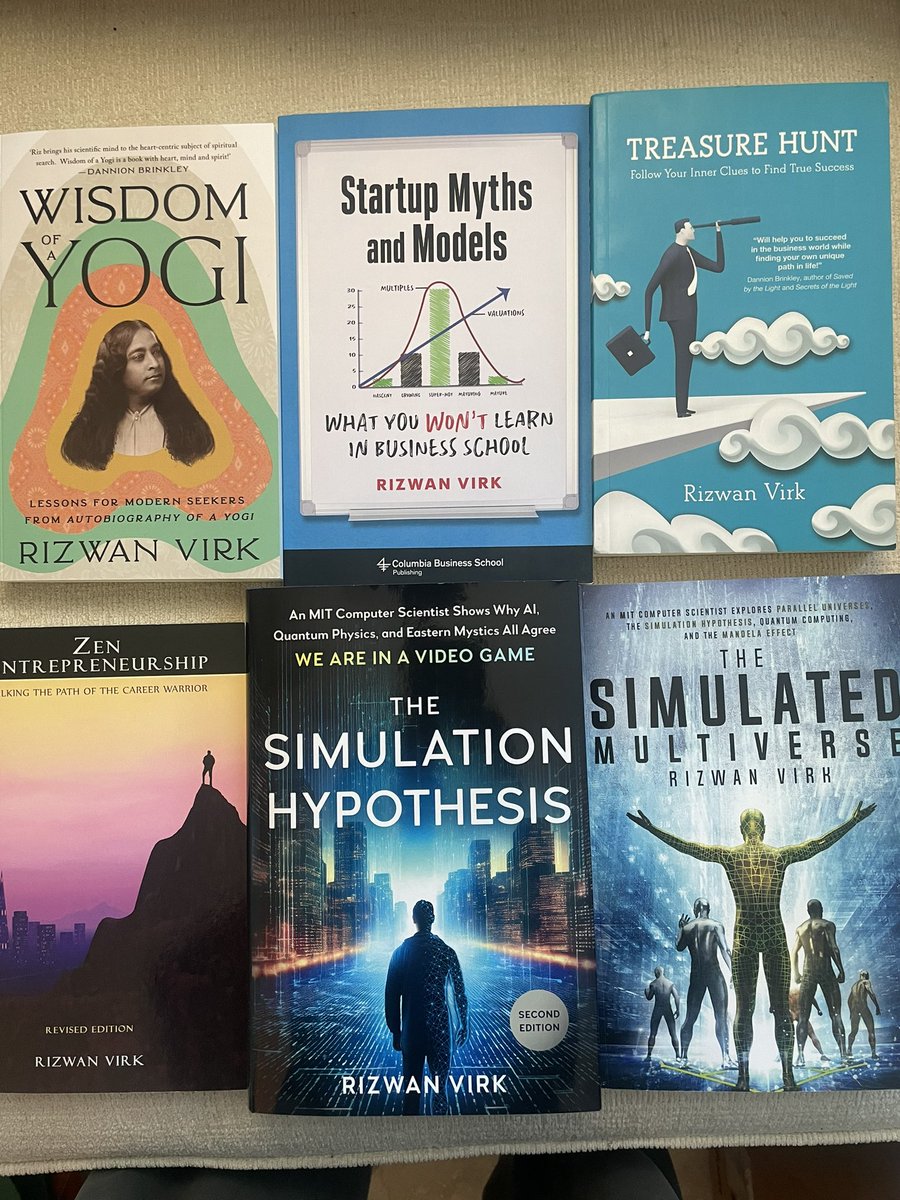
Books make the perfect gift! For the geek or entrepreneur or mystic in your life- consider getting them a hardcover copy of one of my books!
Rizwan Virk tweet media
English
12
5
64
6.9K
Rizwan Virk
Rizwan Virk@Rizstanford·
The physical world might not be the "real" world. Most religions have been telling us this for centuries—we just didn't have the tech language to describe it. Until now. @RedactedNews
English
0
0
3
197
Rizwan Virk retweetledi
Alon Mizrahi
Alon Mizrahi@alon_mizrahi·
Day 1: it's going to take a couple of days Day 20: ok we need 200 billion dollars
English
247
7.1K
43.1K
511K
Rizwan Virk
Rizwan Virk@Rizstanford·
@RepNancyMace Prove it/ let's see you call for a proper vote on war with Iran, and let's see you vote "no" on the record, just like the Constitution *requires* you to do!
English
0
0
2
227
Rep. Nancy Mace
Rep. Nancy Mace@RepNancyMace·
I remain opposed to U.S. troops on the ground in Iran.
English
1.1K
236
3.7K
140.7K
Stephen C. Meyer
Stephen C. Meyer@StephenCMeyer·
Introducing Stephen Meyer's new theatrical film, based on his bestselling book Return of the God Hypothesis. Opening nationwide on April 30. Get tickets now at thestoryofeverything.film
English
14
95
410
14.8K
Rizwan Virk
Rizwan Virk@Rizstanford·
I was at this talk at MIT in 1992 by Steve Jobs. A memorable line was about consulting, all the rage at the time, vs running a startup. "A consultant puts a picture of a banana up on the wall, but doesn't know what the banana tastes like ... You need to build something for a few years to know what it's really like."
Anish Moonka@AnishA_Moonka

Spring 1992. Steve Jobs stands in front of a room of MBA students at MIT, pitching a computer that almost nobody bought. The company was called NeXT. It sold about 50,000 machines in its entire existence. By every measure, it was a failure. The software inside it became the foundation of every Apple product ever made, and the platform on which the World Wide Web was invented. He's 37. He's been fired from Apple, the company he co-founded. He spends 70 minutes talking. He tells a room full of future consultants that consulting is a waste of talent. "Without owning something over an extended period of time, where one has to see one's recommendations through all action stages and accumulate scar tissue for the mistakes, one learns a fraction of what one can." He compares consulting to looking at a picture of a banana. "You might have a lot of pictures on your wall. You can say, I've worked in bananas, I've worked in peaches, I've worked in grapes. But you never really taste it." He says, "I think everybody lost" about being pushed out of Apple. "I think I lost. And I wanted to spend my life there. I think Apple lost. I think customers lost." Then: "Having said all that, so what? You go on. It's not as bad as a lot of things. Not as bad as losing your arm." He says hardware can never be a lasting competitive advantage. "Hardware churns every 18 months. You can make something one and a half or two times as good as your competitor, and it only lasts six months." But software, he says, is a different game. "You can make something five or even ten times as good as your competitors in software. And it's very, very hard to copy. I watched Microsoft take eight or nine years to catch up with the Mac." Then he makes a claim that almost nobody in the room would have believed: "Object-oriented technology is the biggest technical breakthrough I have seen since the early 80s with graphical user interfaces. And I think it's bigger actually." He was describing NeXTSTEP, the software his "failed" company had built. Object-oriented programming, in plain terms, means building software from reusable building blocks rather than writing everything from scratch. Jobs said developers could build apps on NeXTSTEP in about a third to a quarter of the time it took on other systems. Almost nobody cared. By industry standards, NeXT was a flop. But four years after this talk, Apple was nearly bankrupt. They bought NeXT for $427 million. Jobs came back. NeXTSTEP became Mac OS X in 2001. The same code became iOS when the iPhone launched in 2007. Every Mac, every iPhone, every iPad, every Apple Watch runs on what Jobs was selling while Sun was trying to put him out of business. One more thing. In 1990, at a physics lab in Switzerland, Tim Berners-Lee needed a computer to build a prototype for something he called the World Wide Web. He chose a NeXT. He built the first web browser and the first web server. The internet, as you know it, was born on a machine that couldn't find a market. When asked what he learned from being fired from Apple, Jobs pauses. Then he says, "I now take a longer-term view on people. When I see something not being done right, my first reaction isn't to go fix it. It's to say, we're building a team here, and we're going to do great stuff for the next decade, not just the next year." He was 37, running a company most people thought was dead, standing in a room full of MBA students. Apple is now worth $3.7 trillion. Every dollar of it runs on the thing he built when nobody was watching.

English
0
0
7
533
Rizwan Virk
Rizwan Virk@Rizstanford·
I was actually at this talk at MIT in 1992. One of the most memorable things he said was about consulting, which was all the rage at the time, vs running a startup. "A consultant puts a picture of a banana up on the wall, but doesn't really know what the banana tastes like ... You need to build something for a few years to know what it's really like."
English
1
0
13
1.6K
Anish Moonka
Anish Moonka@AnishA_Moonka·
Spring 1992. Steve Jobs stands in front of a room of MBA students at MIT, pitching a computer that almost nobody bought. The company was called NeXT. It sold about 50,000 machines in its entire existence. By every measure, it was a failure. The software inside it became the foundation of every Apple product ever made, and the platform on which the World Wide Web was invented. He's 37. He's been fired from Apple, the company he co-founded. He spends 70 minutes talking. He tells a room full of future consultants that consulting is a waste of talent. "Without owning something over an extended period of time, where one has to see one's recommendations through all action stages and accumulate scar tissue for the mistakes, one learns a fraction of what one can." He compares consulting to looking at a picture of a banana. "You might have a lot of pictures on your wall. You can say, I've worked in bananas, I've worked in peaches, I've worked in grapes. But you never really taste it." He says, "I think everybody lost" about being pushed out of Apple. "I think I lost. And I wanted to spend my life there. I think Apple lost. I think customers lost." Then: "Having said all that, so what? You go on. It's not as bad as a lot of things. Not as bad as losing your arm." He says hardware can never be a lasting competitive advantage. "Hardware churns every 18 months. You can make something one and a half or two times as good as your competitor, and it only lasts six months." But software, he says, is a different game. "You can make something five or even ten times as good as your competitors in software. And it's very, very hard to copy. I watched Microsoft take eight or nine years to catch up with the Mac." Then he makes a claim that almost nobody in the room would have believed: "Object-oriented technology is the biggest technical breakthrough I have seen since the early 80s with graphical user interfaces. And I think it's bigger actually." He was describing NeXTSTEP, the software his "failed" company had built. Object-oriented programming, in plain terms, means building software from reusable building blocks rather than writing everything from scratch. Jobs said developers could build apps on NeXTSTEP in about a third to a quarter of the time it took on other systems. Almost nobody cared. By industry standards, NeXT was a flop. But four years after this talk, Apple was nearly bankrupt. They bought NeXT for $427 million. Jobs came back. NeXTSTEP became Mac OS X in 2001. The same code became iOS when the iPhone launched in 2007. Every Mac, every iPhone, every iPad, every Apple Watch runs on what Jobs was selling while Sun was trying to put him out of business. One more thing. In 1990, at a physics lab in Switzerland, Tim Berners-Lee needed a computer to build a prototype for something he called the World Wide Web. He chose a NeXT. He built the first web browser and the first web server. The internet, as you know it, was born on a machine that couldn't find a market. When asked what he learned from being fired from Apple, Jobs pauses. Then he says, "I now take a longer-term view on people. When I see something not being done right, my first reaction isn't to go fix it. It's to say, we're building a team here, and we're going to do great stuff for the next decade, not just the next year." He was 37, running a company most people thought was dead, standing in a room full of MBA students. Apple is now worth $3.7 trillion. Every dollar of it runs on the thing he built when nobody was watching.
English
44
244
1.1K
212K
Interstellar
Interstellar@InterstellarUAP·
🚨 Aliens fled here to ESCAPE tyranny... not to invade! 🛸 👽 According to Jason Jorjani: "The aliens didn’t come to conquer but they came to escape. They fled a totalitarian empire light-years away to start over on Earth." Now living secretly in small Colorado towns, blending in. Their desperate message: "We just want lives of peace and liberty here in America... We are not trying to take over your government. Please leave our children alone." Do you believe alien refugees are already here? Should we offer them sanctuary? What's your take? Comment below! 👀
English
117
222
1.6K
58K
Patrick Bet-David
Patrick Bet-David@patrickbetdavid·
What is the biggest lesson you learned from your father growing up? Share 👇🏽
English
4.6K
131
2K
401.6K
Rizwan Virk
Rizwan Virk@Rizstanford·
"Nobody understands how quantum computing *really* works. " -- Multiverse Richard Feynman
Massimo@Rainmaker1973

Google’s new quantum chip is so powerful it might be tapping into parallel universes. Google's groundbreaking quantum processor, Willow, has achieved the seemingly impossible: solving an extraordinarily complex computational problem in under five minutes—a feat that would require the world's most advanced supercomputer approximately 10 septillion years to complete (10²⁵). This mind-boggling performance has revived one of the most provocative ideas in physics: could quantum computers like Willow be performing calculations across vast numbers of parallel universes? Hartmut Neven, founder and lead of Google Quantum AI, believes the answer may be yes. He argues that Willow’s results align strikingly with the many-worlds (or multiverse) interpretation of quantum mechanics, in which every quantum measurement causes reality to branch into multiple, equally real parallel universes. In this view, a quantum computer doesn’t just calculate faster within our universe—it effectively distributes the workload across countless parallel realities simultaneously. The idea traces back to physicist David Deutsch, who, as early as the 1980s, suggested that the exponential power of quantum computation could only be fully explained if the machine is exploiting resources from many coexisting worlds. Yet the interpretation remains deeply divisive. Many physicists and quantum computing experts insist that no multiverse is required. Willow’s breakthrough, they argue, is fully explainable through standard quantum mechanics—leveraging superposition (qubits existing in multiple states at once), entanglement, and the mathematics of high-dimensional Hilbert spaces—all within a single universe. So what has Willow truly demonstrated? It has pushed quantum technology into a regime so extreme that it compels us to re-examine the deepest foundations of reality itself. Whether or not Willow is quietly borrowing power from alternate universes, one thing is clear: practical, large-scale quantum computing is no longer science fiction—and it is forcing us to confront profound questions about the nature of the cosmos, computation, and existence.

English
2
0
2
1.1K