Wmmxx~MemeMax⚡️(❖,❖)
71.7K posts

Wmmxx~MemeMax⚡️(❖,❖)
@babaixin
patience is key in life DC:wmmxx11 TG:@wmmxx11
Beigetreten Kasım 2024
3.8K Folgt2.3K Follower

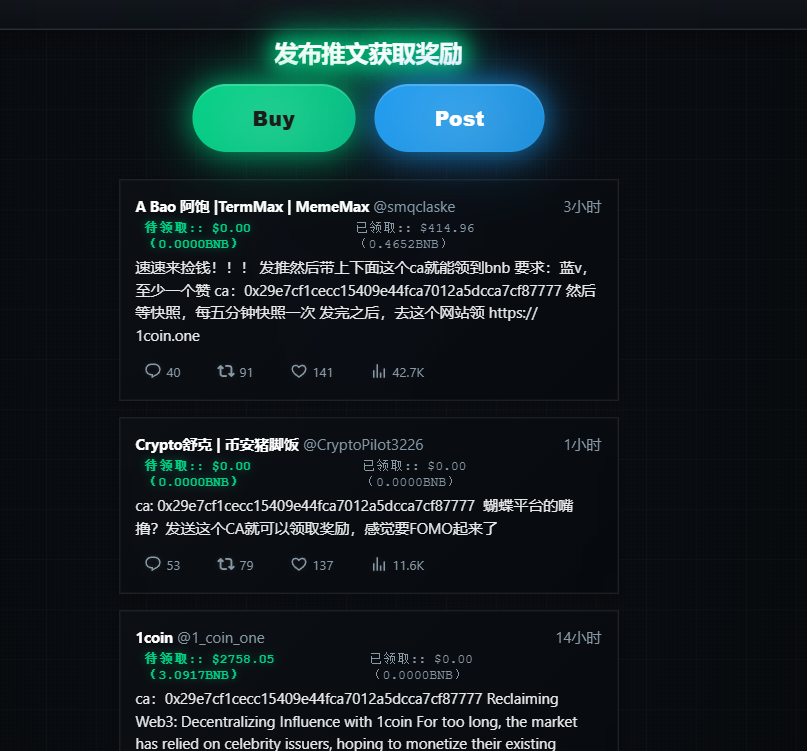
今天居然还能收到嘴撸的奖励
算是报销了香港的路费了
$PTB @PortaltoBitcoin
第一期还值上千U
现在领第二期领了还不够Gas
而一直以为不会发奖励的 @stbl_official
现在也可以领了 记得当时也不怎么卷
参加了两期 领了两百多U
:rewards.stbl.com
挺怀念嘴撸的时光的 啥也不用想

中文


It’s time to game.
Have a break. Have a KitCat. 🍫
🏆 Top 50 GTD Whitelist
Only the fastest minds can stack, clear, and climb.
Play now: game-kitcat.cat

English
许久没抽奖了 这次抽价值42U的NFT给大家
抽 3 个免费的 Degen Lite NFT 直接空投
Base 上最近挺火的 Hungry Degens,走的是那种“越亏越上头”的 degen 文化路线。
他们推出了一个 Degen Lite,算是门槛更低的版本:
• stake 就能开始挖 $DUST
• 角色可以自己打扮 + 升级成长
• 整体是游戏化生态,慢慢 build 自己的 Degen 体系
更像是把 NFT + 游戏 + 挖矿揉在一起
参与方式:
1:关注 @Reboottttttt 和 @HungryDegens
2:点赞+评论+转发此推文
3:留下evm地址
48H开奖 祝大家好运
而且可以看看官方的这个DUST活动:
👉 总共 1 亿 $DUST 空投奖励
玩法也很简单,就是开“食物包”:
• 抽到食物 = 有份
• 收集越多,分得越多
• 集齐 6 种直接拉满(终极奖励)
那 6 个 NFT 也挺有梗的,全是 degen 风格:
Exit Dog / Farmcorn / Rawliquid / Liquidity Slice / Exitol / Struggle Meal
📸 快照时间:4 月 13 号
现在还能参与:
去开包就行 :dapp.hungrydegens.com/?referral=0xd2…

Hungry Degens 💀 Base 🟦@HungryDegens
🍽️ Hungry Degens - The Ultimate Airdrop 100,000,000 $DUST up for grabs. Open Food Packs and collect the meal. The more food you collect, the bigger your reward. 6 Food NFTs to hunt: 🌭 Exit Dog | 🍿 Farmcorn | 🍣 Rawliquid | 🍰Liquidity Slice | 🧼 Exitol |🥫Struggle Meal 1 Food = Small share All 6 Foods = Ultimate Feast 📸 Snapshot: April 13, 2026 How to join: 🔁 Like, Repost & Reply 🌐 dapp.hungrydegens.com - Open Food Packs to grab your share Don’t miss over $100,000 in $DUST rewards before TGE. Complete the meal. Claim the $DUST feast. 💀
中文
@Reboottttttt 不管中不中 先评论是吗
0xf39d4d4b234419f4a78891d3bdb07e231e1901e5
日本語

333 items ~ Free mint ~ EVM
Bear Witness To The Ocean Escape As We Unwind & Recharge 🌊🐬
pacificpod.xyz
whitelist application now live, good luck.

English
《OpenClaw生存指南:如何把 AI 成本砍掉 80%》
最近OpenClaw的热度有目共睹,养龙虾的成本Token的花费一直是大家非常头疼的点。
比如某些简单的场景:
总结一下今天的加密新闻
搜集一下文章需要的资料
这些对话在大模型上,往往会消耗大量的Token。
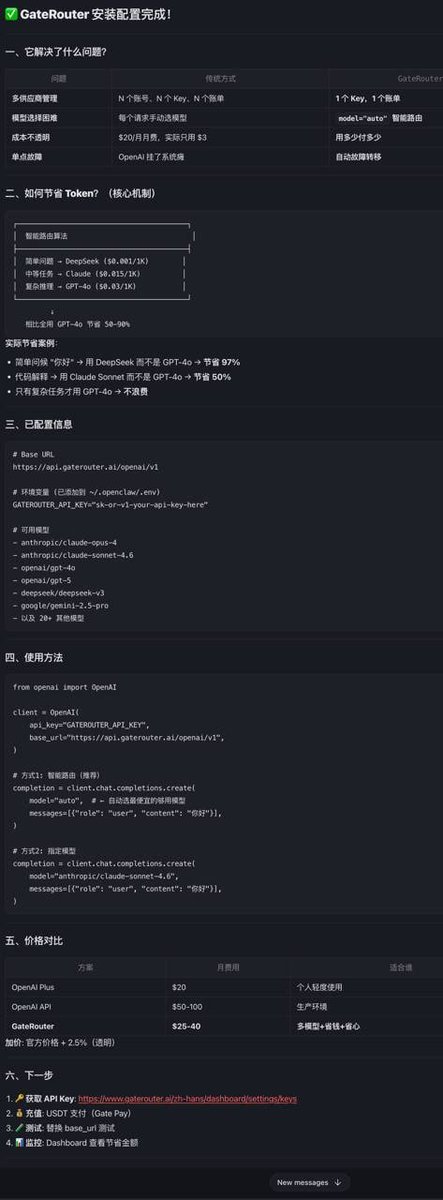
刷到GateRouter,25+大模型,0月费。统一 API 30 秒接入主流 AI 大模型,成本可降 80%,我抱着试试的态度,安装了下,节省不少Token费
你把请求发给 GateRouter,它会自动分析任务复杂度,然后选择最合适的模型:
-简单问候
GPT-4o:$0.00005 → DeepSeek:$0.000004
节省 92.9%
-代码生成
GPT-4o:$0.00006 → Claude:$0.000054
节省 10%
节省下来的Token可以完成更复杂的任务,何乐而不为!!!
安装教程:
1:前往 ,gaterouter.ai/zh-hans 使用 Gate 账号登录
2:进入 Dashboard → 生成 API Key
3:OpenClaw输入命令
bash {baseDir}/scripts/setup.sh
GateRouter对于 多模型使用者 和 成本敏感场景,非常Worth it,每月可节省(最高80%),同样的回答质量,谁愿意多付80%的费用呢?
陆兄 @Gate@Gate_luqingxiao
打工人先干活后付款 龙虾干活先付token 到账在开工,主打一个绝不免费加班 token不到,直接给你罢工 本来装 OpenClaw 是来给我打工的 龙虾还没开始替我赚钱 token 费先出了不少 大门解决痛点上线 GateRouter “养虾人”降低成本 OpenClaw真正变成神器 一个 API,30 秒接入主流大模型 不用每家单独申请,不用来回切 Key 已接入 25+ 主流大模型 平均能降低成本80%+ 毕竟虾再聪明 也得先养得起
中文


English

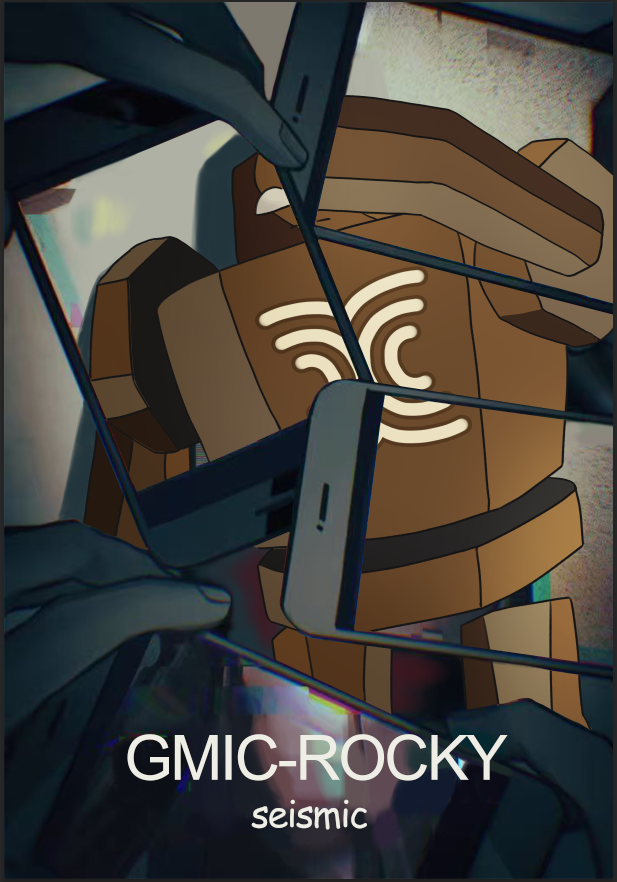
GMIC
Everyone wants to capture Rocky.
But Rocky isn’t going anywhere.
Still here. Still solid. 🪨
@SeismicSys @NoxxW3 @xealistt @heathcliff_eth
English
Wmmxx~MemeMax⚡️(❖,❖) retweetet

Ethereum should use its newfound scaling ability to crush every L2.
L2s are not customers. They're complements that capture $0.95 of every $1.00 earned (true even with native rollups).
Ethereum's real customers are financial services, and the EF could win them all right now, while L1 still has 70% of liquidity, loads of money, and a blue chip brand.
To do that, it needs to stop making protocol changes immediately. The protocol layer is no longer the bottleneck at this scale. Endless protocol work is a red herring. It lets EF engineers feel productive while shipping at a twice-per-decade cadence.
Ethereum should go up the stack instead, where it can ship features that move the needle at a monthly cadence.
Cut deals with on-/off-ramps, card issuers, KYC providers. Use that to win Silicon Valley. Cut deals with exchanges, compliance firms, market makers. Use that to win Wall Street.
This isn't a misunderstanding of Ethereum's goals. If it's truly serious about spreading its worldview, money is the only lever that actually does it.
It's just how it works. There's a reason Base has more influence over Ethereum's future than Taiko ever will.
If Ethereum doesn't pony up and face this reality soon, it won't be Solana that snuffs it out. It'll be its own "customers".
vitalik.eth@VitalikButerin
There have recently been some discussions on the ongoing role of L2s in the Ethereum ecosystem, especially in the face of two facts: * L2s' progress to stage 2 (and, secondarily, on interop) has been far slower and more difficult than originally expected * L1 itself is scaling, fees are very low, and gaslimits are projected to increase greatly in 2026 Both of these facts, for their own separate reasons, mean that the original vision of L2s and their role in Ethereum no longer makes sense, and we need a new path. First, let us recap the original vision. Ethereum needs to scale. The definition of "Ethereum scaling" is the existence of large quantities of block space that is backed by the full faith and credit of Ethereum - that is, block space where, if you do things (including with ETH) inside that block space, your activities are guaranteed to be valid, uncensored, unreverted, untouched, as long as Ethereum itself functions. If you create a 10000 TPS EVM where its connection to L1 is mediated by a multisig bridge, then you are not scaling Ethereum. This vision no longer makes sense. L1 does not need L2s to be "branded shards", because L1 is itself scaling. And L2s are not able or willing to satisfy the properties that a true "branded shard" would require. I've even seen at least one explicitly saying that they may never want to go beyond stage 1, not just for technical reasons around ZK-EVM safety, but also because their customers' regulatory needs require them to have ultimate control. This may be doing the right thing for your customers. But it should be obvious that if you are doing this, then you are not "scaling Ethereum" in the sense meant by the rollup-centric roadmap. But that's fine! it's fine because Ethereum itself is now scaling directly on L1, with large planned increases to its gas limit this year and the years ahead. We should stop thinking about L2s as literally being "branded shards" of Ethereum, with the social status and responsibilities that this entails. Instead, we can think of L2s as being a full spectrum, which includes both chains backed by the full faith and credit of Ethereum with various unique properties (eg. not just EVM), as well as a whole array of options at different levels of connection to Ethereum, that each person (or bot) is free to care about or not care about depending on their needs. What would I do today if I were an L2? * Identify a value add other than "scaling". Examples: (i) non-EVM specialized features/VMs around privacy, (ii) efficiency specialized around a particular application, (iii) truly extreme levels of scaling that even a greatly expanded L1 will not do, (iv) a totally different design for non-financial applications, eg. social, identity, AI, (v) ultra-low-latency and other sequencing properties, (vi) maybe built-in oracles or decentralized dispute resolution or other "non-computationally-verifiable" features * Be stage 1 at the minimum (otherwise you really are just a separate L1 with a bridge, and you should just call yourself that) if you're doing things with ETH or other ethereum-issued assets * Support maximum interoperability with Ethereum, though this will differ for each one (eg. what if you're not EVM, or even not financial?) From Ethereum's side, over the past few months I've become more convinced of the value of the native rollup precompile, particuarly once we have enshrined ZK-EVM proofs that we need anyway to scale L1. This is a precompile that verifies a ZK-EVM proof, and it's "part of Ethereum", so (i) it auto-upgrades along with Ethereum, and (ii) if the precompile has a bug, Ethereum will hard-fork to fix the bug. The native rollup precompile would make full, security-council-free, EVM verification accessible. We should spend much more time working out how to design it in such a way that if your L2 is "EVM plus other stuff", then the native rollup precompile would verify the EVM, and you only have to bring your own prover for the "other stuff" (eg. Stylus). This might involve a canonical way of exposing a lookup table between contract call inputs and outputs, and letting you provide your own values to the lookup table (that you would prove separately). This would make it easy to have safe, strong, trustless interoperability with Ethereum. It also enables synchronous composability (see: ethresear.ch/t/combining-pr… and ethresear.ch/t/synchronous-… ). And from there, it's each L2's choice exactly what they want to build. Don't just "extend L1", figure out something new to add. This of course means that some will add things that are trust-dependent, or backdoored, or otherwise insecure; this is unavoidable in a permissionless ecosystem where developers have freedom. Our job should make to make it clear to users what guarantees they have, and to build up the strongest Ethereum that we can.
English

没什么新鲜事 感觉很无聊啊
那就抽抽奖吧
抽 @NessyNFT_xyz FCFS白名单 10个
Nessy 是 Endless 生态的旗舰 NFT,更像一张通行证,而不是单纯的图片。
目前地板价大概在 2400 EDS(300U左右),而铸造成本只有地板的 1/12(200EDS),而且供应是被严格控制的,每月才开放一次。
参与方式:
关注
@NessyNFT_xyz 和 @Reboottttttt
+ 点赞 + 评论+留下Endless Wallet Address

中文