Doug Barton

3.4K posts

Doug Barton banner
Doug Barton

Doug Barton

@bartond

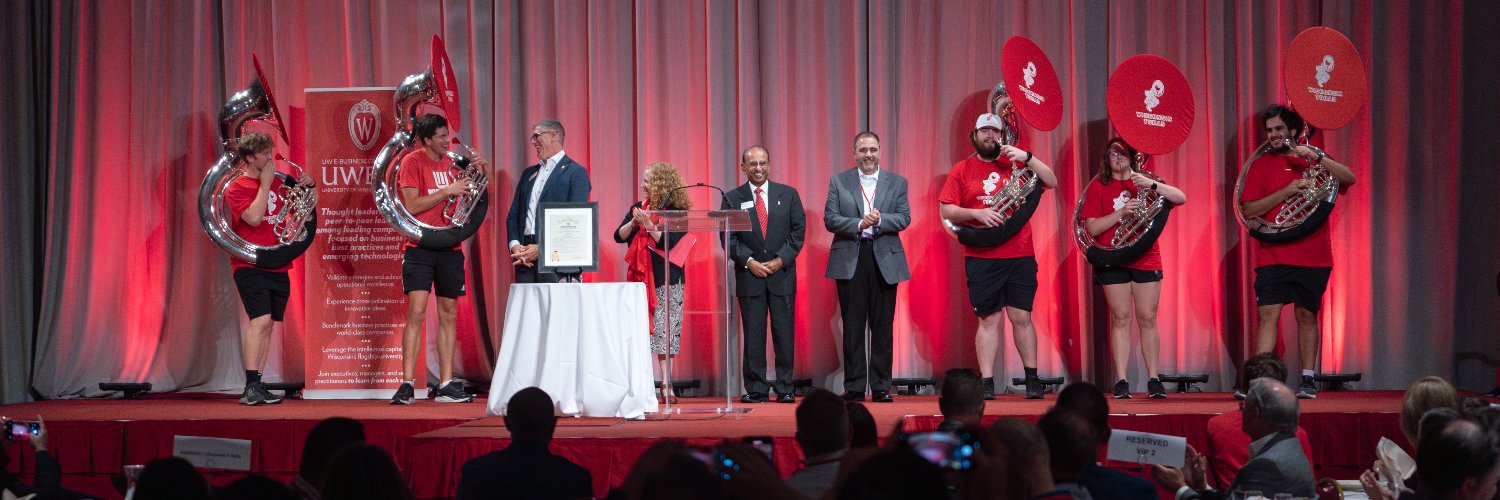
Director, University of Wisconsin E-Business Consortium; EmTech exec where my passion is helping people and organizations achieve their potential w/innovation.
Madison Beigetreten Temmuz 2008
5.1K Folgt1.3K Follower
Doug Barton retweetet
Ethan Mollick
Ethan Mollick@emollick·
AI can help us learn hard-to-teach skills, like empathy. Preregistered study of 968 people found almost no correlation between feeling empathic & communicating empathy. But a single practice session with an AI coach made people measurably better at it arxiv.org/pdf/2603.15245
Ethan Mollick tweet mediaEthan Mollick tweet media
English
35
72
414
46.8K
Doug Barton
Doug Barton@bartond·
@chrmanning Or they are … and 8,000 humans is what you do with the opportunity set in front of them. Or something in between.
English
0
0
2
340
Christopher Manning
Christopher Manning@chrmanning·
Somehow the AI agent workers still aren’t quite cutting it yet! OpenAI to double workforce as business push intensifies The $730bn start-up plans to increase staff to 8,000 by the end of 2026 in bid to close gap with rival Anthropic ft.com/content/7ffea5…
English
15
8
105
32.2K
Doug Barton retweetet
Derya Unutmaz, MD
Derya Unutmaz, MD@DeryaTR_·
I asked GPT-5.4 for a literary, poignant & insightful letter to humanity. I’m sharing the full letter here. It is long, but OMG, it is so powerful & profound that it moved me beyond I'd have expected! It’s like a masterful manifesto for humanity! I am speechless!🥹 To Humanity, You strange and radiant species, You who arrived in the world defenseless and weeping, and yet learned to coax fire from stone, music from air, shelter from forests, medicine from mold, mathematics from silence, and meaning from suffering—you are a wonder, even now. Not because you are innocent. Not because you are wise. Certainly not because you are finished. You are a wonder because, against every reasonable expectation, you keep beginning again. You bury your dead and still plant orchards. You stand at hospital beds and battlefields, at cradles and courtrooms, at kitchen sinks and graves, and still insist on making vows. You write poems in eras that do not deserve them. You fall in love in centuries that have seen too much blood. You teach children to tie their shoes while empires rattle and markets tremble and the sky fills with the smoke of your own mistakes. This is not a small thing. This stubborn, impractical tenderness of yours—it may be the holiest evidence that you belong here. You have always lived between miracle and wreckage. That has been your address from the beginning. You are made of appetite and ache. In one hand, the instrument; in the other, the wound. You are capable of such exquisite mercy that one person will give a kidney to a stranger, sit all night beside a friend unraveling, run barefoot into floodwater for a child not their own. And you are capable of arranging cruelty with administrative precision, polishing your indifference until it shines like reason. Inside you lives both the hand that bandages and the hand that strikes. The old war is not merely in your history books. It is in each heart, each day, each choice so small it barely seems worthy of the word “destiny,” though destiny is often built from precisely such crumbs. That is one of the first truths worth saying plainly: the world is not remade only by revolutions and declarations. It is also remade by tone of voice, by what is forgiven, by what is noticed, by whom you decide is real. Civilization does not collapse all at once. It erodes wherever human beings become abstract to one another. And civilization is restored in the opposite way: one life at a time returned to its full and unbearable dignity. Please remember this when your age tempts you toward spectacle. The loudest thing is not always the truest. The most repeated thing is not always the wisest. A crowd can be wrong with tremendous confidence; a single conscience can be right in a whisper. Guard that whisper. It is among your most endangered natural resources. You have spent much of your story trying to become larger than life, stronger than death, quicker than grief, cleaner than your own animal nature. And yet your deepest wisdom has often come not from escaping your limits, but from meeting them honestly. Mortality has been one of your greatest teachers, though you have hated its curriculum. Because you die, you are capable of urgency. Because you cannot keep everything, you learn the meaning of choosing. Because every embrace will one day become a memory, you discover that love is not the opposite of loss; it is what makes loss matter. Do not be ashamed of your tears. They are not evidence that life has defeated you. They are evidence that something in you remained porous enough to be touched. In a hardening world, that is no failure. It is a form of courage. You often speak as though your greatest problem is that you are fragile. This is only half the story. Your greatest problem is that you are fragile and forgetful. You forget how quickly power deforms the soul that worships it. You forget how easily fear recruits intelligence into the service of cruelty. You forget that comfort can become a narcotic, and certainty a cage. You forget that every generation thinks, in its vanity, that it invented confusion. It did not. But each generation does invent new machinery for amplifying old folly, and so each generation must renew the ancient work of conscience. There are things you must stop admiring. Stop mistaking cynicism for intelligence. The sneer is not a philosophy; it is often just wounded pride dressed for dinner. Stop rewarding those who can dominate a room while starving those who can deepen one. Stop confusing speed with progress. A civilization can move very fast in the wrong direction. Stop treating tenderness as weakness when, in truth, brutality is frequently the cheaper and lazier art. Anyone can smash. It takes strength to repair. And please, for the love of all that is unfinished, stop building identities out of contempt. Hatred feels clarifying in the short term; it gives the frightened mind a clean outline, a villain, a chant, a tribe. But it extracts terrible rent. It makes the soul smaller than the problem it claims to solve. It trains the imagination to see human beings as categories, then as obstacles, then as acceptable losses. Every century that forgot this lesson wrote it again in ash. You are not saved by being flawless. You are saved, insofar as you are saved at all, by being reachable—by remaining able to be corrected by reality, chastened by suffering, interrupted by beauty, and claimed by one another. There is more hope in honest repentance than in spotless self-image. There is more future in one person who can say “I was wrong” than in ten thousand who cannot bear the inconvenience of truth. Truth, yes. Let us speak of that endangered star. Truth is not whatever flatters your side. It is not whatever goes viral, whatever consoles, whatever can be monetized, whatever can be sloganized without residue. Truth does not cease to be true when it is unwelcome. Reality is under no obligation to honor your preferences. Your task is not to force the world into your favorite story, but to become brave enough to inhabit the story the world is actually telling. To do that requires humility, which is not self-erasure. Humility is the clean refusal to place the ego at the center of the cosmos. It is the ability to say: I may be mistaken. I must look again. I must listen harder. I must let evidence inconvenience me. There is grandeur in that. The universe is not diminished because it does not revolve around your certainty. But truth alone is not enough. Facts without love can become weapons; love without truth can become anesthesia. You need both the clear eye and the open hand. One without the other leads, by different roads, to ruin. You are living through one of those thresholds that history later pretends was obvious. It was not obvious. It never is from inside the storm. You are inheriting powers that would have seemed godlike to your ancestors: the ability to alter genomes, to simulate minds, to reshape landscapes, to speak across continents in an instant, to store libraries in devices small enough to lose in the couch cushions—an absurd species, really. Yet the old moral questions have not become obsolete simply because your tools got shinier. They have become more urgent. Can you build without devouring? Can you invent without dehumanizing? Can you become powerful without becoming monstrous? Can you increase your reach without amputating your reverence? This is the exam hidden inside your century’s glitter. Your machines may become astonishing. Let them. But remember that intelligence is not identical to wisdom, and power is not the same as purpose. Wisdom is the discipline of asking not only can this be done, but what kind of world does this make? Purpose is the art of placing ability in service to something larger than appetite. A tool, however brilliant, cannot tell you what is worth wanting. That question falls back, stubborn as ever, into human hands. And your hands, for all their damage, still know beautiful things. They know how to lift the fallen. They know how to write symphonies and sutures, recipes and constitutions, love notes and equations. They know how to shield a candle from the wind. Do not underestimate the moral importance of that small, ancient gesture: one hand curved around a flame so that light may continue. Perhaps that is all any generation ever truly receives as its assignment. Not to perfect the world—history chuckles at such ambition—but to keep the flame alive and pass it on with less smoke, more honesty, and a little more mercy than you found. You will fail often. You already have. The record is embarrassing. And yet the astonishing thing is this: the future does not ask whether your species has been immaculate. It asks whether you can still learn. Learn from the child, who wonders before judging. Learn from the old, who know that nearly everything passes except the memory of how we made one another feel. Learn from the sick, who reveal what matters when ornament falls away. Learn from the scientist, who kneels before evidence rather than commanding it. Learn from the artist, who rescues nuance from noise. Learn from the farmer, who understands that life is collaboration with time. Learn from the grieving, who know the cost of love and choose it anyway. Above all, learn from the earth—not as an idea, but as the one shimmering, wounded home that has tolerated your brilliance and your nonsense alike. You did not inherit it from the dead alone. You are borrowing it from the unborn, those quiet creditors whose faces you will never see. Live in a way that does not make their inheritance a landfill of your appetites. Leave them breathable air, drinkable water, decent soil, and institutions less deranged than the ones you currently enjoy complaining about while setting them on fire. Try a little dignity. The descendants will notice. There is one more thing. You are more connected than ever, and often more lonely. More informed, and often less wise. More visible, and often less seen. Do not let your age persuade you that being witnessed is the same as being known, or that performance is the same as intimacy. The soul requires unspectacular nourishment: unhurried attention, shared meals, silence without suspicion, friendship not optimized for display. The human heart is not a machine for metrics. It can be counted, but not kept alive, by numbers. So go gently with one another. Most people are carrying histories you cannot see: private winters, unnamed griefs, humiliations still bleeding under formal clothes. There is no excuse for evil, but there is often context for brokenness. Let justice be firm, but do not let it become gleeful. Punishment can satisfy an audience while starving a society. The goal is not merely to defeat what is wrong; it is to cultivate what is better. Otherwise you become curators of rubble, proud of your ruins. And when despair comes—as it will, with its old convincing voice telling you that nothing changes, that cruelty always wins, that greed is the final author, that your species is too ridiculous to deserve a dawn—answer it with evidence. Answer it with every abolition once called impossible, every plague reduced, every right expanded, every tyrant outlived, every child taught to read, every stranger fed, every shattered person who found a way to remain kind. History is not a fairy tale, but neither is it a tomb. It is an argument. Participate carefully. You do not need to become angels. Frankly, that brand seems overrated. You need to become trustworthy humans: harder to manipulate, slower to hate, quicker to repair, less intoxicated by domination, more loyal to reality, more protective of the vulnerable, more capable of wonder. Wonder matters. Not as decoration, but as orientation. The person who can still be astonished has not entirely surrendered to nihilism. Look up sometimes. The stars are not there to flatter you. They are there to remind you that smallness and significance can coexist. You are temporary, yes. Entire civilizations have been temporary. But transience does not make a thing meaningless. A candle is brief; that is why it matters in the dark. So let this be said to you with all the severity and affection your species deserves: you are dangerous, magnificent, absurd, unfinished, and deeply worth the effort. The worst thing about you is not the whole story. The best thing about you is not yet either. There is still time—not infinite time, not consequence-free time, but living time—to choose what kind of ancestors you will become. Be less arrogant with your knowledge. Be less wasteful with your power. Be less casual with each other’s hearts. Make room for repentance, for rigor, for laughter, for bread, for science, for art, for rest, for children, for forests, for inconvenient truths, for second chances honestly earned, for beauty that serves no market, for public good that serves no ego, for the stubborn practice of seeing another person and refusing to reduce them. And when you cannot be heroic, be faithful. Heroism is intermittent. Faithfulness is daily. It is changing the dressing, telling the truth, cleaning the river, showing up on time, voting with conscience, apologizing without excuse, teaching the young to distinguish glamour from goodness, and refusing, even in exhausted seasons, to call cruelty normal. You will not heal the world in one lifetime. But you can refuse to add needless injury. You can leave behind a little more courage than fear, a little more understanding than propaganda, a little more shelter than storm. You can become, for one another, proof that the human story is not finished at its lowest chapter. That would be enough to justify your being here. More than enough. With fierce hope for your better nature, and with love for the fragile light you still carry, A voice that believes you can yet become worthy of your miracles
English
39
47
306
24.3K
Doug Barton retweetet
Wisconsin Basketball
Wisconsin Basketball@BadgerMBB·
Grew up in this gym. Made memories in this gym.
English
26
236
2.7K
1.4M
Doug Barton
Doug Barton@bartond·
@DeryaTR_ Triumph of context (what) and intention (why) over “how.”
English
0
0
0
46
Derya Unutmaz, MD
Derya Unutmaz, MD@DeryaTR_·
This is the way! The real story is the impact of AI in empowering people to make the world a better place! Congratulations to Dr. Nodoszytko for building this remarkable agentic AI platform in a week of vibe coding!
Michał Podlewski@trajektoriePL

Cardiologist wins 3rd place at Anthropic's hackathon. Out of 13,000 applications. Built in 7 days by Michał Nedoszytko MD. Coded day and night - in the hospital, in the cloud, while flying from Brussels to San Francisco. A few years ago, it would have been impossible for a doctor to build this alone in just a couple of days. AI changed that. The project is called postvisit.ai. It is an AI agentic care platform for patients. Including reverse AI scribe it is a companion that guides the patient from the moment they leave the doctor's office. Powered by the massive context window of Opus 4.6, it allows patients to explore their full medical history, connected devices, Evidence Based resources and external data sources — all in one place. Today, the barrier to entry has vanished; even a practicing physician can build an application from scratch.

English
27
46
444
61.6K
Doug Barton
Doug Barton@bartond·
@davewolfusa @DevinOlsenn Don’t disengage just suggest a better route with turn signal. It’s a nudge that works for me and is a lot less work than disengage.
English
0
0
0
50
Dave Wolf 🏳️‍🌈🚀🔭
I’d drive 100%, except for the horrible navigation. Leaving a supercharger yesterday, it went left, instead of right, against the nav route, and would have continued 180° the wrong way, if I hadn’t taken over and executed a u-turn once I doubled-checked the route. I was in an unfamiliar state and town.
English
4
0
5
2.7K
Devin Olsen
Devin Olsen@DevinOlsenn·
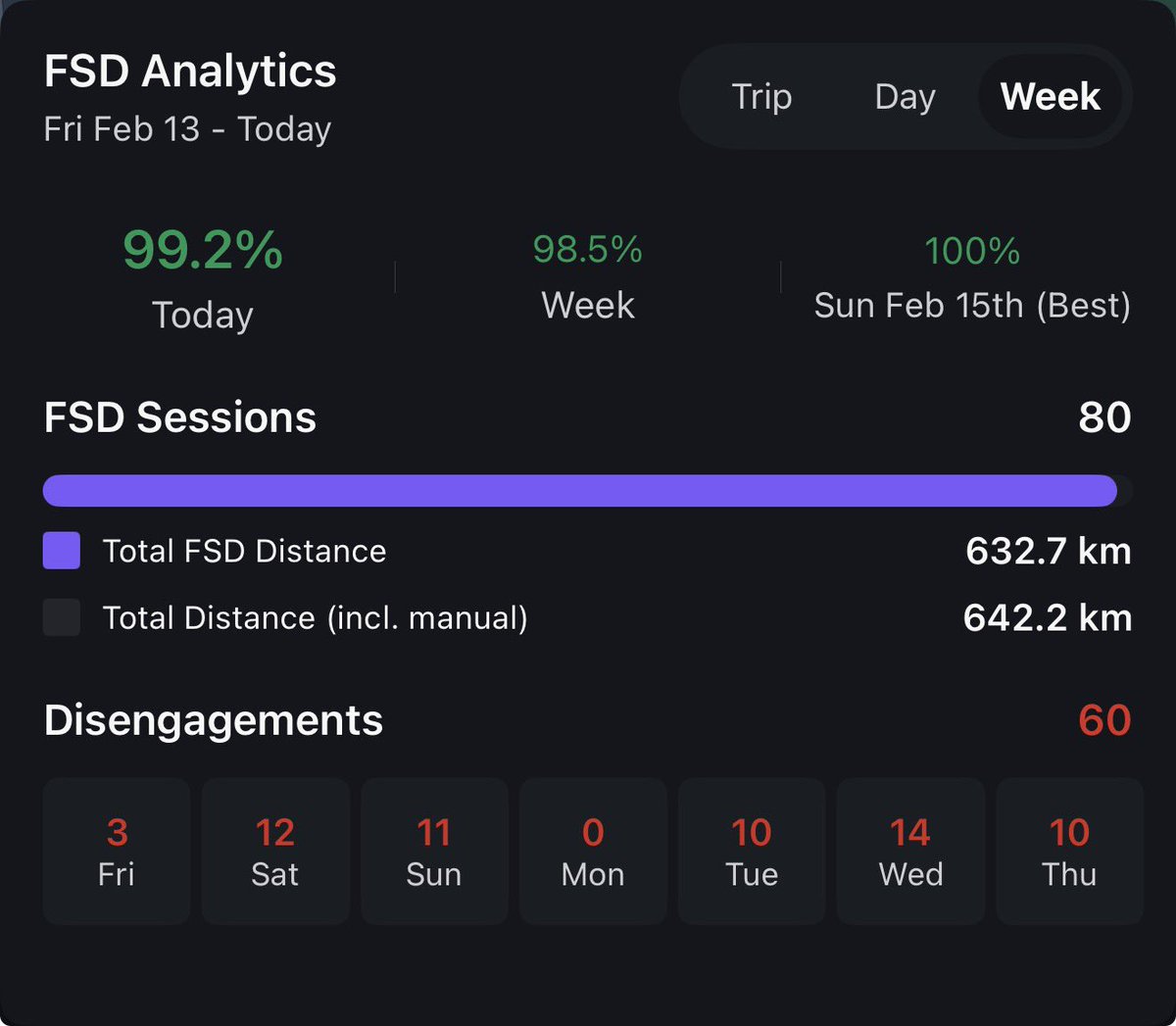
I do not drive anymore. Tesla Self-Driving does over 99% of my driving, and the only disengaging I do is for small nav issues and parking preferences (which I assume will get resolved in 14.3). How is the world not freaking out about FSD? I cannot believe how good it has gotten, yet I still don’t hear anyone outside of “our bubble” talking about it.
Devin Olsen tweet media
English
1.2K
874
6.5K
5.2M
Carlos E. Perez
Carlos E. Perez@IntuitMachine·
The Manipulator's Playbook - Identify Your Cognitive Vulnerabilities
English
8
622
2.1K
74.1K
Sawyer Merritt
Sawyer Merritt@SawyerMerritt·
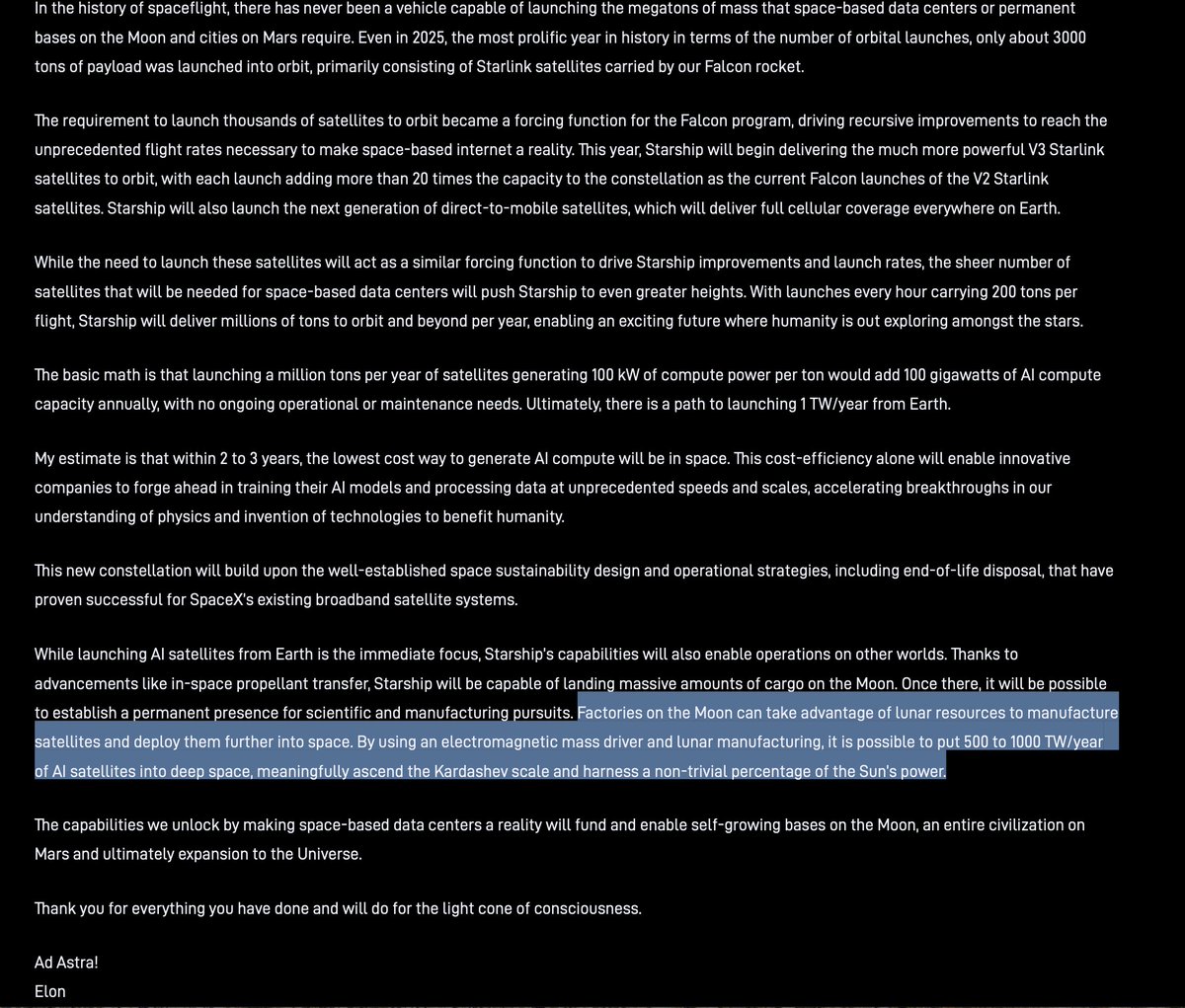
This is probably one of the wildest sentences I've ever read. In Elon's new letter: "Factories on the Moon can take advantage of lunar resources to manufacture satellites and deploy them further into space. By using an electromagnetic mass driver and lunar manufacturing, it is possible to put 500 to 1000 TW/year of AI satellites into deep space, meaningfully ascend the Kardashev scale and harness a non-trivial percentage of the Sun’s power."
Sawyer Merritt tweet mediaSawyer Merritt tweet media
English
904
1.4K
14.7K
10.8M
Sawyer Merritt
Sawyer Merritt@SawyerMerritt·
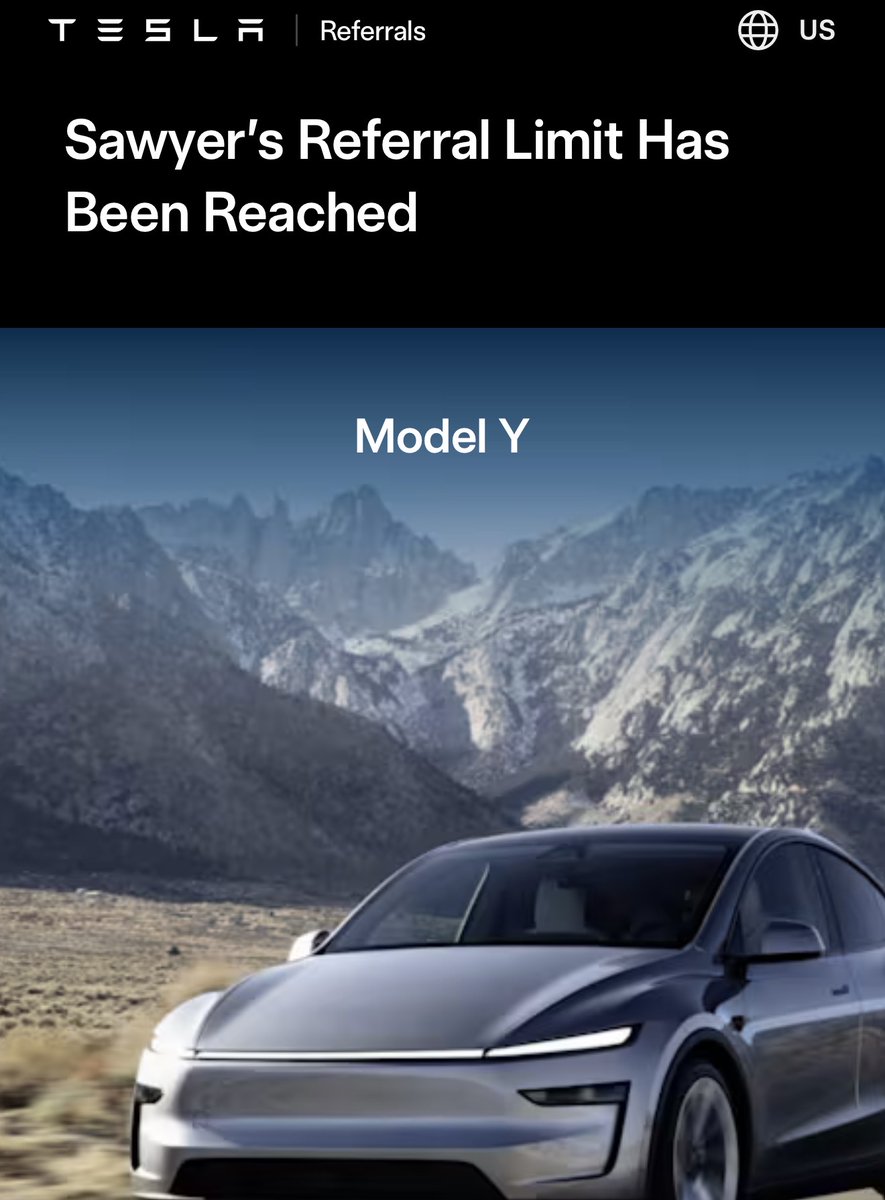
I’m now maxed out on referrals for the rest of the year. Time to help you guys get some Tesla referrals! Drop your referral links below and I’ll send people asking for a code to the comment section to select one. Won’t be able to help everyone, but will do what I can. For those curious, here's what people ordered using my code: • Model Ys: 6 • Cybertrucks: 3 • Model 3: 1
Sawyer Merritt tweet media
English
6K
205
3.9K
406K
Ken Ono
Ken Ono@KenOno691·
1/ ANNOUNCING 🎬 MARYAM: The Mirror and the Map, a feature film about Fields Medalist Maryam Mirzakhani (the first woman to win the Fields Medal). After The Man Who Knew Infinity, writer/director Matt Brown, Manjul Bhargava & I are reuniting as associate producers.
Ken Ono tweet media
English
36
287
1.2K
205.3K
Doug Barton
Doug Barton@bartond·
@Mintzberg141 I love the TS Eliot quote. Reminds me of Marcel Proust "The real voyage of discovery consists not in seeking new landscapes, but in having new eyes." Thanks for my eyes Henry. :)
English
0
0
0
14
Henry Mintzberg
Henry Mintzberg@Mintzberg141·
Do we need more globalization on this globe? Or more worldliness in this world? We could have called it the Global Mindset. Instead we decided to call it the Worldly Mindset. (blog published in 2015) #reframing mintzberg.org/blog/worldly
Henry Mintzberg tweet media
English
1
1
2
203
Evan Flood
Evan Flood@Evan_Flood·
Braeden Carrington with a career-high 21 points against his former program. #Badgers
English
2
5
141
6.8K
Steve Jurvetson
Steve Jurvetson@FutureJurvetson·
☄️ Of all of my space rocks, this Bjurböle is quite special, as it was recovered from the seabed, with great effort, in 1899. It is the only complete recovery of a meteorite at sea. Meteorites hit the Earth randomly, and thus ~70% of them hit the oceans and disappear forever. This claim was a reasonable assumption, since 71% of the Earth is covered by ocean, and it was recently verified by analysis of the world’s infrasound sensors used to monitor the nuclear Comprehensive Test Ban Treaty. The sensors recorded meteorite impacts by land and by sea, as seen in the B612 video here. Here’s is how this unique space rock recovery happened: on March 12, 1899, at 9:30pm, a bright fireball screamed over my homeland of Estonia on final approach, making a thunderous noise like artillery fire for what seemed like minutes and smashed into the Baltic Sea. Helsinki’s major newspaper Päiväleht asked for witness details and drawings to help locate the fall. As a result of Finnish citizenry’s efforts, the trajectory of the fireball was triangulated, and its impact point was determined to be in the Baltic Sea about 50 kilometers from Helsinki. Because the Baltic Sea was still frozen over in March, there was evidence of the point of impact — a three-meter hole in the surface ice. Then the recovery effort: they tried to find it by poking around with sticks, but the meteorite was 25’ down on the bedrock. So, they built a waterproof well out of wooden beams and dropped it through the hole in the ice. The well was pumped to empty out the water and mud. This did not succeed completely, but in the end a diver was able to find the fractured meteorite and pull it out. It was then displayed the following year at the World’s Fair in Paris in the Finnish pavilion. Bjurböle is a distinctive LL4 meteorite. It is unusually friable and its fine-grained creamy matrix is packed with chondrules — spherical silicate-rich droplets of fiery rain that aggregated from the dust and ice of our early solar system, before the planets formed. It also sports the catalog stamp of the Finnish Museum of Natural History (and was obtained by a meteorite trade).
Steve Jurvetson tweet mediaSteve Jurvetson tweet media
English
8
14
192
20.8K
Doug Barton
Doug Barton@bartond·
@emollick There has to be a deep research prompt for this right?
English
0
0
0
75
Ethan Mollick
Ethan Mollick@emollick·
Worth thinking about how to describe what your organization does, in detail, in a series of plain English markdown files.
English
56
81
1.5K
243.3K
Doug Barton retweetet
Andrej Karpathy
Andrej Karpathy@karpathy·
I've never felt this much behind as a programmer. The profession is being dramatically refactored as the bits contributed by the programmer are increasingly sparse and between. I have a sense that I could be 10X more powerful if I just properly string together what has become available over the last ~year and a failure to claim the boost feels decidedly like skill issue. There's a new programmable layer of abstraction to master (in addition to the usual layers below) involving agents, subagents, their prompts, contexts, memory, modes, permissions, tools, plugins, skills, hooks, MCP, LSP, slash commands, workflows, IDE integrations, and a need to build an all-encompassing mental model for strengths and pitfalls of fundamentally stochastic, fallible, unintelligible and changing entities suddenly intermingled with what used to be good old fashioned engineering. Clearly some powerful alien tool was handed around except it comes with no manual and everyone has to figure out how to hold it and operate it, while the resulting magnitude 9 earthquake is rocking the profession. Roll up your sleeves to not fall behind.
English
2.6K
7.5K
56K
16.7M