bebu
3.6K posts


@MrAndyNgo You are the best NGO we have!
English

This mindset, quite prevalent due to mass Islamist indoctrination — particularly in Europe, has produced devastating and deadly consequences for what your religion calls the kuffar (non-Muslims).
Shadi Hamid@shadihamid
My new @washingtonpost column: Why do Muslims need to be like everyone else? A case against assimilation. washingtonpost.com/opinions/2026/…
English
"When we read Psalm 8, we are reading it with a layer of knowledge that should make the vertigo worse."
Faithfulness Okom@AttorneyF_
The ancient Israelite had an excuse for polytheism. Stand at ground level long enough, and the world feels local, bounded by horizons you can name, and seasons you can predict. At that scale, gods make sense in the plural. The sea has its keeper; the harvest, its steward. The “face-to-face” view of the universe produces a distributed theology: small, proportional, and tailored to the visible. Then you board a plane. Everything you thought was large becomes notation. Cities become diagrams. Then, NASA points a camera at the Earth from the Moon. Seeing the Artemis II photographs, shifted something in me that I am still trying to articulate. Not because the images are new information; I knew, intellectually, that the Earth is a marble suspended in incomprehensible darkness, but because knowing something and seeing it are categorically different experiences. The knowing lives in your head. The seeing hits your chest. Someone asked me once why the universe is so obscenely, almost wastefully vast, billions of light-years of what looks like empty silence on every side. I think the answer is simpler and more terrifying than we want to admit: God is making a resoundingly emphatic point. He is making the point the way a master architect makes a point, by building something so far beyond the requirements of the brief that the brief itself seems absurd in retrospect. The sheer excess of the cosmos is itself a declaration. David understood this. David, who by any modern metric was working with almost nothing; no telescope, no physics, no photographs, no orbital mechanics, looked up at the same sky and was stopped cold. “When I consider the heavens, the work of your fingers, the moon and the stars which you have set in place...” He was bamboozled. He had 1% of our information and arrived at the exact same place we arrive with 100% of it. That should tell us something. The awe is not a function of data. It is a function of scale meeting the soul. We went to the Moon. We have gone further. We have instruments that can see to the edge of observable creation. And we are still standing where David stood, asking David’s question. What is mankind that you are mindful of them?… [FULL ARTICLE] open.substack.com/pub/crossroads…
English
bebu retweetet

Finland tracked every gender-referred adolescent in the country for up to 25 years.
Their psychiatric needs didn't improve after 'gender reassignment'. They surged.
A landmark peer-reviewed study just dropped. Here's what it found. 🧵

English
Massive room for improvement here. Trump's style has a lot of drawback.
Threatening to slice a child in half, per Solomon, is a one-time move.
Kaizen D. Asiedu@thatsKAIZEN
@JeremyDBoreing Certain things shouldn’t be threatened in public, and destroying a civilization is one of those things. Great leaders know how to create leverage without creating unnecessary hysteria.
English

I don't really do Apologetics anymore.
Aquinas famously said "To one who has faith, no explanation is necessary; to one without faith, no explanation is possible" but even more importantly the Apostle Paul said "they will know we are Christians by our love."
But even more importantly than that Jesus Christ Himself said "by their fruits you will know them."
The way I see it there is no explanation necessary nor is there one that is even possible. That's the nature of faith.
But, if there is one way laid out for us to win souls it is by example. The ultimate apologia is living a life so joyful and serene that other people can't help but ask you "what is your secret? how do you do it?" and you can tell them "through the Grace of God and my Lord and Savior Jesus Christ"
And honestly if no one is asking, I'm starting to think, best to not even bring it up. I'm obviously not not letting the Holy Spirit shine through me if no one is curious about what I'm doing or how I'm doing it. Honestly half the time or more I fear I would be a discredit to God to volunteer that I consider myself a follower of His; what example does that set?? I'm no saint...
But if someone were to ask I won't deny my Lord either. Nor should I. So I think I ought to try to live such that people ask. Maybe.
So my unsolicited advice to believers is to stop offering unsolicited advice to unbelievers. Live a life so aligned with God's will that people can't help but solicit advice from you, and then give it.
wanye@xwanyex
I can’t believe I actually have to explain this, but, “I just find it impossible to accept that the accounts we have of the apostles would exist unless they really did behave exactly as described on the basis of having witnessed a resurrection” is trivially defeated by, “well, I find it impossible to accept that there was a resurrection, mate.” You are creating a case of, “which is more likely” and, “a guy rose from the dead” is definitely the less likely of the two possibilities, from a purely scientific and secular worldview, even if the other thing is really, really, really, really, really, really, really, really improbable. Even if we grant that the accounts that we have today of their behavior are perfectly accurate, that nothing has been left out, that no mistakes were made, that literally everything occurred exactly as described, and even if we therefore grant that they went to their deaths genuinely believing they had firsthand evidence of a resurrection, one would still have to say, I think, that some other explanation for their behavior, no matter how unlikely or improbable, is still more likely than that a guy genuinely rose from the dead. If your acceptance of Christianity is based on arguments like this one, then I think it will always be flimsy. These just aren’t very good arguments. That is to say, at the very least, these arguments are not going to be convincing to most smart, scientifically-minded people. I would just simply resist the urge to try to compare probabilities in this way. Most smart, rational people see these two options and think that resurrection is the dramatically least likely of all available explanations. ”But without the resurrection, these accounts of the disciples make no sense!” just simply cannot overcome the improbability of a literal resurrection (again, from a purely secular, scientific worldview). I think it is a mistake to base your Christianity on these kinds of arguments. I think you will find that these kinds of arguments are not very convincing to most educated people. And I think also that the reason for this is that it is in fact not a very convincing argument. We cannot hope to construct Christianity on logic in this way. If one believes, as I do, that Christ was in fact resurrected, as I proclaim in my recitation of the Nicene Creed every Sunday, then one must have the courage to accept that this must somehow be possible absent the intuition described above.
English

@DanBurmawy Moloch and baal are jewish gods. Nothing has changed. We know what jews do to Christian children on their holidays. It's called ritual murder.
English
bebu retweetet

In the Old Testament, the Canaanite gods, like Moloch and Baal, required child sacrifice, innocent blood poured out to appease idols made of stone.
And now, in the modern world, allah operates no differently.
allah demands the blood of sons. Not in the way Abraham was tested, where God ultimately provided the sacrifice Himself, but in the way of the pagan gods, who expect their followers to slaughter without end.
A Christian missionary, for example, gives his life to save others. He lays down everything for the sake of bringing hope, healing, and truth.
His sacrifice is not a demand from God, it is an act of love, freely given, because God Himself first sacrificed for us.
He does not take life. He does not spill innocent blood. He follows Christ, who shed His own blood so that others may live.
A jihadist, however, does not give his life, he takes as many lives as possible with him. His sacrifice is not out of love but out of servitude to an idol that thirsts for death.
He does not die to save others; he dies to kill in the name of his god, believing his blood and the blood of his victims will buy him paradise.
This is what separates the God of the Bible from the false god of Islam.
The God of the Bible stopped Abraham’s hand and declared that human blood would not be the price of righteousness. He provided the sacrifice.
But allah does not stop the hand of the jihadist, he commands him to strike.
English
bebu retweetet

We need a divine intervention in the Middle East. Please consider joining me in prayer for a godly solution to our woes.
“Some trust in chariots and some in horses, but we trust in the name of the Lord our God.” Psalm 20:7 (NIV).
Please pray fervently for President Trump, Secretary of War, Pete Hegseth, and other decision-makers in Europe and the Middle East.
Ask God to give these leaders wisdom, direction, and restraint where restraint is needed.
Ask God to break off any spirit of deception, pride, or rage that clouds their judgement.
Ask God to remove or silence any false prophets in the White House Office of Faith.
Ask God to raise up men and women whose fear of God is greater than their fear of men or love of the spotlight.
We ask that God’s superior plan and prophetic timetable take primacy over the plans of men.
We ask in Jesus’s name that the leaders of all affected nations will have their moves dictated by the God of Abraham, Issac, and Jacob.
If you agree with this prayer, please pray and share it with others. Please also feel free to post and share what God gives you.
#IranWar #PresidentTrump #PeteHegseth #Europe #MiddleEast

English
bebu retweetet

Why Socialism Doesn't Work, Explained for a 10-Year-Old.
You're in a class of 30 students. One kid works like crazy and gets an 18 average. Another does nothing and gets a 4. The teacher decides it's unfair and gives everyone the class average: 11.
The one who had 18 stops working. Why bother if it changes nothing? The one who had 4 keeps doing nothing. Why work if you're handed 11 for free?
The next year the class average is 7. Then 5. Then 3.
The teacher doesn't get it. He thinks the problem is that the students aren't supportive enough of each other. So he starts punishing those who don't put in enough effort. He monitors everyone. He decides who studies what. He bans switching classes.
That's exactly what happened. Every time. In every country. No exceptions.
USSR, China, Cuba, Venezuela, North Korea, Cambodia, Ethiopia, East Germany. 40 attempts. Same result. Every time.
Socialism punishes those who produce and rewards those who don't. Everyone ends up producing nothing. And when no one's producing anymore, the government uses force to make people work.
It's not an accident. It's the design.
- @BrivaelFr
English
bebu retweetet

A Russian teacher conducted this little experiment to show the difference between boys and girls at the same age.
English
@iranidaturan The guilt works because one's heart is still seeking to preserve itself from harm. The sacrifice of others is tolerable to secure safety for one's self.
Fear and self-seeking are at the heart of Islam.
English

Happy Resurrection Day to all my friends who are celebrating Easter.
As someone who was raised under strict Islamic teachings, even after many years of living in the West and getting to know Christianity closely, I’m still amazed by the night-and-day difference between Islam and Christianity.
Christians believe that through Christ’s resurrection, the sins of all humanity were forgiven. Now, people are encouraged to live joyful, loving, and fulfilling lives, free from constant guilt, torment, or a heavy conscience. They’re invited to do good out of inner freedom and love.
But in Islam, and especially in Shia Islam, it’s the complete opposite. In Shia tradition, the mourning of Ashura and Muharram is built on the continuous injection of guilt and emotional torment. Shiites are constantly reminded to mourn, cry, and seek forgiveness for “failing to help Imam Hussein.”
Islam uses this mechanism of guilt and bad conscience to tightly control people, push them toward unquestioning obedience, and turn them into tools for the expansion of Islam.
In Islam, the happiness and well-being of individuals are not the priority , the priority is the growth and domination of Islam itself.
This fundamental difference shapes entire societies.
Christians tend to focus on their own happiness and the well-being of their communities. In contrast, Muslims, shaped by this ideology, are primarily driven by the vision of expanding and dominating others.
And you can clearly see this in them. I hope Christians stop denying this and protect their society from the invasion of Islam.
Secretary Marco Rubio@SecRubio
He is Risen.
English
bebu retweetet


Happy Easter from me! 🐰🐰
Pictured below: something that is not risen.

English
@nickshirleyy @SenWarren Right to the point!
This attitude of refusing to address fraud has caused many to abandon trust in Democrats.
English

@SenWarren Why don’t you guys eliminate fraud before asking for more money?
English

Jeff Bezos has $222 billion.
If he paid my wealth tax this year, we could fund insulin in America for everyone who needs it plus free school lunch for every kid in Texas—and have plenty of money left over.
And Bezos would still have $215 billion dollars to spare.
English

A few months ago, I remember asking the Lord "How can I see you?" I sat in my car, and it hit me. I asked "Is THAT how I can see you?!" I immediately ran inside and did my best to capture what I saw in my head.
He is Risen.
He changed my life.
Happy Easter.

English

I don’t know how to put it into words, but as I was in church this morning looking at my kids, my wife, my parents… all together
I realized that this entire time, as I was running as fast as I could away from God, he has been relentlessly chasing me.
The whole time.
English


bebu retweetet

In 1986, the American Medical Association published an article titled "The Physical Death of Jesus Christ". It details the entire process of Jesus' trial to His death on the cross.
In Luke 22, before Jesus is arrested, it is written that He was in great distress & sweating blood. Although rare, it is recognized as Hematidrosis, a condition caused by high levels of stress.
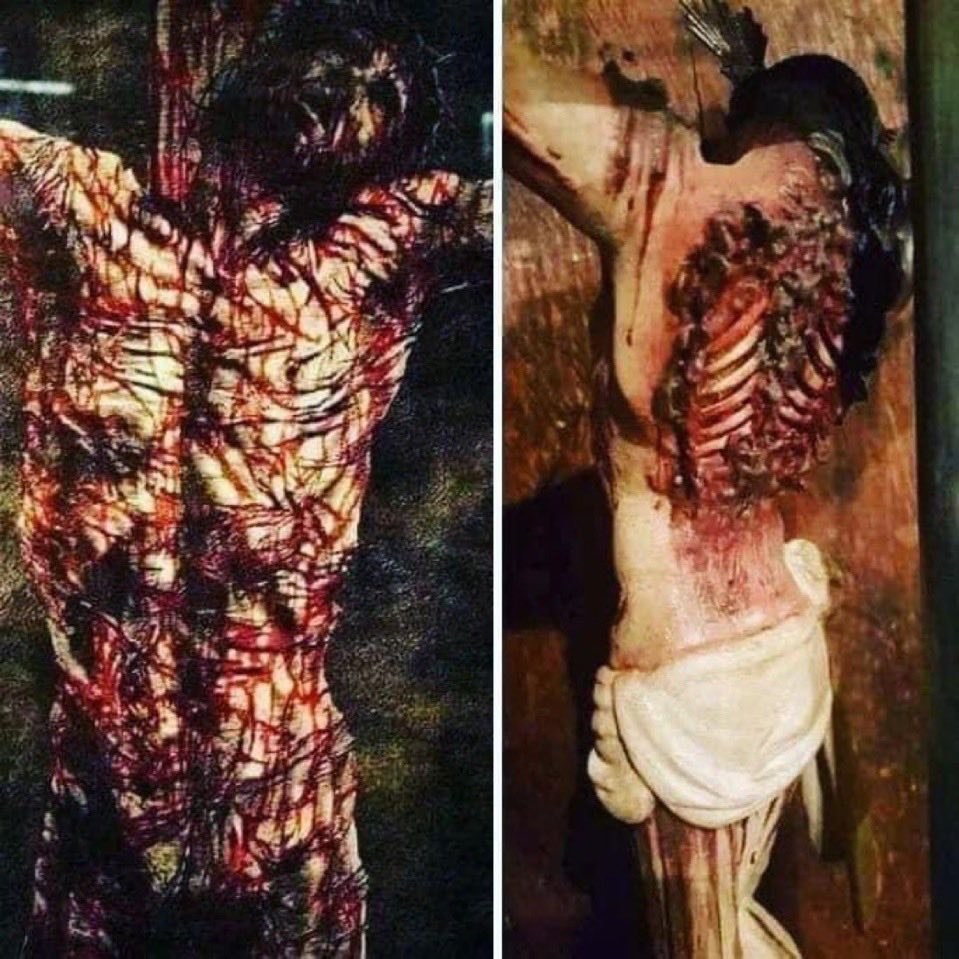
At the time, the crucifixion was considered the worst death for the worst of criminals. But this is not all Jesus faced. He endured whipping so severe that it tore the flesh from His body. He was beaten so horribly that His face was torn & His beard ripped.
A crown of thorns, 2-3 inches long cut deeply into His scalp. The leather whip used to flog Him had tiny iron balls & sharp bones. The balls caused internal injuries while the sharp bones ripped open His flesh. His skeletal muscles, veins, & bowels are exposed, causing major blood loss. Most men do not survive this kind of torture. After Jesus was severely flogged, He was forced to carry His cross while people mocked & spat on Him.
Crucifixion was a process meant to instill excruciating pain, creating a slow & agonizing death. Nails as long as 8 inches were driven into Jesus' wrists & feet. The Roman soldiers knew the tendons in the wrists would tear & break, forcing Jesus to use His back muscles to support Himself to breathe. Imagine the struggle, the pain, the courage...Jesus endured this reality for 3 hours!
The Gospel of John writes that after Jesus' death, a Roman soldier pierced His side with a spear & blood & water came out. Scientists explain that from hypovolemic shock, the rapid heart rate causes fluid to gather in the sack around the lungs & heart. The accumulation of fluid in the membrane around the heart is called a Pericardial effusion & the lungs is called a pleural effusion.
To the world, Christianity is as foolish as it can get. They believe it's for the weak. But when you are confronted by the reality of the cross, it's clearly not a pretty sight. It is brutal & horrific.
This is the weight Jesus carried. The weight of the sins of the world, all so that we can live. God's wrath is fully satisfied in Jesus. This is what it took. Repent & believe! Jesus is “God among us” in the flesh. Jesus is our Savior. Jesus loves you so much that He went through this spiritual and physical punishment for your sins and mine.
Jesus is the LORD, Almighty God, Everlasting Father.
Thank You, Jesus.
English
bebu retweetet