

Brett Peppler
1.3K posts

Brett Peppler
@cbrettp
Interested in the things that happen at the intersection of strategy, intelligence, foresight, innovation, and risk.
Melbourne, Australia Beigetreten Şubat 2013
714 Folgt286 Follower

In forming analytic judgements, first-order effects can mislead because meaning unfolds over time. thinkingaboutintelligence.substack.com/p/zen-and-inte…
English
Organisations that integrate Horizon Scanning, Emerging Issues Analysis, and the Wheel of the Future in a structured way, strengthen their ability to anticipate and adapt. linkedin.com/pulse/from-noi…
English
I spent a thoughtful day in Melbourne at a joint #ISRM #EngineersAustralia summit entitled: 'Enhancing Infrastucture Resilience - Strategies for Risk and Sustainable Adaptation.'

English
The role of patterns in public policy and service design. publicpolicydesign.blog.gov.uk/2026/01/08/the…
English

The design imperative for intelligence environments. sloanreview.mit.edu/article/stop-d…
English
Brett Peppler retweetet

Today we share the preprint of our pilot study, A Horizon Scan of Global Catastrophic Risks (which is also the first phase of the Odyssean Process).
odysseaninstitute.org/_files/ugd/cad…

English
Why Homeland Security must embrace strategic foresight. hstoday.us/subject-matter…
English
Many insights for problem framing and analysis in this article offering a complex systems model of evidence combining three types of evidence with the three dimensions of complex systems. media.licdn.com/dms/document/m…
English
Rethinking expertise in the Age of AI. sloanreview.mit.edu/article/whats-…
English
The evolution of strategy consulting. linkedin.com/pulse/strategy…
English
Brett Peppler retweetet

Most executives assume that if they plan thoroughly, a strategic path will reveal itself. But that won’t work today. What will is paying attention to two questions: “What forces are shaping this situation?” and “How should we respond?” Specifically, it means considering a situation’s time horizon, from short term to long term, and its impact level, from low to high. This simple act of decoding the forces that are impacting their company can help leaders see where to focus their attention.
t.co/FwrCfvDJYZ
English
Using AI as a new way of 'seeing' the world. every.to/chain-of-thoug…
English
Challenges to digital sovereignty. adigaskell.substack.com/p/are-attempts…
Deutsch
Brett Peppler retweetet
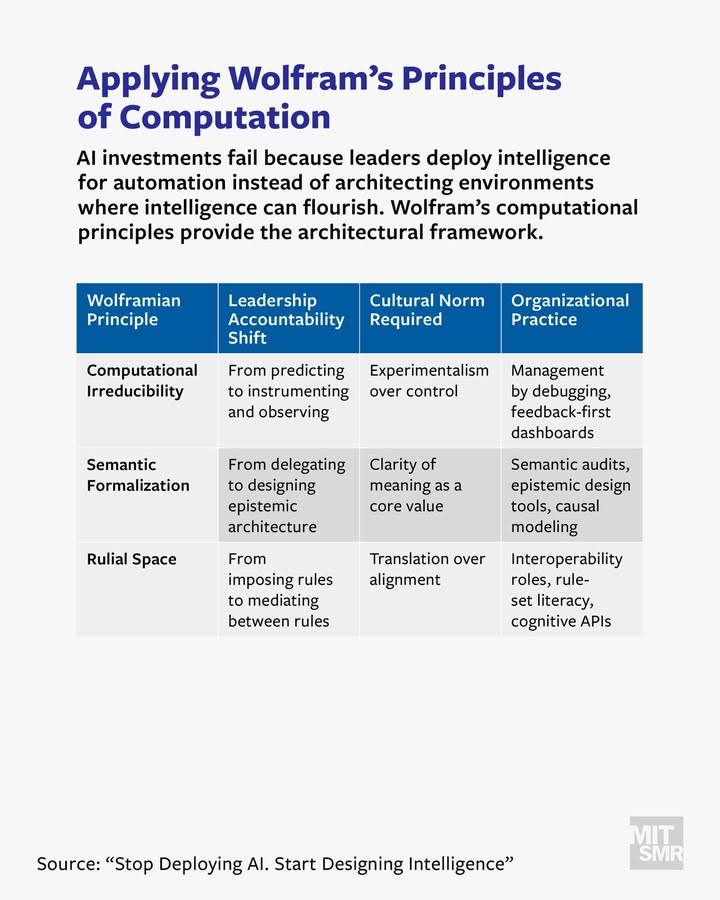
AI investments are exploding, but enterprise returns remain mediocre. The core issue? Leadership deploys intelligence as if it were automation. But intelligence — human or machine — can’t simply be inserted into workflows; it must be architected into environments. Most organizational designs manage effort and enforce alignment — they do not orchestrate reasoning, learning, or adaptive value creation. This is their AI strategic blind spot. Yet this is precisely where Wolfram’s computational philosophy offers essential and actionable clarity: Unlocking AI’s value requires leaders to ask not what tools can do but what architectures and infrastructures let intelligence emerge, evolve, and flourish.
Organizations that treat intelligence as a designable infrastructure — not as an emergent property of tools — are likely to obtain faster, higher-quality decisions; reduced systemic risk; and enhanced adaptive capacity.
Read the full article >> mitsmr.com/4lCLN9Z
English
Brett Peppler retweetet

“Leverage points” is an important principle in implementing change. By identifying the leverage points within a system where small changes can have a large impact, change leaders can target those points & make changes that can have a cascading effect throughout the entire system.
The classic approach to leverage points is the work of Donella Meadows (1997) who identifies 12 potential leverage points (“places to intervene”) in a system. Very often, we intervene by redesigning the structures or changing the practices, when the greatest leverage for change comes from thinking differently - our assumptions & mindsets.
What frequently happens is that change leaders love the idea of leverage points but find Meadows’s descriptors hard to work with in practice. This article by @ryanjamurphy is helpful because it suggests ways to put Meadows’s powerful concept into a more usable framework. So I have created a new graphic for leverage points, based on one of the models the author suggests.
See the Murphy article: systemic-design.org/contexts/vol1/…
The “leverage” principles in this graphic taken from @johnvkania et al: fsg.org/wp-content/upl…
Donella Meadows on leverage points: donellameadows.org/archives/lever…

English
Decoding the competing forces that are impacting their organisations can help leaders see where to focus their attention. sloanreview.mit.edu/article/decode…
English
The latest @theISRM Global Risk Report (Sep 25) has some interesting observations (pp.23-30) on the links between risk modelling and strategic foresight. theisrm.org/documents/GRR_…
English