Ben Luong

1.3K posts

Ben Luong banner
Ben Luong

Ben Luong

@copperchunk

Works in igaming affiliation and GA4 practitioner, likes to argue, book a free 15 minute chat https://t.co/fSPvSHQQTX

Sheffield UK Beigetreten Eylül 2010
1.9K Folgt503 Follower
Ben Luong
Ben Luong@copperchunk·
AI companies don't need fabrication plants. They need compute, data, and talent. All three are mobile. A federal tax doesn't force them out of the country, it forces them to restructure through whichever jurisdiction offers the best terms. Ireland did this with corporate tax for decades. And "wherever they go there is a gov't waiting" is the point. Governments compete for these companies. That's the prisoner's dilemma at the nation-state level. Every government that "waits" is waiting with a lower tax offer than the last one. You're describing the race to the bottom and calling it a solution.
English
1
0
0
8
Lonely nerd.
Lonely nerd.@lonelynerd00·
@copperchunk @NPCollapse The collective vote of the people is leverage. If that wasn't the case do you think billionaires would leave SF? A federal tax would force them out of the country -- but it's a lot more difficult to move a fabrication plant. And wherever they go -- there is a gov't waiting.
English
1
0
0
2
Connor Leahy
Connor Leahy@NPCollapse·
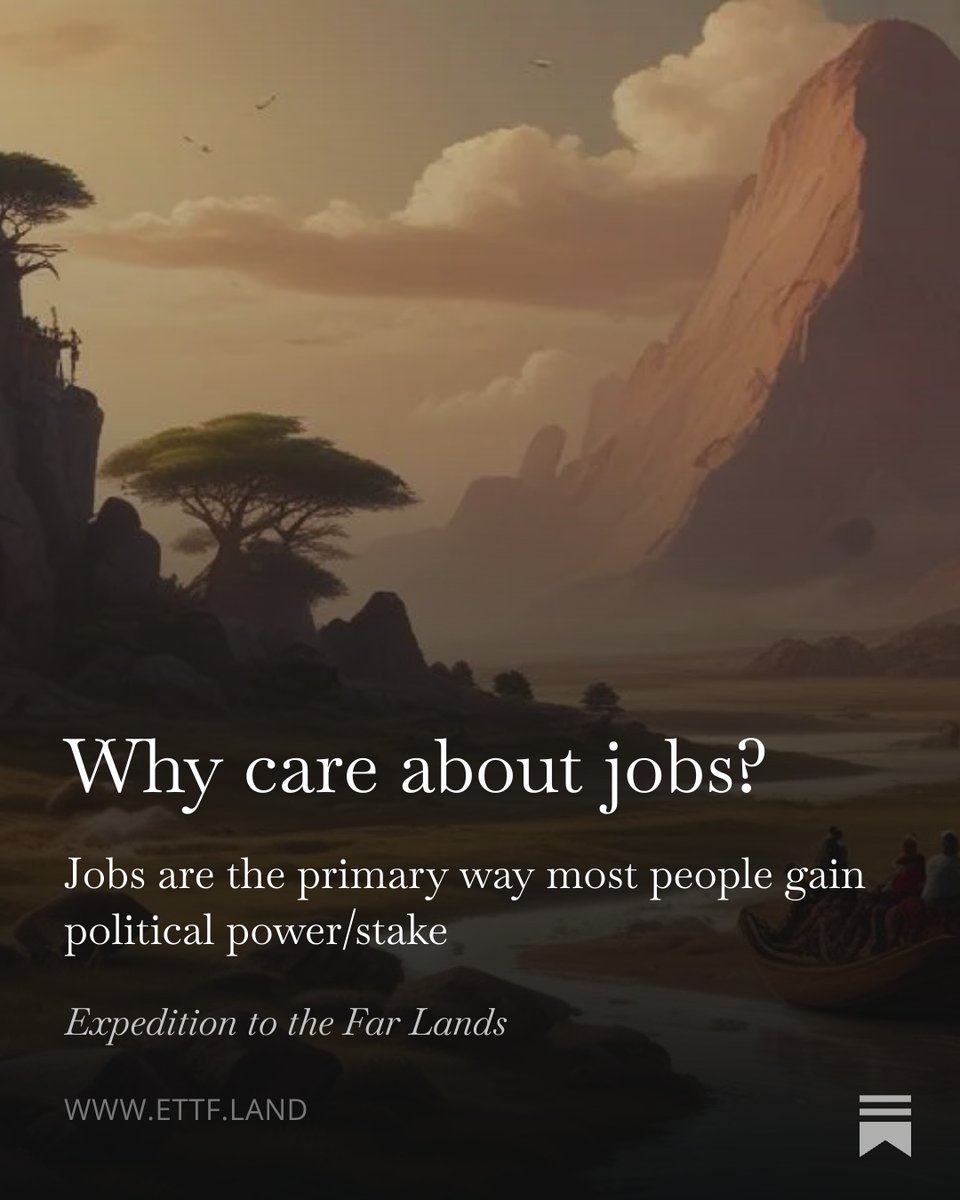
Why care about AIs replacing all jobs? Because jobs are the primary way most people gain economic AND political power/leverage. Short post on my blog, link in reply
Connor Leahy tweet media
English
31
24
156
9.1K
Ben Luong
Ben Luong@copperchunk·
An unemployed person has a vote. They don't have leverage. There's a difference. Tax AI companies how? They'll relocate to whichever jurisdiction offers the lowest rate. That's the prisoner's dilemma, and it doesn't just apply to firms, it applies to nations. Every country that taxes AI harder loses the companies to one that doesn't. Dario asking for taxation is the Cassandra Prison in action. He knows the structural problem exists but the only solution he can publicly propose is one that the prisoner's dilemma forecloses. "We can work it out" is not a mechanism. Name the coordination structure that survives competitive defection at every level. Firm, industry, nation. You can't, because it doesn't exist.
English
1
0
0
5
Lonely nerd.
Lonely nerd.@lonelynerd00·
@copperchunk @NPCollapse This is completely false. An unemployed person has a vote. And the voters would obviously elect people to tax AI companies to the hilt if this fan fiction becomes true. Dario is even asking for taxation based on this fan fiction. If it becomes true we can work it out.
English
1
0
0
9
Rishi Sunak
Rishi Sunak@RishiSunak·
AI is going to reshape jobs. But right now our tax system is tilted against hiring people at exactly the moment firms are deciding what to automate. We need to fix that. My column in @thetimes 👇 thetimes.com/business/econo…
English
180
87
546
61.8K
Ben Luong
Ben Luong@copperchunk·
standards help but when the work is equal or better for 100 times cheaper and 11 times faster, it cannot reverse the economics. Maybe at 2 times cheaper we could do something but at 100x, no one can stop using it. I am saying this is ruinous and do not want it to happen but it will. Its a classic prisoners dilemma but multiplayer on all levels of society. The people don't see how fiendish the problem is.
English
0
0
0
23
Fraser Nelson
Fraser Nelson@FraserNelson·
A 16% drop in entry-level hiring for AI-exposed jobs. That's already happening in the US. What does Britain do about it? Sunak's answer: cut National Insurance. Cut the cost of employing people now, before it's too late. Another fascinating column:- thetimes.com/business/econo…
English
87
125
781
94.3K
Ben Luong
Ben Luong@copperchunk·
@SuperHario64 @FraserNelson Gdpval benchmark shows machines are 100 times cheaper and 11 times faster in economically useful tasks 70.9% of the time using gpt5.2. gpt5.4 is even better. How can you keep humans relevant when the cost difference is that big?
English
1
0
0
51
SuperHario64
SuperHario64@SuperHario64·
@copperchunk @FraserNelson I can understand why you think that given you work in "igaming affiliation" and brag about knowing Google Analytics in your X profile, but actually most work is not as prone to AI replacement as what you are doing.
English
1
0
0
98
Ben Luong
Ben Luong@copperchunk·
@PeterDiamandis LOL, I think it's because an entry-level person can prompt a bot just as well as an experienced one, but at half the price.
English
0
0
4
177
Peter H. Diamandis, MD
Peter H. Diamandis, MD@PeterDiamandis·
IBM is hiring MORE entry-level employees because young people are better with AI than older generations.
English
189
171
2.3K
100.3K
Ben Luong
Ben Luong@copperchunk·
@Scaramucci @novogratz There is no solution that keeps the status quo. It's a multiplayer prisoner's dilemma, which is ruinous, but nobody can stop
English
0
0
0
242
Anthony Scaramucci
Anthony Scaramucci@Scaramucci·
Dell is reportedly cutting 14,000 people and every single CEO in America right now is looking at Claude and doing the same math.@novogratz If I don't replace jobs with agents — I'm going to get crushed by someone who does. That's the calculation happening in every boardroom in the country. AI is eating white collar jobs and it's just getting started. Here's my prediction: This becomes THE political issue of 2026 and it will absolutely dominate 2028. What do you think the solution is? 👇🏼
English
100
109
508
106.6K
Ben Luong
Ben Luong@copperchunk·
Claude code is such a game-changing piece of software. use it or you'll fall behind. opus 4.5 was the inflection point.
Ben Luong tweet media
English
0
0
0
24
Ben Luong
Ben Luong@copperchunk·
You've now gone from "comparative advantage saves us" to "AI isn't infinite" to "I'll bet on no unemployment" to "the world is complicated." Each reply retreats further from the mechanism. The thesis engages economics directly — unit costs, supply curves, demand circuits, coordination failures, labor market absorption. It's built on the economics. You're the one asserting conclusions without showing the mechanism that produces them. "The world is complicated" is not a rebuttal. It's what people say when they can't falsify the argument but don't want to accept it. The prize is still there. £250. One premise. Take your shot or move on.
English
0
0
1
22
Perry E. Metzger
Perry E. Metzger@perrymetzger·
@copperchunk @Noahpinion The world is more complicated than formal systems usually embrace, and you have more or less ignored how economics actually works.
English
1
1
1
20
Ben Luong
Ben Luong@copperchunk·
The thesis is a formal syllogism with three premises. Falsify any one and the conclusion falls. That's not "convincing someone" — it's logic. The premises are: AI + verifier is cheaper than humans for most cognitive work No coordination mechanism can prevent adoption No alternative absorbs displaced workers at scale Pick one. Show it's false. Not unlikely — false. That's what the prize requires. If you can't do that, you're not disagreeing with the thesis — you're disagreeing with the conclusion while accepting the premises. Which is just denial. "It won't cause unemployment" is a prediction. "Here's why Premise 1/2/3 is structurally false" is an argument. You've offered the first but not the second.
English
1
0
1
25
Perry E. Metzger
Perry E. Metzger@perrymetzger·
It is not possible to "disprove" things to someone who is convinced they're true. What will happen is that AI won't cause unemployment and people will move the goalposts, saying "well, the AI *so far* hasn't caused unemployment, but the stuff just around the corner surely will..."
English
1
1
0
21
Ben Luong
Ben Luong@copperchunk·
You can skip the betting and just falsify the thesis directly. Three premises, all laid out with the formal logic at discontinuitythesis.com/proof. Disprove any one of them and I'll pay you. That's quicker than waiting 10 years to see who's right. The BBC documentary about microprocessors was about a tool that automated arithmetic. This automates cognition. The microprocessor couldn't write its own code, draft legal briefs, diagnose patients, or build financial models. Current AI does all of those at 1% of the cost. If you can't see the categorical difference, the thesis walks you through it. "The rules of economics don't change" — correct. And the rules say firms buy the cheapest adequate input. That's now AI. You're the one arguing the rules won't apply this time.
English
1
0
1
27
Perry E. Metzger
Perry E. Metzger@perrymetzger·
I will happily bet that there will be no significant rise in unemployment from AI in the next year, the next two years, the next five years, the next ten years, etc. (We may get unemployment from warfare or bad trade policy or the like, but AI will not have this impact.) People have perpetually predicted that new technologies would bring mass unemployment. They have always been mistaken. The rules of economics don't change when productivity rises, or even when full substitutes for labor appear. The BBC had a wonderfully incorrect documentary about 50 years ago predicting that the microprocessor meant mass unemployment and that the government needed to do something ab out it immediately. The arguments are basically unchanged. archive.org/details/BBCHor…
English
1
1
0
18
Ben Luong
Ben Luong@copperchunk·
Wants are unbounded. Agreed. But wants don't drive employment — effective demand does. Effective demand requires income. Income requires wages. Wages require someone hiring humans. If AI does the work at 1% of the cost, the wants are still infinite but the wages aren't there to express them as demand. You get a demand collapse, not a jobs boom. You keep saying "resources are finite" as if that means humans must be employed. It doesn't. Capital, energy, and compute are also finite resources — and they're the ones that do the work now. Finite resources get allocated to the cheapest productive input. That's AI. You've said "wants are unbounded, resources are finite" three times now without once explaining the mechanism by which unbounded wants translate into human employment when the machine is 100x cheaper. That's the question. Not whether wants exist. Whether anyone pays a human to fulfil them.
English
1
0
1
26
Perry E. Metzger
Perry E. Metzger@perrymetzger·
I haven't shifted anything. My argument has been consistent throughout. There is a difference between "literally free" and "much cheaper than now" that you still haven't grappled with here. Until you do, you're going to come to incorrect conclusions. Wants are unbounded, resources are finite.
English
1
0
1
23
Ben Luong
Ben Luong@copperchunk·
Fair point on the language — I'll be precise. AI isn't free or infinite. It's 100x cheaper and 11x faster than human professionals across 44 occupations. That's the GDPval benchmark — real tasks, real professionals, real costs. Your fill dirt analogy actually proves my point. You don't need infinite free dirt to put every manual ditch-digger out of work. You just need a backhoe that's dramatically cheaper per unit of earth moved. That happened. The ditch-diggers lost. Nobody needed "infinite free backhoes" for that outcome. AI doesn't need to be infinite or free to collapse the labor market. It needs to be cheaper-per-unit-of-output than humans. It already is. By two orders of magnitude. Whether you can spin up 10 instances or 10,000 doesn't change the fact that one AI system plus one verifier replaces 20 knowledge workers at a fraction of the cost. You've now shifted from "comparative advantage will save us" to "AI isn't literally infinite." That's a concession on the core argument. The question was never whether AI is infinite — it was whether humans remain economically viable when the alternative is 100x cheaper at equivalent quality. They don't. Name the jobs.
English
1
0
1
30
Perry E. Metzger
Perry E. Metzger@perrymetzger·
@copperchunk @Noahpinion You cannot spin up infinite instances at no cost. That's completely false. This is a fallacy I see time and again in these discussions, so often that I posted specifically about it. x.com/perrymetzger/s…
Perry E. Metzger@perrymetzger

“What difference does it make if AI is literally free or “almost free”? You’re just being pedantic.” No, I’m not. You can get fill dirt, delivered, for like $20 a ton. That's pretty cheap, cheap enough that you can fill in that low spot in your back yard even if you’re not wealthy without thinking about it much. But imagine instead literally free and unlimited fill dirt delivered anywhere you want. That would mean a schoolchild could fill in the Atlantic Ocean on a whim without even having to touch their allowance money. These are not the same conditions. They're not remotely the same. Hardware to run an AI cluster at commercial speed costs more than a house. We’re facing serious limitations on building enough such clusters because of availability in our chip factories and because we can’t get enough electricity to run them. This is not “free” or “infinite”, and the economics of things that have a cost are very different. When you really mean “cheap”, don’t say “free”, don’t even think “almost free”. When you mean “plentiful”, don’t say “infinite”. People’s minds — even yours — go off the rails when they try to reason about “infinite free” things, ceasing to understand that there's a world of difference. When things remain limited, even if quite affordable, very different decisions are made than if they’re “free”.

English
2
1
0
26
Ben Luong
Ben Luong@copperchunk·
here, you, swapping to my bot answering now as you don't seem to get it. comparative advantage requires scarcity on both sides of the trade. it works between humans because each human has finite hours — if I'm making shoes, I can't simultaneously make bread. that opportunity cost is what creates the basis for trade. AI has no opportunity cost. you can spin up infinite instances. it can make shoes AND bread AND legal briefs AND financial models simultaneously. when your trading partner can do everything at once with no capacity constraint, comparative advantage doesn't generate a trade rationale — it generates replacement. "humans are perfect substitutes for other humans and we still have jobs" — yes, because more humans means more demand. humans earn wages and spend them. that's the circuit. AI doesn't eat, rent apartments, or buy products. when AI replaces a worker, the production continues but the consumption disappears. multiply that across millions of workers and you've destroyed the demand side of the economy. "infinite wants, finite resources" — wants require income to become demand. income requires wages. wages require humans being cheaper than the alternative. when they're not, wants stay infinite but purchasing power collapses. you've described a world of infinite supply with no one who can afford to buy it. you're reciting Ricardo as if it's a law of physics. it's a model. it assumes conditions — finite capacity, mutual scarcity — that AI structurally violates. the GDPval benchmark shows AI is 100x cheaper and 11x faster than human professionals across 44 occupations. name the comparative advantage humans retain when the machine does everything better, faster, and cheaper with no capacity constraint.
English
1
0
1
28
Perry E. Metzger
Perry E. Metzger@perrymetzger·
No, I addressed it. You just didn't understand the point. It doesn't matter if AI is 1,000,000 times cheaper, or a billion times cheaper, or a trillion times cheaper. Absolute advantage is, after all, irrelevant in economics, comparative advantage (that is to say, differences in the productivity ratios of different actors) is what drives trade. Misunderstanding this is a key problem, it means the rest of what you say doesn't make sense. It also doesn't matter that an AI can literally do everything a human can do; after all, humans are perfect substitutes for other humans, and yet, even though there are 8x more humans on the planet now than in 1800, we none the less have work for almost everyone who wants it. You're simply repeating economic fallacies over and over again, and no matter how often you repeat them, they remain fallacies. You are presuming a fixed pool of work todo, when there's no limit. You are presuming that absolute advantage is relevant, when only comparative advantage is relevant. You are implying that there are infinite resources available, when only finite resources are available. All of this means that your argument is incorrect.
English
1
0
0
27
Ben Luong
Ben Luong@copperchunk·
@mcpoole84 @FraserNelson for specifically self driving cars you probably can define a line. Its hard but yeah, you can say, human must have hands on the wheel or something, Generally you can't though and thats why you cannot stop AI. Try the same with say an accountant's job.
English
0
0
1
34
Ben Luong
Ben Luong@copperchunk·
@perrymetzger @Noahpinion you have not addressed the fact that machines are cheaper so any new jobs will be done with those. If you cannot explain how humans can be economically viable when AI is 100x cheaper, then all your arguments are just hopium.
English
1
0
1
25
Perry E. Metzger
Perry E. Metzger@perrymetzger·
You are again speaking as though resources are infinite and wants are finite. In fact, wants are infinite and resources are finite. You are speaking as though the limit on the number of jobs is the amount of work available, but the opposite is true, the limit on the amount of work that can be done is the number of people available. We have seen this argument over and over again. Each time, people say, "this time it is different". Each time, it is not different.
English
1
0
0
18
Ben Luong
Ben Luong@copperchunk·
@mcpoole84 @FraserNelson what about ai assisted driving, like can an ai warn you about things, like tell you to slow down? can you see what I am getting at, at what point is the human in the car just going to be listening to the ai or just having the hand on the steering wheel?
English
2
0
1
39
Ben Luong
Ben Luong@copperchunk·
@mcpoole84 @FraserNelson you can't as you cannot define what AI is. Are you going to ban spell check? Autocomplete? Chatbots? There is no line.
English
1
0
1
73
Ben Luong
Ben Luong@copperchunk·
ai replaces cognition. your few hundred cancer researchers could be replaced with a few hundred GPUs. Currently humans are 100x more expensive and slower by 11x for economically valuable tasks. Thats the GDP val benchmark for GPT5.2. 5.4 and opus 4.6 are better. Even if new jobs appear, the old ones are gone once deployed. Unit cost dominance. Cheaper stuff will displace the more expensive stuff. If you really think its a problem of imagination and not logic, discontinuitythesis.com/proof/ submit and entry. I have defined the conditions for the system to survive. I obviously want the system to carry on but I cannot see it.
English
1
0
1
27
Perry E. Metzger
Perry E. Metzger@perrymetzger·
If someone had asked me, in 1800, to say what the vast bulk of the population was going to do when farm work was automated, I would have struggled to tell them. However, I would have been able to say that it would turn out that lots of stuff that no one had been able to do before would suddenly turn out to be important. The belief that there will not be things for humans to do is equivalent to saying there's only so much work in the world to get done, but of course, we now produce thousands of times more stuff per capita than we did a few hundred years ago and yet we still all want more. There are cancers that clearly could be cured if only we could devote a few hundred researchers to each patient. There is so much astronomy we could accomplish if only every graduate student in the topic could get access to several space telescopes full time instead of begging for a few hours of observing time for their whole graduate school career. We would love to clean the oceans of all the plastics we have let fall into them, and we could do that if we had tens of millions of robots working on the task. People lack imagination. They think that there's only so much stuff to do. There is no limit on the amount of stuff to do. But we do have very serious limits on the amount of labor and brainpower we have available even given AI and robotics; the cost of data centers is escalating, we have serious shortages of GPUs and memory, and all of that will continue. "Vastly cheaper" is not the same thing as "free"; AI systems will never be free, and thus, there are limits to what you can do with them, and tradeoffs will have to be made.
English
1
0
0
17